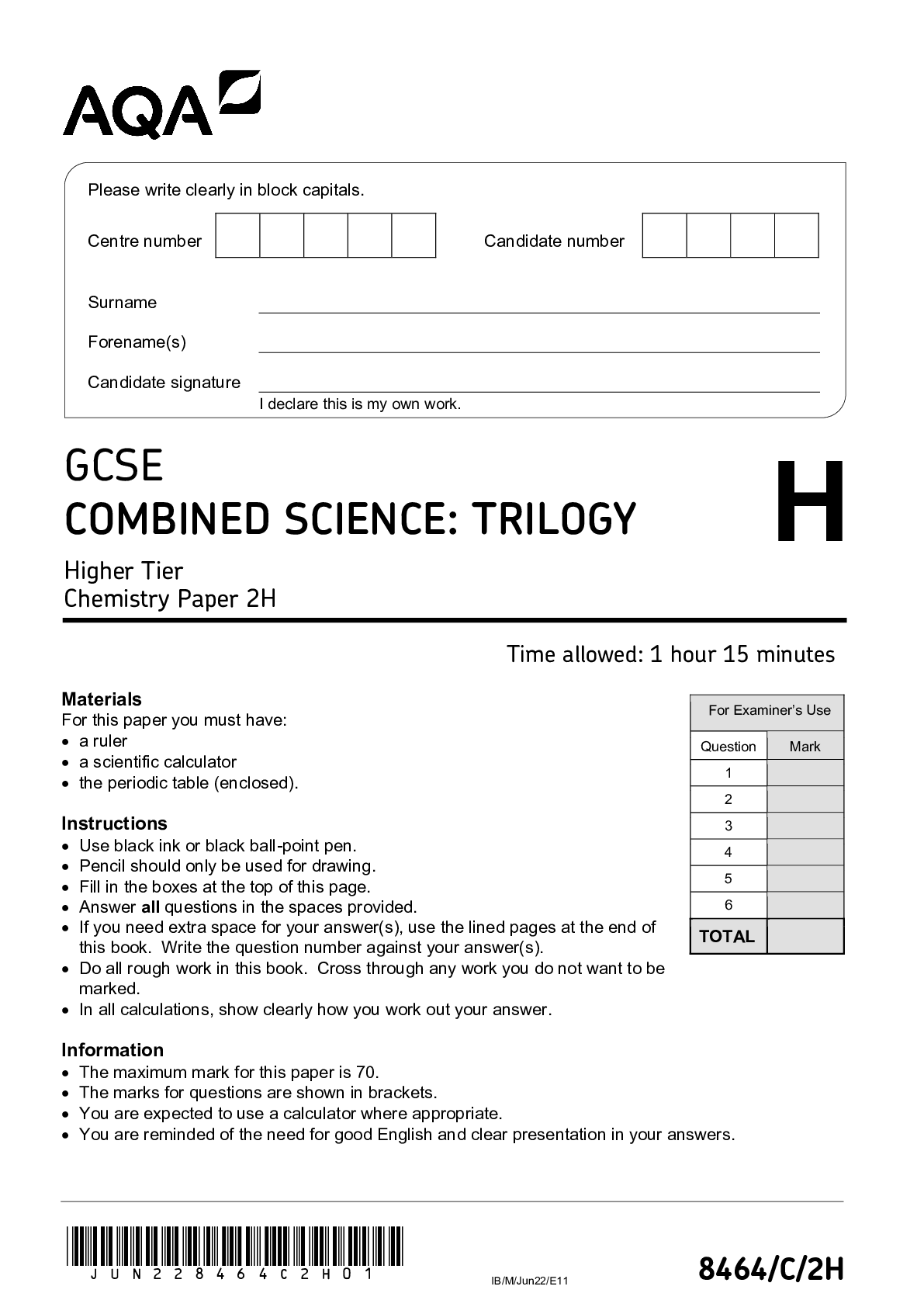
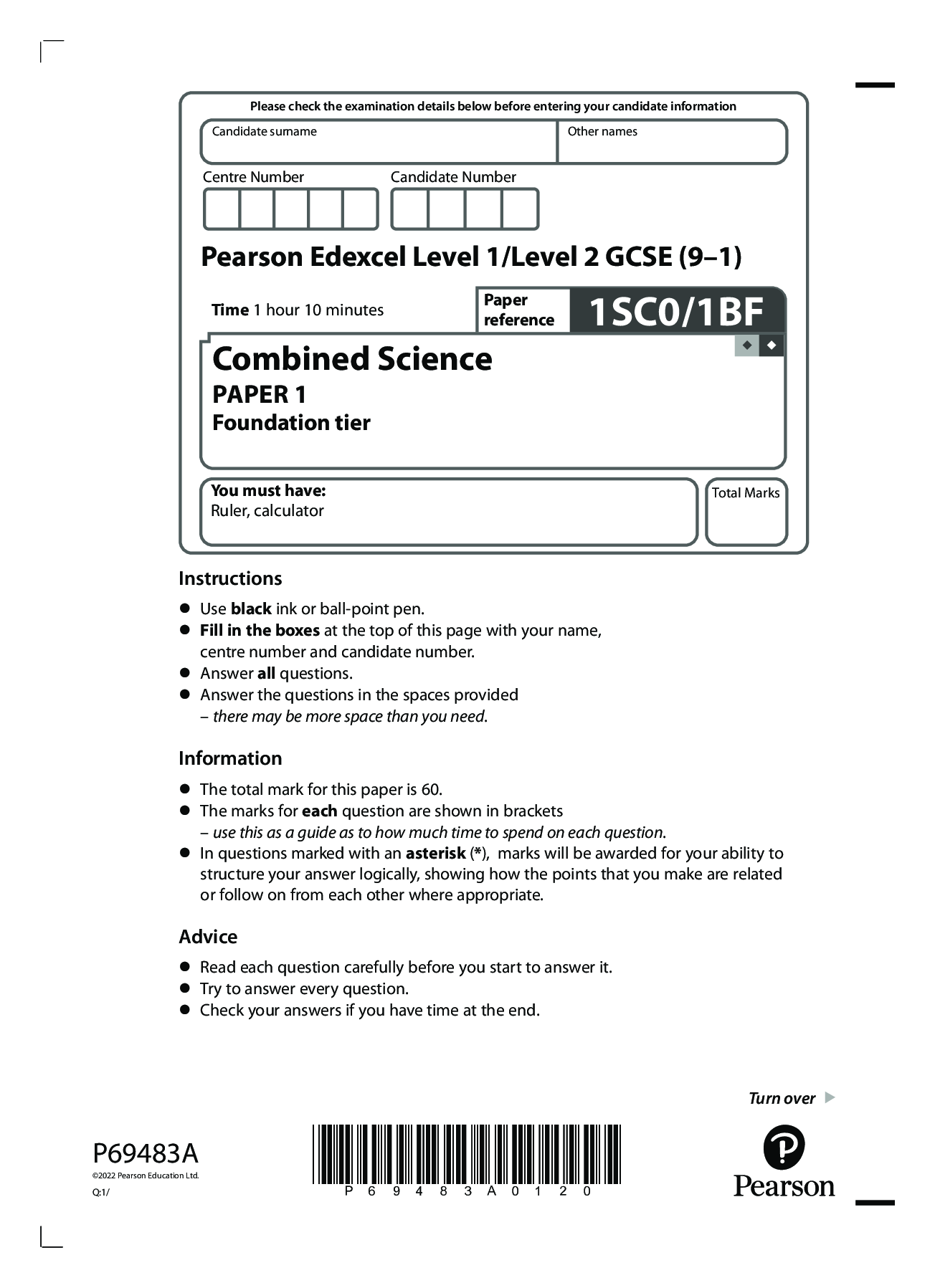
Combined Science: Synergy > QUESTION PAPER (QP) > Pearson Edexcel Level 1/Level 2 GCSE (9-1 Time 1 hour 10 minutes Paper reference 1 sco/l BF Combined (All)
Pearson Edexcel Level 1/Level 2 GCSE (9-1 Time 1 hour 10 minutes Paper reference 1 sco/l BF Combined Science PAPER 1 Foundation tier
Document Content and Description Below
Instructions • Use black ink or ball-point pen. • Fill in the boxes at the top of this page with your name, centre number and candidate number. • Answer all questions. • Answer the quest ... ions in the spaces provided – there may be more space than you need. Information • The total mark for this paper is 60. • The marks for each question are shown in brackets – use this as a guide as to how much time to spend on each question. • In questions marked with an asterisk (*), marks will be awarded for your ability to structure your answer logically, showing how the points that you make are related or follow on from each other where appropriate. Advice • Read each question carefully before you start to answer it. • Try to answer every question. • Check your answers if you have time at the end. You must have: Ruler, calculator Combined Science PAPER 1 Foundation tier Time 1 hour 10 minutes 1SC0/1BF Pearson Edexcel Level 1/Level 2 GCSE (9–1) *P69483A0220* 2 BLANK PAGE *P69483A0320* Turn over 3 Answer ALL questions. Write your answers in the spaces provided. Some questions must be answered with a cross in a box . If you change your mind about an answer, put a line through the box and then mark your new answer with a cross . 1 Some bacteria cause disease. (a) Which word describes an organism that causes disease? (1) A pathogen B culture C antibiotic D platelet (b) Draw one straight line from each disease to the main way that the disease is spread. (2) in the air by animal vectors in body fluids by a vaccination in water cholera malaria disease main way the disease is spread *P69483A0420* 4 (c) A scientist investigated the effect of temperature on the growth of bacteria. The bacteria were grown at 10°C and 20°C. The number of bacteria grown at each temperature were counted every two hours. Figure 1 shows the result. time in hours number of bacteria at 10°C in thousands number of bacteria at 20°C in thousands 0 10 10 2 20 47 4 30 74 6 40 80 8 50 80 Figure 1 Figure 2 shows a graph of the results at 20°C. 0 2 4 6 8 Time in hours 90 80 70 60 50 40 30 20 10 0 Number of bacteria in thousands 20°C Figure 2 (i) Plot the points on the graph for the number of bacteria at 10°C. The first two points have been plotted for you. (1) (ii) Draw a line of best fit on the graph for 10°C. (1) *P69483A0520* Turn over 5 (iii) Describe how the growth of bacteria at 10°C was different from the growth of bacteria at 20°C. (2) .................................................................................................................................................................................................................................................................................... .................................................................................................................................................................................................................................................................................... .................................................................................................................................................................................................................................................................................... .................................................................................................................................................................................................................................................................................... .................................................................................................................................................................................................................................................................................... (Total for Question 1 = 7 marks) *P69483A0620* 6 2 Stone tools can be found at sites used by our human ancestors. (a) Figure 3 shows tool P. P Figure 3 (i) Describe how tool P was made. (2) .................................................................................................................................................................................................................................................................................... .................................................................................................................................................................................................................................................................................... .................................................................................................................................................................................................................................................................................... (ii) Figure 4 shows tool Q which was found at the same site as tool P. Q Figure 4 A scientist stated that tool Q was made by a more evolved human ancestor than tool P. Which observation supports this statement? (1) A tool Q is a darker colour than tool P B tool Q is more pointed than tool P C tool Q is a lighter colour than tool P D tool Q is less pointed than tool P *P69483A0720* Turn over 7 (iii) Tools provide evidence for human evolution. Use words from the box to complete the sentences. (2) enlarge human migrate mutate natural negative Evolution is the change of inherited characteristics through ............................................................................................. selection. These changes occur because genes ............................................................................................. . (b) Fossils were also found in the soil around tool Q. Describe two ways that stone tools and fossils can be dated to find out how old they are. (2) 1................................................................................................................................................................................................................................................................................ .................................................................................................................................................................................................................................................................................... 2................................................................................................................................................................................................................................................................................ .................................................................................................................................................................................................................................................................................... (Total for Question 2 = 7 marks) *P69483A0820* 8 3 Alcohol is broken down by liver cells. (a) Which process moves alcohol from the blood into the liver cells? (1) A diffusion B respiration C osmosis D transpiration (b) If a person drinks too much alcohol, liver cells die and the person can develop cirrhosis of the liver. The relative risk of developing cirrhosis of the liver is affected by two factors. 1. The volume of alcohol a person drinks in one week. 2. Whether the person drinks the alcohol on its own or with a meal. Figure 5 shows how these two factors affect the relative risk of people developing cirrhosis of the liver. 36322824201612840 5 4 3 2 1 0 Relative risk of developing cirrhosis of the liver Number of units of alcohol consumed per week drinks alcohol with meals drinks alcohol on its own Figure 5 *P69483A0920* Turn over 9 (i) Person A drinks alcohol on its own. Person B drinks alcohol with their meals. Calculate the difference in risk for these two people when each one drinks 28 units of alcohol per week. (3) .............................................................. (ii) Using evidence from Figure 5, state two pieces of health advice for people about drinking alcohol. [Show More]
Last updated: 2 years ago
Preview 1 out of 20 pages
Buy this document to get the full access instantly
Instant Download Access after purchase
Buy NowInstant download
We Accept:

Reviews( 0 )
$7.00
Can't find what you want? Try our AI powered Search
Document information
Connected school, study & course
About the document
Uploaded On
Apr 03, 2023
Number of pages
20
Written in
All

Additional information
This document has been written for:
Uploaded
Apr 03, 2023
Downloads
0
Views
127