Social Sciences > QUESTIONS & ANSWERS > CAADAC Code of Ethics, Exam preview Questions and answers, graded A (All)
CAADAC Code of Ethics, Exam preview Questions and answers, graded A
Document Content and Description Below
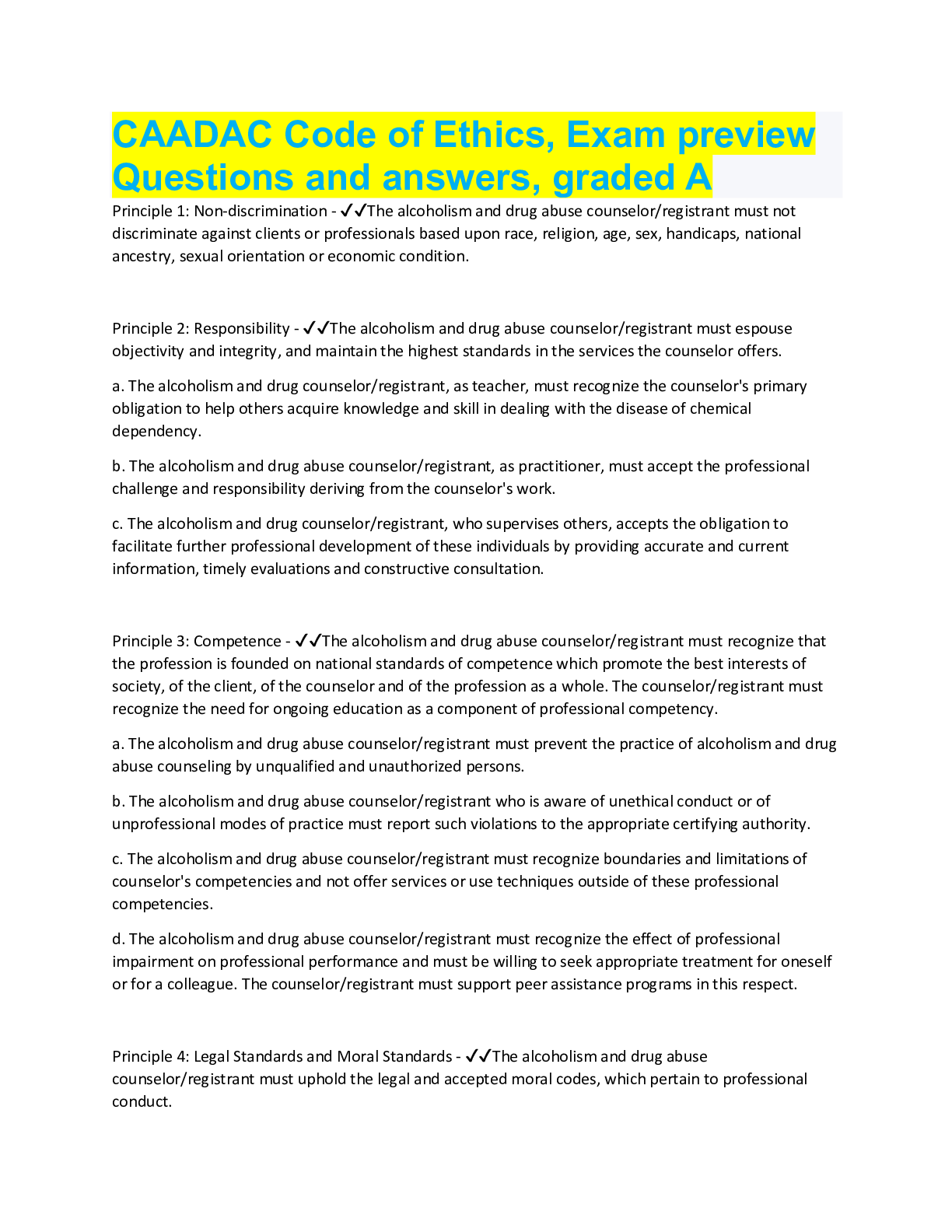
CAADAC Code of Ethics, Exam preview Questions and answers, graded A Principle 1: Non-discrimination - ✔✔The alcoholism and drug abuse counselor/registrant must not discriminate against client ... s or professionals based upon race, religion, age, sex, handicaps, national ancestry, sexual orientation or economic condition. Principle 2: Responsibility - ✔✔The alcoholism and drug abuse counselor/registrant must espouse objectivity and integrity, and maintain the highest standards in the services the counselor offers. a. The alcoholism and drug counselor/registrant, as teacher, must recognize the counselor's primary obligation to help others acquire knowledge and skill in dealing with the disease of chemical dependency. b. The alcoholism and drug abuse counselor/registrant, as practitioner, must accept the professional challenge and responsibility deriving from the counselor's work. c. The alcoholism and drug counselor/registrant, who supervises others, accepts the obligation to facilitate further professional development of these individuals by providing accurate and current information, timely evaluations and constructive consultation. Principle 3: Competence - ✔✔The alcoholism and drug abuse counselor/registrant must recognize that the profession is founded on national standards of competence which promote the best interests of society, of the client, of the counselor and of the profession as a whole. The counselor/registrant must recognize the need for ongoing education as a component of professional competency. a. The alcoholism and drug abuse counselor/registrant must prevent the practice of alcoholism and drug abuse counseling by unqualified and unauthorized persons. b. The alcoholism and drug abuse counselor/registrant who is aware of unethical conduct or of unprofessional modes of practice must report such violations to the appropriate certifying authority. c. The alcoholism and drug abuse counselor/registrant must recognize boundaries and limitations of counselor's competencies and not offer services or use techniques outside of these professional competencies. d. The alcoholism and drug abuse counselor/registrant must recognize the effect of professional impairment on professional performance and must be willing to seek appropriate treatment for oneself or for a colleague. The counselor/registrant must support peer assistance programs in this respect. Principle 4: Legal Standards and Moral Standards - ✔✔The alcoholism and drug abuse counselor/registrant must uphold the legal and accepted moral codes, which pertain to professional conduct. a. The alcoholism and drug abuse counselor/registrant must not claim directly or by implication, professional qualifications/affiliations that the counselor does not possess. b. The alcoholism and drug abuse counselor/registrant must not use the affiliation with the California Certification Board of Alcohol/Drug Counselors (and/or CAADAC) for purposes that are not consistent with the stated purposes of the Association. c. The alcoholism and drug abuse counselor/registrant must not associate with or permit the counselor's name to be used in connection with any services or products in a way that is incorrect or misleading. d. The alcoholism and drug abuse counselor/registrant must not associate with the development or promotion of books or other products offered for commercial sale must be responsible for ensuring that such books or products are presented in a professional and factual way. e. The alcoholism and drug abuse counselor/registrant must not attempt to secure certification or registration (or certification renewal) by fraud, deceit, or misrepresentation on any application or other documents submitted to the certifying organization whether engaged in by an applicant for certification or registration or in support of any application for certification or registration. Any altered documents as identified by staff in the application or renewal process will be denied immediately and reapplication may be required and the CCBADC Chairperson may deny application or reapplication as a result of such fraudulent activity. f. The alcoholism and drug abuse counselor/registrant must not violate, attempt to violate, or conspire to violate any regulation or law adopted by the California Alcohol and Drug Program Administration or CCBADC Policies and/or Code of Ethics. Principle 5: Public Statements - ✔✔The alcoholism and drug abuse counselor/ registrant must respect the limits of present knowledge in public statements concerning alcoholism and other forms of drug addiction. a. The alcoholism and drug abuse counselor/registrant who represents the field of AOD counseling to clients, other professionals, or to the general public must report fairly and accurately the appropriate information. b. The alcoholism and drug abuse counselor/registrant must acknowledge and document materials and techniques used. c. The alcoholism and drug abuse counselor/registrant who conducts training in alcoholism or drug abuse counseling skills or techniques must indicate to the audience the requisite training/qualifications required to properly perform these skills and techniques. Principle 6: Publication Credit - ✔✔The alcoholism and drug abuse counselor/registrant must assign credit to all who have contributed to the published material and for the work upon which the publication is based. a. The alcoholism and drug abuse counselor/registrant must recognize joint authorship, major contributions of a professional character, made by several persons to a common project. The author who has made the principle contribution to a publication must be identified as a first listed. b. The alcoholism and drug abuse counselor/registrant must acknowledge in footnotes or an introductory statement minor contributions of a professional character, extensive clerical or similar assistance and other minor contributions. c. The alcoholism and drug abuse counselor/registrant must acknowledge, through specific citations, unpublished, as well as published material, that has directly influences the research or writing. d. The alcoholism and drug abuse counselor/registrant who complies and edits for publication the contributions of others must list oneself as editor, along with the names of those who have contributed. Principle 7: Client Welfare - ✔✔The alcoholism and drug abuse counselor/registrant must respect the integrity and protect the welfare of the person or group with whom the counselor is working. a. The alcoholism and drug abuse counselor/registrant must define for self and others the nature and direction of loyalties and responsibilities and keep all parties concerned informed of these commitments. b. The alcoholism and drug abuse counselor/registrant, in the presence of professional conflict must be concerned primarily with the welfare of the client. c. The alcoholism and drug abuse counselor/registrant must terminate a counseling or consulting relationship when it is reasonably clear that the client is not benefiting from it. d. The alcoholism and drug abuse counselor/registrant, in referral cases, must assume the responsibility for the client's welfare either by termination by mutual agreement and/or by the client becoming engaged with another professional. In situations when a client refuses treatment, referral or recommendations, the alcohol and drug abuse counselor/registrant must carefully consider the welfare of the client by weighing the benefits of continued treatment or termination and must act in the best interest of the client. e. The alcoholism and drug abuse counselor/registrant who asks a client to reveal personal information from other professionals or allows information to be divulged must inform the client of the nature of such transactions. The information released or obtained with informed consent must be used for expressed purposes only. f. The alcoholism and drug abuse counselor/registrant must not use a client in a demonstration role in a workshop setting where such participation would potentially harm the client. g. The alcoholism and drug abuse counselor/registrant must ensure the presence of an appropriate setting for clinical work to protect the client from harm and the counselor and the profession from censure. h. The alcoholism and drug abuse counselor/registrant must collaborate with other health care professional(s) in providing a supportive environment for the client who is receiving prescribed medications. Principle 8: Confidentiality - ✔✔The alcoholism and drug abuse counselor/registrant must embrace, as a primary obligation, the duty of protecting the privacy of clients and must not disclose confidential information acquired, in teaching, practice or investigation [Show More]
Last updated: 2 years ago
Preview 1 out of 6 pages
Buy this document to get the full access instantly
Instant Download Access after purchase
Buy NowInstant download
We Accept:

Reviews( 0 )
$7.00
Can't find what you want? Try our AI powered Search
Document information
Connected school, study & course
About the document
Uploaded On
Mar 22, 2023
Number of pages
6
Written in
All

Additional information
This document has been written for:
Uploaded
Mar 22, 2023
Downloads
0
Views
87