NR 511 – FINAL EXAM STUDY GUIDE
1
NR 511 – FINAL EXAM STUDY GUIDE
WEEK 1
1. Define diagnostic reasoning
Reflective thinking because the process involves questioning one's thinking to
determine if all possible avenu
...
NR 511 – FINAL EXAM STUDY GUIDE
1
NR 511 – FINAL EXAM STUDY GUIDE
WEEK 1
1. Define diagnostic reasoning
Reflective thinking because the process involves questioning one's thinking to
determine if all possible avenues have been explored and if the conclusions that are
being drawn are based on evidence.
Seen as a kind of critical thinking.
2. Discuss and identify subjective data?
What the patient tells you, complains of, etc.
Chief complaint
HPI
ROS
3. Discuss and identify objective data?
What YOU can see, hear, or feel as part of your exam.
Includes lab data, diagnostic test results.
Components of HPI
4. Discuss and identify the components of the HPI
Specifically related to the chief complaint only.
Detailed breakdown of CC.
OLDCART
5. What is medical coding?
The use of codes to communicate with payers about which procedures were performed
and why
6. What is medical billing?
Process of submitting and following up on claims made to a payer in order to receive
payment for medical services rendered by a healthcare provider.
7. What are CPT codes?
Common procedural terminology
Offers the official procedural coding rules and guidelines required when reporting
medical services and procedures performed by physician and non-physician providers.
8. What are ICD codes?
International classification of disease
Used to provide payer info on necessity of visit or procedure performed.
9. What is specificity?NR 511 – FINAL EXAM STUDY GUIDE
2
The ability of the test to correctly detect a specific condition.
If a patient has a condition but test is negative, it is a false negative.
If a patient does NOT have a condition but the test is positive, it is a false positive.
10.What is sensitivity?
Test that has few false negatives.
Ability of a test to correctly identify a specific condition when it is present.
The higher the sensitivity, the lesser the likelihood of a false negative.
11.What is predictive value?
The likelihood that the patient actually has the condition and is, in part, dependent upon
the prevalence of the condition in the population.
If a condition is highly likely, the positive result would be more accurate.
12.Discuss the elements that need to be considered when developing a plan
Pt's preferences and actions
Research evidence
Clinical state/circumstances
Clinical expertise
13.Describe the components of Medical Decision Making in E&M coding
Risk
Data
Diagnosis
The more time and consideration involved in dealing with a pt, the higher the
reimbursement from the payer.
Documentation must reflect MDM!
evaluation and management (E&M)
14.Correctly order the E&M office visit codes based on complexity from least to most
complex
New patient: Established patient:
1. Minimal/RN visit: 99201 Minimal RN visit: 99211
2. Problem focused: 99202 Problem focused: 99212
3. Expanded problem focused: 99203 Expanded problem focused: 99213
4. Detailed: 99204 Detailed: 99214
5. Comprehensive: 99205 Comprehensive: 99215
15.Discuss a minimum of three purposes of the written history and physical in
relation to the importance of documentation
Important reference document that gives concise info about the pt's Hx and exam
findings.
Outlines a plan for addressing issues that prompted the visit. Info should be
presented in a logical fashion that prominently features all data relevant to the
pt's condition.
Is a means of communicating info to all providers involved in the pt's care.NR 511 – FINAL EXAM STUDY GUIDE
3
Is a medical-legal document.
Is essential in order to accurately code and bill for services.
16.Accurately document why every procedure code must have a corresponding
diagnosis code
Diagnosis code explains the necessity of the procedure code.
Insurance won't pay if they don't correspond.
17.Correctly identify a patient as new or established given the historical information
If that pt has never been seen in that clinic or by that group of providers OR if the
pt has not been seen in the past 3 years.
18.Identify the 3 components required in determining an outpatient, office visit E&M
code
Place of service
Type of service
Patient status
19.Describe the components of Medical Decision Making in E&M coding
Risk
Data
Diagnosis
The more time and consideration involved in dealing with a pt, the higher the
reimbursement from the payer.
Documentation must reflect MDM!
evaluation and management (E&M)
20.Explain what a “well rounded” clinical experience means
Includes seeing kids from birth through young adult visits for well child and acute visits,
as well as adults for wellness or acute/routine visits.
Seeing a variety of pt's, including 15% of peds and 15% of women's health of total time
in the program.
21.State the maximum number of hours that time can be spent “rounding” in a
facility
No more than 25% of total practicum hours in the program
22.State 9 things that must be documented when inputting data into clinical
encounter
Date of service
Age
Gender and ethnicity
Visit E&M code
CC
Procedures
Tests performed and orderedNR 511 – FINAL EXAM STUDY GUIDE
4
Dx
Level of involvement (mostly student, mostly preceptor, together, etc.)
23.What is the first “S” in the SNAPPS presentation?
Summarize: present the pt's H&P findings
24.What is the “N” in the SNAPPS presentation?
Narrow: based on the H&P findings, narrow down to the top 2-3 differentials
25.What is the “A” in the SNAPPS presentation?
Analyze: analyze the differentials. Compare and contrast H&P findings for each
of the differentials and narrow it down to the most likely one
26.What is the first “P” in the SNAPPS presentation?
Probe: ask the preceptor questions of anything you are unsure of.
27.What is the second “P” in the SNAPPS presentation?
Plan: come up with a specific management plan
.
28.What is the last “S” in the SNAPPS presentation?
Self-directed learning: an opportunity to investigate more about any topics that you
are uncertain of.NR 511 – FINAL EXAM STUDY GUIDE
5
WEEK 2
1. What is the most common type of pathogen responsible for acute gastroenteritis?
Viral (can be viral, bacterial, or parasitic), usually norovirus
2. Assessing for prior antibiotic use is a critical part of the history in patients presenting
with diarrhea. True
3. Describe the difference between Irritable Bowel Disease (IBS) and Inflammatory
Bowel Disorder (IBD)
IBS: disorder of bowel function (as opposed to being due to an anatomic
abnormality).
Changes in bowel habits (diarrhea, constipation, abd pain, bloating, rectal urgency
w/diarrhea).
Symptoms fall into two categories: abd pain/altered bowel habits, and painless
diarrhea. Usually pain is LLQ.
PE: normal except for tenderness in colon.
Labs: CBC, ESR. Most other labs and radiology/scopes are normal.
Dx made on careful H&P.
May be associated with non-intestinal (extra-intestinal) symptoms (sexual function
difficulty, muscle aches/pains, fatigue, fibromyalgia, HAs, back pain, urinary
symptoms).
Not associate with serious medical consequences. Not a risk factor for other serious GI
dz's.
Does not put extra stress on other organs.
Overall prognosis is excellent.
Major problem: changes quality of life.
Treatment: based on symptom pattern. May include diet, education, pharm (for modsevere pt's)/other supportive interventions. Usually focuses on lifestyle, diet, and stress
reduction. NO PROVEN TREATMENT! Antidiarrheals: use temporarily, reserve for
severe. Loperamide (Imodium) or diphenoxylate (Lomotil) 2.5-5mg q6h usually works.
Constipation: high fiber diet, hydration, exercise, bulking agents. If these don't work,
intermittent use of stimulant laxatives (lactulose or mag hydroxide); don't use long-term!
Linzess (linaclotide), Trulance (plecanatide), and Amitiza (lubiprostone): newer for
constipation, work locally on apical membrane of GI tract to increase intestinal fluid
secretion and improve fecal transit. Abd pain: dicloclymine (Bentyl), hyoscyamine (avoid
anticholinergics in glaucoma and BPH, especially in elderly). TCAs and SSRIs can
relieve symptoms in some pt's.
Can be managed by PCP, but if not responsive to tx, refer to GI.NR 511 – FINAL EXAM STUDY GUIDE
6
IBD: chronic immunological dz that manifests in intestinal inflammation.
UC and Crohn's are most common.
UC: mucosal surface of colon is inflamed, resulting in friability, erosions, bleeding.
Usually occurs in rectosigmoid area, but can involve entire colon. Ulcers form in eroded
tissue, abscesses form in crypts, become necrotic and ulcerate, mucosa
thickens/swells, narrowing lumen. Pt's are at risk for perforation. Symptoms: bleeding,
cramping, urge to defecate. Stools are watery diarrhea with blood/mucus. Fecal leuks
almost always present in active UC. Tenderness usually in LLQ or across entire abd.
Crohn's: inflammation extends deeper into intestinal wall. Can involve all or any layer of
bowel wall and any portion of GI tract from mouth to anus. Characteristic segmental
presentation of dz'd bowel separated by areas of normal mucosa ("skipped lesions").
With progression, fibrosis thickens bowel wall, narrowing lumen, leading to obstructions,
fistulas, ulcerations. Pt's are at greater risk for colorectal cancer. Most common
symptoms: cramping, fever, anorexia, wt loss, spasms, flatulance, RLQ pain/mass,
bloody/mucus/pus stools. Symptoms increase with stress, after meals. 50% of pt's have
perianal involvement (anal/perianal fissures).
Inflammation can lead to bleeding, fever, increased WBC, diarrhea, cramping.
Abnormalities can be seen on cross-sectional imaging or colonscopy.
No single explanation for IBD. Theory: viral, bacterial, or allergic process initially
inflames small or large intestine, results in antibody development which chronically
attack intestine, leading to inflammation. Possible genetic predisposition.
Dx made by H&P correlated with symptoms, must exclude infectious cause for colitis.
Primary dx tools: sigmoidoscopy, colonoscopy, barium enema w/small bowel followthrough, CT.
Tx is very complex, managed by GI.
Drugs: 5-aminosalicylic acid agents have been used for >50yrs, but have shown to be of
little value in CD; still used as first attempt for UC. Antidiarrheals w/caution
(constipation). Don't use in acute UC or if toxic megacolon. Corticosteroids used when
5-ASA not working. If corticosteroids don't work, use immunomodulators (azathioprine,
methotrexate, 6-mercaptopurine), but can cause bone marrow suppression and
infection. Newer class: anti-TNF (biologic response modifiers) for mod-severe dz.
Remicade (infliximab), Humira (adalimumab), Entyvio (vedolizumab); can increase risk
of infection.
4. Discuss two common Inflammatory Bowel Diseases
UC and Crohn's are most common.NR 511 – FINAL EXAM STUDY GUIDE
7
5. Discuss the diagnosis of diverticulitis, risk factors, and treatments
Subjective:
S/S of infection (fever, chills, tachycardia)
Localized pain LLQ
Anorexia, n/v
If fistula present, additional s/s will be present associated w/affected organ (dysuria,
pneumaturia, hematachzia, frank rectal bleeding, etc)
Objective:
Tenderness in LLQ
Maybe firm, fixed mass at area of diverticuli
Maybe rebound tenderness w/involuntary guarding/rigidity
Hypoactive bowel sounds initially, then hyperactive if obstructive process present
Rectal tenderness
+occult blood
Diagnostics:
Mild-moderate leukocytosis
Possibly decreased hgb/hct r/t rectal bleeding
Bladder fistula: urine will have increased WBC/RBC, culture may be +
If peritonitis, blood culture should be done (for bacteremia)
Abd XR: perforation, peritonitis, ileus, obstruction
CT may be needed to confirmNR 511 – FINAL EXAM STUDY GUIDE
8
6. Identify the significance of Barrett’s esophagus.
A condition in which the esophageal lining is replaced by a tissue resembling intestinal
lining. Squamous lining of lower esophagus turns into columnar epithelium (goblet
cells).
Average age of onset: 55
1.6 – 6.8% of persons affected (5-10% of people with GERD get Barrett’s esophagus).
Risk Factors:
GERD
Obesity
Smoking
Age
Gender
Ethnicity
Signs/Symptoms:
1.Long-term indigestion-heart burn, fullness, bloating, belching
2. difficulty swallowing food
3. losing symptoms of GERD without doing anything
Diagnosis:
Upper endoscopy & biopsy if cells are present
How to tx:
Medications (acid suppressing (proton pump inihibitors)
Endoscopic ablative therapies
Endoscopic mucosal resection
Esophagectomy
Increases Risk of BE:
H. pylori
NSAIDS and aspirins
Diet and nutrition
Decreases Risk of BE:
Folate
Vitamin E
Intake of LuteinNR 511 – FINAL EXAM STUDY GUIDE
9
7. What is best test for diagnosing GERD?
24 pH probe
- Probe through nose, sits in esophagus for 24 hours
- Constantly monitors pH
Heartburn is typical symptom. Usually occurs 30-60 min after meals and with
reclining. Burning chest pain and regurgitation are common. Pain may be
relieved by antacids.
Most have no structural defects
Non-GI symptoms included asthma, chronic cough, laryngitis, sore throat or noncardiac chest pain.
8. Risk factors of GERD:
Obesity
Pregnancy
Smoking
Collagen Vascular Disease
ETOH use
Hiatal Hernia
Gender (more common in males)NR 511 – FINAL EXAM STUDY GUIDE
10
9. How do we treat suspected GERD in patients with classic symptoms?
Empiric therapy (PPI trial) is used both as a test and a treatment
Empiric therapy:
PPI once daily for 4-8 weeks
PPI are preferred over H2 receptor antagonists
PPI should be taken 30min before breakfast
Many PPI's now over OTC formulations
10-20% will need twice daily PPI to get relief
Patients with good symptom control on empiric therapy s/b continued on PPI for 8-12
weeks.
1st line: life modification (elevate HOB, smoking cessation, avoid high fat/large meals,
chocolate, ETOH, peppermint, caffeine, onions, garlic, citrus, tomatoes); don't sleep 3-
4hrs after meal, avoid bedtime snack.
Meds: avoid Ca blockers, beta blockers, alpha adrenergic agonists, theophylline,
nitrates, some sedatives.
Encourage wt loss for overweight/obese pts
If lifestyle mods not working: step-up/down treatment guidelines for GERD. Mild,
intermittent symptoms: trial for 4wks, if symptoms persist, step up:
1. Dietary/lifestyle mods
2. Antacid
3. OTC H2-RA: cimetidine (Tagamet), ranitidine (Zantac), famotidine (Pepcid),
nizatidine (Axid)
Trial above for 6wks, if symptoms persist, step up +referral to GI:
1. Continue dietary/life mods
2. H2-RA Rx dosage: cimetidine 800mg TID, ranitidine 150mg TID, nizatidine 150mg
TID, famotidine 20mg TID. OR PPI: omeprazole 20mg, rabeprazole 20mg, lansoprazole
30mg, esomeprazole 20mg, or pantoprazole 40mg daily.
Trial above for 8wks, if symptoms persist step up:
1. Diet/lifestyle mods
2. PPI increase to 40mg daily
Trial for 8wks, if symptoms persist, step up:
1. Diet/lifestyle mods
2. Surgical interventionNR 511 – FINAL EXAM STUDY GUIDE
11
10. How do we treat suspected GERD in patients with “alarm symptoms”?
EGD+/-PPI trial
-EGD good for finding complications of GERD (stricture, esophagits, barrett’s), but bad
for looking at GERD itself. It misses non-erosive reflux disease (NERD).
11.What are “alarm symptoms” for patients with suspected GERD?
Weight loss
Dysphagia
Anemia
Early satiety
Bleeding
12. Clinical characteristics of GERD:
Heartburn
Regurgitation
Water brash (reflex salivation)
Dysphagia
Sour taste in mouth in the morning
Odynophagia (painful swallowing)
Belching
Coughing
Hoarseness
Wheezing usually at night
Substernal or retrosternal chest pain
Aggravating: reclining after eating, eating large meal, alcohol, chocolate, caffeine,
fatty/spicy food, nicotine, constrictive clothes, heavy lifting, straining, bending over.
Alleviating: antacids, sitting upright after meal, eating small mealsNR 511 – FINAL EXAM STUDY GUIDE
12
13.Discuss the differential diagnosis of acute abdominal pain, work-up and testing,
treatments
One of the most frequent complaints in Primary Care: Abdominal Pain
Most Frequent cause of ABD pain in pediatric patients and common in all ages is:
Nonspecific Abdominal Pain (NSAP)
Common Cause of Abd pain in RUQ: Hepatitis, GBD, Renal disease, Pylo, Renal stone
Common Cause of Abd pain in LUQ: Spleen, Renal disease
Common Cause of Diffuse Abd pain: IBD, IBS, Gastroenteritis, AAA, Bowel Obstruction,
Ischemic Bowel
Common Cause of RLQ ABD pain: Appendicitis, PID, Ovarian Cyst, Ectopic Pregnancy
Common Cause of LLQ ABD pain: Ectopic Pregancy, Ovarian Cysts, Diverticulitis, PID
Common Cause of Epigastric ABD pain: MI, PUD, Biliary Disease, Pancreatitis
Common cause of Periumbilical Region: Early Appendicitis, Small bowel disease.
Terminology Signs:
Murphy's:
RUQ pain on deep inspiration: seen with inflamed gallbladder. May also be elicited by
palpating the RUQ as they take a deep breath.
Signs of Peritoneal Irritation:
Guarding:
voluntary:
usually symmetric, muscles more tense on inspiration, usually does hurt to rise from
supine to sitting position (using abd muscles), lessens with distraction.
involuntary:
asymmetrical, rigidity present on inspiration and expiration, rising to sitting position
greatly increases pain, doesn't chg with distraction.
Rebound Tenderness: McBurney’s point
slowly compress abd, then quickly release pressure pain increases.NR 511 – FINAL EXAM STUDY GUIDE
13
Lab Test for abdominal pain:
CBC (to look for infection and blood loss)
CMP: (check hydration with BUN, Cr, electrolytes, check LFT's for hepatitis or biliary
disease)
Amylase/Lipase: (elevated in pancreatitis)
UA: (nitrates, leukocytes, RBCs may indicate UTI)
Stool for occult blood: (cancer, IBD, diverticulitis, PUD)
Pregnancy test of all childbearing age females: (remember this even in young teens)
Imaging in Abd Pain:
KUB :
may detect renal stones, look for stool in colon free air in perforation, dilated loops of
bowel in obstruction)
Abdominal US:
look for gallstones, ovarian cysts or ectopic pregnancy, hydronephrosis due to renal
stone, high specificity for appy but not as sensitive as CT.
CT:
MOST sensitive test for diagnosing acute abd pain. Useful in appy, abscesses, AAA,
diverticulitis, SBO, tumors.
DISORDERS CAUSE BY INFLAMMATION OF THE GI TRACT
"ACPGD"
Appendicitis
Cholecystitis
Pancreatitis
Gastroenteritis
Diverticulitis
APPENDICITIS SYMPTOMS/ IMAGING:
Symptoms:
anorexia, periumbilical pain that later migrates to RLQ, N/V usually after onset of pain,
prefers to remain still
Signs:
pain at McBurney's pain (RLQ), rebound tenderness, + obturator, rovsing and iliopsoas
signs, involuntary abd guarding( rigidity)
WBC: may be normal or slightly elevated
Diagnositic Imaging:
US very specific but not as sensitive as CT, useful in females to rule out gyn causes.NR 511 – FINAL EXAM STUDY GUIDE
14
CT more sensitive
If high suspicion of Appy, some surgeons forego imaging prior to surgery.
CHOLECYSTITIS, SYMPTOMS/IMAGING
Acute or Chronic inflammation of the GB
Symptoms develop from mechanical obstruction, local inflammation or a combination of
these factors
Pain is colicky located in the RUQ with radiation to the flanks & occasionally Right
shoulder pain
Classic pain occurs within 1 hour after eating a large meal, lasts for several hours, and
is followed by a residual aching that can last for days.
May have anorexia, nausea, and fever and less often with vomiting
RUQ US: has a sensitivity > 95% in detecting stones in GB
Treatment: Bowel rest, pain management , ABX and Surgery after infection is
controlled.
PANCREATITIS SYMPTOMS
Risk:
hx of gallstones, heavy etoh use, hypertrigylceridemia, abd trauma. May be a hx of
recent heavy drinking or a large meal prior to attack.
Symptoms:
abrupt onset of severe epigastric pain that may radiate to the back. N/V, sweating &
anxiety. Pain is movement or lying supine and patient prefers to sit up and lean forward.
Signs:
abd tenderness w/o guarding, rigidity or rebound. Distension, fever, tachycardia, absent
bowel sounds, pallor and hypotension may be present
Labs:
Amylase & Lipase elevated 3x normal, CT if unsure
Imaging:
KUB, CT if unsure
REFER!!!!!!NR 511 – FINAL EXAM STUDY GUIDE
15
GASTROENTERITIS SYMPTOMS
Acute infectious diarrhea
70-80% d/t viruses such as Rotovirus, Adenovirus or Norvo virus after ingestion of
contaminated food or water or by person-to person spread.
10-20% d/t bacterial infections: S. aureus, Calmonella, Shigella, C-diff, Vibrio, E coli
after ingestion of contaminated foods or antibiotic exposure (C-difficile)
< 10% d/.t parasites: Giardia, Cryptospridium, Entamoeba histolytica: look for daycare
attendance or camping (untreated water)
Usually self-limiting. Very young or elderly at more risk for complications
Symptoms:
Viral:
Large Volume, watery stools, no blood, Last 1-2 days, assoc N/V, crampy ABD pain,
fever, malaise, dehydration in young children.
Bacterial:
variable from mild symptoms to severe, may have bloody diarrhea. C. Difficile may
occur up to 8 weeks after exposure to antibiotics, esp. clindamycin, with watery diarrhea
and cramps.
Parasitic:
watery diarrhea which may be prolonged, cramps
GASTROENDTERITIS TREATMENT:
Treatment is supportive for most
Assess Dehydration
Testing with stool culture not needed if less than 3 days duration unless <3 mo or > 70
years or at risk of transmitting to others.
Treatment:
oral hydration for all ages with mild to moderate diarrhea. Infants and children may
continue diet for age, adults should avoid dairy caffeine and alcohol and eat rice,
potatoes, wheat, bananas, yogert and soup and crackers.
Antimotility agents such as Lomotil or Imodium for adults only
Antibiotics if bacterial cause is suspectedNR 511 – FINAL EXAM STUDY GUIDE
16
DIVERTICULITIS ESSENTIALS OF DIAGNOSIS
Essentials of Diagnosis:
1. Acute abd pain and fever
2. LLQ abd tenderness and mass
3. Leukocytosis
Perforation of a diverticulum results in intra-ABD infection that varies from micro to
macro perforation
Symptoms:
mild to moderate aching ABD pain, usually in LLQ, constipation or loose stools. N/V
may occur, usually symptoms are mild and pts do not seek medical attention until
several days after onset.
DIVERTICULITIS PHYSICAL EXAM/DIFF DX
Physical Exam:
low-grade fever, LLQ tenderness, and a palpable mass, stool occult blood is common,
but hematochezia is rare, leukocytosis is mild to moderate; if a free perforation is
present pt will appear a more dramatic picture with generalized abd pain and peritoneal
signs.
Differential Dx:
1. Perforated colonic carcinoma
2. Crohn's disease
3. Appy
4. Ischemia Colitis,
5. GYN disorders
DIVERTICULITIS IMAGING
1. Plain abd films to look for evidence of free abd air, ileus, and small or large bowel
obstruction
2. Barium enema gives the best visualization, but is a stricture or mass is
seen....colonoscopy is needed.
3. Barium enema and flex sigmoidoscopy are contraindicated during the initial
stages of an acute attack because of risk of perforation
4. CT scan of the ABD is sometimes needed to r/o abscess formation.NR 511 – FINAL EXAM STUDY GUIDE
17
14.Discuss the difference between sensorineural and conductive hearing loss
Sensorineural: results from deterioration of cochlea due to loss of hair cells from organ
of Corti.
Very common in adults.
Gradual, progressive, predominantly high-frequency loss with advanced aging
(presbycusis).
Other causes: ototoxic drugs, loud noises, head trauma, autoimmune dz, metabolic dz,
acoustic neuroma.
Genetic makeup can influence.
Not correctable w/medical or surgical therapies, but can stabilize if loss is gradual.
Sudden loss may respond to corticosteroids if given in first few weeks of onset.
Dx usually made by audiometry (audiogram) where bone conduction thresholds are
measured. Done by audiologist.
No proven or recommended treatment/cure. Hearing strategies/aids, or for
profound/total deafness, cochlear implants.
In Weber test: normal ear hears sounds better.
Commonly seen in primary care: tinnitus and Meniere's.
In Rinne test: Air conduction is GREATER than bone conduction.
Conductive: result of obstruction between middle and outer ear.
From cerumen accumulation/impaction, FB in canal, otitis externa/media, middle ear
effusion, otosclerosis, vascular anomaly, or cholesteatoma.
Tx depends on accurately identified etiology.
Most types are reversible.
In Weber test: defective ear hears tuning fork louder.
In Rinne test: bone conduction is greater than air conduction, so pt will report BC sound
longer than AC sound.NR 511 – FINAL EXAM STUDY GUIDE
18
15.Identify the triad of symptoms associated with Meniere's disease
Vertigo
Tinnitus
Hearing loss
16.Identify the symptoms associated with peritonsillar abscess
Almost always unilateral, located between tonsil and superior pharyngeal constrictor
muscle
Gradual onset of severe unilateral sore throat
Odynophagia
Fever
Otalgia
Asymmetric cervical adenopathy
Pronounced trismus (hot potato voice)
Toxic appearance (poor/absent eye contact, failure to recognize parents, irritability,
inability to be consoled/distracted, drooling, severe halitosis, tonsillar erythema,
exudates)
Swelling above affected tonsil with a discrete bulge, deviation of soft palate/uvula
REFER TO ER IMMEDIATELY!!!!!!!!!!!!!!!!!!!
17.Identify the most common cause of viral pharyngitis
Adenovirus
Mononucleosis (Epstein-Barr)
HSV-1
RSV
Flu A&B
Coxsackie
Enteroviruses
18.Identify the most common cause of acute nausea & vomiting
Acute gastroenteritis
19.What is the importance of obtaining an abdominal XR to rule out perforation or
obstruction even though the diagnosis of diverticulitis can be made clinically?
To look for free air (indicating perforation), ileus, or obstruction and treat
empirically. Early treatment leads to better outcomes, so don't delay treatment.
20.What are colon cancer screening recommendations relative to certain populations?
Age 50 or older: initial scope at 50yo, then every 10yrs.
If at increased/high risk of colorectal cancer, start screening earlier (i.e. age 40) and be
screened more often based on findings.
African Americans: Starts screening at age 40-45.NR 511 – FINAL EXAM STUDY GUIDE
19
21.Identify at least two disorders that are considered to be disorders related to
conductive hearing loss.
Cerumen accumulation/impaction
FB in ear canal
Otitis externa
Chronic otitis media
Middle ear effusion
Tosclerosis
Vascular anomaly
Cholesteatoma
22.What is the most common cause of bacterial pharyngitis?
Group A Beta Hemolytic Streptococcus (GABHS)
23.What are the clinical findings associated with mononucleosis?
Gradual onset of fever
Marked malaise
Severe sore throat
Maybe exudative tonsillitis (50% of cases)
Palatal petechiae/rash
Anterior/posterior cervical lymphadenopathy
Splenic enlargement
24.What are common characteristics in a rash caused by Group A Strep?
Red sandpaper rash (feels like it too)
Fever
Bright red sore throat
Lymphadenopathy
Bright red skin in skin folds (underarms, elbows, groin)
25.How is the diagnosis of streptococcal pharyngitis made clinically based on the
Centor Criteria?
Fever >38C (100.5F)
Tender anterior cervical lymphadenopathy
No cough
Pharyngotonsillar exudate
Presence of all 4 strongly suggest GABHS infection.
3 or more present: empirically dx and treat w/out further testing
26.What is one intervention for a patient with gastroenteritis?NR 511 – FINAL EXAM STUDY GUIDE
20
Fluid repletion (PO if possible, pedialyte; IVF for more severe dehydration)
Nutrition
27.What is an appropriate treatment for prophylaxis or treatment of traveler's diarrhea?
Trimethoprim-sulfamethoxazole (Bactrim DS) 1 tab BID x3days
Cipro 500mg
Norfloxacin (Noroxin) 400mg
Ofloxacin (Floxin) 300mg
28.What is at least one effective treatment for IBS?
Diet (avoid lactose, caffeine, legumes, artificial sweeteners; eat low-fat diet with
increased protein, high fiber, bulk-producing agents, 64oz water daily)
Lifestyle modification
Exercise
Stress reduction
Pharm (for moderate-severe symptoms only): antidiarrheals (imodium, lomotil),
laxatives (lactulose, mag hydroxide), antispasmodics (dicyclomine,
hyoscyamine), tricyclic antidepressants; avoid anticholinergics with glaucoma
and BPH pts.
29.What is at least one prescription med used to treat chronic constipation?
Linzess (linaclotide)
Trulance (plecanatide)
Amitiza (lubiprostone)
Lactulose
Mag hydroxide
30.What is at least one treatment for Meniere's disease?
Bedrest with eyes closed, protection from falling
Maintenance therapy: chlorothiazide (Diurel) 500mg/day
Meclizine
Promethazine
Dimenhydrinate
Diphenhydramine
MetoclopramideNR 511 – FINAL EXAM STUDY GUIDE
21
WEEK 3
1. The majority of dyspnea complaints are due to cardiac or pulmonary
decompensation? True
2. What are the differences between intra-thorax and extra-thorax flow disorders
Intra: obstruction of distal/smaller airway (asthma, bronchiolitis, vascular ring,
solid FB aspiration, lymph node enlargement pressure). Take place in the
supraglottic, glottis, and infraglottic regions. Supraglottic = space above larynx
and epiglottis. Glottis = area of opening in vocal cords. Infraglottic = starts at
bottom of vocal cords and ends at top of trachea.
Extra: Obstruction of proximal/larger airway (rhinitis with nasal obstruction, nasal
polyp, cranio-facial malformation, OSA, tonsil/adenoid hypertrophy,
laryngotracheomalacia, larynx papilloma, diphtheria, croup, epiglottitis, thymus
hypertrophy)
Difference is location of obstruction.NR 511 – FINAL EXAM STUDY GUIDE
22
3. What are at least three examples of flow and volume disorders (intra and/or extra
thorax)?
Intra Flow:
Asthma, Bronchiolitis, Vascular ring, Solid FB aspiration, Lymph node enlargement
pressure
Extra flow:
Rhinitis w/nasal obstruction/nasal polyp
Cranio-facial malformation
Obstructive sleep apnea
Tonsil-adenoid hypertrophy
Laryngo-tracheo-malacia
Larynx papilloma
Diphtheria
Croup
Epiglottitis
Thymus hypertrophy
Intra Volume:
PNA
Atelectasis
Pulmonary edema
Near drowning
Extra Volume:
Pneumothorax CNS Infections
Pneumomediastinum Encephalopathy
Cardiomegaly Psychologic
Heart failure Poisoning
Pleural effusion Trauma capitis
Hernia diaphragmatica CNS disease sequelae
Diaphragmatica eventration
Intra-thorax mass
Chest trauma
Thorax deformity
Neuromuscular disorders
Gastritis
PUD
Extreme obesity
Peritonitis
Appendicitis
Acute abdomen
Aerophagia
Meteorismus
Ascites
Hepato-splenomegalyNR 511 – FINAL EXAM STUDY GUIDE
23
Abdominal solid tumor
Anemia
Metabolic acidosis
4. Describe classes of asthma?
Mild intermittent:
Less than once weekly
Brief exacerbations lasting few hrs to few days
Nighttime symptoms <2/wk
PEFR or FEV1: >80% predicted
PFT variability >20%
Mild persistent:
Symptoms >2/wk but 80%
PFT variability 20-30%
Moderate persistent:
Daily but not continual
Nighttime, but not every night
More than once weekly
Exacerbations affect activity/sleep
Daily use of short-acting beta-2 agonist
PEFR or FEV1 60-80%
PFT variability >30%
Severe persistent:
Continuous daily
Frequent nighttime
Frequent exacerbations
Physical activity limited
PEFR or FEV1 < or = 60%
PFT variability >30%
5. What are the different treatments for the asthma classes?
Mild intermittent:
No daily meds
PRN inhaled short acting beta-2 agonist or cromolyn before exercise or allergen
exposure
Mild persistent:
One daily controller med (inhaled corticosteroid), cromolyn/nedocromil, leukotriene
modifiers
Inhaled beta-2 agonist PRN
Moderate persistent:
Daily meds: combo inhaled medium dose corticosteroid and long-acting bronchodilator:NR 511 – FINAL EXAM STUDY GUIDE
24
cromolyn-nedocromil, leukotriene modifiers
Severe persistent:
Inhaled beta-2 agonist PRN
Multiple daily controller meds: high dose inhaled corticosteroid, long-acting
bronchodilator, cromolyn/nedocromil, leukotriene modifiers.
6. Identify respiratory characteristics of asthma:
Chronic, inflammatory, obstructive disease in airways.
May occur at any age and presents with wheezing (airway spasms), chest
tightness, dyspnea, cough.
Reversible hyperreactivity of bronchi and bronchioles to a variety of stimuli.
FVC: normal
RV: normal, increased during attacks
TLC: normal to increased
EFR: normal to decreased
FEV1/FVC: normal to decreased
7. What are treatment options for asthma?
Short acting albuterol rescue inhalers prn
Long acting steroid inhalers to prevent symptoms
Learn triggers and avoid as much as possible
-Step wise management approach
-Patients should start at the step most appropriate to the initial state of their
asthma
-You should check adherence and reconsider diagnosis if response to treatment
is unexpectedly poor
STEP 1: For mid intermittent asthma. Inhaled short-acting beta 2 agonist as
required
STEP 2: Regular preventer therapy. Add inhaled corticosteroid. Start a dose
appropriate to the severity of the disease
STEP 3: Additional add-on therapy. Add inhaled long-acting beta 2 agonist
(LABA). Assess control of asthma
STEP 4: Persistent poor control. Consider trials of increasing inhaled
corticosteroid and addition of 4th drug (e.g. leukotriene)
STEP 5: Continuous or frequent use of oral steroids. Use daily steroid tablet in
lower dose providing adequate control. Refer to specialist
8. What are appropriate tests in the work-up for dyspnea?
CXR to rule out tumors, TB, PNA, other major pulmonary disorders.
CBC w/diff to rule out anemia, infection
Peak expiratory flow test (in office) to determine degree of expiratory airflow
obstruction in pt's with asthma, COPD
EKG
Echo
Spirometry to determine obstructive, restrictive, mixed lung dz
Sleep apnea or sleep hypoxia testingNR 511 – FINAL EXAM STUDY GUIDE
25
9. What is Asthma?
-It is a clinical diagnosis when the patient has more than one of the following
symptoms: Wheeze, SOB, chest tightness and cough
-Diagnosis especially considered when there is diurnal variation in the symptoms
and a history pf atopy (syndrome chracterised by a tendency to be
hyerallergenic)
-Symptoms of asthma are usually in response to an allergen, exercise or cold air
-Asthma is a REVERSIBLE AIRWAY OBSTRUCTION.
10. Why are there two peaks in prevalence of asthma?
-Asthma tends to get better with age as you improve your immunity to common
respiratory viruses
-As well as this, children grow up so their airways become larger. Small increases in
airway size can lead to eased work of breathing.
11. What would you anticipate to happen in between asthma attacks?
-Patient would have normal breath sounds, no wheezes and normal spirometry
12. How do you monitor asthma?
-Can monitor by using peak expiratory flow rate by using a peak flow meter
-Can get nocturnal dips so it is important to educate the patient in the increased use
of therapy at night
13. What is the non-pharmacological treatment for asthma?
-Achieve and maintain a normal BMI if overweight
-Breathing and exercise programs (pulmonary rehab gets better respiratory and
cardiac levels on exercise)
-Stop smoking (patient +/- household members)
14. What is COPD?
-Common, preventable and treatable disease
-Chronic means symptoms for more than 3 months in 2 consecutive years.
Obstructive means the predominant sign will be wheeze so needs spirometry for
assessment. Pulmonary because it affects both the lungs and the airway
-Characterised by persistent airflow limitation that is usually progressive and
associated with enhanced chronic inflammatory response in airways and lung to
noxious particles or gases
-Exacerbations and comorbidities contribute to overall severity in individual patients
-You will not improve lung function that you have lost as disease is progressiveNR 511 – FINAL EXAM STUDY GUIDE
26
15. Describe the clinical presentation of COPD
-Insidious onset
-Usually affects people in their 50s/60s
-Chronic cough (disease is markedly advanced by the time patients present to the
health service. Patients adapt lifestyle to a certain extent until adaptations impact on
their quality of life
-Sputum production (typically worse in the morning)
-Increasing (over time) shortness of breath
-Diminishing exercise tolerance (specifics): try and get out of the patient how much
they are able to do
-History of exposure to risk factors
16. Describe the differences between pink puffers and blue bloaters
PINK PUFFERS- Barrel chest due to air trapping, pink, predominant pathology is
emphysema, type A (blue bloater is type B), pursed lips (trying to keep airway open
as alveoli tend to collapse, helps ease work of breathing), decreased breath sounds
symmetrically, use of accessory muscles
BLUE BLOATERS- Blue=cyanosed, bloater means signs of heart failure, one of your
body's ways of coping is by pulmonary vasconstriction, R. ventricle is having to push
against much higher resistance than normal, R. ventricle not designed for pumping
or working hard- used to pushing against lower pulmonary resistance therefore can
fail very easily in comparison to left ventricle. Causes ankle swelling, raised JVP,
thigh swelling and liver enlargement
17. What will an X-ray of a patient with COPD show?
-Hyperinflated lungs, heart shadows look squashed in
-Pulmonary presentation is emphysema
-Much more transparent at he base of the lung
18. Describe the medication routes in the treatment of COPD
-If the FEV1 is more than or equal to 50%, give LABA followed by LABA and ICS
in combo inhaler is the exacerbations get worse. Can also give LAMA
(discontinue SAMA) and offer LAMA in preference to regular SAMA 4x daily
-If FEV1 is less than 50% then give LABA and ICS in a combo inhaler (onsider
LABA and LAMA if ICS declined or not tolerated). Can also hove LAMA
(discontinue SAMA), offer LAMA in preference to regular SAMA 4x daily
-If none of these options work and the patient starts to get persistent
exacerbations, consider LAMA and LABA as well as ICS in combo inhalerNR 511 – FINAL EXAM STUDY GUIDE
27
19. Compare and contrast asthma and COPD
-Asthma is non-smoking related and COPD is smoking-related
-Asthma is allergic and COPD non-allergic
-Asthma tends to be younger patients and COPD over 50s
-Asthma is intermittent and COPD is chronic
-Asthma is non-progressive and COPD is progressive decline
-Asthma has diurnal variation and tehre is no diurnal variation in COPD
-Asthma has good corticosteroid response and bronchodilator response whereas COPD
doesn't
-In asthma there is preserved FVC and TLCO (transfer factor of lungs for carbon
monoxide) and in COPD there is reduced FVC and TLCO
-Normal gas exchange in asthma and impaired gas exchange in COPD
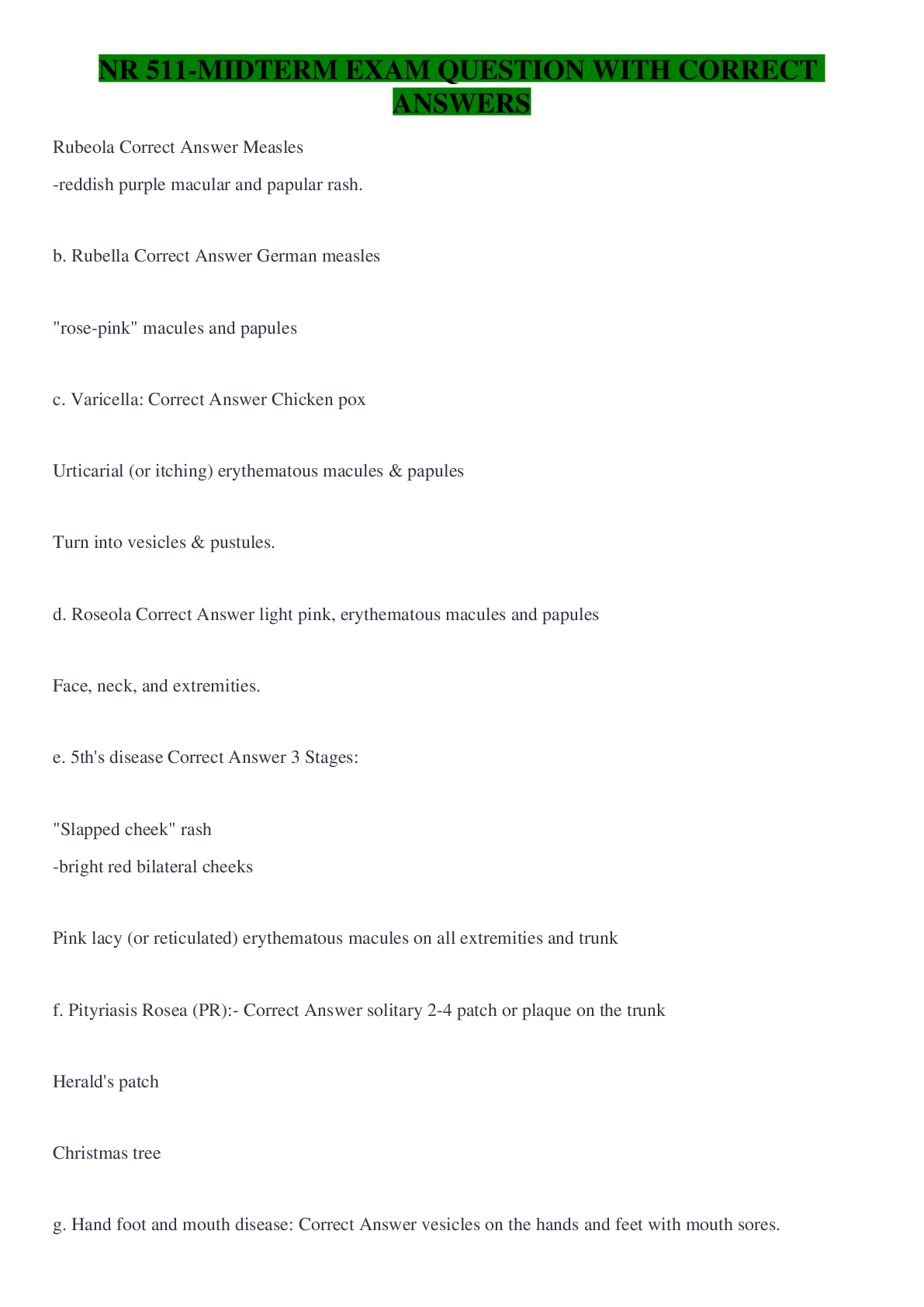
20.Differentiate between rubeola, rubella, varicella, roseola, 5ths disease, pityriasis
rosea, hand/foot/mouth, and molluscum contagiosum.
Rubeola: "the Measles"
From morbillivirus
Highly contagious spread through respiratory drops
No cure
Vaccine since 1963
Pt appears very sick: high fever, red mucosal membranes, conjunctivitis, nasal
congestion, reddish/purple generalized macular and papular rash. Lesions start on head,
esp. face or behind ears, spread down body within 1-2 days.
Blood work: reverese-transcriptase polymrease chain reaction (RT-PCR) and IgG and
IgM.
All positive cases must be reported to CDC.
Possible complications: PNA, bronchitis, myocarditis, encephalitis.
Pregnant: possible miscarriage.
Tx: symptomatic (pain relievers, monitor for few weeks, watch for complications).
Infectious 4 days before onset of rash up to 4 days after onset. Able to return to
work/school after rash gone.
Rubella: German measles or 3-day measles.
Caused by rubella virus.
Rash may start 2wks after exposure, spread from respiratory droplets.
Low-grade fever, HA, sore throat, rhinorrhea, malaise, eye pain, myalgia 2-5 days before
rash (may last weeks after outbreak).
Skin rash: rose-pink macules and papules, first on head, travel down body. Fades in 1-2
days in same order they appeared.
Clinical diagnosis.
Tx: symptomatic (apap, NSAIDs, rest).NR 511 – FINAL EXAM STUDY GUIDE
28
Rubella vaccination.
Infectious 4-7 days before rash, can return to work/school after rash gone.
Varicella: chicken pox.
Highly contagious.
Caused by varicella zoster virus (VZV).
Malaise, fever, chills, HA, arthralgia, then 1-2 days later urticarial erythematous macules
and papules appear, quickly turning into vesicles and pustules. Rash starts on
face/chest, spreads quickly over entire body. Blisters can be in ear canal or mouth. Dry
up in 1wk.
Clinical diagnosis.
Tx: symptomatic (oral antihistamines, NSAIDs, cool compresses, oatmeal baths).
Varicella vaccination.
Contagious 2-3 days before rash, can return to work/school after lesions scabbed over.
Roseola: 6th disease
Caused by human herpes virus types 6 and 7.
Virus usually mild, common in children under age 2.
Spread through saliva.
Short-lived, 3-5 days.
High fever, irritability, diarrhea, cough, cervical lymphadenopathy.
Rash: light pink, erythematous macules and papules on face, neck, extremities. Usually
resolves in 1-3 days.
Dx based on clinical presentation and history.
Tx: symptomatic.
Contagious 1-2 days before fever, can return to work/school when fever, fatigue, cough,
diarrhea gone.
Fifth's dz: erythema infectiosum, human parvovirus.
Spread through respiratory drops, blood products.
3 stages: HA, fever/chills, possible cough, classic slapped cheek rash, bright red bilat
cheeks (not forehead, nasal bridge, perioral area); pink lacy (reticulated) erythematous
macules on all extremities and trunk (not palms, sole surfaces), may be itchy; 2-3wks of
body rash
Dx can be made via blood test, but results not detected for 3wks after rash, so not
valuable.
Tx: symptomatic. Avoid heat (exacerbates rash).
Contagious few days before rash, can return to work/school after initial s/s of HA, fever,
chills are gone, even if rash still present.
Pityriasis rosea: viral, but difficult to confirm.
Majority 10-35yo, more females than males.
Common breakouts in spring.
Solitary 2-4 patch/plaque on trunk ("herald patch"), starts 2-3wks before general rash.
Rash is pink, erythematous, round to oval plaques/papules w/possible scaly borders.
Resembles shape of a Christmas tree on the trunk. Usually not on face, palmar, sole
surfaces. Can be itchy. Pt may have low-grade fever, HA, fatigue. Can last 1-2mo or
longer.
Dx made by H&P.NR 511 – FINAL EXAM STUDY GUIDE
29
Tx: antihistamines, sun (could help rash). Acyclovir for 1wk (may reduce severity).
Contagious 7-14 days prior to rash. Returning to activities depend on symptoms, but by
the time rash appears, pt is not contagious.
Hand, foot, mouth dz: mostly occurring in young children.
Caused by coxsackievirus A16 and enterovirus 71.
Low-grade fever, fatigue, sore throat 1-2 days, then rash.
Rash: vesicles on hands/feet w/mouth sores. Mouth sores are in almost 90% of cases,
usually first sign. Hand vesicles appear with erythematous halos and appear mostly on
soles/palms. Might appear on legs, butt, face. Usually resolve in 7 days.
Dx made by H&P.
Tx: symptomatic. Reassure parents that there will be no scarring.
Contagious 4-6days prior to outbreak, can return to school when lesions are scabbed.
Molluscum contagiosum: from family of Poxviridae.
Virus is encased in protective sac that prevents immune system from being triggered.
Tiny pustules 2-5mm, some have slight depression in center of flesh-colored dome.
Single or multiple lesions.
Spread by contact, scratching, autoinocculation, shaving.
Most common places in kids are thighs/arms.
Most common places in adults are genital region.
Never soles/palms.
Sometimes erythematous papules/scaling from itching.
Can last 8mo or longer.
Dx by H&P, often misdiagnosed as genital warts.
Tx: non-Rx OTC Zymaderm. Rx topical retinoids. PO Cimetidine (Tagamet) 40mg/kg/day
x2mo. Cryosurgery w/liquid nitrogen (may be scarring or hypopigmentation).
No single treatment better than another.
Exclude from activities/sports until symptom-free or lesions are covered.
21.Differentiate between tinea pedis, cruris, corporis, and unguium. What are the
appropriate treatments for each?
Tinea pedis: aka athlete's foot.
Erythematous, scaly, possible inflammation/itching.
Tx: antifungal cream, vinegar soak/Burrow solution to decrease itch. Ketoconozole is
topical treatment of choice, used for at least 4wks if not longer to resolve. OTC antifungal spray for all shoes during/after treatment. Terbanifine sometimes for
prolonged/severe cases.
Tinea cruris: aka jock itch.
Rash presents on inner thighs, butt, groin. Well-demarcated erythematous/tan plaques
with raised scaly borders.
Tx: topical antifungal; if repetitive infections, OTC zeabsorb powder can help prevent
breakout.
Tinea corporis: aka ringworm
On the extremities or trunkNR 511 – FINAL EXAM STUDY GUIDE
30
Erythematous annular lesion with scaly macules and papules, well-defined edges.
May be itchy.
Edge of lesion is raised, center of lesion is flattened. Can be small or cover large body
surface area.
Tx: antifungal topical cream or PO antifungal (Terbanafine) if widespread.
Follow-up 3-4wks.
Tinea unguium: aka onychomycosis.
Fingernails or toenails.
Very common.
Nail appearance may vary: yellow, green, black or white ridging w/possible cracking of
nails.
Tx: determined by severity and pt's age. Topical Ciclopirox nail laquer 8% applied daily
for months at base of nail. PO Terbanafine 250mg daily x2wks has high cure rate but pt
has to have healthy liver (do CMP prior to inititation).
Cure is VERY slow (4-6mo for fingernails, 8-10mo for toenails).
22.Identify the virus that causes warts
HPV (human papilloma virus)
23.Differentiate between atopic and contact dermatitis and give examples of each.
Contact: allergic reaction to substance that produces immune reaction in skin
resulting in pruritic and erythemic rash.
Common causes: nickel, abx creams, cosmetics, soaps, fragrances, jewelry,
plants (poison ivy).
Usually occurs in same area that was directly exposed to reaction within minutes
to hours of exposure.
Not contagious, cannot be spread from one area of body to another by touching.
Tx: removal of substance causing reaction; mostly symptomatic; topical
antihistamines; steroid creams; PO antihistamines to combat itching; mores
severe cases or if reaction is on face, esp around eyes: taper dose of PO
steroids.
Can lead to secondary infection if area is repeatedly scratched.
Atopic: disorder that is result of gene variation that affects skin's ability to retain
moisture and protection from irritants.
Often associated in people with asthma or hay fever.
Patches of itchy, dry skin; red to brownish-gray; may have small raised vesicles
that leak when scratched.
Usually starts before age 5, persists into adulthood.
Tx: symptomatic, much like contact derm. Topical steroid creams, PO
antihistamines. Moisturize skin at least BID. Avoid triggers that worsen rash.NR 511 – FINAL EXAM STUDY GUIDE
31
24.Identify common characteristics associated with blepharitis, chalazion and
hordeolum
Blepharitis: irritation, burning, itching, scales, redness.
If lice is cause: reddish brown crust in lashes (not white or clear as typically
seen).
Chalzion: mass in mid-portion of upper lid away from margin. Usually not painful
or tender. Slightly red, swollen.
Hordeolum: usually on outside of lid, abscess on lid margin. Redness, swelling,
painful.
25.Differentiate between viral, allergic, bacterial, toxic and HSV conjunctivitis
Bacterial: aka pink eye.
Direct hand-to-eye contact w/infected person.
Spread of one's own nasal/sinus bacteria during illness.
Purulent discharge (HALLMARK)
Reddened conjunctiva
Eyelid swelling
Can start unilat, but can spread bilat.
May resolve without treatment, but abx drops can shorten duration.
Very contagious (stay home until 24hrs of abx treatment or when clinical improvement
noted).
Viral: usually caused from adenovirus, but can be HSV, HZV, molluscum contagiosum.
Irritation, mild light sensitivity, swollen lids, mild FB sensation.
Mild conjunctival hyperemia to insense hyperemia. Watery/mucousy drainage, not
purulent.
Enlarged tender preauricular lymph nodes on affected side.
Red throat, nasal drainage, ear infection, etc.
Self-limiting, resolve on their own from few days to few weeks.
Highly contagious
Current recommendation is stay home until redness/tearing resolved.
Allergic: usually caused by environmental allergen (pollen, grass, trees, etc.).
Can be seasonal and can be isolated to eyes or include upper resp allergy symptoms
such as rhinitis.
Hallmark characteristic: itching
Diffuse, milky, conjunctival hyperemia
Swollen conjunctiva
Tearing
Almost always bilat
Uniquely identifying bumps on conjunctiva ("follicles")NR 511 – FINAL EXAM STUDY GUIDE
32
Tx: symptomatic. Artificial tears, anti-allergy drops.
Toxic: due to overuse of topical ocular meds (Visine), but abx drops most common
(usually from using abx drops for longer than prescribed or for viral infections).
Clear, watery discharge and red conjunctiva
Dx usually from history
Tx: stop the drops
HSV: spread by contact w/persons who have visible, infected lesions and w/persons
symptomatically shedding the virus.
Pt may be experiencing prodrome of ill-related symptoms (malaise, low grade fever,
pain/tingling near site of lesions but lesions not yet visible).
Skin vesicles
Conjunctivitis (same as viral)
Corneal infection w/hallmark dendrite appearance
26.Which chemical injury is associated with the most damage and highest risk to
vision loss?
Moderate to severe alkali (ammonia, drain cleaners, cement, plaster/mortar,
airbag rupture, fireworks; all contain ammonia, lye, lime, sodium, mag hydroxide).
27.What are common eye emergency conditions that require emergency room eval?
Gonococcal conjunctivitis (sight threatening because it can affect the cornea)
Eyelid lac
Moderate to severe subconjunctival hemorrhage with concern for more extensive
injury.
FB
Hyphema
Open or ruptured globe
Chemical injuries
Orbital cellulitis (because can cause meningitis)NR 511 – FINAL EXAM STUDY GUIDE
33
28.Discuss glaucoma, diagnosis and treatment
open angle glaucoma:
there is no obvious systemic or ocular cause of rise in the intraocular pressure. It
occurs in eyes with open angle of the anterior chamber. Primary open angle
glaucoma (POAG) also known as chronic simple glaucoma of adult onset and is
typically characterised by slowly progressive raised intraocular pressure (>21
mmHg recorded on at least a few occasions) associated with characteristic optic
disc cupping and specific visual field defects.
closed angle glaucoma
the opening between the cornea and iris narrows so the fluid cannot reach the
trabecular meshwork - causes a sudden increase in the intraocular pressure that
produces pain, nausea, redness of the eye and blurred vision
glaucoma treatment options
1 Medical treatment in progressive cases may include betaxolol because of its
beneficial effects on optic nerve blood flow in addition to its IOP-lowering
properties. Prostaglandin derivatives tend to have a greater ocular hypotensive
effect, which may be an over-riding consideration. It should be noted that topical
beta-blockers can have a dramatic effect on BP in a minority of patients, and may
contribute to nocturnal dips.
2 Laser trabeculoplasty can be effective.
3 Surgery should be considered if progression occurs despite IOP in the low
teens.
4 Control of systemic vascular disease such as diabetes, hypertension and
hyper-lipedema may be important, in order theoretically to optimize optic nerve
perfusion.
5 Systemic calcium-channel blockers have been advocated by some authorities
to address vasospasm.
6 Anti-hypotensive measures. If significant nocturnal dips in BP are detected, it
may be necessary to reduce antihypertensive medication (especially if taken at
bedtime).
29.What is diabetic retinopathy?
degenerative changes in the retina
-#1 cause of legal blindness in the USNR 511 – FINAL EXAM STUDY GUIDE
34
30. what are the causes of diabetic retinopathy
DM (which weaken and cause leaking of blood vessels in the retina)
-stages: nonproliferative, preproliferative, proliferative.
31. What are the risk factors for diabetic retinopathy?
DM, productive years, Native american, hispanic, african-american, family
history, hyperglycemia, HTN, hyperlipidemia, smoking, anemia, renal disease
32. What are the manifestations of diabetic retinopathy?
revascularization of disc or elsewhere in the retina, vitreous hemmorhage, gliotic
tissue or traction retinal detachment, neovascular glaucoma of the iris, "cottonwool spots" or soft exudates from lack of blood to tissue
33. How is diabetic retinopathy diagnosed?
baseline dilated eye exam and eval,
fasting glucose and HgA1c
fluorescein angiography (which reveal microaneurysms).
34. What are nursing implications/ND for clients with diabetic retinopathy?
ED: don't smoke, control blood sugar and BP
35.How is diabetic retinopathy managed/goal of treatment?
S/S: floating spots, streaks, lines, scattered lights, poor color vision
goal: control diabetes, maintain HbA1c level in 6-7% range
Management: prevent from worsening, control glucose, and cholesterol, laser
photocoagulation, vitrectomy
36. What are the surgeries for diabetic retinopathy:
laser photocoagulation, vitrectomy
37. What assessment data would the nurse gather for someone with diabetic retinopathy?
meds for diabetes? BG and BP? smoke? wear glasses or contacts or have eye
problems?
-assess: visual acuity, blood sugar, eye examNR 511 – FINAL EXAM STUDY GUIDE
35
Week 5
1. Identify the population most commonly affected by bacterial prostatitis
-Predominantly in sexually active men 30-50yo
-Chronic is more common in pt's >50yo
2. Discuss the physical exam characteristics of acute bacterial prostatitis
Prostate exam:
-Warm
-Tense
-Boggy
-Very tender
3. Discuss how the Phren sign can differentiate between testicular torsion and epididymitis
Epididymitis:
-Pain often improves when scrotum elevated above level of pubic symphysis
Testicular torsion:
-Does NOT relieve pain if scrotum elevated
4. Discuss common symptoms reported from a patient with BPH
Obstructive:
-Decreased force of stream
-Hesitancy
-Postvoid dribbling
-Sensation of incomplete bladder emptying
-Overflow incontinence
-Inability to voluntarily stop urinary stream
-Urinary retention
-Double voiding
-Straining
Irritative:
-Nocturia
-Urinary frequency
-Urgency
-Dysuria
-Urge incontinence
5. Discuss the hallmark characteristic of a varicocele
Pt describes sensation as a feeling like a "bag of worms"NR 511 – FINAL EXAM STUDY GUIDE
36
6. Identify the population most affected by testicular cancer
Young men 15-35yo
7. Explain spinal stenosis
-Narrowing of one or more levels of lumbar spinal canal, subsequent compression of
nerve roots
-Anatomically: as many as 30% of population may have spinal stenosis after 60yo, but
only a portion have symptoms
-Obesity is predisposing factor
-Osteoporosis is predisposing factor
8. Discuss common characteristics (subjective and objective findings) of patients with
lumbar spinal stenosis
Onset may follow lifting incident or minor trauma or may gradually emerge
-Symptoms progress from prox to distal
-Walking or prolonged standing causes pain/weakness in legs/butt
-May get short-term relief by leaning forward (manifested as "stopping")
-Relief after sitting is variable, depending on degree of neural compression
-Pt's who sleep on back (with spine extended) might awaken after several hrs w/back
and leg pain
-Vague aching in legs or leg weakness may be present
-Spondylolisthesis (degenerative or spondylolytic), vascular insufficiency, OA in hips,
obesity are often associated with spinal stenosis
9. Identify the red flags associated with back and neck complaints which warrant further
investigation
T: trauma
U: unexplained wt loss
N: neuro symptoms
A: age >50
F: fever
I: IV drug user
S: steroid use
H: h/o cancer (prostate, renal, breast, lung)
10. Define chronic pain
-Pain that extends beyond expected period of healing
-Pain >3mo
-More generalized, less localized to site of injury/initial complain
-Referral patterns can shift in location, intensity, frequency, quality
-Pain does not change w/movement, rest, time
-Usually reported as constant/continuous (less likely intermittent)
-Mood or current psych status tends to affect/worsen c/o painNR 511 – FINAL EXAM STUDY GUIDE
37
11. Identify the number of joints involved in a poly-articular disorder
Monoarticular: 1 joint
Periarticular: 2-4 joints
Polyarticular: 4 or more joints
12. Describe the four cardinal signs of joint inflammation
Erythema
Warmth
Pain
Swelling
13. Differentiate between DeQuervain’s Tenosynovitis and Carpal Tunnel Syndrome
Carpal tunnel:
-Result of median nerve constriction, often from repetitive motion
-Discomfort described as burning, itching, tingling
-Nocturnal: awakens the sufferer from sleep
-Sensation felt in wrist, thumb, 2nd, 3rd, sometimes 4th digits.
-Symptoms begin gradually, but as condition progresses, day symptoms present as well
(may affect tasks like grabbing small objects)
-Positive Tinel test and Phalen maneuver are indicators
DeQuervain's tenosynovitis:
-Affects APL and EPB tendons at lateral wrist and base of thumb
-Pain felt over thumb, radiates up forearm
-Pain worsens when grasping or twisting wrist
-Popping or snapping noise may be heard when moving thumb
-Positive Finkelstein test indicates
14. Differentiate between lateral and medial epicondylitis
Medial:
-Golfer's elbow
-Pain radiates from medial epicondyle down forearm w/extension and supination of
wrist
-Weakness in hand
-Numbness in 4th and 5th fingers
Lateral:
-Tennis elbow
-Pain in lateral elbow, down outer forearm
-Weakness in forearm
-Weak gripNR 511 – FINAL EXAM STUDY GUIDE
38
15. Discuss at least 3 vital body functions which thyroid hormones regulate
-Breathing
-HR
-CNS/PNS
-Body wt
-Muscle strength
-Menstrual cycles
-Body temp
-Cholesterol levels
16. Describe a goiter and the type of thyroid dysfunction that can be associated with it
-Goiter is hypertrophy/hyperplasia of thyroid gland in response to TSH levels
-Most commonly seen in Hashimoto's (hypo)
-Toxic multinodular goiter (hyper) in iodine deficiency
-Grave's (hyper) has firm goiter
17. Differentiate between overt hypothyroidism and subclinical hypothyroidism
Overt:
-TSH >10
-FT4 decreased
-Too little hormone produced
-Pituitary attempting to get thyroid to produce more
Subclinical hypothyroidism:
-TSH increased
-FT4 normal
-Some have symptoms, others don't
18. Differentiate between Hashimoto’s thyroiditis and Grave’s disease
Grave's:
-Autoimmune (attacks thyroid cells)
-Overproduction of thyroid leading to hyperthyroidism
-90% of hyperthyroidism
Hashimoto's:
-Autoimmune (attacks thyroid cells)
-Underproduction of thyroid leading to hypothyroidism
-ID'd via TPO and TPG abs in bloodNR 511 – FINAL EXAM STUDY GUIDE
39
19. Identify at least 3 risks associated with obesity
-DM
-CVD
-Afib
-HTN
-NSTEMI
-Varicosities
-Cancer
-Skin infections
-Arthritis
-GB dz
-GERD
-Acute pancreatitis
-NAFLD
-Stress incontinence
-Infertitility
-OSA
20. Identify at least 3 causes of obesity
-Calorie excess (overeating or high intake of carbs)
-Food insecurity (eating from fear of potential hunger or past experience w/poor
availability of food on regular basis)
-Genetic predisposition w/fam Hx (influences of ghrelin/leptin levels)
-Med influences (antidepressants, anti-sz, steroids, insulin, PO contraceptives)
-Psych factors (self-soothing, large CHO intake = increased serotonin)
-Dz states (hypothyroidism, insulin resistance, PCOS, Cushing's)
21. Discuss one primary prevention for obesity
-Increase activity level: 60min most days of the week
-Manage caloric intake (low CHO, high protein, small/frequent meals, eliminate sweet
liquids)
-Encourage activity/diet for family, not just individual
-24hr diet recall/journaling food
-Promote good sleep hygiene
22. Identify the categories of obesity based on the BMI
-Overweight: 25-29.9 (relative wt 100-120%)
-Obesity: 30-40 (relative wt 140-200%
-Severe/morbid obesity: >40 (relative wt >200%)NR 511 – FINAL EXAM STUDY GUIDE
40
23. Discuss how acute low back pain without neurological dysfunction does not warrant
radiological imaging
-Acute low back pain may have multiple DD
-If pain not found to be related to neuro complaints, imaging not warranted
24. Identify the roles of TSH, FT4, TT3, and TPO Abs in determining thyroid function
TSH:
-Pituitary messenger to thyroid to increase or decrease thyroid hormone production
-Used to dx hypothyroidism
-TSH and FT4 used to follow tx
-If TSH low or elevated in presence of low T4: central hypothyroidism caused by
hypothalamic or pituitary dz should be excluded before starting meds
FT4:
-Circulating unbound thyroid hormone produced by thyroid
-Replaced by levothyroxine
-Useful for dx of hypothyroidism (both overt & subclinical)
-Primary hypothyroidism: low FT4, high TSH
-Subclinical hypothyroidism: mildly high TSH, normal FT4
TT3:
-Circulating unbound thyroid hormone that has been converted from T4
-Not routinely used as diagnostic b/c it isn't sensitive or specific to to hypothyroid
-May be normal in early dz, may not fall until late dz
Thyroperoxidase antibodies (TPO Ab):
-Useful in detecting autoimmune thyroiditis (Grave's or Hashimoto's)
-Diagnostic for Hashimoto's when found in high titers (1:400)
-Higher levels = more thyroid destruction = more severe hypothyroidism
Misc:
-No universal screening recommendations for thyroid dz
-ATA recommends screening for: baseline at 35yo, pregnant, women older than 60yo,
people w/autoimmune dz's
25. Identify at least one “at-risk” population who should be considered for thyroid screening
-Pregnant
-Women >60yo
-People w/other autoimmune dz's
-People w/pernicious anemia
-People w/fam Hx (1st degree relative) w/thyroid dz
-People with h/o prior thyroid surgery/dysfunction/neck radiation
-People w/abnormal thyroid exam
-People w/psych disordersNR 511 – FINAL EXAM STUDY GUIDE
41
26. Discuss one physical characteristic seen in a hyperthyroid patient
-Smooth, velvety skin
-Soft, thin hair
-Increased pigmentation, spider angiomas, vitiligo
-Onycholysis
-Exopthalmus
-Muscle atrophy
-Tremors
-Warm/flushed/moist skin
-Lid lag/edema
-Corneal ulceration
-Sinus tach
-Elevated BP
-Afib
-CHF symptoms
-Gynecomastia
27. Identify the CDC recommended antibiotic class for treatment of acute bacterial
prostatitis
fluoroquinolones: cipro 500 mg PO BID x 14-28 days or Levaquin 500 mg PO daily x 14-28 days
28. Identify at least one treatment for BPH
alpha beta blockers:
Flomax 0.4 mg - 0.8 mg Po daily
Doxazosin 4-8 mg PO daily
Finesteride 5 mg PO daily or Dutasteride 0.5 mg PO daily
29. Identify treatment options for obesity based on BMI and comorbid conditions
BMI > 25 diet, exercise, and behavior modification
BMI > 27 with cormorbidity or > 30 w/ or w/o cormorbid: medication
BMI >35 w/comorbid or > 40 w/or w/o cormorbid: surgery
30. Describe the Spurling test and what condition it is used to diagnose
Cervical Radicular Syndrome
Have pt. extend neck and lateral flex to affected side. press down on the head. positive
if pain down the affected armNR 511 – FINAL EXAM STUDY GUIDE
42
31. Describe how to perform a Phalen and Tinnel test
Tinnel:
-Tap over median nerve in affected wrist
-If fingers feel tingling = positive Tinnel sign
Phalen:
-Pt presses backs of hands /fingers together w/wrists flexed to as close to 90degrees as
possible
-If numbness/tingling within 2-3min = positive Phalen sign
32. Identify at least 3 physical exam maneuvers to assess the knee
Diagnosing ACL injury:
-Lachman's
-Anterior drawer sign: pull tibia anteriorly; if tear present in anterior cruciate ligament,
will be able to pull ("draw") tibia anteriorly
-Posterior drawer sign: push tibia posteriorly; if tear present in posterior cruciate
ligament, will be able to push tibia anteriorly
Diagnosing meniscal tears:
-McMurray's test: idea is to trap meniscus between tibia and femur. Pt needs to be
relaxed. One hand on knee joint line, other holds foot/ankle. Flex knee as far as possible
(hyperflexion). Externally rotate (medial meniscus), or internally rotate (lateral
meniscus) tibia and then extend knee. Positive if clicking or popping felt w/pain.
Diagnosing collateral (MCL & LCL) injury:
-Varus and Valgus stress testsNR 511 – FINAL EXAM STUDY GUIDE
43
Week 6
1. Differentiate between resting, postural and intention tremors and describe each
Resting:
-Occurs at rest, against gravity, or sitting still w/arms resting in lap.
-Most common condition that causes resting tremors is is PD and med tremors
Postural:
-Seen when pt is asked to extend arm in front of them.
-Most common is essential.
-Bilat, generally symmetric
-Often fam Hx
-Drinking ETOH can reduce
Intention (kinetic) tremor:
-Characterized by increase in amplitude when pt attempts movement
-Can be checked by having pt perform finger-to-nose coordination
2. Describe one disease with resting tremor as a clinical finding
PD:
-Progressive neuro dz
-4 hallmark signs: resting tremor, cogwheel rigidity, bradykinesia, postural instability
-Other characteristics: facial masking, difficulty standing from sitting in chair, "freezing,"
reduced arm swing, festinating (quick, short stride w/head down), shuffling gait.
3. Describe a medication commonly associated with tremors
-Extrapyramidal SE similar to PD
-Antipsychotics are most common
-Metoclopramide (Reglan)
-Phenothiazine (Compazine)
-Steroids
-Caffeine
-Anti-epileptics
-Antidepressants
-Asthma meds
-Intention tremor may be associated with meds, ETOH/drug abuse, MS, stroke, mass
affecting cerebellum
4. Identify at least 3 laboratory tests to rule out systemic causes of tremorNR 511 – FINAL EXAM STUDY GUIDE
44
-Electrolytes, ABGs (metabolic imbalances, drugs, caffeine, physiological fatigue)
-Serum glucose (hypoglycemia)
-Toxicology screen/drug levels (toxic conditions, antipsychotic drugs, caffeine)
5. Describe at least one at-risk population that is recommended to have HIV screening
-Anyone who had unprotected sex
-Men who have sex w/men
-Those who exchange sex for drugs/money
-Those who have other STIs
-IV drug users
-Healthcare workers
6. Describe at least one pharmacologic treatment option for tremor
beta blockers, primidone or benzodiazepines. dopamine agonist for parkinsons disease
-If tremor due to ETOH withdrawal: diazepam, lorazepam (mild symptoms)
7. Describe an appropriate empiric antibiotic treatment plan for cellulitis
cephalexin 500 mg PO daily x 5 days or clindamycin 300-450 mg PO QID x 5 days
if MRSA, add Bactrim DS PO BID, Doxy 100 mg PO daily or Minocycline 200 mg PO once
then 100 mg PO BID
8. Discuss an intervention to prevent HIV and HIV-associated behaviors
Condoms, delay sexual debut, and reduce partner concurrency and/or changes
9. Identify physical exam findings in the patient with HIV
pharyngeal edema with no tonsillar enlargement or exudate, painful mucocutaneous
ulcerations in oral mucosa, anus, esophagus, or penis, generalized rash, n/d/anorexia,
weight loss, dry cough, mild anemia, and elevated liver function tests, and
thrombocytopeniaNR 511 – FINAL EXAM STUDY GUIDE
45
10. Describe symptoms, DDx, pathogens, testing, and treatment for the following
conditions: Cellulitis, impetigo, MRSA, Bites (dogs, cats, humans), Erysipelas
Cellulitis:
-Acute infection as result of bacterial entry via breaches in skin barrier
-As bacteria enters SQ tissues, toxins are released which causes inflammatory response
-Involves deeper dermis & SQ fat
-Observed most frequently among mid-aged individuals & older adults
-Vast majority of pathogens associated with cellulitis are from strep or staph
-Most common are beta-hemolytic strep (groups A, B, C, G, F) & S. aureus
-S/S: with or without purulence, skin erythema, edema, warmth, pain, maybe fever,
lymphangitis, inflammation of regional lymph nodes; edema around hair follicle may
cause dimpling in skin (orange peel texture "peau d'orange").
-Tx: should be directed at infection and predisposing condition if possible (i.e. tinea
pedis, lymphedema, chronic venous insufficiency); empiric therapy due to betahemolytic strep and MSSA: cephalexin 500mg 4x/day (alternative for mild pcn allergy),
clinda 300-450mg 4x/day (alternative for severe pcn allergy)
-Usually symptomatic improvement within 24-48hrs of abx intitiation
Impetigo:
-Superficial bacterial infection of skin
-Primary impetigo when infection at sites of minor skin trauma
-Impetiginization: most frequently in kids 2-5yo, but older kids/adults may be affected;
infection usually in warm, humid conditions, easily spread among people w/close
contact; risk factors: poverty, crowding, poor hygiene, underlying scabies
-Source: S. aureus, GAS either alone or w/S. aureus, occasionally MRSA
-Non-bullous: most common, starts as papules, progress to vesicles w/erythema; in 1wk,
papules become pustules, enlarge, break down, form thick/adherent crusts
w/characteristic golden appearance; lesions usually on face/extrem; may have regional
lymphadenitis, though systemic symptoms usually absent.
-Bullous: seen primarily in young kids where vesicles enlarge, form flaccid bullae w/clear
yellow fluid, later becoming darker, ruptures, leaving thin brown crust. Trunk more
frequently affected. Adults w/appropriate demographic risk factors should prompt
investigation for previously undx'd HIV.
-Ecthyma: caused by GAS. Ulcerative form. Lesions extend through epidermis, deep into
dermis. Resembles "punched-out" ulcers covered in yellow crust surrounded by raised
violaceous margins.
-Complications: poststrep glomerulonephritis is serious complication of impetigo
(ecthyma). Develops in 1-2wks after infection. Manifests w/edema, HTN, fever,
hematuria.
-Dx: made from clinical manifestations. Gram stain/culture of pus/exudateNR 511 – FINAL EXAM STUDY GUIDE
46
recommended to ID S. aureus and/or beta-hemolytic Strep.
-Tx: can initiate w/out studies in pt's w/typical presentation. Bullous/nonbullous: either
topical or PO. Top used for pt's w/limited skin involvement. Top has fewer SE, lower risk
for contributing to bacterial resistance VS PO: mupirocin TID x5days, retapamulin BID
x5days. PO for pt's w/numerous lesions. Extensive impetigo/Ecthyma: always PO
therapy. Treat w/abx effective for S. aureus and strep unless cultures show only one:
dicloxacillin x7days, cephalexin x7days. If only strep detected in culture: penicillin. MRSA
impetigo: doxy, clinda, bactrim; crusted lesions washed gently, return to work/school
24hrs after starting abx; cover draining lesions.
-DD: contact dermatitis, tineas, eczema herpeticum, HSV, pemphigus vulgaris, bullous
drug erruption, burns, bullous insect bite reactions.
MRSA:
-Mediated by pcn-binding protein that permits organism to grow/divide in presence of
methicillin/other beta-lactam abx.
-Risk factors for community-associated MRSA (CA-MRSA): abx use secondary to abx
selective pressure; cephalosporin/fluoroquinolone use strongly correlated w/MRSA;
HIV; HD; LTAC.
-CA-MRSA: direct contact w/colonized/infected person; contact w/contaminated
fomites used by infected person; ppl colonized w/MRSA serve as reservoir for
transmission; can colonize skin/nares of hospitalized pt's/healthcare workers/healthy
ppl; colonization can occur from inhalation of aerosolized drops from chronic nasal
carriers. Isolates usually associated w/skin/tiss infections. S/S: skin abscess-collection of
pus in dermis or subq space; painful, fluctuant, erythematous nodule, w/or w/out
surrounding cellulitis; spontaneous drainage of pus may occur; maybe regional
adenopathy; fever; chills; furuncles; carbuncles. Dx: of skin abscess usually based on
clinical manifestations; lab testing not required for pt's w/uncomplicated infection
w/out comorbidities/complications; get blood cx before starting abx when lesion is
secondary to animal bites/water associated injuries. DD: epidermoid cyst (skin-colored
cutaneous nodule, usually w/central punctum, freely movable), folliculitis (inflammation
of one or more hair follicles), hidradenitis suppurativa (chronic suppurative process
involving skin/subq tissue of intertriginous skin), recluse spider bites. Drainable abscess
should have I&D w/C&S. If I&D, give abx if: single abscess >/=2cm, multiple lesions,
extensive surrounding cellulitis, associated immunosuppression/other comorbidities,
systemic s/s toxicity, presence of indwelling medical device, high risk for transmission to
others. Abx: Bactrim DS BID, doxy 100mg BID, minocycline 200mg once then 100mg
q12h, clinda 300-450mg 4x/day; give for at least 5 days; beta-lactam should be added if
abscess is perioral/perirectal.
Dog bites:
-Can have serious clinical implications due to complication potential.
-Animal bites more common in kids than adults.
-Can cause range of injuries.
-Extremities (esp dominant hand) are most frequent site in older kids/adults.
-Predominant pathogens are oral flora of animal and human skin flora, so infection
usually from mixture of organisms.NR 511 – FINAL EXAM STUDY GUIDE
47
-Common pathogens: Pasteurell, Staph, Strep, Capnocytophaga canimorsus (significant
in asplenic pt's, chronic ETOH abuse, underlying hepatic dz).
Cat bites:
-2/3 involve upper extrem.
-Deep puncture wounds have particular concern because cats have long, slender, sharp
teeth.
-Can transmit Pasteurella, Bartonella henselae.
Human bites:
-Semicircular/oval area of erythema/bruising usually visible.
-Skin may/may not be intact.
-Occlusive wounds: more common in females, w/teeth closing over/breaking skin.
-Clenched-fist/fight bites: more common in males, where skin surface usually of hand
strikes tooth, resulting in damage to skin/underlying structures, usually skin breaks over
knuckles (usually third/fourth metacarpophalangeal or proximal interphalangeal joints
of dominant hand).
-Organisms usually Eikenella corrodens, GAS.
-Clinical manifestations: fever, erythema, swelling, tenderness, purulent drainage.
Pasteurella multocida:
-Usually rapidly after cat/dog bites
-Erythema, swelling, intense pain 12-24hrs after bite
-Aerobic/anaerobic blood cx & gram stain warranted before abx if s/s infection are
present systemically.
-Wound cx not useful
-Lab req should note that animal/human bite is source because Eikenella and
Pasteurella are fastidious.
-DD: limited because of evident h/o trauma; if hx can't be elicited, cellulitis/insect bites
are appropriate DD.
Bite Tx:
-Irrigate copiously w/sterile saline, remove grossly visible debris.
-Prophylactic abx if: deep puncture wounds (esp if cat bite), wound requires surgical
repair, moderate/severe wounds w/associated crush injury, wounds in areas of
underlying venous/lymphatic compromise, wounds on hands/close proximity to
bone/joint, wounds on face/genitals, wounds in immunocompromised pt's.
-Augmentin 875/125mg BID is agent of choice.
-Alternatives: doxy 100mg BID, Bactrim DS BID, pen VK 500mg 4x/day, cipro 500mg BID
PLUS flagyl 500mg TID or clinda 450mg TID.
-1st gen cephs/macrolides should be avoided.
-Duration of prophylactic PO abx = 3-5 days w/close follow-up.
-Tetanus toxoid if booster is 5 or more yrs old.
-Pt's w/mild infection: can treat initially w/same abx for 5-14 days.NR 511 – FINAL EXAM STUDY GUIDE
48
Erysipelas:
-Upper dermis
-Lesions are raised w/clear demarcation between involved/uninvolved tissue.
-Young kids and older adults
-Almost always from GAS
-Skin erythema, edema, warmth, pain (BOTH erysipelas and cellulitis)
-Fever
-Lymphangitis, inflammation of regional lymph nodes (BOTH)
-Orange peel texture ("peau d'orange")
-Non-purulent
-Acute onset of symptoms w/systemic manifestations incl. fever/chills
-Classic description: butterfly involvement of face
-Involvement of ear (Milian's ear sign) is distinguishing feature since region does not
have deeper dermis tissue
-Tx: manage w/empiric therapy due to beta-hemolytic strep; pen VK 500mg q6h, amox
875mg BID, cephalexin 500mg 4x/day (alternative for pcn allergy), clinda 300-450mg
4x/day (alternative for severe pcn allergy).
[Show More]