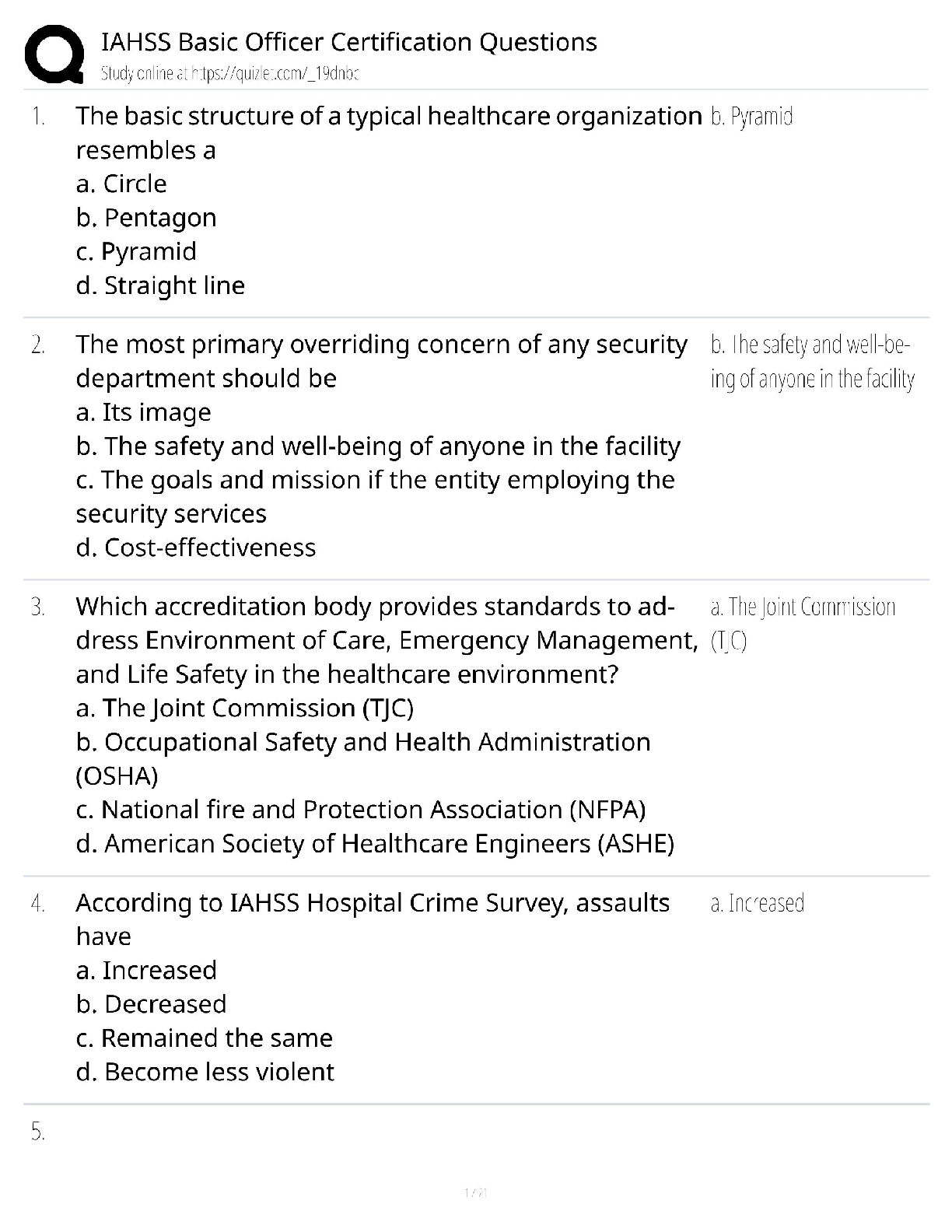
WGU C846 ITIL Questions and Answers with Certified Solutions
Document Content and Description Below
WGU C846 ITIL Questions and Answers
with Certified Solutions
Strategy life cycle ✔✔This is considered the core of the life cycle management process
Core Service ✔✔A service that produces th
...
e basic outcome of the customers desire
Customer ✔✔Someone who buys good or services
Enabling service ✔✔A service needed to deliver a core service
Enhancing service ✔✔A service that is added to the core to make it more attractive
IT Service ✔✔A service carried out by an IT provider. Consist of a combination of IT
technology, people, and processes
Outcome ✔✔The result of carrying out an activity, following a process, delivering an IT service.
The term is used for intended results as well as actual results
Process ✔✔Is a set of structured set of activities designed to accomplish a specific objective.
Service ✔✔A mean to deliver value to a customer by facilitating the outcome a customer wants
without the ownership and cost and risk.
Service Management ✔✔A set of specialized organizational capabilities for providing value to
customers in the form of services
Service strategy ✔✔How do we truly create value for a customer. How we can make the case for
a strategic investment. Resolves conflicting demands for resources. What services we should be
offering to whom
Utility ✔✔Fit for purpose
Warranty ✔✔Fit for use
Warranty Requires assurance in what area ✔✔Availability, Capacity, Security and continuity.
Assets ✔✔Any resource or capability
Attribute ✔✔Information held about a configuration item such as a serial number, make or
model
Capabilities ✔✔The ability of an organization, person process, application. IT service to carry
out an activity
Governance ✔✔Ensures that policies and strategies are actually implemented and processes are
followed correctly
IT Service management ✔✔The implementation and management of quality IT services that
meet the needs of the business.
PBA - Patterns of Business Activity ✔✔A Work load of one or more business activities. Used to
help the IT service provider understand and plan for different levels of business activity.
Resources ✔✔A Generic term that includes IT infrastructure people, money, or anything else
that might help IT delivery a service
Risk Management ✔✔The approach adopted to identify document, analyze, mitigate against the
likelihood of a potential impact to service.
Service Strategy ✔✔A phase of the service life cycle, service strategy defines the perspective,
position, plans and patterns that a service provider needs to execute to meet an organizations
business outcome.
Utility ✔✔The functionality offered by a product or service to meet a particular need or whether
it is fit for purpose.
Warranty ✔✔The assurance that a product or service will meet the agreed requirements, fit for
use.
User ✔✔A person who uses IT daily
Role ✔✔A Set of responsibilities, activities, or authorities assigned to a person or a team.
Business Case ✔✔Justification for significant items of expenditure, identifying cost and benefits,
including considering other options.
Business relationship Management ✔✔The process of maintaining a positive relationship with
customers. The business relationship manager focuses IT strategy ensuring that it will deliver
what is required by the business strategy.
Design Coordination ✔✔The process responsible for coordinating all service design activities,
process and resources.
Service portfolio ✔✔The complete set of services that is managed by a service provider. It
includes 3 categories: Service Pipeline (future), Service catalog (live) Retired services
Service Portfolio Management ✔✔The process that maintains the service portfolio. It ensures
that the service provider has the right mix of services that meet the required business outcomes at
an appropriate level of investing.
Service provider ✔✔An organization providing services to an internal or external customer.
Service Portfolio ✔✔Service Pipeline, Service Catalog, Retired Services
Architecture ✔✔The structure of a system or IT service, including the relationship of
components to each other.
Service Acceptance Criteria (SDP) ✔✔A document defining all aspects of an IT service and its
requirements though each stage of its life cycle
SLA ✔✔A written agreement between the service provider and the customer.
Supplier Contract ✔✔A legally binding agreement between the IT service provider and a third
party supplier.
OLA ✔✔An underpinning agreement between IT service providers and another part of the same
organization that assist with the provision of services.
Service level Agreement ✔✔Service description, Service Availability, Service Review
Schedules
SLA ✔✔Agreement that must be signed by both parties
Service based SLA ✔✔An agreement covering a single service used by multiple customers.
Customer Based SLA ✔✔An agreement covering multiple services used by a single customer
Corporate based SLA ✔✔An agreement covering services used across an organization.
SIP- Service improvement plan ✔✔A formal plan to implement improvements to a processor IT
service
SLR- Service level Requirements ✔✔A customer requirement for an aspect of an IT service.
Service level requirements are based off business objectives and used to negotiate agreed service
level targets.
UC- Underpinning Contracts ✔✔A contract between an IT service level provider and a third
party. The third party provides goods and services that support the delivery of an IT service to a
customer.
Demand Management ✔✔considers the patterns of business activity to understand the demands
of the service. May provide techniques for influencing the demands for services.
IT Service Provider ✔✔An organization providing services to one or more internal or external
customers
Supplier ✔✔A third party supplying goods or services that are required to deliver IT services.
Capacity Management ✔✔Business Capacity, Service Capacity, Component Capacity.
IT service continuity Management ✔✔Initiation, requirements and strategy, implementation and
on going operations.
Supplier Management ✔✔Manages the relationship between the IT service provider and supplier
while monitoring and management the required performance.
Information Security ✔✔Defines the security and access policies for all services
CMIS ✔✔Capacity Management Information System
AMIS ✔✔Availability Management Information System
Availability Management ✔✔The process for ensuring IT services meet the current and future
availability needs of the business in a cost effective and timely manner.
BCM- Business Continuity Management ✔✔Business process for managing risk that could
possibly disrupt critical business functions. Ensures that critical business functions are made
available following a major disruption.
BIA - Business impact Analysis ✔✔Its the part of business continuity that identifies vital
business functions and their dependencies. It is used to decide which business functions will be
impacted if IT service is unavailable.
Capacity Management ✔✔The process responsible for ensuring that the capacity of IT services
and the IT infrastructure is able to meet the agreed on capacity and performance requirements in
a cost effective and timely manner. 3 subsets are: Business capacity Management, Service
Capacity Management, Component Capacity Management.
Capacity Plan ✔✔A plan drawn up to address current and future capacity and performance
requirements. It shows current and historic useage of services and components and their
respective increase or decrease in capacity for the next 18 to 24 months. The plan suggest actions
to ensure sufficient but not excessive capacity.
ISM- Information Security Management ✔✔The process that ensures that the CIA of an
organizations assets match the agreed needs of a business.
IT service Continuity Management ✔✔The process responsible for managing risk that could
seriously affect IT servides.
MTBF- Meantime between failure ✔✔Is the average of the time between when a configuration
item starts working until it fails next time.
MTBSI- Meantime between service incidents ✔✔A metric used for measuring and reporting
reliability. It's the measurement from when a system fails until when it fails again.
MTRS- Meantime to restore service ✔✔A metric for reporting downtime. It is the average time
taken to restore an IT service or another configuration item after a failure. The measurement is
from the time of failure until it is restored.
Service Catalog ✔✔A database or structured document with information about all live IT
services, which may include services available for deployment.
Service Catalog Management ✔✔The process for providing and maintaining the service catalog
and ensuring it is available to those who are authorized to access it.
SKMS - Service knowledge management system. ✔✔A set of tools and databases that are used
to manage knowledge, information and data.
Supplier Management ✔✔The process responsible for obtaining value from suppliers, ensuring
contracts and agreements support the needs of the business and ensuring that suppliers meet the
contractual agreements.
VBF- Vital business function ✔✔Part of the business process that is critical to the success of the
business.
Process Owner ✔✔Is responsible for ensuring that the process is carried out correctly.
RACI ✔✔used to understand the allocations of roles and responsibility for an activity.
RACI ✔✔Responsible, Accountable, Consulted, Informed.
RFC- Request for change ✔✔A formal proposal for a change to be made.
Processes ✔✔All share a common set of characteristics
Normal Change ✔✔A change that follows the basic flow of assessments and authorizations.
Emergency Change ✔✔A change that is needed to be implemented immediately on business
critical systems.
Remediation Plan ✔✔A fallback plan or proposal for remedial action where a back out plan is
not achievable.
Projected service Outage ✔✔A document detailing the effect of planned changed on agreed
service availability.
Change Manager ✔✔Has the Role to chair the CCB.
Emergency Change ✔✔Failure of a critical component causing service impact on a number of
services that would justify this type of change.
Exception ✔✔An event that occurs requires detection and a specific action to be taken
Change ✔✔The addition, modification, or removal of anything that could effect IT.
CAB- Change advisory Board ✔✔The group of people who support the assessment,
prioritization and authorizing for scheduling changes.
Change Management ✔✔The process for controlling the lifecycles of change
Change Proposal ✔✔A high level description or business case of a potential service or
significant change.
Change management ✔✔A record containing the details of the change. Each record documents
the life cycle of a single change
CS Change Schedule ✔✔A document that list all authorized changes and their planned
implementation, dates as well as the estimated dates of the longer term changes.
Emergency Change ✔✔A change that has to be done ASAP. Example: Security Patching.
ECAB- Emergency Change Advisory Board ✔✔A subset of the CCB that deals with emergency
changes.
PSO Projected Service Outage ✔✔A document that identifies the effects of the planned changes,
maintenance activities, and test plans of agreed service levels.
Remediation Plan ✔✔A plan of actions to recover from a failed change or release. Remediation
may include back out, invocation of continuity plans.
Service transition ✔✔A phase in the service life cycle. It ensures that new modifies or retired
services meet the expectations of the business as documented in the service strategy and service
design stages of the life cycle.
Standard Change ✔✔A pre-authorized change that is low risk, relatively common and follows a
procedure or work instruction.
Data ✔✔A set of discrete facts about an event, often in raw form part of knowledge
management.
Information ✔✔Rationalization and context applied to a set of discrete facts and is part of
knowledge management.
Knowledge ✔✔Combining experience, ideas, insights, values, and judgments that are applied to
contextual facts.
Wisdom ✔✔Informed decision making application of understanding contextual facts.
Document ✔✔Where a service level agreement is categorized under this portion of service asset
and configuration management.
Release Policy ✔✔Mechanism for the automation of release build, installation, and release
distribution to improve efficiency would be captured in this document associated to the release
and deployment management process.
Big Bang ✔✔A roll out that is delivered to all targets at the same time.
Phased ✔✔A roll out that is delivered to part of the whole audience then rolled out to the rest
when shown to be successful.
Pull/Push ✔✔This is a roll out that is done on demand to target recipients.
Automation or manual ✔✔A roll out is delivered through a system or other approach suitable for
the demands of the infrastructure and organization.
CMDB ✔✔Holds records about CI that are held in the definition media library DML.
Release and change records ✔✔These items are recorded in the configuration management
system.
CMS ✔✔Configuration management system.
CMDB ✔✔Configuration management database
DML ✔✔Definitive media library.
Change evaluation ✔✔The process responsible for a formal assesment of a new or changed IT
service to ensure that risk have been managed to help determine whether to authorize the change.
CMDB ✔✔A database used to store configuration records through their life cycle.
CMS-Configuration management system ✔✔A set of tools, data, and information that is used to
support service assets and configuration management. It may include a federated approach to
managing CMDBs.
DML-Definitive media Library ✔✔one of the more secure locations containing the definitive
and authorized versions of all software. It may also hold license information.
Early Life Support ✔✔The extra support given at the end of deployment until the new change
service is fully operational. The service is reviewed to ensure that it will be able to meet it's
targets.
Knowledge management ✔✔The process responsible for sharing perspectives, ideas, experience,
and information as well as ensuring that these are available in the right place at the right time.
Release and deployment management ✔✔The process for planning, scheduling, and controlling
the build test and deployment of releases and for delivering new functionality required by the
business while protecting the integrity of existing services.
[Show More]
Last updated: 2 years ago
Preview 1 out of 18 pages
.png)



.png)

.png)

.png)
.png)

.png)




.png)