Access plan Ans- A set of instructions generated at application compilation time that is created and
managed by a DBMS. The access plan predetermines how an application's query will access the
database at run time.
...
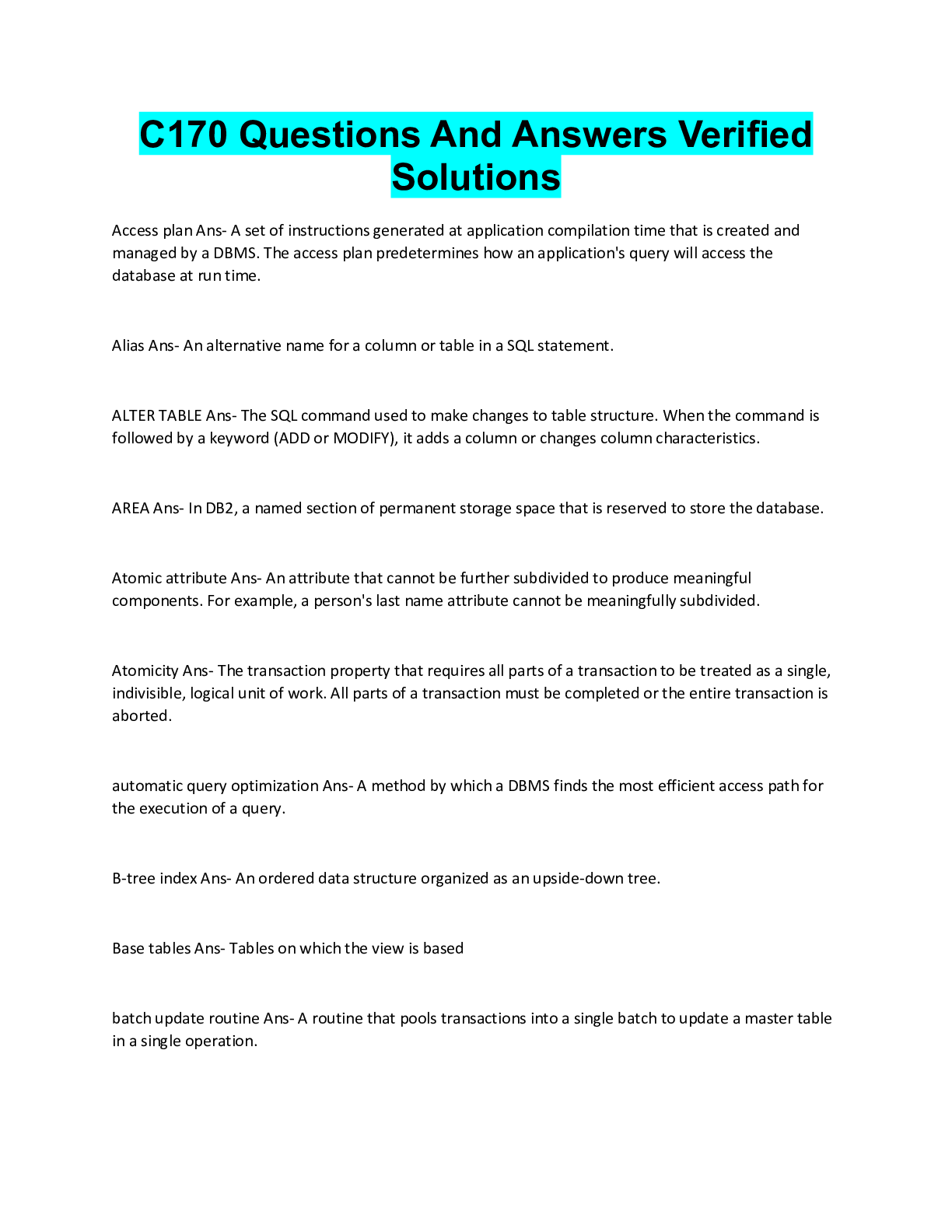
Access plan Ans- A set of instructions generated at application compilation time that is created and
managed by a DBMS. The access plan predetermines how an application's query will access the
database at run time.
Alias Ans- An alternative name for a column or table in a SQL statement.
ALTER TABLE Ans- The SQL command used to make changes to table structure. When the command is
followed by a keyword (ADD or MODIFY), it adds a column or changes column characteristics.
AREA Ans- In DB2, a named section of permanent storage space that is reserved to store the database.
Atomic attribute Ans- An attribute that cannot be further subdivided to produce meaningful
components. For example, a person's last name attribute cannot be meaningfully subdivided.
Atomicity Ans- The transaction property that requires all parts of a transaction to be treated as a single,
indivisible, logical unit of work. All parts of a transaction must be completed or the entire transaction is
aborted.
automatic query optimization Ans- A method by which a DBMS finds the most efficient access path for
the execution of a query.
B-tree index Ans- An ordered data structure organized as an upside-down tree.
Base tables Ans- Tables on which the view is based
batch update routine Ans- A routine that pools transactions into a single batch to update a master table
in a single operation.
BETWEEN Ans- In SQL, a special comparison operator used to check whether a value is within a range of
specified values.
binary relationship Ans- An ER term for an association (relationship) between two entities. For example,
PROFESSOR teaches CLASS.
Bitmap index Ans- An index that uses a bit array (0s and 1s) to represent the existence of a value or
condition.
Boolean Algebra Ans- A branch of mathematics that uses the logical operators OR, AND, and NOT.
Boyce-Codd Normal Form (BCNF) Ans- A special type of third normal form (3NF) in which every
determinant is a candidate key. A table in BCNF must be in 3NF. See also determinant.
Candidate Key Ans- A minimal superkey; that is, a key that does not contain a subset of attributes that is
itself a superkey.
Cardinality Ans- A property that assigns a specific value to connectivity and expresses the range of
allowed entity occurrences associated with a single occurrence of the related entity.
Cascading order sequence Ans- A nested ordering sequence for a set of rows, such as a list in which all
last names are alphabetically ordered and, within the last names, all first names are ordered.
Closure Ans- A property of relational operators that permits the use of relational algebra operators on
existing tables (relations) to produce new relations.
Composite Attribute Ans- An attribute that can be further subdivided to yield additional attributes. For
example, a phone number such as 615-898-2368 may be divided into an area code (615), an exchange
number (898), and a four-digit code (2368). Compare to simple attribute.
Composite Entity Ans- An entity designed to transform an M:N relationship into two 1:M relationships.
The composite entity's primary key comprises at least the primary keys of the entities that it connects.
Also known as a bridge entity. See also linking table.
Composite Identifier Ans- In ER modeling, a key composed of more than one attribute.
Composite Key Ans- A multiple-attribute key.
Correlated Subquery Ans- A subquery that executes once for each row in the outer query.
COUNT Ans- A SQL aggregate function that outputs the number of rows containing not null values for a
given column or expression, sometimes used in conjunction with the DISTINCT clause.
CREATE INDEX Ans- A SQL command that creates indexes on the basis of a selected attribute or
attributes.
CREATE TABLE Ans- A SQL command that creates a table's structures using the characteristics and
attributes given.
CREATE VIEW Ans- A SQL command that creates a logical, "virtual" table based on stored end-user
tables. The view can be treated as a real table.
Cross Join Ans- A join that performs a relational product (or Cartesian product) of two tables.
Data Cache Ans- A shared, reserved memory area that stores the most recently accessed data blocks in
RAM. Also called buffer cache.
Data Sparsity Ans- A column distribution of values or the number of different values a column can have.
database performance tuning Ans- A set of activities and procedures designed to reduce the response
time of a database system—that is, to ensure that an end-user query is processed by the DBMS in the
minimum amount of time.
database statistics Ans- In query optimization, measurements about database objects, such as the
number of rows in a table, number of disk blocks used, maximum and average row length, number of
columns in each row, and number of distinct values in each column. Such statistics provide a snapshot of
database characteristics.
DBMS performance tuning Ans- Activities to ensure that clients' requests are addressed as quickly as
possible while making optimum use of existing resources.
DELETE Ans- A SQL command that allows data rows to be deleted from a table.
Denormalization Ans- A process by which a table is changed from a higher-level normal form to a lower�level normal form, usually to increase processing speed. Denormalization potentially yields data
anomalies.
dependency diagram Ans- A representation of all data dependencies (primary key, partial, or transitive)
within a table.
dependent Ans- An attribute whose value is determined by another attribute.
derived attribute Ans- An attribute that does not physically exist within the entity and is derived via an
algorithm. For example, the Age attribute might be derived by subtracting the birth date from the
current date.
Determinant Ans- Any attribute in a specific row whose value directly determines other values in that
row.
Determination Ans- The role of a key. In the context of a database table, the statement "A determines
B" indicates that knowing the value of attribute A means that the value of attribute B can be looked up.
DIFFERENCE Ans- A SQL clause that produces only a list of values that are different from one another.
Domain Ans- In data modeling, the construct used to organize and describe an attribute's set of possible
values.
DROP INDEX Ans- A SQL command used to delete database objects such as tables, views, indexes, and
users.
DROP TABLE Ans- A SQL command used to delete database objects such as tables, views, indexes, and
users.
dynamic query optimization Ans- The process of determining the SQL access strategy at run time, using
the most up-to-date information about the database.
dynamic statistical generation mode Ans- In a DBMS, the capability to automatically evaluate and
update the database access statistics after each data access operation.
Entity Integrity Ans- The property of a relational table that guarantees each entity has a unique value in
a primary key and that the key has no null values.
Equijoin Ans- A join operator that links tables based on an equality condition that compares specified
columns of the tables.
existence-dependent Ans- A property of an entity whose existence depends on one or more other
entities. In such an environment, the existence-independent table must be created and loaded first
because the existence-dependent key cannot reference a table that does not yet exist.
existence-independent Ans- A property of an entity that can exist apart from one or more related
entities. Such a table must be created first when referencing an existence-dependent table.
EXISTS Ans- In SQL, a comparison operator that checks whether a subquery returns any rows.
Extents Ans- In a DBMS environment, refers to the ability of data files to expand in size automatically
using predefined increments.
1NF Ans- The first stage in the normalization process. It describes a relation depicted in tabular format,
with no repeating groups and a primary key identified. All nonkey attributes in the relation are
dependent on the primary key.
Flags Ans- Special codes implemented by designers to trigger a required response, alert end users to
specified conditions, or encode values. Flags may be used to prevent nulls by bringing attention to the
absence of a value in a table.
foreign key (FK) Ans- An attribute or attributes in one table whose values must match the primary key in
another table or whose values must be null. See ke
[Show More]




.png)

.png)