ENERGY
Simulation Activity #4: Energy Skate Park
Simulation created by the Physics Education Technology Project (PhET)
c/o The University of Colorado at Boulder http://phet.colorado.edu/
Investigating Energy Exchange
...
ENERGY
Simulation Activity #4: Energy Skate Park
Simulation created by the Physics Education Technology Project (PhET)
c/o The University of Colorado at Boulder http://phet.colorado.edu/
Investigating Energy Exchanges: Kinetic Energy and Gravitational
Potential Energy
Objective:
This activity is intended to enhance your physics education. We offer it as a virtual lab online.
We think it will help you make connections between predictions and conclusions, concepts and
actions, equations and practical activities. We also think that if you give this activity a chance, itwill be fun! This is an opportunity to learn a great deal. Answer all questions as you follow the
procedure in running the simulation.
Learn about conservation of energy with a skater dude! Build tracks, ramps and jumps for the
skater and view the kinetic energy, potential energy and friction as he moves. You can also take
the skater to different planets or even space!
Take some time and play with the skater and his track. It helps you to practice with the
following features and controls.
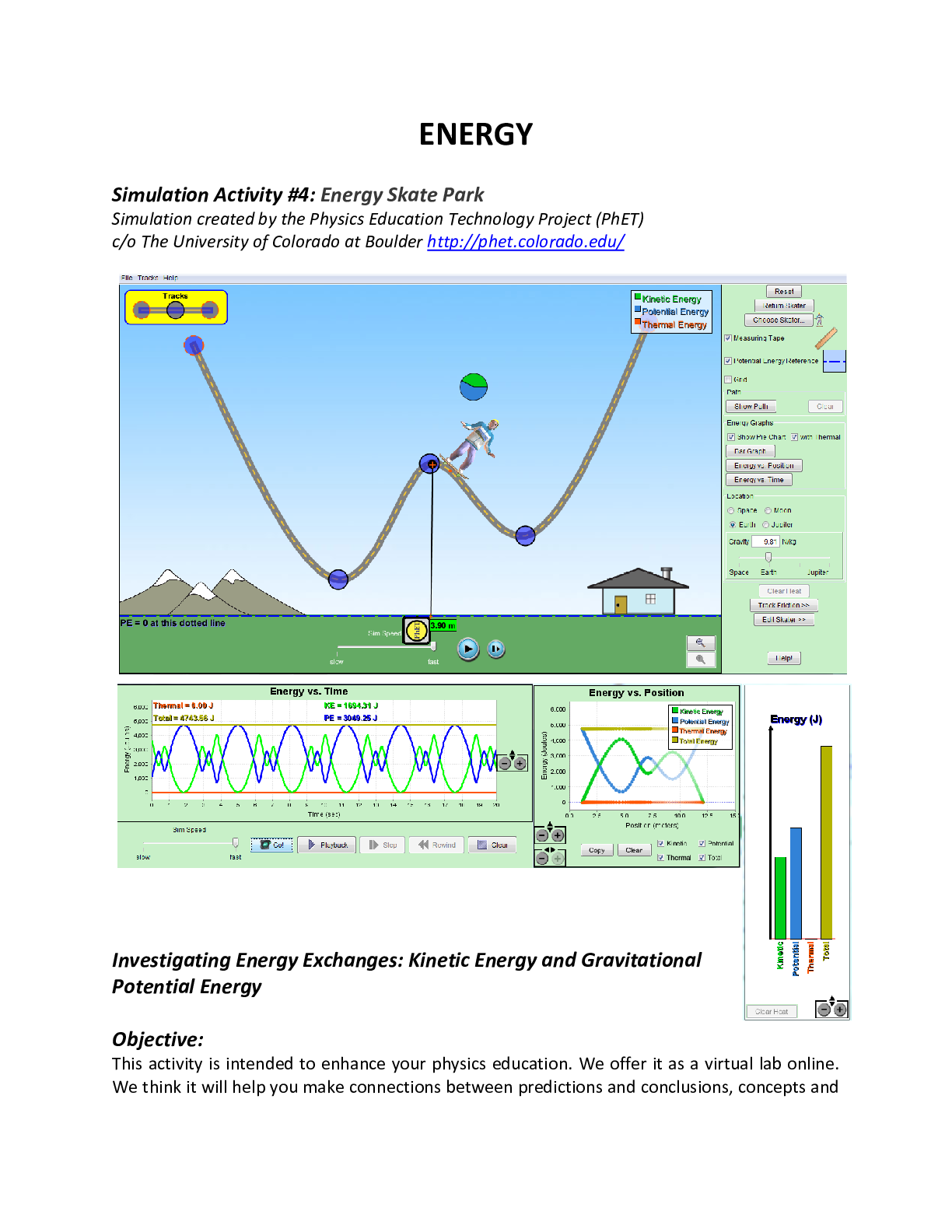
Track selector: click on Tracks and select from the drop down menu. For example, the “Double
well (Roller Coaster)” shown above.
Reset: This rests the simulation to default values and sets the track to friction parabola track.
Skater selector: clicking on Choose skater… will allows you to choose a skateboarder with a
different mass.
Measuring Tape: Check the Measuring Tape Box when you want to make measurements. Drag
the left end of the tape measure to where you start your measurement, and then drag the right
end to the final location. To make a reference horizontal line to your measurement, check the
potential energy reference box and drag the blue line you see on the screen to the initial
position.
Graph Selector: If you would like to observe graphs that depicts the relationships among
potential, kinetic, and thermal energy of the simulation, click buttons under the Energy Graphs.
The types of graphs are shown above. You can also add pie graph by checking the show pie
chart box. These graphs can be shown with or without the Thermal energy.
Gravity: you may change the gravitational force by changing the location or the sliding bar
underneath Gravity box.
Additional Features: Clicking the Clear Heat makes the track frictionless. You can also edit the
track friction and the skater mass using Track friction and Edit Skater buttons. You can also
control the speed of the skater using the slide bar under the screen.
Introduction:
The law of conservation of energy states that the total amount of energy in an isolated system
remains constant. As a consequence of this law, we can say that energy neither created nor
destroyed, but can change its form.
The total energy E of a system (the sum of its mechanical energy and its internal energies,
including thermal energy) can change only by amounts of energy that are transferred to or from
the system. If work W is done on the system, then
W = E = Emech + Eth + Eint
If the system is isolated (W = 0), this gives
Emech + Eth + Eint = 0
The skate park is an excellent example of the conservation of energy. For the isolated skatetrack-Earth system, the law of conservation of energy equation has the form
Emech + Eth = 0Mechanical Energy: The mechanical energy Emech of a system is the sum of its kinetic energy K
and its potential energy U: Emech = K + U
The conservation of mechanical energy can be written as
Emech = K + U = 0. It can also rewritten as K1 + U1 = K2 + U2
In which the subscript refer to different instants during an energy transfer process.
Gravitational Potential Energy: The potential energy associated with a system consisting of
Earth and a nearby particle is gravitational potential energy. If the particle moves from y1 to
height y2 , the change in gravitational potential energy of the particle-Earth system is
U = mg(y2 – y1)=mgy
Kinetic Energy: The kinetic energy is associated with the state of motion of an object. If an
object changes its speed from v1 to v2 , the change in kinetic energy is
K = K2 – K1 = ½ mv22 - ½ mv12
Procedure: Open Energy Skate Park
http://phet.colorado.edu/simulations/sims.php?sim=Energy_Skate_Park
[Show More]
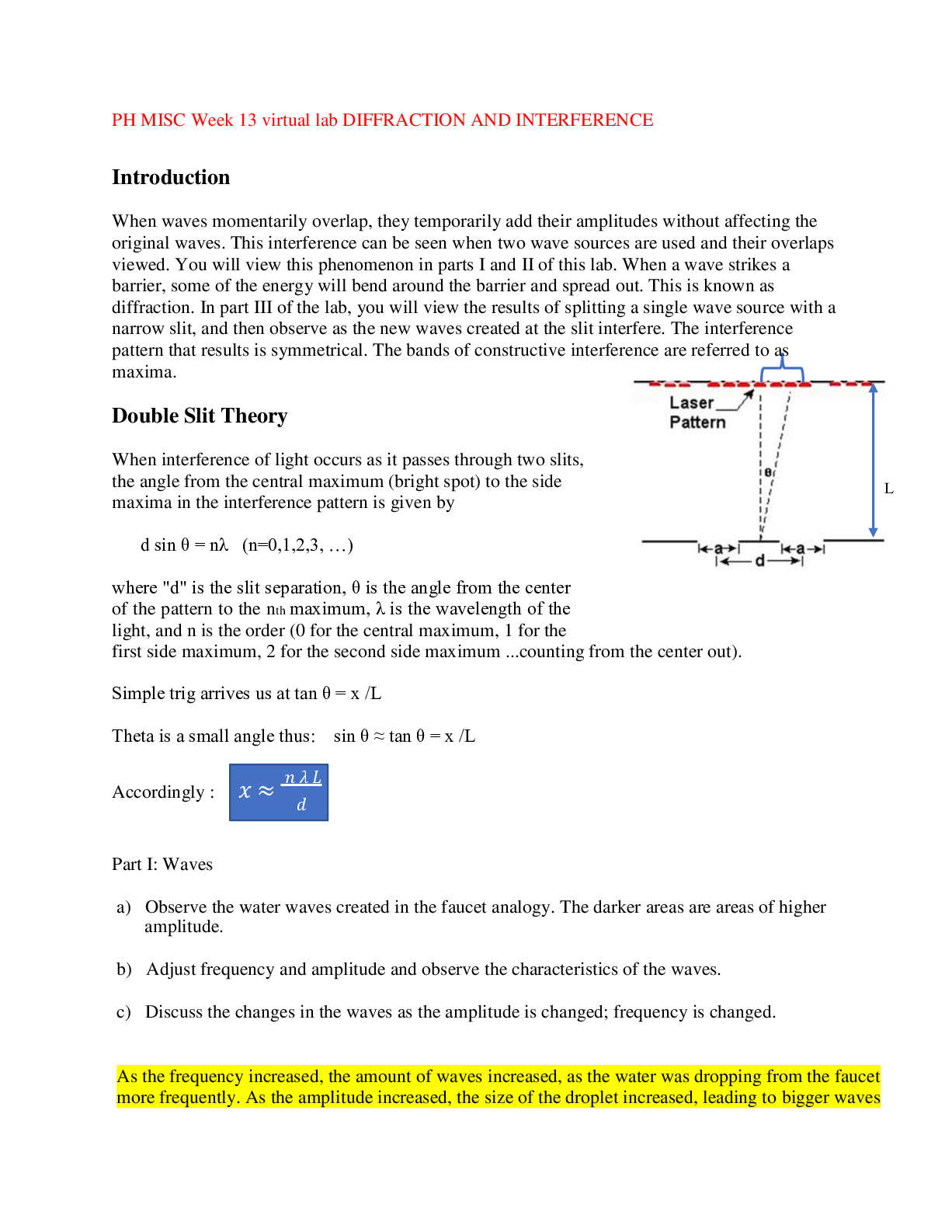




 (1).png)




.png)


.png)


