1. Question :
The nurse is performing a physical assessment on a newly admitted
patient. An example of objective information obtained during the
physical assessment includes the
Student Answer: patient’s history of a
...
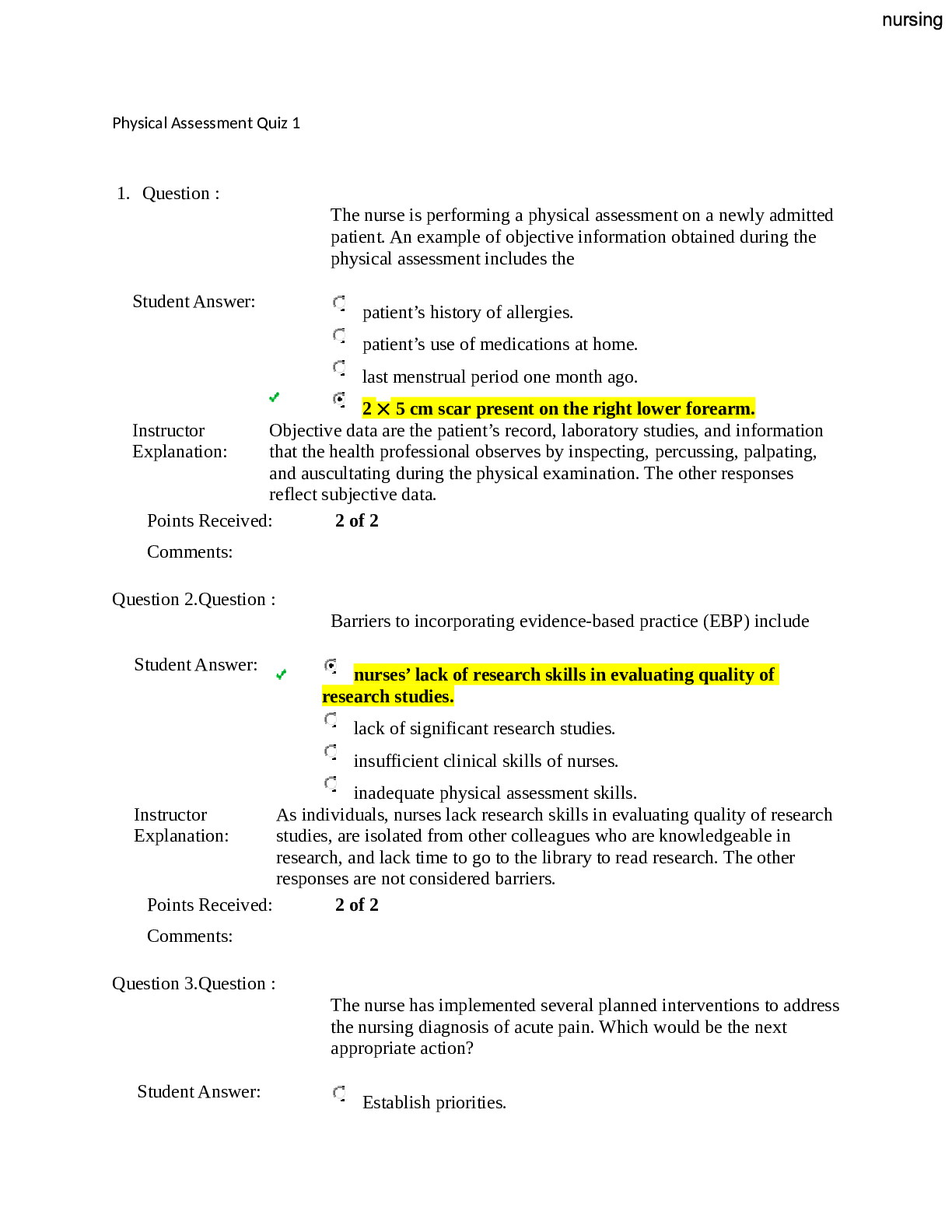
1. Question :
The nurse is performing a physical assessment on a newly admitted
patient. An example of objective information obtained during the
physical assessment includes the
Student Answer: patient’s history of allergies.
patient’s use of medications at home.
last menstrual period one month ago.
2 5 cm scar present on the right lower forearm.
Instructor
Explanation:
Objective data are the patient’s record, laboratory studies, and information
that the health professional observes by inspecting, percussing, palpating,
and auscultating during the physical examination. The other responses
reflect subjective data.
Points Received: 2 of 2
Comments:
Question 2.Question :
Barriers to incorporating evidence-based practice (EBP) include
Student Answer: nurses’ lack of research skills in evaluating quality of
research studies.
lack of significant research studies.
insufficient clinical skills of nurses.
inadequate physical assessment skills.
Instructor
Explanation:
As individuals, nurses lack research skills in evaluating quality of research
studies, are isolated from other colleagues who are knowledgeable in
research, and lack time to go to the library to read research. The other
responses are not considered barriers.
Points Received: 2 of 2
Comments:
Question 3.Question :
The nurse has implemented several planned interventions to address
the nursing diagnosis of acute pain. Which would be the next
appropriate action?
Student Answer: Establish priorities.
Identify expected outcomes.
Evaluate the individual’s condition and compare actual
outcomes with expected outcomes.
Interpret data and then identify clusters of cues and make
inferences.
Instructor
Explanation:
Evaluation is the next step after the implementation phase of the nursing
process. During this step, the nurse should evaluate the individual’s
condition and compare actual outcomes with expected outcomes.
Points Received: 2 of 2
Comments:
Question 4.Question :
Which of these would be formulated by a nurse using diagnostic
reasoning?
Student Answer: Nursing diagnosis
Medical diagnosis
Diagnostic hypothesis
Diagnostic assessment
Instructor
Explanation:
Diagnostic reasoning calls for the nurse to formulate a diagnostic
hypothesis; the nursing process calls for a nursing diagnosis.
Points Received: 2 of 2
Comments:
Question 5.Question :
The nurse asks, “I would like to ask you some questions about your
health and your usual daily activities so that we can better plan your
stay here.” This question is found at the _____ phase of the
interview process.
Student Answer:
summary
closing
body
opening or introduction
Instructor
Explanation:
When gathering a complete history, the nurse should give the reason for the
interview during the opening or introduction of the interview, not during or at
the end of the interview.
Points Received: 2 of 2
Comments:
Question 6.Question :
A female nurse is interviewing a male patient who is near the same
age as the nurse. During the interview, the patient makes an overtly
sexual comment. The nurse’s best reaction would be
Student Answer: “Stop that immediately!”
“Oh, you are too funny. Let’s keep going with the interview.”
“Do you really think I would be interested?”
“It makes me uncomfortable when you talk that way. Please
stop.”
Instructor
Explanation:
The nurse’s response must make it clear that she is a health professional
who can best care for the person by maintaining a professional relationship.
At the same time, the nurse should communicate that he or she accepts the
person and understands the person’s need to be self-assertive but that sexual
advances cannot be tolerated.
Points Received: 2 of 2
Comments:
Question 7.Question :
The nurse makes this comment to a patient: “I know it may be hard,
but you should do what the doctor ordered because she is the expert
in this field.” Which statement is correct about the nurse’s
comment?
Student Answer: This comment is inappropriate because it shows the nurse’s
bias.
This comment is appropriate because members of the
healthcare team are experts in the area of patient care.
This type of comment promotes dependency and inferiority
on the part of the patient and is best avoided in an interview
situation.
At times, it is necessary to use authority statements when
dealing with patients, especially when they are undecided about an
issue.
Instructor
Explanation:
Using authority responses promotes dependency and inferiority. It is best
to avoid using authority. Although the healthcare provider and patient do
not have equal professional knowledge, both have equally worthy roles
in the health process. The other statements are not correct.
Points Received: 2 of 2
Comments:
Question 8.Question :
A patient has finished giving the nurse information about the reason
he is seeking care. When reviewing the data, the nurse finds that
some information about past hospitalizations is missing. At this
point, which statement by the nurse would be most appropriate to
gather these data?
Student Answer: “Mr. Y., at your age, surely you have been hospitalized before!”
“Mr. Y., I just need permission to get your medical records from
County Medical.”
“Mr. Y., you mentioned that you have been hospitalized on
several occasions. Would you tell me more about that?”
“Mr. Y., I just need to get some additional information
about your past hospitalizations. When was the last time you
were admitted for chest pain?”
Instructor
Explanation:
The nurse should use direct questions after the person’s opening
narrative to fill in any details he or she left out. The nurse also should
use direct questions when specific facts are needed, such as when
asking about past health problems or during the review of systems.
Points Received: 2 of 2
Comments:
Question 9.Question :
The nurse is incorporating a person’s spiritual values into the health
history. Which of these questions illustrates the “community”
portion of the FICA questions?
Student Answer: “Do you believe in God?”
“Are you a part of any religious or spiritual congregation?”
“Do you consider yourself to be a religious or spiritual
person?”
“How does your religious faith influence the way you think
about your health?”
[Show More]