Uconn Comm 1000 Exam 1
Why study Comm? - ✔✔Keeps us alive, impacts everything, it is a skill, employers value it
What is Human Communication - ✔✔-the process of managing messages for the purpose of
creating shared mea
...
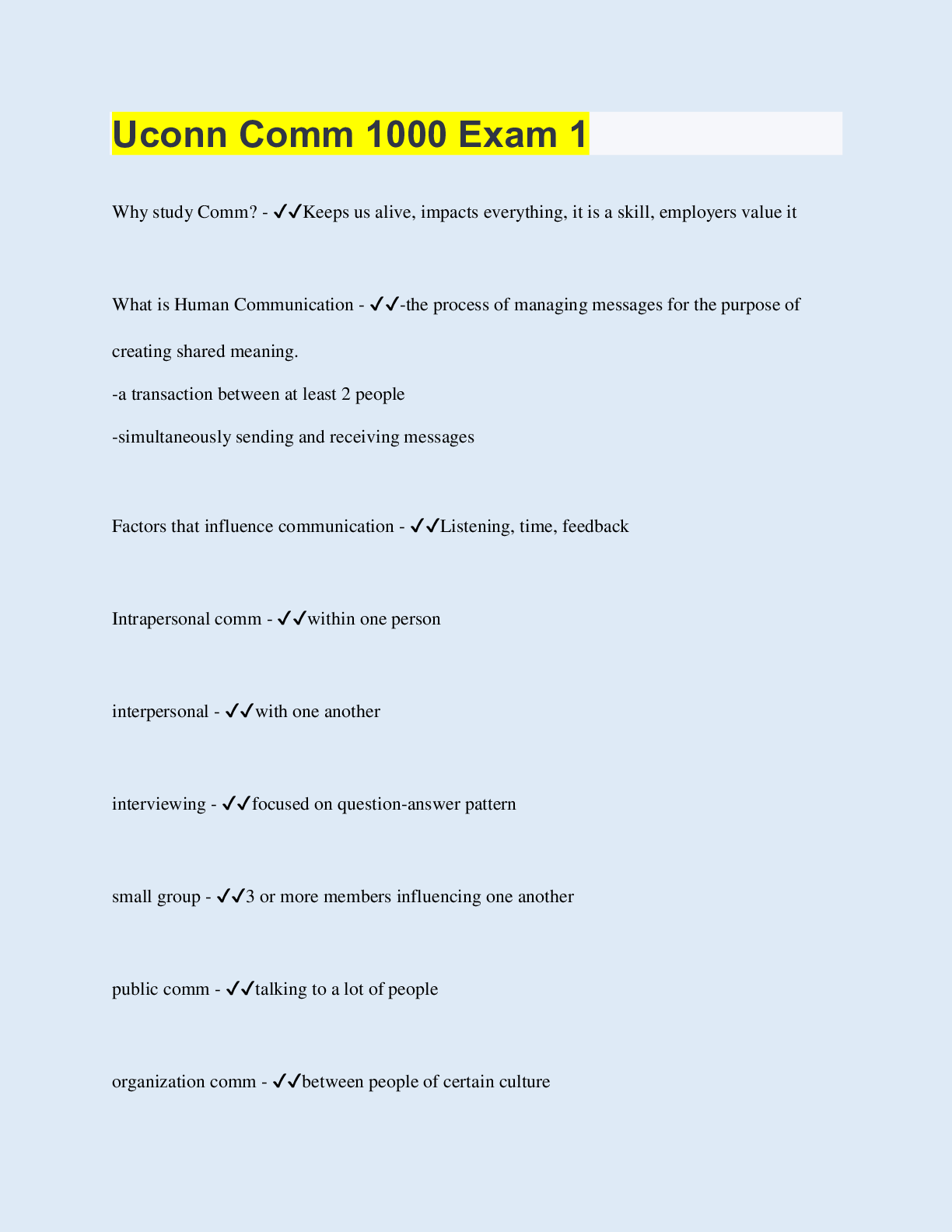
Uconn Comm 1000 Exam 1
Why study Comm? - ✔✔Keeps us alive, impacts everything, it is a skill, employers value it
What is Human Communication - ✔✔-the process of managing messages for the purpose of
creating shared meaning.
-a transaction between at least 2 people
-simultaneously sending and receiving messages
Factors that influence communication - ✔✔Listening, time, feedback
Intrapersonal comm - ✔✔within one person
interpersonal - ✔✔with one another
interviewing - ✔✔focused on question-answer pattern
small group - ✔✔3 or more members influencing one another
public comm - ✔✔talking to a lot of people
organization comm - ✔✔between people of certain culture
Elements of effective comm - ✔✔understanding, pleasure, attitude influence, improved
relationships, action
Humanistic approaches - ✔✔rhetoric, interpretivists, critical scholars
Rhetoric - ✔✔basis for public speaking
interpretivists - ✔✔make sense of the world based on events
Critical scientific approaches - ✔✔Qualitative, quantitative
Qualitative - ✔✔rigorous observational rules , work in the field
Quantitative - ✔✔seeks to uncover patterns in comm behavior via numbers, in the field or lab
The scientific method - ✔✔ask questions or state problem
formulate hypothesis or research question
think through, refine hypothesis
Perception - ✔✔interpreting the sensory experience of the world
Process of Perception - ✔✔1. select
2.organize
3.interpret
Perceptual filters - ✔✔Physical/physiological limits (glasses)
Pyschological sets - ✔✔expectations that shape experiences (gender, age)
Attribution - ✔✔the process of assigning meaning to others' behavior
Dispositional other - ✔✔Overuse of personality reasons (dispositions) with others
"joe failed the exam because he was lazy"
Self-serving bias - ✔✔Overuse of situational attributions with self
"I failed the exam because the exam was ridiculous and unfair
Impressions of self - ✔✔self concept
-(looking-glass)
-self expansion model
-social comparison
self-esteem
-feedback
selffulfilling prophecy
-can or can not do something
Impressions of Others - ✔✔First impressions
-primary effect
Physical attractiveness
expressiveness
charisma
Stereotyping - ✔✔a generalization about a class of people, objects, or events that is widely held
by a given culture
Social Roles - ✔✔work, student, gender-limited, marital
Verbal Communication - ✔✔a system of symbols and codes used to construct and covey
meaning
symbol - ✔✔the word itself, the word means nothing, but culturally we have created a meaning
for the word
referent - ✔✔the thing that the word stands for
Denotive meaning - ✔✔dictionary definition of the word
connotative meaning - ✔✔individuals interpretation of a word
private & shared meaning - ✔✔Inside joke
Sapir-Whord hypothesis - ✔✔language shapes how we see the world
Strong determinism - ✔✔language outright determines our thoughts
weak determinism - ✔✔the way we view the world shapes our thoughts but do not outright
determine our thoughts
Abstract/ Vague language - ✔✔does not give a definitive answer, causes confusion
inferences - ✔✔drawing conclusions from information we have in front of us
dichotomes - ✔✔assuming; thinking in terms of two -contrast
equivocal lang - ✔✔words have two or more meanings
euphemisms - ✔✔changing language to make it easier to understand/handle
metacommunication - ✔✔communication about communication
Listening - ✔✔a process of receiving, construction meaning from & responding to spoken and or
nonverbal messages
Listening vs. Hearing - ✔✔hearing= a physiological(1 step of listening)
listening= processing what it is that we are listening
6 components of listening - ✔✔1. hearing
2.understanding
3.remembering
4.interpreting
5.evaluating
6.responding
Barriers to listening - ✔✔-physical/physiological: literal noise from what could be an outside
force
-psychological: pain, fatigue, emotional trial
-conflicting objectives: professor "we'll discuss this topic but it wont be on the exam"
-poor listening habits: you just suck at listening
How to improve - ✔✔1. listen carefully
2. pay attention(consistently)
3. take notes on most important ideas (physically or mentally)
4.Take the time to process messages
5. Aerobic Listening:
C onverse
A acknowledge
R espect
E emphasize
Nonverbal comm - ✔✔use of objects, action, sound, time and space to convey meaning
Vocal - ✔✔groans + sighs
Nonvocal - ✔✔facial expressions, movement
Nonverbal - ✔✔complements, regulations, substitutes for, contradicts, illustrates verbal
Paralanguage - ✔✔where we put emphasis on words "how you say it"
Objectics - ✔✔personal appearance, artifacts we posess
proxemics - ✔✔the use of space to convey meaning
orientation - ✔✔where you are situated
competitive orientation
or cooperative orientation
ex: where you are sitting at a table
Haptics - ✔✔study of touch, touch comm
-tough indicates dominance
Kinesics - ✔✔facial expressions and gestures - cultural differences
body movements and gesture- emblems, illustrators, regulators, adaptors, affect displays
Oculesics - ✔✔eye contact- where we look
shows attraction
women tend to use eye contact more
chronemics - ✔✔time
monochonic - ✔✔one thing at a time
ex. class
polychronic - ✔✔more things at once
ex. focused on people more than things we are doing
Emotion - ✔✔helps control/ understand non-verbal
-minute signals of affect, attention, approach, dominance
sign - ✔✔ex: growling to show anger
Spontaneous comm - ✔✔nonvoluntary, involves signs not symbols
based on biologically-shared signal system
Symbolic Comm - ✔✔socially-shared system
voluntary
involves symbols
includes nonverbal behaviors
3 types of emotions - ✔✔1. Bodily Adaptation & maintenance of Homeostasis
2. external expression of motivational/ emotional stats
3. the subjective expression of motivational emotional stats
Bodily Adaptations - ✔✔includes fight or flight responses & need for food and water and
oxygen
external expression - ✔✔useful for social coordination, sexual reproduction, dominance and
submission
subjective expression - ✔✔useful for self-regulation, reflection, learning. Monitoring system for
humans
6 basic emotions - ✔✔happy, sad, fear, anger, surprise, disgust
Sending accuracy - ✔✔sending emotions making the reaction
-some people make faces better than others
receiving ability - ✔✔making sense of the reaction
what we can improve on and usually better with those we are close with
pseudospontaneous communication - ✔✔posing/faking of a facial expression for a reason
deception - ✔✔repress emotions or events
coping- involves making sense of what we feel
emotional education - ✔✔as we age we get better at this
role models and media help us with this
developmental interactionist theory - ✔✔as we age we use more reasoning than emotion
[Show More]






.png)