Peds Master Test
Peds Question & Answers
Question Answer
Fine, downy hair found on all
body parts of the fetus, with the
exception of the palms of the
hands and the soles of the feet,
after 20 weeks' gestation.
l
...
Peds Master Test
Peds Question & Answers
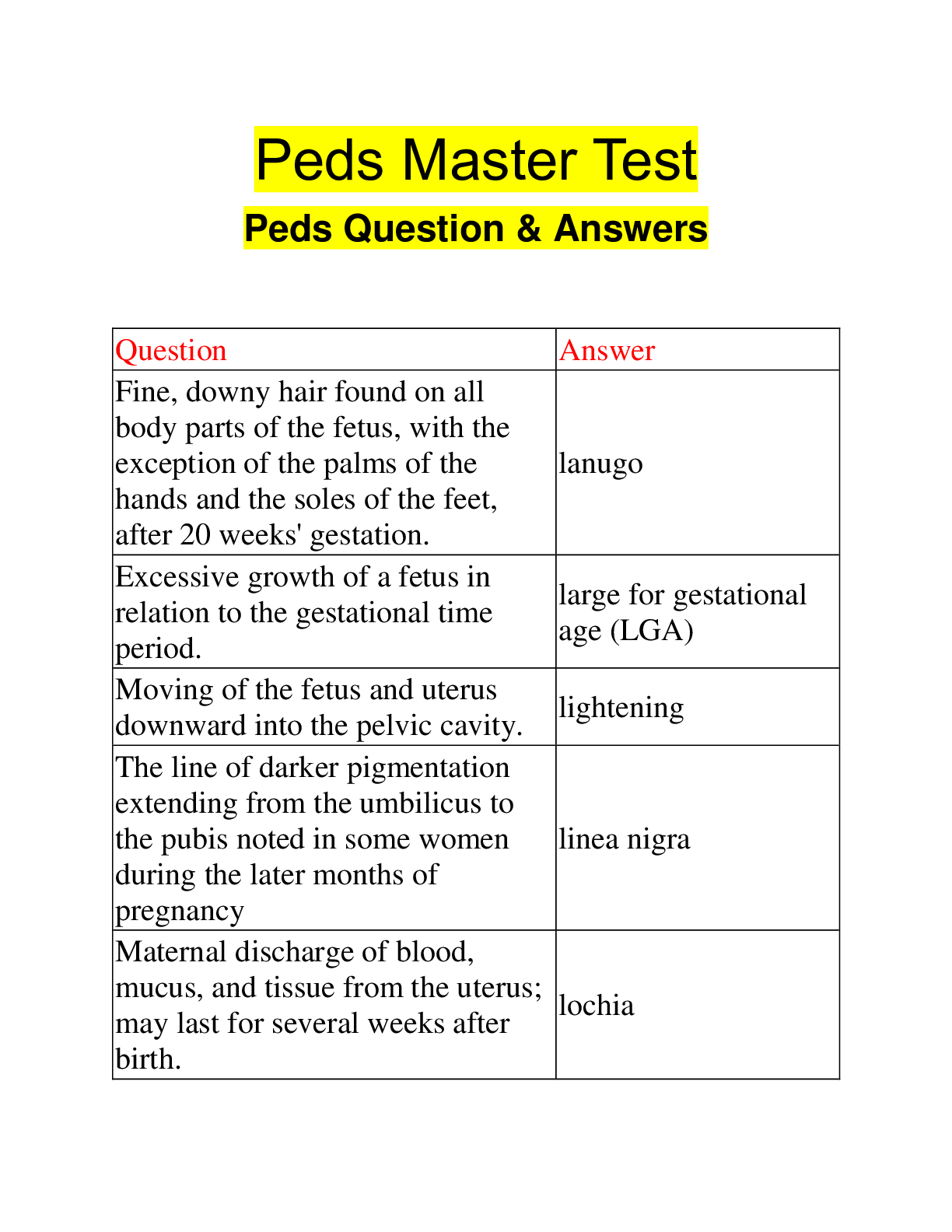
Question Answer
Fine, downy hair found on all
body parts of the fetus, with the
exception of the palms of the
hands and the soles of the feet,
after 20 weeks' gestation.
lanugo
Excessive growth of a fetus in
relation to the gestational time
period.
large for gestational
age (LGA)
Moving of the fetus and uterus
downward into the pelvic cavity. lightening
The line of darker pigmentation
extending from the umbilicus to
the pubis noted in some women
during the later months of
pregnancy
linea nigra
Maternal discharge of blood,
mucus, and tissue from the uterus;
may last for several weeks after
birth.
lochia
Pink, serous, and blood-tinged
vaginal discharge that follows
lochia rubra and lasts until the
seventh to tenth day after birth.
lochia serosa
A condition seen in neonates of
large body size and high birth
weight, as those born of
prediabetic and diabetic mothers.
macrosomia
Inflammation of the breast mastitis
Dark green or black material
present in the large intestine of a
full-term infant; the first stools
passed by the newborn.
meconium
Tiny white papules appearing on
the face of a neonate as a result of
unopened sebaceous glands; they
disappear spontaneously within a
few weeks.
milia
Discoloration of the skin in
irregular areas; may be seen with
chilling, poor perfusion, or
hypoxia.
mottling
A woman who has never been
pregnant. nulligravida
Active and compassionate
therapies intended to comfort and palliative care
support those with short life
expectancies
Pinpoint red lesions. petechiae
Yellow pigmentation of body
tissues caused by the presence of
bile pigments.
physiologic jaundice
Born after the completion of the
42 st week of gestation. Postterm
After childbirth or delivery postpartum
Any infant born before 37 week of
gestation. Preterm
Blood-tinged mucus from the
vagina in the newborn female
infant; caused by withdrawal of
maternal hormones that were
present during pregnancy.
pseudomenstruation
Inadequate weight or growth for
gestational age; birth weight below
the tenth percentile.
small for gestational
age (SGA)
A surface-active mixture of
lipoproteins secreted in the alveoli
and air passages that reduces
surface tension of pulmonary
fluids and contributes to the
elasticity of pulmonary tissue.
surfactant
Normal newborn reflex elicited by
inserting a finger or nipple in the
newborn's mouth, resulting in
forceful, rhythmic sucking.
sucking reflex
Fibrous connections of opposed
joint surfaces, as in the skull sutures
The normal duration of pregnancy term
Postural reflex seen in the
newborn. When the supine infant's
head is turned to one side, the arm
and leg on that side extend while
the extremities on the opposite
side flex. Also called the fencing
position
tonic neck reflex
The structure connecting the
placenta to the umbilicus of the
fetus and through which nutrients
from the woman are exchanged for
wastes from the fetus
umbilical cord
A protective cheeselike whitish
substance made up of sebum and
desquamated epithelial cells that is
present on the fetal skin.
vernix caseosa
Yellow-white gelatinous material
surrounding the vessels of the
umbilical cord.
Wharton's jelly
the nasal rim of the eyelids; the
angle at either end inner canthus
The temporal rim of the eyelids;
the angle at either end of the slit
between the eyelids
outer canthus
The inflammation of the eyes in
the newborn
ophthalmia
neonatorum
Partial or total premature
separation of a normally implanted
placenta.
abruptio placentae
Difficult labor due to mechanical
factors produced by the fetus or
the maternal pelvis, or due to
inadequate uterine or other
muscular activity.
dystocia
A major complication of
pregnancy. Its cause is unknown;
it occurs more often in the
primigravida and is accompanied
by elevated blood pressure,
albuminuria, oliguria, tonic and
clonic convulsions, and coma
eclampsia
It may occur during pregnancy
(usually after the 20th week of
gestation) or within 48 hours after
childbirth.
eclampsia
Implantation of the fertilized ovum
outside the uterine cavity;
common sites are the abdomen,
fallopian tubes, and ovaries. Also
called oocyesis.
ectopic pregnancy
Hemolytic disease of the newborn
characterized by anemia, jaundice,
enlargement of the liver and
spleen, and generalized edema.
Caused by isoimmunization due to
Rh incompatibility or ABO
incompatibility.
erythroblastosis
fetalis
Degenerative process in chorionic
villi, giving rise to multiple cysts
and rapid growth of the uterus
with hemorrhage.
hydatidiform mole
An excess of amniotic fluid,
leading to overdistention of the
uterus. Frequently seen in diabetic
pregnant women, even if there is
no coexisting fetal anomaly. Also
called polyhydramnios.
hydramnios
Excessive vomiting during
pregnancy, leading to dehydration
and starvation.
hyperemesis
gravidarum
Abnormal implantation of the
placenta in the lower uterine placenta previa
segment. Classification of type is
based on proximity to the cervical
os: total-completely covers the os;
partial-covers a portion of the os;
marginal-is in close proximity to
the os.
abnormal deep attachment of the
placenta to the uterine wall
(decidua) such that the chorionic
villi invade abnormally into the
myometrium
placenta accreta
The presence of excessive
amniotic fluid surrounding the
unborn infant.
polyhydramnios
Bleeding into the subcutaneous
tissue in the perineal area caused
by episiotomy, labor and delivery
is called?
postpartum hematoma
Any blood loss from the uterus
between 500 and 1,000 milliliters
within 24 hours after delivery is
called?
postpartum
hemorrhage
Toxemia of pregnancy,
characterized by hypertension,
albuminuria, and edema.
preeclampsia
Simply means that the cervix is
unable to support a pregnancy
premature cervical
dilation
This occurs when the women
expells all during delivery such as
placenta and fetus.
products of
conception
Umbilical cord that becomes
trapped in the vagina before the
fetus is born.
prolapsed cord
A maternal temperature of 38C
(100.4F) or higher on any 2 of the
first 10 postpartal days, excluding
the first 24 hours. The temperature
is to be taken by mouth at least 4
times per day.
puerperal
Relationship of the presenting fetal
part to an imaginary line drawn
between the pelvic ischial spines
station
EFM (electronic fetal monitoring)
test of the well-being of the fetus
during contractions deliberately
stimulated with oxytocin.
stress test
Inflammation of a vein wall
resulting in thrombus thrombophlebitis
reflex that occurs when a finger or
small object is placed in the
newborn’s hand
palmar grasp reflex
urethral opening on the ventral
(lower) surface of the penis hypospadius
reflex that occurs when the sole of
the foot is touched plantar grasp reflex
heat lost by transfer to cooler
objects that are nearby, but not in
direct contact
radiation
heat lost when water is changed to
vapor
evaporation
heat lost by direct contact with a
cooler object conduction
heat lost by the movement of air convection
occurs when the infant is searching
for food rooting reflex
outward movement of the nostrils nasal flaring
white pinpoint spots resembling
white heads milia
reflex that occurs when newborns
have a sense of falling; startle
reflex
moro
reflex elicited by stroking the
lateral side of the foot from heel to
toe
babinski reflex
small white cysts, may be present
on the palate of neonates epstein’s pearls
obtained by holding newborns
with the feet touching the table stepping reflex
Surgical delivery or surgical
removal of the fetus cesarean section
rebounding of the fetus against
examiner’s fingers, when
examiner puts two fingers into the
vagina and pushes upward on the
uterus
ballottement
first fetal stool meconium
first fetal movements felt by the
mother quickening
ability to live outside the uterus, is
24 weeks viability
Excessive fullness - usually
referring to the breasts. engorgement
The sensation the mother feels
when the baby "drops" down or
gradually settles into the pelvis.
lightening
The process of starting labor by
artificial means. Induction
Instruments used by physicians
when assistance is needed to move
the baby through the birth canal.
Forceps:
Forceps are designed to fit the
baby’s head and the mother’s
pelvis
Forceps:
The use of artificial drugs, such as
Pitocin or Prostaglandin hormone,
to enhance or stimulate labor.
Induction
delivery of the baby other than
headfirst. Most breech deliveries
are buttocks first.
Breech birth
delivery of the baby through an
incision in the abdomen and
uterus.
cesarean delivery
Excessive amount of bilirubin in
the blood; indicative of hemolytic
processes due to blood
incompatibility, intrauterine
infection, septicemia, neonatal
renal infection, and other
disorders.
hyperbilirubinemia
The treatment of jaundice by
exposure to light phototherapy
A fungal infection of the oral
mucous membranes caused by
Candida albicans. Most often seen
in infants; characterized by white
plaques in the mouth.
thrush
a physical split or separation of the
two sides of the upper lip cleft lip
split or opening in the roof of the
mouth cleft palate
a birth defect in which part of
esophagus is not hollow esophageal atresia
An organ that is one that is turned
inside out like a rubber glove.
exstrophy
an abnormal accumulation of
cerebrospinal fluid (CSF) in the
brain. The fluid (the CSF) is often
under increased pressure which
can compress (squeeze) and
damage the brain.
hydrocephalus
This term is sometimes familiarly
called "water on the brain." hydrocephalus
A congenital failure of one or both
nasal passages to open choanal atresia
A congenital malformation (a birth
defect) in which the rectum is a
blind alley (a cul-de-sac) and there
is no anus.
imperforate anus
Narrowing (stenosis) of the outlet
of the stomach so that food cannot
pass easily from it into the
duodenum, resulting in feeding
problems and projectile vomiting.
pyloric stenosis
the foot is turned in sharply and
the person seems to be walking on
their ankle
talipes
The Latin word for clubfoot talipes
infection caused by a single-celled
parasite named toxoplasma gondii. toxoplasmosis
Very few have symptoms from
this parasite because the immune
system usually keeps the parasite
from causing illness.
toxoplasmosis
A hemolytic blood disease of
newborn that can be seen less than
24 hours after birth.
pathologic jaundice
The inability of the newborn
immature liver to handle bilirubin,
a by product of red cell breakdown
about 48 to 72 hours after birth.
physiologic jaundice
The presence of an extra finger or
toe is called? ploydactylism
the fusing together of two or more
digits that separation is possible by
surgery.
syndactylism
The new born with a complication
is considered compromissed or
what ?
high risk newborn
Part or all of the brain is missing,
the skill is flat and newborns live
for only short time.
anencephaly
refers to any state in which thyroid
hormone production is below
normal
hypothyroidism
A Latin word that means top of the
head,the top of the baby's head
comes first at delivery, is called?
vertex
(blank) version
This alrenative to forceps delivery,
a round, soft plastic cup is placed
on the fetal head and suction is
applied to ease the fetus out.
vacum extraction
The fetus lies across the uterus and
when the membrane ruptures
usually results in a shoulder
presentation.
transverse lie
Medical management including
manuual rotation of the fetus
before another type of help is
needed?
version
A nonabsorbable suture or ring
placed around the cervix is called? cerclage
Another term used to describe
postpartal or following the birth. puerperal
This term means outside. ectopic
Inflammation of the bladder is
called? cystitis
The condition when the umbilical
cord becomes wrapped around the
fetus neck.
nuchal cord
The insufficient or uncoordinated
contraction that do not produce
effective dilation is called?
uterine inertia
A follow up after delivery of
hydratiform mole is done that
should fall but if ramins high this
is known as?
choriocarcinoma
when to measure head
circumference?
every visit to 2years
old; annually to age 6
When should peek-a-boo be
achieved? 1 year old
[Show More]







.png)