FF2 IFSAC Study Guide latest updated
Document Content and Description Below
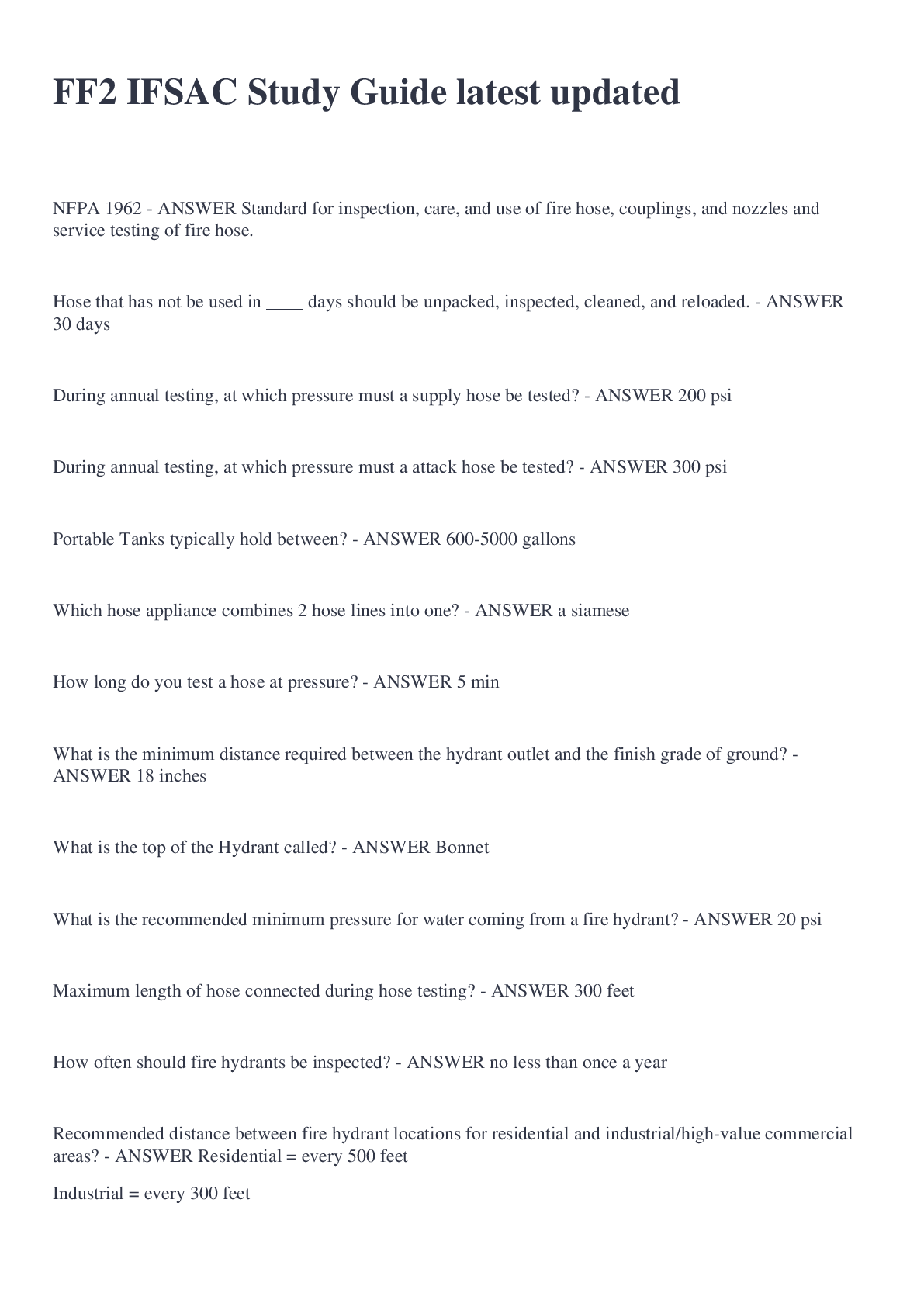
NFPA 1962 - ANSWER Standard for inspection, care, and use of fire hose, couplings, and nozzles and service testing of fire hose. Hose that has not be used in ____ days should be unpacked, inspected ... , cleaned, and reloaded. - ANSWER 30 days During annual testing, at which pressure must a supply hose be tested? - ANSWER 200 psi During annual testing, at which pressure must a attack hose be tested? - ANSWER 300 psi Portable Tanks typically hold between? - ANSWER 600-5000 gallons Which hose appliance combines 2 hose lines into one? - ANSWER a siamese How long do you test a hose at pressure? - ANSWER 5 min What is the minimum distance required between the hydrant outlet and the finish grade of ground? - ANSWER 18 inches What is the top of the Hydrant called? - ANSWER Bonnet What is the recommended minimum pressure for water coming from a fire hydrant? - ANSWER 20 psi Maximum length of hose connected during hose testing? - ANSWER 300 feet How often should fire hydrants be inspected? - ANSWER no less than once a year Recommended distance between fire hydrant locations for residential and industrial/high-value commercial areas? - ANSWER Residential = every 500 feet Industrial = every 300 feet Hose Records should include: - ANSWER Hose size, type, and manufacturer; Dates of when the hose was manufactured, purchased, and tested, Any repairs that have been made to the hose. Fire Hydrant Flows for each Color? - ANSWER Red = less than 500 gpm Orange = 500-1000 gpm Green = 1000-1500 gpm Light Blue = above 1500 gpm Steamer port - ANSWER the side outlets are usually 2 1/2 inch and the steamer port is usually a 4 or 4 1/2 inch outlet Hose sizes for SDH, MDH, and LDH - ANSWER SDH = 1-2 inch diameter MDH = 2 1/2 or 3 inch diameter LDH = 3 1/2 or larger diamter Types of Harnesses - ANSWER Class 2 = "seat harness" Class 3 = "full body harness" Carabiner (NFPA?) - ANSWER is used to connect one rope to another rope or to other hardware. NFPA 1983 3 Reasons for Venting - ANSWER Life safety, Fire Containment, and/or Property Conservation Type I building construction - ANSWER (fire resistive) buildings with structural members made of noncombustible material that have a specified fire resistance Type II construction - ANSWER (noncombustible) same structural members as Type I but without a specified fire resistance Type III construction - ANSWER (ordinary) noncombustible or limited-combustible exterior walls but with interior floors and walls made of combustible materials Type IV construction - ANSWER (heavy timber) same as ordinary Type III but with the interior walls, and floors made of large-diameter wood members Type V contstruction - ANSWER (wood frame) exterior walls, floors, interior walls, and roof structures made of wood. Class A foam - ANSWER used to fight fires involving ordinary combustible material such as wood, paper, and textiles. Also, effective on straw and hay. "reduces the surface tension of water" allowing the water to penetrate dense material. Class B foam - ANSWER used to fight class B Fires, to smother the fuel of the fire. Class A fire - ANSWER including ordinary combustible material such as wood, cloth, paper, rubber and plastics Class B fire - ANSWER flammable liquids and gasses Class C fire - ANSWER (C as circuit) energized electrical equipment Class D fire - ANSWER flammable metals such as potassium, lithium, sodium, magnesium etc. Foam concentrate - ANSWER mix with water and air to produce a solution that can serve as an effective extinguishing agent. What foam must be used on incidents involving polar solvents? - ANSWER AR Foam (Alcohol resistant) Alcohol-resistant foam - ANSWER Formulated so that alcohols and other polar solvents do not dissolve the foam. Class A Foam ratios - ANSWER 0.1 - 1% Class B Foam ratios - ANSWER 3 and 6 percent Protein foam - ANSWER made from animal by-products. They are effective on Class B hydrocarbon fires. Fluoroprotein foam (Fast spreading) - ANSWER made from the same base materials as protein foam but include additional fluorochemical surfactant additive, which allow this foam to produce a fast spreading film (FFFP) Film-forming fluoroprotein - ANSWER Composed of protein plus film-forming fluorinated surface-active agents, which make them capable of forming water solution films on the surface of most flammable hydrocarbons. (AFFF)Aqueous Film-forming foam - ANSWER A synthetic based foam that is particularly suitable for spill related fires involving gasoline and light hydrocarbon fuels. 2 types of foam proportioners - ANSWER foam eductor and foam injectors Foam eductor - ANSWER Draws foam concentrate from a container or storage tank into a moving stream of water. Foam injectors - ANSWER Add the foam concentrate to the water stream under pressure. Batch mixing - ANSWER pouring foam concentrate directing in to a apparatus tank Premixed foam - ANSWER is commonly used in 2 1/2 gallons portable fire extinguishers High-expansion foam - ANSWER used to completely fill a large space with foam Medium-expansion foam is produced with what type of nozzle? - ANSWER a special aerating nozzle Methods of foam application techniques - ANSWER sweep (roll-on), bank-down, and rain-down. Bulkhead - ANSWER Structure that decides the engine compartment from the passenger compartment Platform vs Unibody frames - ANSWER Platform uses beams to fabricate the load bearing frame of a vehicle. Unibody combines the vehicle body and frame into a single component (poured into a mold during manufacturing) Laminated vs Tempered glass - ANSWER Laminated is used in windshields of cars (3 layers) Tempered is used in side and rear windows that shatters into little pieces. NFPA 921 - ANSWER used to determine the origin and cause of a fire Mass arsons - ANSWER offender who sets 3 or more fires at same site/location during a limited time period Spree arsons - ANSWER offender who sets 3 or more fires at separate locations. (no cool off period) Demonstrative evidence - ANSWER anything that can be used to validate a theory or show how something could have occurred. Basic Signs of roof collapse - ANSWER sagging roof supports, indication that the roof assembly is separating from the walls (like appearance of fire or smoke near the roof edges), structural failure of any portion of the building, sudden increase in the intesity of the fire from the roof opening, and high heat indicators. Four standard methods of searching - ANSWER 1) Standard search 2) Oriented 3) O-VEIS (Oriented Vent Enter Isolate Search) 4) Team search What is the most effecient method to remove an unconscious or unresponsive victim from a dangerous location? - ANSWER a drag 4 Stages of fire development - ANSWER 1. Incipient Stage 2. Growth 3. Fully Developed 4. Decay 4 key attributes of smoke - ANSWER 1. Volume 2. Velocity 3. Density 4. Color The most frequently used hose size for interior fire attack? - ANSWER 1 3/4 inch Large handlines are defined as hoses that are at least what diameter? - ANSWER 2 1/2 inch diameter with a flow rate of more than 250 gpm Master streams can flow between - ANSWER 350-1500 gpm solid stream is what nozzle? - ANSWER smooth bore Fog nozzle can produce these two streams? - ANSWER straight and fog stream Propane (LPG) is in what state? - ANSWER a gas in it natural state. any temp higher than -44F What is added to propane to give its distinct smell? - ANSWER mercaptan Cool the upper part of the tank to cool the gas vapors. - ANSWER LPG fire Activities that prevent fire and limit their consequences? - ANSWER Stop drop and roll, EDITH (exit drills in the home), public safety education, fire safety inspections, and walk thrus smoke alarms should be mounted on the ceiling at least ___ inches from a wall. - ANSWER 4 inches If you can't do a ceiling mount, then mount the detector __ to __ inches below the ceiling as high as possible on the wall. - ANSWER 4 to 12 inches below the ceiling. Working smoke alarms and residential fire sprinklers can reduce the risk of fire death by __%? - ANSWER 82 percents Smoking in bed is responsible for __% of civilian fire deaths? - ANSWER 23 percents Ionization vs Photoelectric smoke detectors - ANSWER Ionization senses the pressence of these charged particles where photoelectric uses a light beam to detect smoke particles. Which smoke detector is more common and less expensive? - ANSWER Ionization smoke detectors Double-action pull-stations - ANSWER require a person to perform two steps before the alarm will activate. Tamper alarm - ANSWER OSU EMT fire alarm with Shane Beam detector - ANSWER is a type of photoelectric smoke detector used to protect large open areas such as churches, auditoriums, etc. Spot detectors - ANSWER are individual units that can be spaced throughout an occupancy so that each detector covers a specific floor area Line detectors - ANSWER use wire or tubing strung along the ceiling of large open areas to detect an increase in heat. Fusible-link sprinkler heads - ANSWER uses a metal alloy, such as solder, that melts at a specific temperature. [Show More]
Last updated: 3 years ago
Preview 1 out of 7 pages
Buy this document to get the full access instantly
Instant Download Access after purchase
Buy NowInstant download
We Accept:

Reviews( 0 )
$7.00
Can't find what you want? Try our AI powered Search
Document information
Connected school, study & course
About the document
Uploaded On
Nov 27, 2022
Number of pages
7
Written in
All

Additional information
This document has been written for:
Uploaded
Nov 27, 2022
Downloads
0
Views
44