Ethics and Computer Science > QUESTIONS & ANSWERS > INTRO TO ETHICS FINAL EXAM QUESTIONS WITH CORRECT ANSWERS (All)
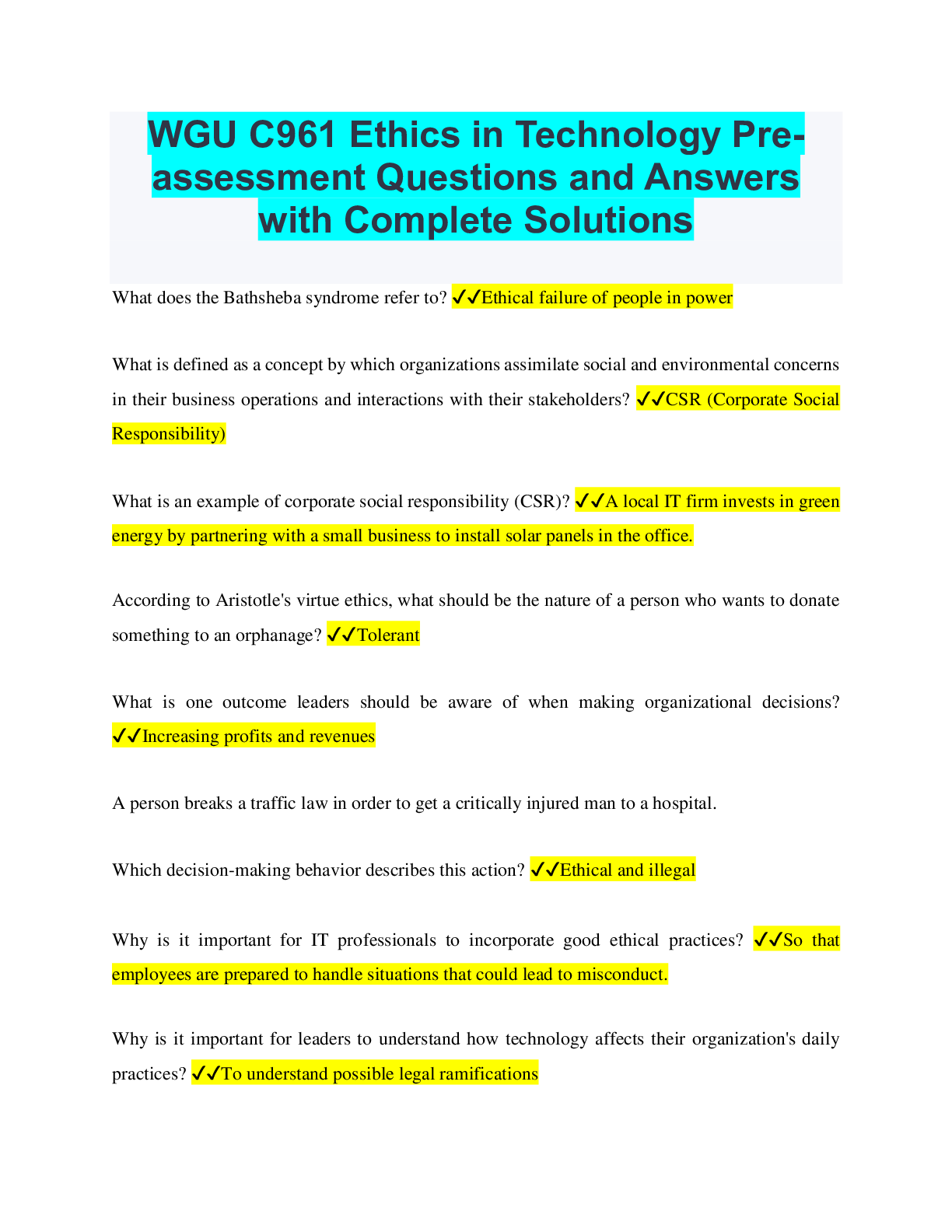
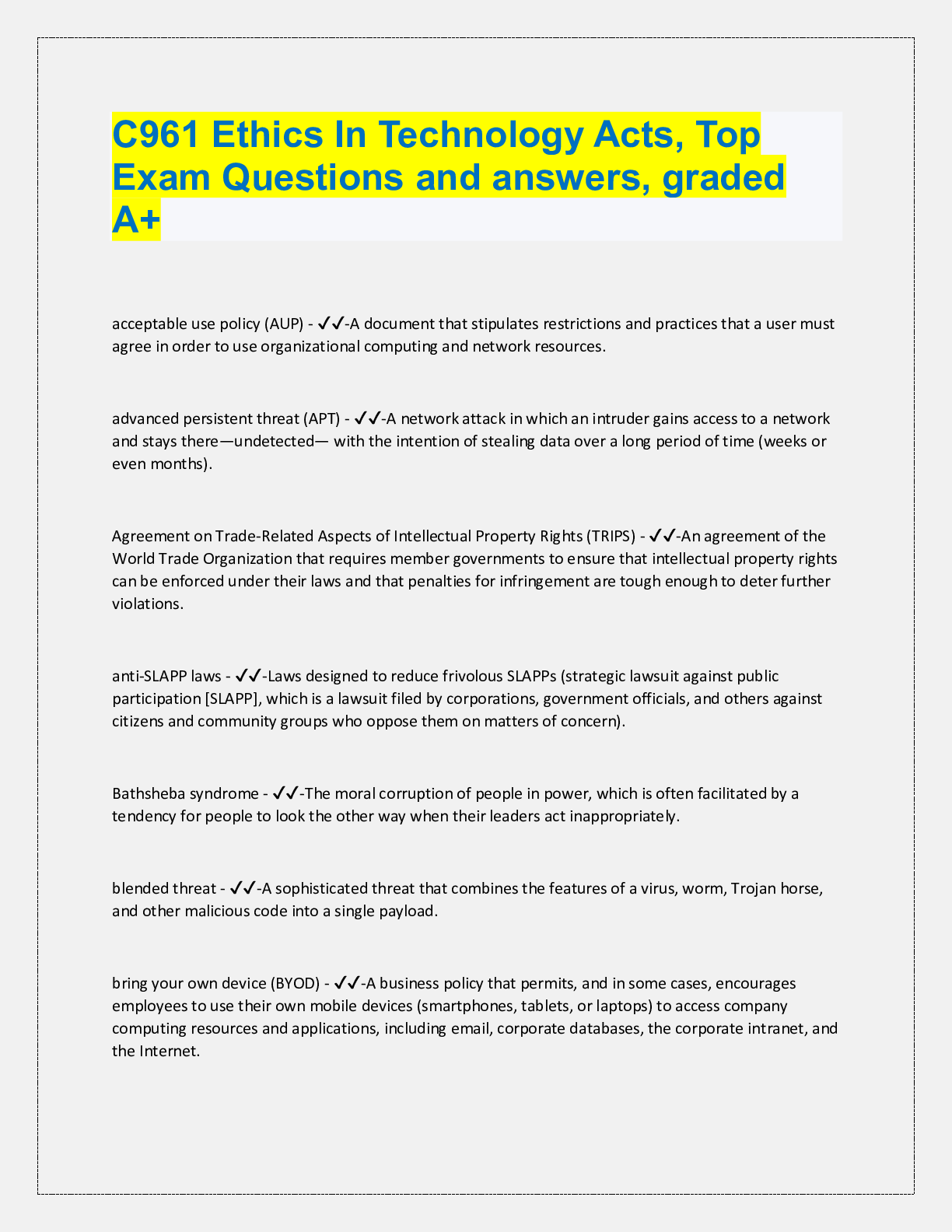
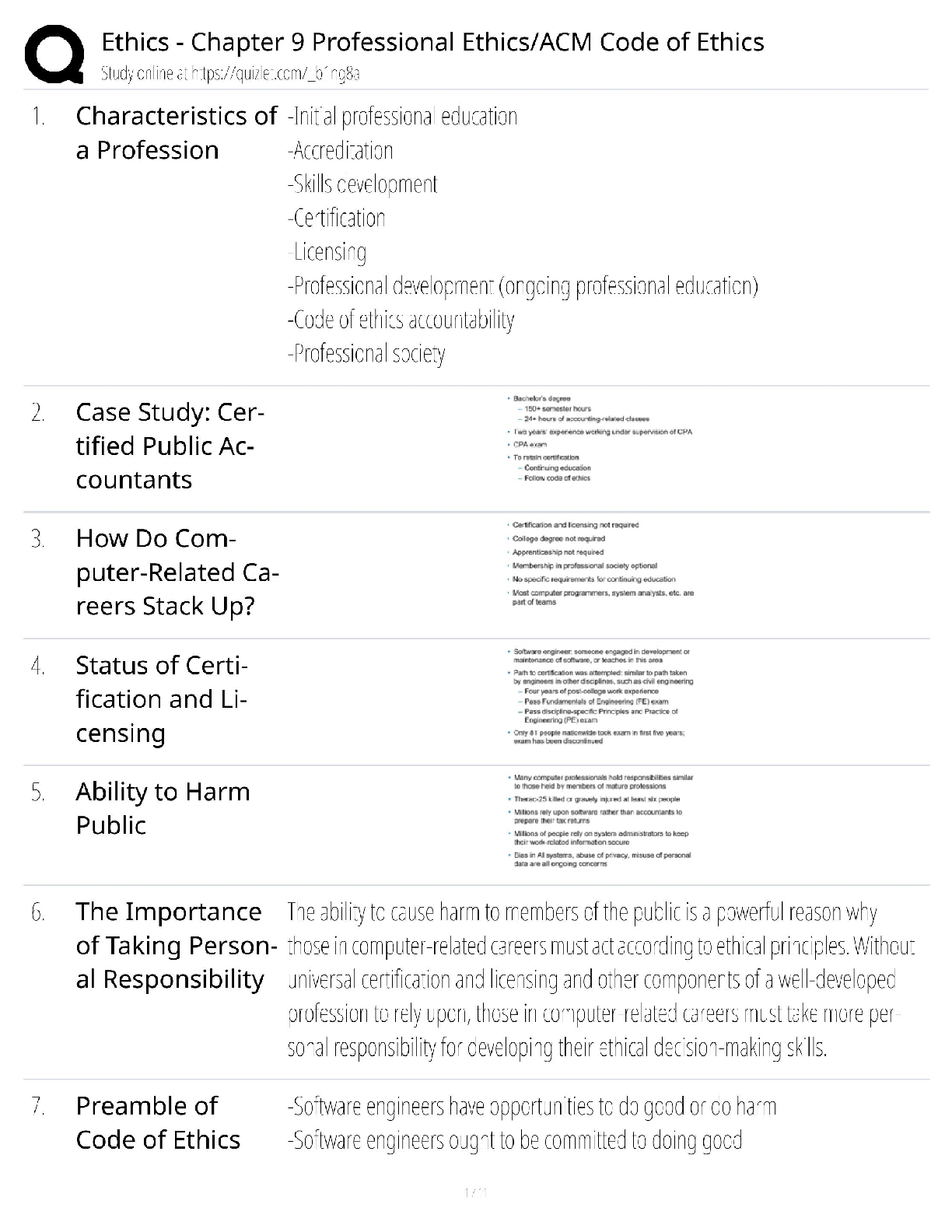
Give an example of indirect moral reasoning, including a principle, fact and judgment Correct Answer -Taking something that doesn't belong to you is wrong (moral principle) -Henry took silver that di ... dn't belong to him (non-moral fact) -So Henry's taking the silver was wrong (moral judgement) Why would someone accepting the Divine Command Theory have trouble explaining that God is good? Correct Answer It's meaningless to make moral judgments about the source of morality. Because the divine command theory explains that moral principles are God's 10 commandments and they are correct moral principles just because God commanded them, and they created morality so it wasn't right or wrong for him to command what he did because he didn't create them because he is good he created them because he thought they were good. In Ross's theory, what does it mean to say that a duty is prima facie? Correct Answer A correct way everyone ought to act until proved otherwise. In any situation our duty is the prima facie duty that is what's most stringent. List and briefly describe the three levels of moral development in Kohlberg's theory Correct Answer (ontogenesis) 1. Pre conventional Level: before age 10 regard moral restrictions as only important for personal reasons. 2. Conventional Level: age 10-16 conform to moral rules regarded as meeting social expectations. 3. Post Conventional Level: age 16+ separation of morality from social authority Is non-judgmentalism a moral principle or a moral judgment? Correct Answer moral principle Why does Kant disagree with utilitarianism? Correct Answer Kant pointed out that it is possible for people to enjoy happiness they do not deserve. What did Kant believe? Correct Answer Moral rules are absolute. Believed that lying is wrong under any circumstances and said that reason always forbids lying. Categorical Imperative? Correct Answer Kant said that: Act only according to that maxim by which you can at the same time will that it should become a universal law. Interest theory or will theory: Someone violates your right by not doing his or her duty to provide the thing that is in your interest. Correct Answer interest theory Interest theory or will theory: Someone violates your right by acting contrary to your will in regard to your right's object. Correct Answer will theory [Show More]
Last updated: 3 years ago
Preview 1 out of 5 pages
Buy this document to get the full access instantly
Instant Download Access after purchase
Buy NowInstant download
We Accept:
Can't find what you want? Try our AI powered Search
Connected school, study & course
About the document
Uploaded On
Nov 23, 2022
Number of pages
5
Written in
All
This document has been written for:
Uploaded
Nov 23, 2022
Downloads
0
Views
79
Scholarfriends.com Online Platform by Browsegrades Inc. 651N South Broad St, Middletown DE. United States.
We're available through e-mail, Twitter, Facebook, and live chat.
FAQ
Questions? Leave a message!
Copyright © Scholarfriends · High quality services·