Psychology Test #2 (solved)
Document Content and Description Below
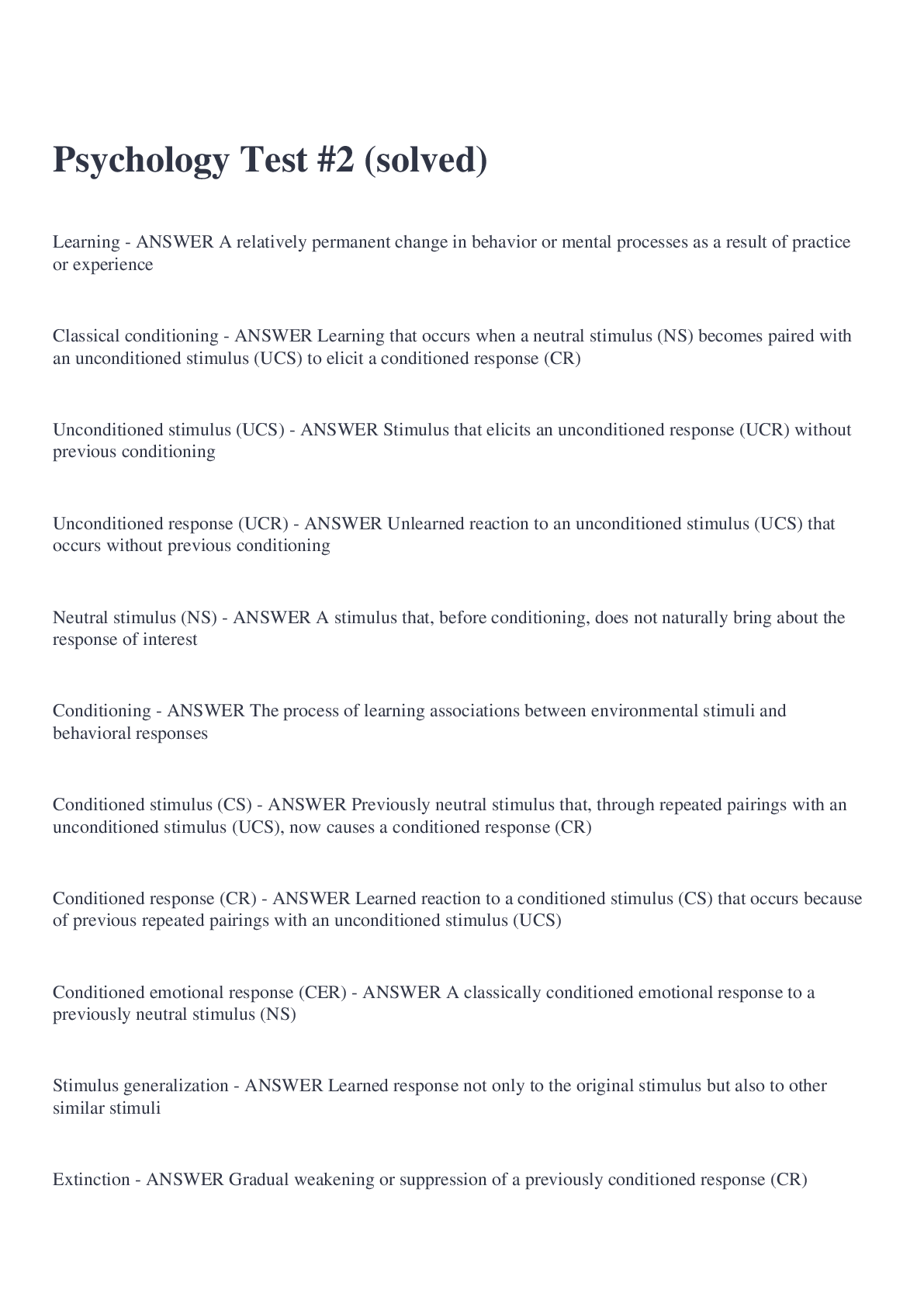
Learning - ANSWER A relatively permanent change in behavior or mental processes as a result of practice or experience Classical conditioning - ANSWER Learning that occurs when a neutral stimulus (N ... S) becomes paired with an unconditioned stimulus (UCS) to elicit a conditioned response (CR) Unconditioned stimulus (UCS) - ANSWER Stimulus that elicits an unconditioned response (UCR) without previous conditioning Unconditioned response (UCR) - ANSWER Unlearned reaction to an unconditioned stimulus (UCS) that occurs without previous conditioning Neutral stimulus (NS) - ANSWER A stimulus that, before conditioning, does not naturally bring about the response of interest Conditioning - ANSWER The process of learning associations between environmental stimuli and behavioral responses Conditioned stimulus (CS) - ANSWER Previously neutral stimulus that, through repeated pairings with an unconditioned stimulus (UCS), now causes a conditioned response (CR) Conditioned response (CR) - ANSWER Learned reaction to a conditioned stimulus (CS) that occurs because of previous repeated pairings with an unconditioned stimulus (UCS) Conditioned emotional response (CER) - ANSWER A classically conditioned emotional response to a previously neutral stimulus (NS) Stimulus generalization - ANSWER Learned response not only to the original stimulus but also to other similar stimuli Extinction - ANSWER Gradual weakening or suppression of a previously conditioned response (CR) Operant conditioning - ANSWER Learning in which voluntary responses are controlled by their consequences Skinner box - ANSWER A box containing lights, levers, food dispensers, and electrical wiring to produce shocks; used to operantly condition rats Reinforcement - ANSWER Strengthens a response and makes it more likely to recur Punishment - ANSWER Weakens a response and makes it less likely to recur Positive Reinforcement - ANSWER Adding a stimulus, which strengthens a response and makes it more likely to recur (your behavior causes something pleasant to happen) Negative Reinforcement - ANSWER Taking away a stimulus, which strengthens a response and makes it more likely to recur (your behavior causes something unpleasant to stop happening) Positive Punishment - ANSWER Adding a stimulus that weakens a response and makes it less likely to recur (your behavior causes something unpleasant to happen) Negative Punishment - ANSWER Taking away a stimulus that weakens a response and makes it less likely to recur (your behavior causes something pleasant to stop happening) Shaping - ANSWER Reinforcement delivered for successive approximations of the desired response; basically, reinforcement that occurs in baby steps Observational learning - ANSWER Learning new behavior or information by watching others; how humans do the majority of their learning Levels of processing - ANSWER The degree or depth of mental processing that occurs when material is initially encountered determines how well it is later remembered Elaborative rehearsal - ANSWER Linking new information to previously stored material Memory - ANSWER An internal record or representation of some prior event or experience Decay theory - ANSWER Memory, like all biological processes, decays over time Motivation - ANSWER Set of factors that activate, direct, and maintain behavior, usually toward a goal Emotion - ANSWER A subjective feeling that includes arousal (heart pounding), cognitions (thoughts, values, and expectations), and expressions (frowns, smiles, and running) Intelligence - ANSWER The global capacity to think rationally, act purposefully, and deal effectively with the environment Creativity - ANSWER The ability to produce valued outcomes in a novel way Language - ANSWER A creative form of communication consisting of symbols put together according to a set of rules (it is symbolic/semantic, has a rule-governed structure/syntax, and is generative) Intrinsic motivation - ANSWER Motivation resulting from personal enjoyment of a task or activity Extrinsic motivation - ANSWER Motivation based on obvious external rewards or threats of punishment Emotional intelligence - ANSWER Goleman's term for the ability to know and manage one's emotions, empathize with others, and maintain satisfying relationships Maslow's Hierarchy of Needs - ANSWER Theory that some motives (such as physiological and safety needs) must be met before going on to higher needs (such as belonging and self-actualization) Self-actualization - ANSWER The need to find self-fulillment and realize one's potential Mental retardation - ANSWER A label applied when someone is significantly below average in general intellectual functioning (IQ is less than 70) and has significant deficits in adaptive functioning (such as communicating with others, living independently, social or occupational functioning, and maintaining safety and health) Mental giftedness - ANSWER A label applied when someone has an especially high IQ (typically, people in the top 1% or 2%) Mental age - ANSWER Age where you mentally fit based on what "normal" children can do at that age Intelligence quotient (IQ) - ANSWER A subject's mental age divided by chronological age and multiplied by 100 Phoneme - ANSWER The smallest units of sound that make up every language Morpheme - ANSWER The smallest units that carry meaning; they are created by combining phonemes Grammar - ANSWER A system of rules (syntax and semantics) used to generate acceptable language that enables us to communicate with and understand others Syntax - ANSWER A system of rules for putting words in order Semantics - ANSWER A system of using words to create meaning Divergent thinking - ANSWER Thinking that produces many alternatives or ideas; a major element of creativity Convergent thinking - ANSWER Narrowing down a list of alternatives to converge on a single correct answer Encoding - ANSWER Translating information into neural codes (language) Storage - ANSWER Retaining neurally coded information over time Retrieval - ANSWER Recovering information from memory storage Sensory memory - ANSWER First memory stage that holds sensory information; relatively large capacity, but duration is only a few seconds Short-term memory - ANSWER Second memory stage that temporarily stores sensory information and decides whether to send it on to long-term memory; capacity limited to 5-9 items and duration is about 30 seconds Chunking - ANSWER Grouping separate pieces of information into a single unit (or chunk) Working memory - ANSWER Understanding of short-term memory as a stage of active processing that occurs in parts Long-term memory - ANSWER Third stage of memory that stores information for long periods of time; its capacity is virtually limitless, and its duration is relatively permanent Flashbulb memory - ANSWER Vivid images of circumstances associated with surprising or strongly emotional events; they are often somewhat inaccurate Traumatic brain injury - ANSWER Injury that occurs when the skull makes a sudden collision with another object, which causes serious and sometimes permanent damage to the brain Retrograde amnesia - ANSWER Loss of memory for events before an injury; backward-acting amnesia Anterograde amnesia - ANSWER Inability to form new memories after an injury; forward-acting amnesia False memories - ANSWER Memories of events that never occurred or occurred quite differently; they often result from suggestions from outside sources combined with our imaginations Repressed memories - ANSWER Memories of painful or traumatic events that are actively and consciously forgotten in an effort to avoid the pain of remembering; also possible that they exist unconsciously, making them inaccessible to the individ [Show More]
Last updated: 3 years ago
Preview 1 out of 5 pages
Buy this document to get the full access instantly
Instant Download Access after purchase
Buy NowInstant download
We Accept:

Reviews( 0 )
$8.00
Can't find what you want? Try our AI powered Search
Document information
Connected school, study & course
About the document
Uploaded On
Nov 21, 2022
Number of pages
5
Written in
All

Additional information
This document has been written for:
Uploaded
Nov 21, 2022
Downloads
0
Views
47