SCIENCE 101 3.3.5 Discuss:Kinematics Lab Discussion Physics Sem 1 Points Possible: 15
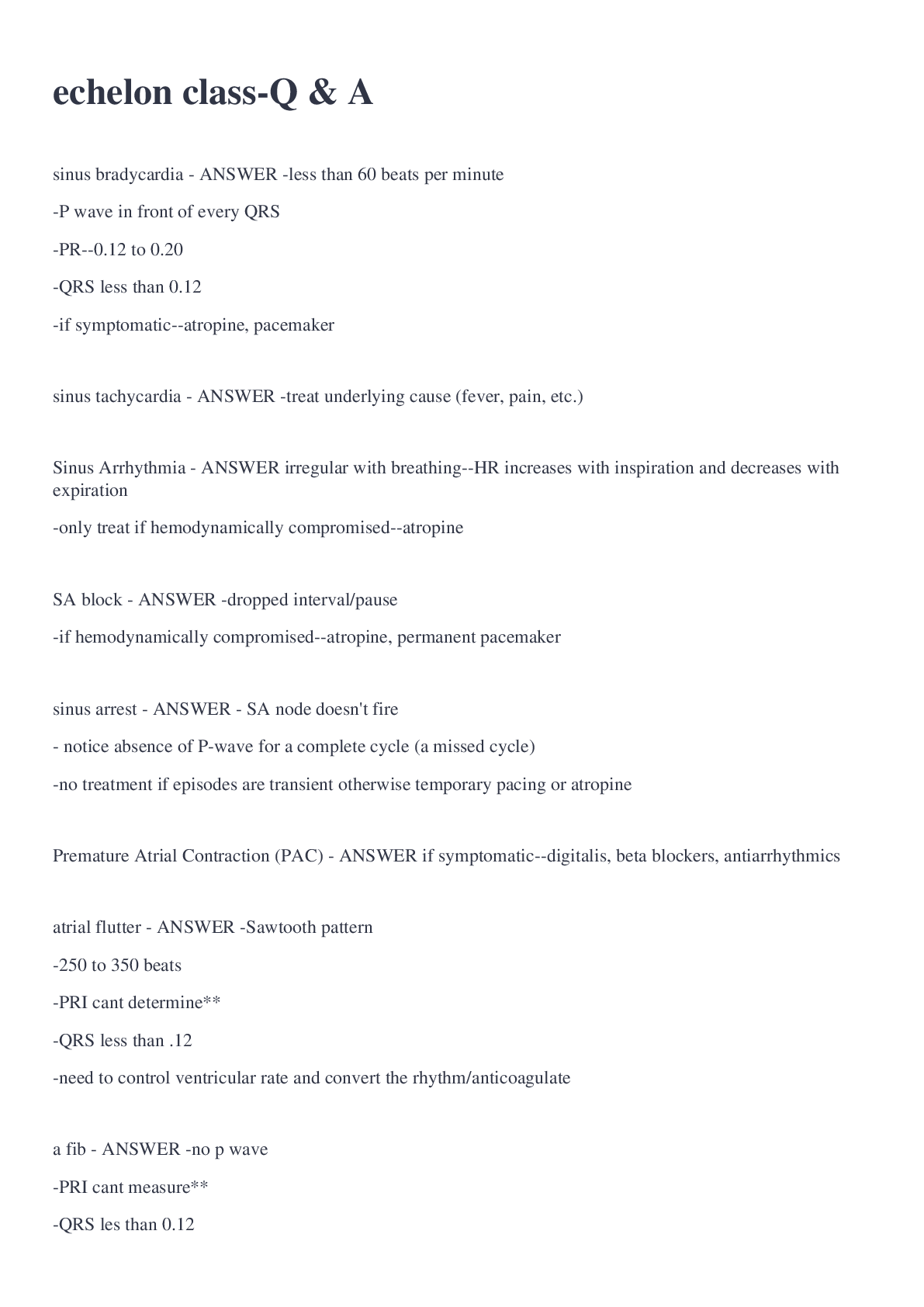
sinus bradycardia - ANSWER -less than 60 beats per minute -P wave in front of every QRS -PR--0.12 to 0.20 -QRS less than 0.12 -if symptomatic--atropine, pacemaker sinus tachycardia - ANSWER -tr ... eat underlying cause (fever, pain, etc.) Sinus Arrhythmia - ANSWER irregular with breathing--HR increases with inspiration and decreases with expiration -only treat if hemodynamically compromised--atropine SA block - ANSWER -dropped interval/pause -if hemodynamically compromised--atropine, permanent pacemaker sinus arrest - ANSWER - SA node doesn't fire - notice absence of P-wave for a complete cycle (a missed cycle) -no treatment if episodes are transient otherwise temporary pacing or atropine Premature Atrial Contraction (PAC) - ANSWER if symptomatic--digitalis, beta blockers, antiarrhythmics atrial flutter - ANSWER -Sawtooth pattern -250 to 350 beats -PRI cant determine** -QRS less than .12 -need to control ventricular rate and convert the rhythm/anticoagulate a fib - ANSWER -no p wave -PRI cant measure** -QRS les than 0.12 -rate control and anti coag SVT - ANSWER -regular rate and rhythm -P wave not visible** -PRI 0.12-0.20** -QRS less than 0.12 -tx: vagal simulation -if stable--adenosine, calcium channel blockers, beta blockers, dig, antiarrhythmics -if unstable--cardioversion Premature Junctional Contraction - ANSWER -Inverted p wave or hidden p wave PRI<0.12 or none Normal QRS -p wave goes down instead of up -no PRI unless P wave before QRS junctional escape rhythm - ANSWER -regular rhythm -40 to 60 beats -P wave inverted (down) -PRI and QRS less than 0.12 -asymptomatic -check current meds -check dig level -atropine or pacing accelerated junctional rhythm - ANSWER -regular rhythm, rate 60-100, p waves inverted or occur before during or after QRS, PRI measured if p before QRS <0.12 -check current meds, check dig level, 02 junctional tachycardia - ANSWER -Rate: 100 to 180bpm Regularity: regular P-wave: inverted, absent, or occur after the QRS-complex PR-interval: short or absent -control rate if symptomatic--beta blockers, CCB, amiodarone -if rate >150--vagal stimulation, adenosine, beta blockers, CCB, amiodarone, check dig level -no cardioversion premature ventricular contraction - ANSWER -no p wave -no PRI -QRS is wide and bizarre -check electrolytes, monitor pulse -usually no medical intervention v tach - ANSWER -no p wave -no pri -qrs is wide and bizarre -stable: amiodarone or lidocaine, cardioversion -unstable: cardioversion 100j, 200j, 300j, followed by amiodarone or lidocaine -if no pulse follow v fib v fib - ANSWER -no discernable waves -CPR, defib, epi or vasopressin -amiodarone -lidocaine -magnesium -sodium bicarbonate pulseless electrical activity - ANSWER -CPR -atropine -epi -iV fluids first degree heart block - ANSWER -P waves -prolonged PRI -QRS less than 0.12 second degree type 1 - ANSWER -P wave--some not followed by QRS -PRI lengthens until one P wave is not conducted -QRS less than second degree type 2 - ANSWER -p waves outnumber qrs -PRI is constant but possibly prolonged -QRI less than third degree heart block - ANSWER -40 to 60 beats or 20-40 -no PRI relationship -QRS less than treatment for heart blcok - ANSWER -atropine for 1st and second degree type 1 -transcutaneous pacing -dopaine -epinephrine [Show More]
Last updated: 3 years ago
Preview 1 out of 4 pages
Buy this document to get the full access instantly
Instant Download Access after purchase
Buy NowInstant download
We Accept:

Can't find what you want? Try our AI powered Search
Connected school, study & course
About the document
Uploaded On
Nov 20, 2022
Number of pages
4
Written in
All
This document has been written for:
Uploaded
Nov 20, 2022
Downloads
0
Views
45
Scholarfriends.com Online Platform by Browsegrades Inc. 651N South Broad St, Middletown DE. United States.
We're available through e-mail, Twitter, and live chat.
FAQ
Questions? Leave a message!
Copyright © Scholarfriends · High quality services·