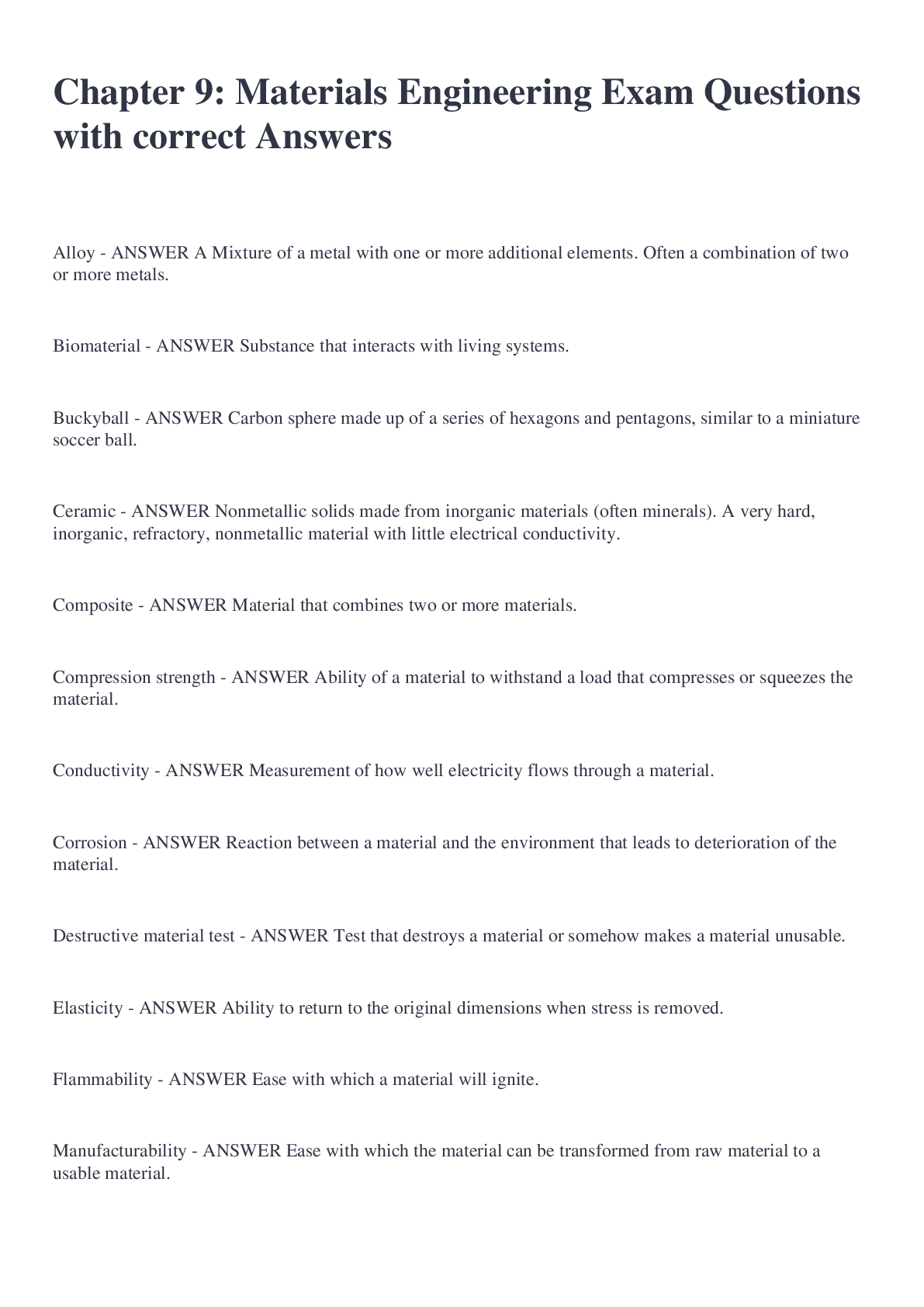
Alloy - ANSWER A Mixture of a metal with one or more additional elements. Often a combination of two or more metals.
Biomaterial - ANSWER Substance that interacts with living systems.
Buckyball - ANSWER Carbon sphe
...
Alloy - ANSWER A Mixture of a metal with one or more additional elements. Often a combination of two or more metals.
Biomaterial - ANSWER Substance that interacts with living systems.
Buckyball - ANSWER Carbon sphere made up of a series of hexagons and pentagons, similar to a miniature soccer ball.
Ceramic - ANSWER Nonmetallic solids made from inorganic materials (often minerals). A very hard, inorganic, refractory, nonmetallic material with little electrical conductivity.
Composite - ANSWER Material that combines two or more materials.
Compression strength - ANSWER Ability of a material to withstand a load that compresses or squeezes the material.
Conductivity - ANSWER Measurement of how well electricity flows through a material.
Corrosion - ANSWER Reaction between a material and the environment that leads to deterioration of the material.
Destructive material test - ANSWER Test that destroys a material or somehow makes a material unusable.
Elasticity - ANSWER Ability to return to the original dimensions when stress is removed.
Flammability - ANSWER Ease with which a material will ignite.
Manufacturability - ANSWER Ease with which the material can be transformed from raw material to a usable material.
Materials engineering - ANSWER Design of machines, tools, and processes used to manufacture goods.
Melting point - ANSWER The temperature at which the material changes from a solid to a liquid
Metal - ANSWER Chemical element that belongs to one of the families of metals on the periodic table; a type of inorganic material with good conductivity to heat and electricity.
Nanoparticle - ANSWER The most basic component at the nanoscale.
Nanotechnology - ANSWER Design of new materials and devices at the scale of a nanometer.
Nanotubes - ANSWER Nano-sized cylinders of carbon.
Nanowire - ANSWER Small strand of material that ranges 1nm - 60 nm in width.
Nondestructive Material Test - ANSWER Test that leaves the material intact and does not destroy the material.
Plasticity - ANSWER Deformation that occurs from the yield point to the fracture point.
Polymer - ANSWER Organic, noncrystalline material made up of a long chain of small molecules (primarily made up of carbon and hydrogen atoms) that form a much larger molecule.
Radiography test - ANSWER Test that uses x-rays that pass through the material.
Resistivity - ANSWER measurement of how well a material resists the flow of electricity.
Shear stress - ANSWER Bending or twisting force, like the stress that occurs when using a wrench.
Strain - ANSWER Deformation that occurs from stress.
Stress - ANSWER Amount of force or load that is applied to a material.
Tensile strength - ANSWER Ability of a material to withstand a force that pulls the material apart.
Thermal conductivity - ANSWER Material property determined by how well heat is transferred through the material.
Thermal Resistance - ANSWER Reciprocal of thermal conductivity.
Ultrasonic test - ANSWER Test that uses sound waves that "bounce off" changes in the material to determine the internal comp
[Show More]