Computer Science  >  EXAMs  >  WGU C175 Exam Solved 100% (All)

WGU C175 Exam Solved 100%

Document Content and Description Below

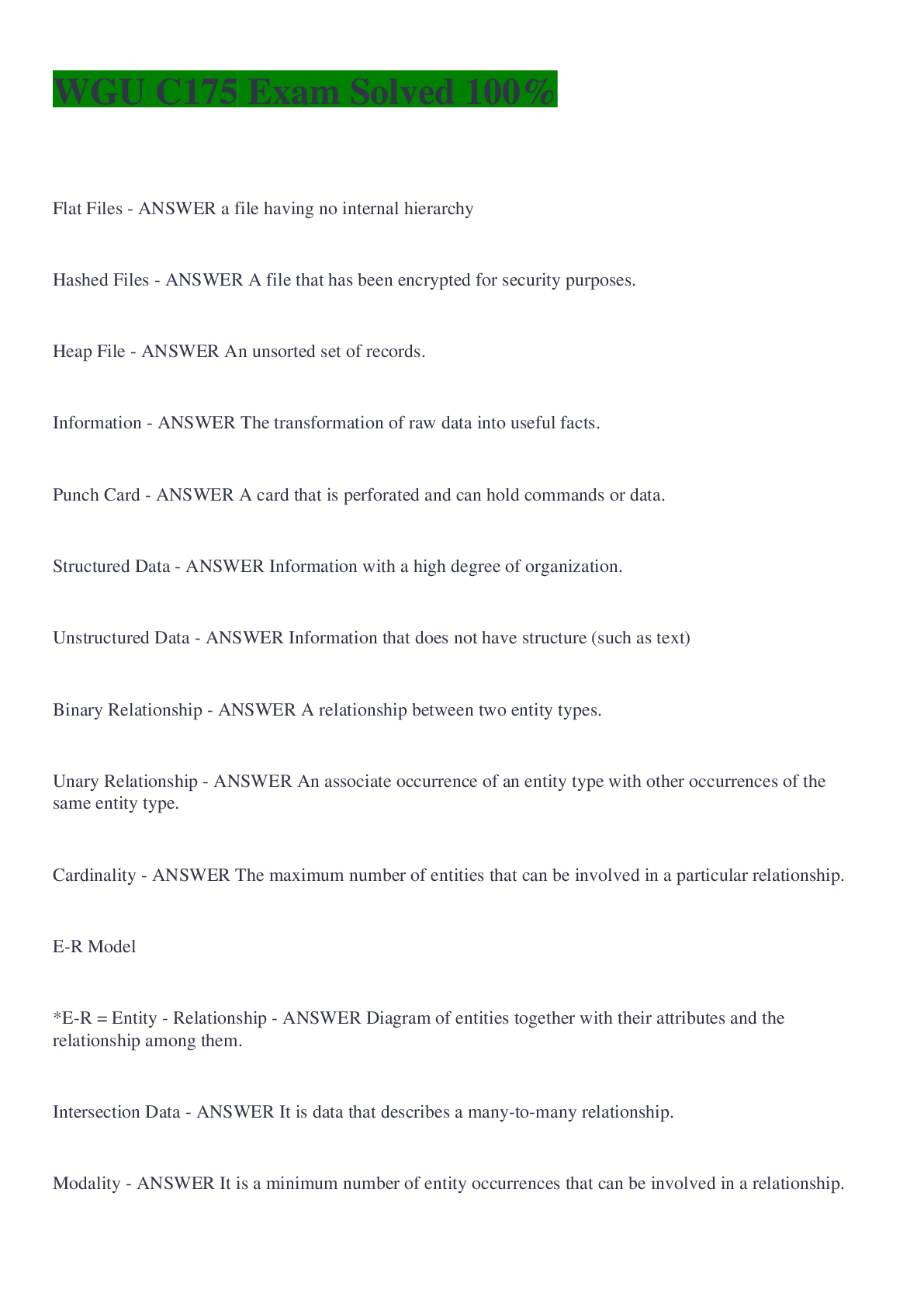
Flat Files - ANSWER a file having no internal hierarchy Hashed Files - ANSWER A file that has been encrypted for security purposes. Heap File - ANSWER An unsorted set of records. Information ... - ANSWER The transformation of raw data into useful facts. Punch Card - ANSWER A card that is perforated and can hold commands or data. Structured Data - ANSWER Information with a high degree of organization. Unstructured Data - ANSWER Information that does not have structure (such as text) Binary Relationship - ANSWER A relationship between two entity types. Unary Relationship - ANSWER An associate occurrence of an entity type with other occurrences of the same entity type. Cardinality - ANSWER The maximum number of entities that can be involved in a particular relationship. E-R Model *E-R = Entity - Relationship - ANSWER Diagram of entities together with their attributes and the relationship among them. Intersection Data - ANSWER It is data that describes a many-to-many relationship. Modality - ANSWER It is a minimum number of entity occurrences that can be involved in a relationship. One-to-one Binary Relationship - ANSWER It means that a single occurrence of one entity type can be associated with a single occurrence of the other entity type and vice versa. Ternary Relationship - ANSWER Involves three different entity types. Unique identifier - ANSWER It is used to uniquely identify each record in a database table. Attribute - ANSWER A property, characteristic, or fact that we know about an entity. "A salesperson works in one office." What is the name of this relationship? - ANSWER One-to-one binary relationship "A salesperson sells to many customers." What is the name of this relationship? - ANSWER One-to-many binary relationship "A salesperson is authorized to sell many products, and a product can be sold by many salespersons." What is the name of this relationship? - ANSWER Many-to-many binary relationship What is the positioning and meaning for Cardinality and Modality on an E-R model? - ANSWER Cardinality is the outer symbol; represents the maximum. Modality is the inner symbol; represents the minimum. "A salesperson works in a minimum of one and a maximum of one office, and an office may be occupied by or assigned to a minimum of zero and a maximum of one salesperson." - ANSWER "A salesperson may have no customers or many customers." - ANSWER Describe the ER model for "Each salesperson is authorized to sell to at least one or many products, and each product can be sold by at least one or many salespeople." - ANSWER "One salesperson backs-up another salesperson." What is the name of this model? - ANSWER One-to-one unary relationship "A salesperson manages zero to many other salespersons, and a salesperson is managed by exactly one other salesperson." What is the name of this model? - ANSWER One-to-many unary relationship "A product can either be part of no other products or be part of several other products, and a product can either be composed of no other products or be composed of several other products." What is the name of this model? - ANSWER Many-to-many unary relationship What does 'refer' in Referential Integrity imply? - ANSWER This revolves around the circumstance of trying to refer to data in one relation in the database, based on values in another relation. Define the delete rule RESTRICT. - ANSWER If the delete rule between two relations is RESTRICT and an attempt is made to delete a record on the "one side" of the one-to-many relationship, the system will forbid the delete to take place if there are any matching foreign key values in the relation on the "many side". Define the delete rule CASCADE. - ANSWER If the delete rule between two relations is CASCADE and an attempt is made to delete a record on the "one side" of the relationship, not only will the record be deleted but all of the records on the "many side" of the relationship that have a matching foreign key value will also be deleted. In other words, the delete will "cascade" from one relation to the other. Define the delete rule SET-TO-NULL. - ANSWER If the delete rule between the two relations is SET-TO-NULL and an attempt is made to delete a record on the "one side" of the one-to-many relationship, that record will be deleted and the matching foreign key values in the records on the "many side" of the relationship will be set to null. Essentially, it's exactly like the CASCADE delete option, but instead of completely deleting all possible values, the values are set to NULL instead. Which entity is uniquely identified by concatenating the primary keys of the two entities it connects? - ANSWER Associative Entity Which type of entity is also called a dependent entity? - ANSWER Weak Entity Candidate Key - ANSWER This is when a relation has more than one attribute or minimum group of attributes that represents a way of uniquely identifying the entity. Concurrency Problem - ANSWER When two or more users are trying to update the same record simultaneously. Equijoin - ANSWER Combines two or more tables based on a column that is common to the tables. Example: Joining Client and Salesman tables that both contain the SalesmanID column which have the exact same values. Foreign Key - ANSWER When an attribute or group of attributes serves as the primary key of one relation and also appears in another relation. Natural Join - ANSWER Matches each row in a table against each row in another table based on common values found in columns sharing a common name and data type. Tuple - ANSWER Rows/records are referred to as tuples when talking about relations. They serve the exact same function, it just has a different name in the context of relations. What are the five basic principles of The Database Concept? - ANSWER 1. The creation of a datacentric environment that is a significant company resource, which can be shared inside and outside the company. 2. The ability to achieve data integration while storing data in a non-redundant fashion. 3. The ability to store data representing entities involved in multiple relationships w/o introducing data redundancy. 4. Managing data control issues such as data security, backup and recovery, and concurrency control. 5. High degree of data independence. What are the four major DBMS approaches? - ANSWER - Hierarchical - Network - Relational - Object-oriented What are four key differences between a RELATION and a FILE? - ANSWER - The columns of a relation can be arranged in any order w/o affecting the meaning of the data. That is not true of a file. - Similarly, the rows of a relation can be arranged in any order, which is not true of a file. - Every row/column position, sometimes referred to as a "cell", can have only a single value, which is not necessarily true in a file. - No two rows of a relation are identical, which is not necessarily true in a file. * in the SELECT clause - ANSWER - It indicates that all attributes of the selected row are to be retrieved AND operator - ANSWER - It displays a record if more than one condition is true AVG() function - ANSWER - It returns the average value of a numeric column. BETWEEN operator - ANSWER - It allows you to specify a range of numeric values in a search. DISTINCT operator - ANSWER - It is used to eliminate duplicate rows in a query result. IN operator - ANSWER - It allows you to specify a list of character strings to be included in a search JOIN clause - ANSWER - It is used to combine rows from more than one table, based on a common field between them. Sometimes it is done by using the '=' symbol. LIKE operator - ANSWER - It allows you to specify partial character strings in a "wildcard" sense. OR operator - ANSWER - It displays a record it either the first condition OR the second condition is true. ORDER BY clause - ANSWER - It simply takes the result of a SQL query and orders them by one or more specified attributes. SELECT command - ANSWER - Data retrieval in SQL is accomplished with the SELECT command. Subquery - ANSWER - When on SELECT statement is "nested" within another in a format, it is known as subquery. This is shown when there is a second SELECT phrase within a set of parenthesis. Common DDL commands: - ANSWER - DROP - ALTER - RENAME - CREATE - TRUNCATE Common DML commands: - ANSWER - UPDATE - DELETE - INSERT - MERGE - SELECT Write the basic SQL query command: - ANSWER SELECT<columns> FROM<table> WHERE<predicates identifying rows to be included> Write the SQL query to "Find the commission percentage and year of hire of salesperson 186": - ANSWER SELECT COMMPERCT, YEARHIRE FROM SALESPERSON WHERE SPNUM=186; Write the SQL query to "Retrieve the entire record for salesperson 186": - ANSWER SELECT * FROM SALESPERSON WHERE SPNUM=186; Write the SQL query to "List the salesperson numbers and salesperson names of those salespersons who have a commission percentage of 10.": - ANSWER SELECT SPNUM, SPNAME FROM SALESPERSON [Show More]

Last updated: 3 years ago

Preview 1 out of 13 pages

Buy Now

Instant download

We Accept:

Payment methods accepted on Scholarfriends (We Accept)
Preview image of WGU C175 Exam Solved 100% document

Buy this document to get the full access instantly

Instant Download Access after purchase

Buy Now

Instant download

We Accept:

Payment methods accepted on Scholarfriends (We Accept)

Reviews( 0 )

$8.00

Buy Now

We Accept:

Payment methods accepted on Scholarfriends (We Accept)

Instant download

Can't find what you want? Try our AI powered Search

73
0

Document information


Connected school, study & course


About the document


Uploaded On

Oct 26, 2022

Number of pages

13

Written in

All

Seller


Profile illustration for MARKALLAN
MARKALLAN

Member since 3 years

58 Documents Sold

Reviews Received
5
2
0
0
1
Additional information

This document has been written for:

Uploaded

Oct 26, 2022

Downloads

 0

Views

 73

Document Keyword Tags

Recommended For You

Get more on EXAMs »

$8.00
What is Scholarfriends

Scholarfriends.com Online Platform by Browsegrades Inc. 651N South Broad St, Middletown DE. United States.

We are here to help

We're available through e-mail, Twitter, Facebook, and live chat.
 FAQ
 Questions? Leave a message!

Follow us on
 Twitter

Copyright © Scholarfriends · High quality services·