*NURSING > QUESTIONS & ANSWERS > ACLS Exam Version A 2020-2021 questions with answers (All)
ACLS Exam Version A 2020-2021 questions with answers
Document Content and Description Below
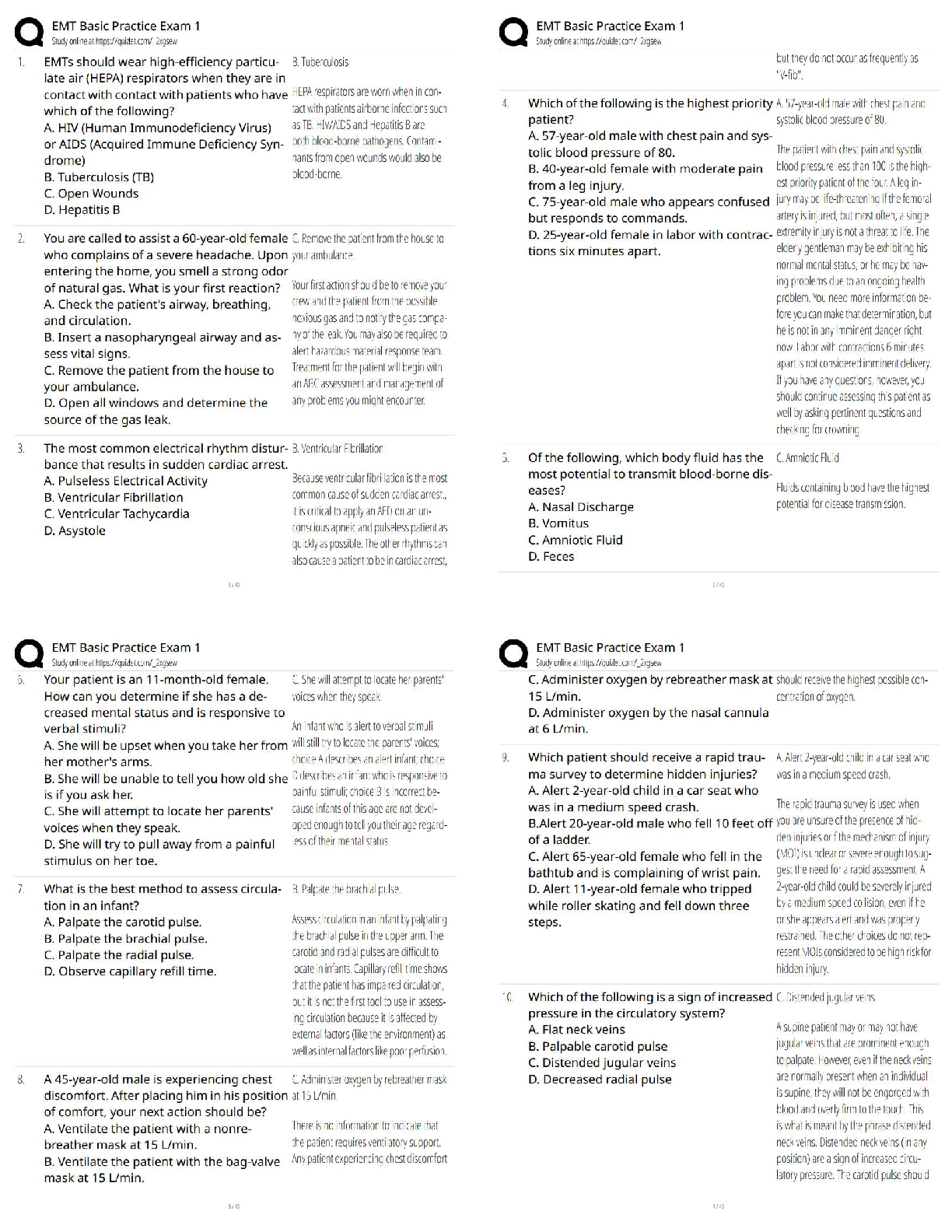
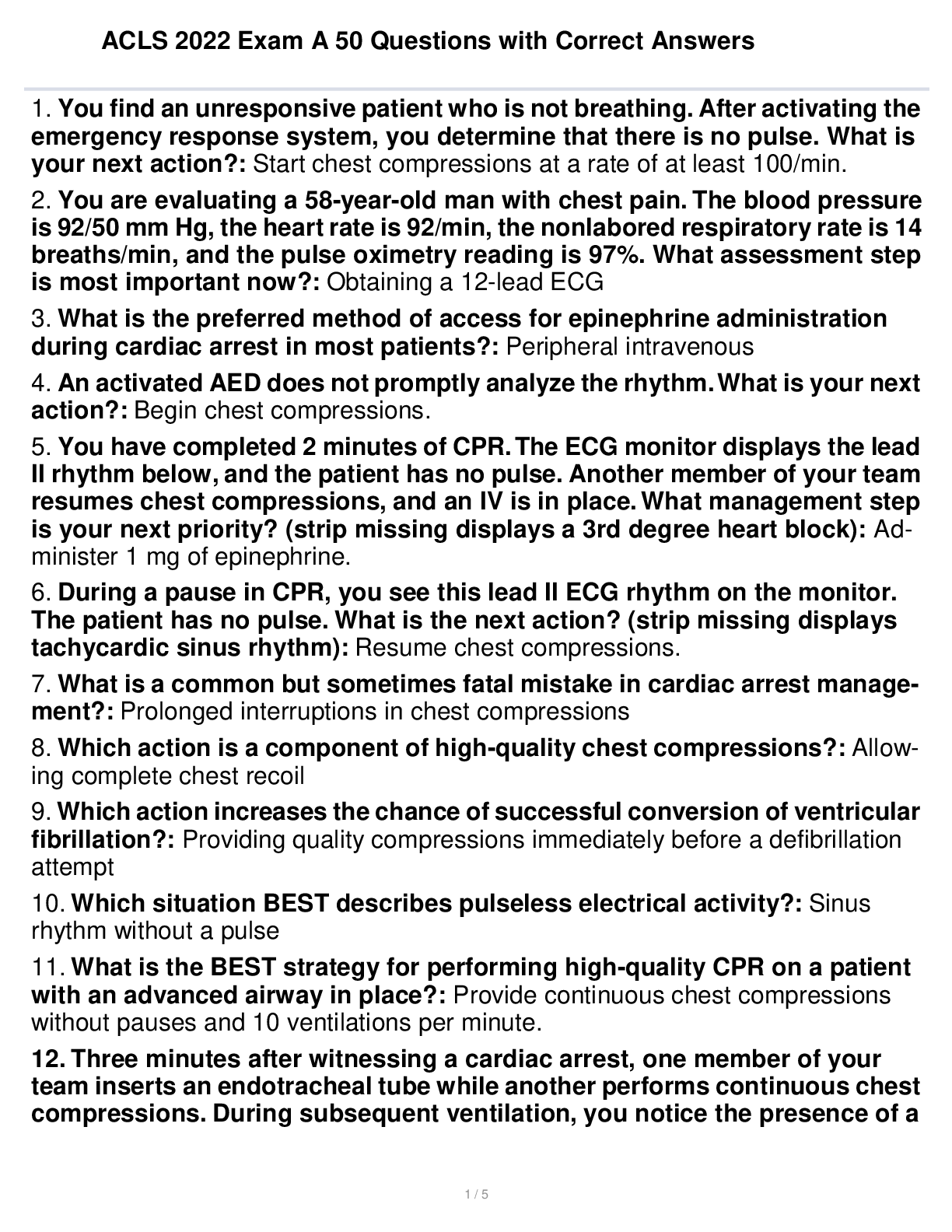
1. You find an unresponsive patient who is not breathing. After activating the emergency response system, you determine that there is no pulse. What is your next action?: Start chest compressions at a ... rate of at least 100/min. 2. You are evaluating a 58-year-old man with chest pain. The blood pressure is 92/50 mm Hg, the heart rate is 92/min, the nonlabored respiratory rate is 14 breaths/min, and the pulse oximetry reading is 97%. What assessment step is most important now?: Obtaining a 12-lead ECG 3. What is the preferred method of access for epinephrine administration during cardiac arrest in most patients?: Peripheral intravenous 4. An activated AED does not promptly analyze the rhythm. What is your next action?: Begin chest compressions. 5. You have completed 2 minutes of CPR. The ECG monitor displays the lead II rhythm below, and the patient has no pulse. Another member of your team resumes chest compressions, and an IV is in place. What management step is your next priority? (strip missing displays a 3rd degree heart block): Ad- minister 1 mg of epinephrine. 6. During a pause in CPR, you see this lead II ECG rhythm on the monitor. The patient has no pulse. What is the next action? (strip missing displays tachycardic sinus rhythm): Resume chest compressions. 7. What is a common but sometimes fatal mistake in cardiac arrest manage- ment?: Prolonged interruptions in chest compressions 8. Which action is a component of high-quality chest compressions?: Allow- ing complete chest recoil 9. Which action increases the chance of successful conversion of ventricular fibrillation?: Providing quality compressions immediately before a defibrillation attempt 10. Which situation BEST describes pulseless electrical activity?: Sinus rhythm without a pulse 11. What is the BEST strategy for performing high-quality CPR on a patient with an advanced airway in place?: Provide continuous chest compressions without pauses and 10 ventilations per minute. 12. Three minutes after witnessing a cardiac arrest, one member of your team inserts an endotracheal tube while another performs continuous chest compressions. During subsequent ventilation, you notice the presence of a waveform on the capnography screen and a PETCO2 level of 8 mm Hg. What is the significance of this finding?: Chest compressions may not be effective [Show More]
Last updated: 3 years ago
Preview 1 out of 5 pages
Buy this document to get the full access instantly
Instant Download Access after purchase
Buy NowInstant download
We Accept:

Also available in bundle (1)
Click Below to Access Bundle(s)
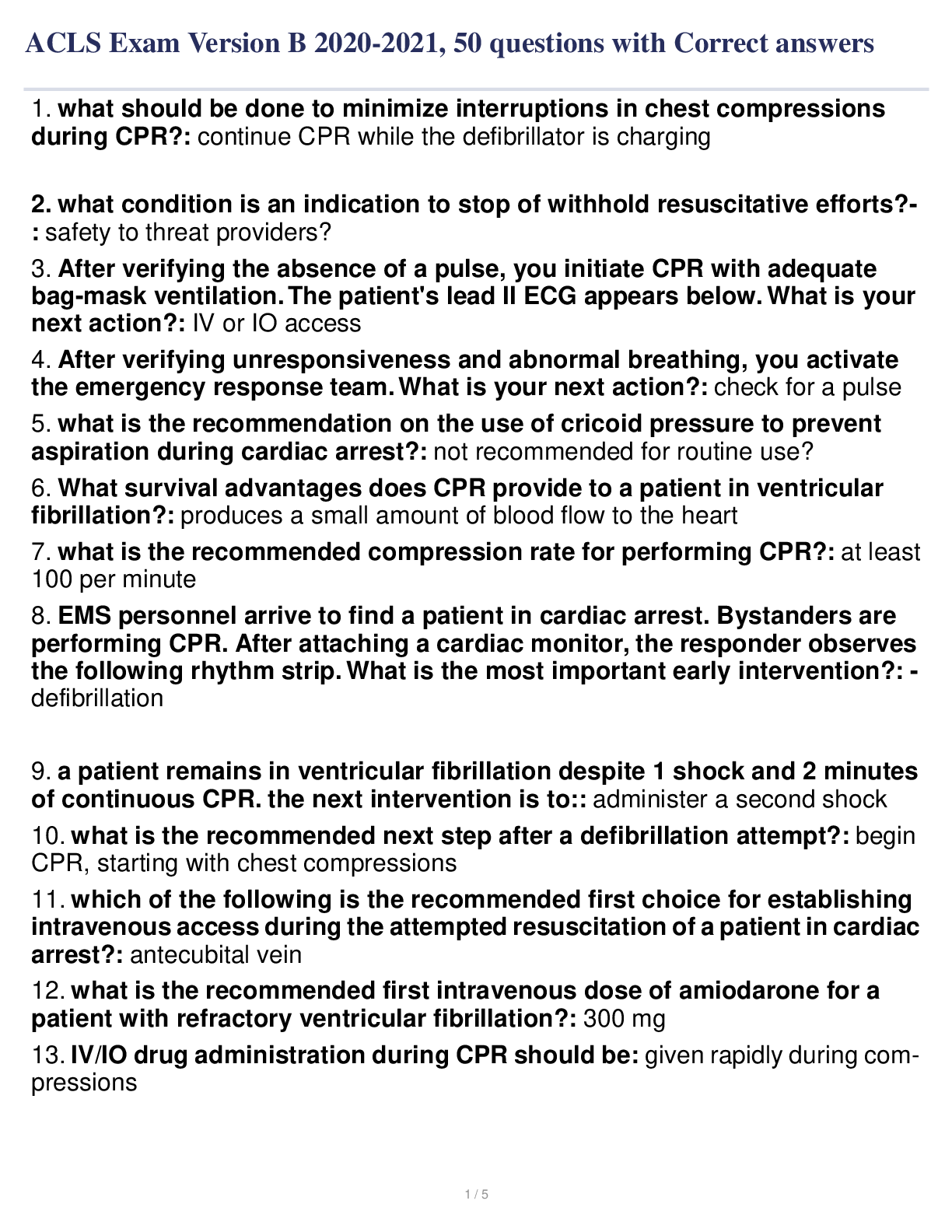
ACLS Exam Version A and B 2020-2021 questions with answers
ACLS Exam Version B 2020-2021 questions with answers ACLS Exam Version A 2020-2021 questions with answers
By Alphascore 3 years ago
$12
2
Reviews( 0 )
$10.00
Can't find what you want? Try our AI powered Search
Document information
Connected school, study & course
About the document
Uploaded On
Oct 25, 2022
Number of pages
5
Written in
All

Additional information
This document has been written for:
Uploaded
Oct 25, 2022
Downloads
0
Views
220


 with Complete Solution.png)
 Career Information with Complete Solution.png)


 for E-6 Career Information_watermark.png)