Hayes-Bautista: Latino Terminology: Conceptual Bases for Standardized Terminology
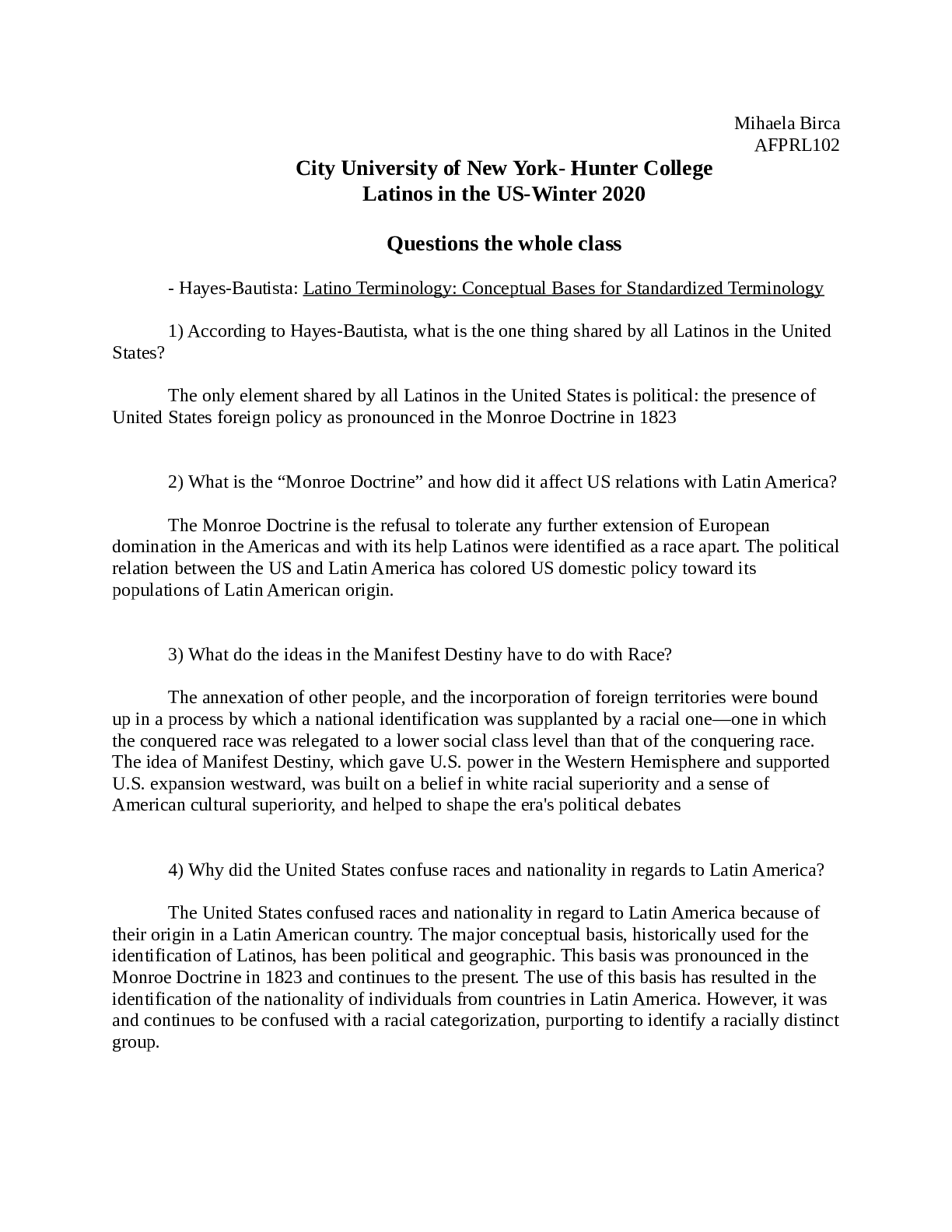
1) According to Hayes-Bautista, what is the one thing shared by all Latinos in the United
States?
The only element shared by all Latino
...
Hayes-Bautista: Latino Terminology: Conceptual Bases for Standardized Terminology
1) According to Hayes-Bautista, what is the one thing shared by all Latinos in the United
States?
The only element shared by all Latinos in the United States is political: the presence of
United States foreign policy as pronounced in the Monroe Doctrine in 1823
2) What is the “Monroe Doctrine” and how did it affect US relations with Latin America?
The Monroe Doctrine is the refusal to tolerate any further extension of European
domination in the Americas and with its help Latinos were identified as a race apart. The political
relation between the US and Latin America has colored US domestic policy toward its
populations of Latin American origin.
3) What do the ideas in the Manifest Destiny have to do with Race?
The annexation of other people, and the incorporation of foreign territories were bound
up in a process by which a national identification was supplanted by a racial one—one in which
the conquered race was relegated to a lower social class level than that of the conquering race.
The idea of Manifest Destiny, which gave U.S. power in the Western Hemisphere and supported
U.S. expansion westward, was built on a belief in white racial superiority and a sense of
American cultural superiority, and helped to shape the era's political debates
4) Why did the United States confuse races and nationality in regards to Latin America?
The United States confused races and nationality in regard to Latin America because of
their origin in a Latin American country. The major conceptual basis, historically used for the
identification of Latinos, has been political and geographic. This basis was pronounced in the
Monroe Doctrine in 1823 and continues to the present. The use of this basis has resulted in the
identification of the nationality of individuals from countries in Latin America. However, it was
and continues to be confused with a racial categorization, purporting to identify a racially distinct
group.
[Show More]