MGB225
INTERCULTURAL COMMUNICATION
& NEGOTIATION
Week 102
Lecture learning objectives
Discuss what is communicated in a negotiation
Explore how parties communicate in negotiation
Evaluate ways to improve com
...
MGB225
INTERCULTURAL COMMUNICATION
& NEGOTIATION
Week 102
Lecture learning objectives
Discuss what is communicated in a negotiation
Explore how parties communicate in negotiation
Evaluate ways to improve communication in negotiation
Communication & e-communication in negotiation3
Basic communication model
Message in
Medium
Receive and
Interpret
Communicator
B
Encode with
language
Message in
Medium
Receive and
Interpret
Communicator
A
Encode with
language
(Lewicki, Saunders & Barry, 2011)Decoding
4
Decoding can be defined as the process by which messages are put into
symbolic form.
True False
(Lewicki, Barry & Saunders, 2011)Intercultural communication process
5
Sender
Encodes
Meaning
(Deresky, 2011)
Receiver
Decodes
Meaning
Medium
Message
Noise
Culture
Feedback6
Culture & communication: A model
Culture 1: Sender’s
normative beliefs about
appropriate
communication behaviour
Culturally compatible
communication style Sender’s communication
style
Culture 2: Receiver’s
normative beliefs about
appropriate
communication behaviour
Culturally compatible
communication style
Receiver’s communication
style
Other influences on communication processes
(Steers, Sanchez-Runde & Nardon, 2010)7
Communication in negotiation
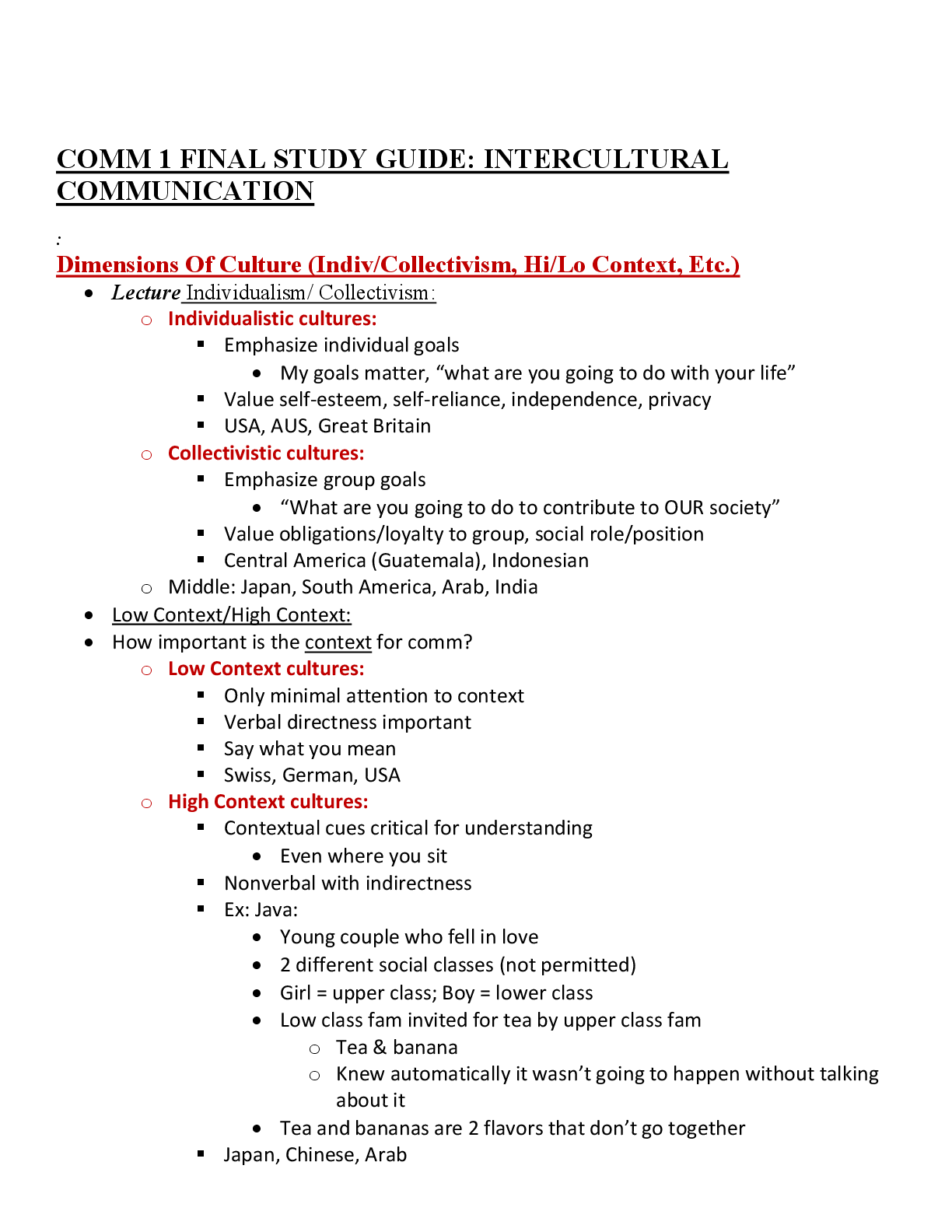
• Communication processes, both verbal and nonverbal, are critical to achieving
negotiation goals and to resolving conflicts.
• Even parties whose goals are compatible or integrative may fail to reach
agreement or reach suboptimal agreement
• Negotiation is a form of interpersonal communication that is achieved
through words or statements, and nonverbal gestures or cues to vie for
outcomesWHAT IS COMMUNICATED
IN NEGOTIATION
Offers, counteroffers, and motives
• Affiliation motive vs. power
motives
Information about alternatives
• Politely and subtly
Information about outcomes
• Cautious about sharing the
outcomes
• Sharing after self-evaluation
8WHAT IS COMMUNICATED
IN NEGOTIATION
Social accounts
• Explanations of mitigating
circumstances
• No choice
• Explanations of exonerating
circumstances
• Positive motives
• Reframing explanations
• Short-term pain for long-term
gain
Communication about process
• How well it is going
• What procedure might be adopted
to improve the situation
9Information about outcomes
10
Thompson, Valley, & Kramer (1995) found that winners and losers evaluated
their own outcomes equally when they did not know how well the other
party had done, but if they found out that the other negotiator had done
better, or was even pleased with his or her outcome, then negotiators felt
less positive about their own outcome.
True False
(Lewicki, Saunders & Barry, 2011)11
Relevant questions
1. Are negotiators consistent or adoptive in their communication patterns?
2. Does it matter what is said early in the negotiation?
3. Is more information always better?HOW PARTIES COMMUNICATE
IN NEGOTIATION
Characteristics of language
• Logical level (proposals, offers)
• Pragmatic level (semantics, syntax,
style)
• Cross-cultural & cross-gender
miscommunication
Use of nonverbal communication
• Making eye contact, face or head
gestures
• Adjusting body position
• Tone of voice
• Nonverbal cues can be encouraging
or discouraging of opponent’s
statements or given priority
12Diverse goals
13
The more diverse the goals of the two parties, or the more antagonistic they
are in their relationship, the lesser the likelihood that distortions and errors
in communication will occur.
True False
(Lewicki, Saunders & Barry, 2011)WAYS TO IMPROVE
COMMUNICATION IN NEGOTIATION
Manageable questions
• Causes attention or prepares the other
person’s thinking for further questions:
• “May I ask you a question?”
• Gets information
• “How much will this cost?”
• Generates thoughts
• “Do you have any suggestions for
improving this?”
Unmanageable questions
• Cause difficulty
• “Where did you get that dumb idea?”
• Gives information
• “Didn’t you know we couldn’t afford
this?”
• Brings the discussion to a false conclusion
• “Don’t you think we have talked about
this enough?”
14WAYS TO IMPROVE
COMMUNICATION IN NEGOTIATION
15
Listening
• Passive listening: Receiving the message
while providing no feedback to the sender
• Acknowledgement: Receivers nod their
heads, maintain eye contact, or interject
responses
• Active listening: Receivers restate or
paraphrase the sender’s message in their
own language
Role reversal
• Negotiators realise that increasing
understanding does not necessarily lead to
an easy resolution of the conflict
Managing conflict
• Using direct vs. indirect confrontation styles
based on cultural differences to find
collaborative solutions16
Channels in negotiation
• Communication is experienced differently when it occurs through different
channels
• Social presence (social bandwidth) distinguishes one communication channel
from another
• People negotiate through a variety of communication media – by phone, in
writing and increasingly through electronic channels or virtual negotiations17
Face-to-Face
• Fast tempo
• Better flow of information leading
to better decision-making
• Verbal & non-verbal cues
• Development of rapport &
understanding
• Higher satisfaction
• Schmoozing can be part of the
process
E-Negotiation
• Direct & to the point
• Separate issues from personalities
• Eliminate status differences
• Lack of verbal & non-verbal signals
• Lack of trust
• Likely to end up in impasse
• Challenging for anyone who does
not speak that native language
being used
• Move too rapidly towards closureRESEARCH FINDINGS ON
FACE-TO-FACE VS. E-COMMUNICATION
• Face-to-face negotiation yields more
integrative outcomes (no support)
• Face-to-face negotiation is preferable to enegotiation in terms of time duration
(support)
• Soft tactics are more frequently employed
in face-to-face negotiation & hard tactics
are more frequently employed in enegotiation (support)
• The sequence of the negotiation media
affects both the negotiation process & its
outcomes. Face-to-face negotiation prior
to e-negotiation leads to more integrative
outcomes (low support)
1819
Messages for Online Negotiators
• Supplement e-mail messages with phone calls & face-to-face
meetings
• Set up ground rules for e-mail negotiations in advance
• Keep each other in the loop throughout the negotiation process
• Use e-mail to craft a series of proposals for your counterpart to
consider
• Speak up if you don’t understand what the other person has written
(Asherman, 2010)20
Newer vehicles for dispute resolution
Twitter, facebook & texting
Are they worthy platforms to air private concerns?
What are the opportunities & risks?
What do you think could be done to improve dispute resolution in cyberspace?21
Special communication considerations for closure
• Avoiding fatal mistakes
• Keeping track of what you expect to happen
• Systematically guarding yourself against self-serving expectations
• Reviewing the lessons from feedback for similar decisions in the future
• Achieving closure
• Avoid surrendering important information needlessly
• Know when to be quiet & refrain from making dumb remarks
• Don’t nit-pick or second-guess parties who didn’t participate, but may
review the bargaining
• Try to be the one who writes the contract to conduct the deal & achieve
clarity of purpose22
Takeaway message
1. Analyse verbal cues & adapt reaction to emotion
2. Avoid yes & no questions
3. Ask the other party to write the 1st draft of a contract23
APS
(Make, 2007) framework24
Summary
Placed communication in the context of negotiation by:
• Discussing how negotiators communicate their own interests, positions & goals while trying to
make sense of the opposition’s set
Reminded that it is important to avoid fatal mistakes & be constructive to reach a satisfactory
closure25
Tutorial this week
• Negotiation simulation 5 (assessed)
Next week
Lecture: Ethics & best practices in negotiation
Tutorial: Recap negotiations & obtain feedback on
negotiation skills26
References
Adler, R., & Towne, N. (1978). Looking out/looking in (2nd ed.). New York: Holt, Rinehart and Winston.
Asherman, I. (2010, January). Make the Most of e-Mail Negotiations. Retrieved from
www.asherman.com/downloads/news-2010-10.pdf
Deresky, H. (2011). International management managing across borders and cultures (7th ed.). Sydney:
Pearson.
Drolet, A. L. & Morris, M. W. (2000) Rapport in conflict resolution: Accounting for how face-to-face contact
fosters mutual cooperation in mixed-motive conflicts. Journal of Experimental Social Psychology, 36, 26-50.
Ebner, N., Bhappu, A. D., Brown, J. C., Kovach, K. K., & Kupfer, A. (2009 ). You’ve Got Agreement: Negotiating
Via E-mail. In C. Honeyman, J. Coben, & G. De Palo (Eds.), Rethinking Negotiation Teaching: Innovations for
Context and Culture. (pp. 81-103). St. Paul, MN: DRI Press.
Lewicki, R.J., Saunders, D.M., & Barry, B. (2010). Essentials of negotiation (5th ed.). New York: McGraw-Hill.27
References
Make, Y. (2007). Principles and Tactics of Negotiation. Journal of Oncology Practice, 3(2).
Maslow, A. (1970). Motivation and personality. New York: Harper & Row.
Morris, M., Nadler, J., Kurtzberg, T., & Thomson, L. (2000). Schmooze or lose: Social friction and lubrication in
e-mail negotiations. Group Dynamics- Theory Research and Practice, 6, 89-100.
Steers, R. M., Sanchez-Runde, C. J., & Nardon, L. (2010). Management across cultures. New York: Cambridge.
Thompson, L., Valley, K. L., & Kramer, R. M. (1995). The bittersweet feeling of success: An examination of
social perception in negotiation. Journal of Experimental Social Psychology, 31(6), 467-492.
Valley, K. L., Moag, J., & Bazerman, M. H. (1998). A matter of trust: Effects of communication on the efficiency
and distribution of outcomes. Journal of Economic Behavior and Organization, 34, 211-238.
[Show More]