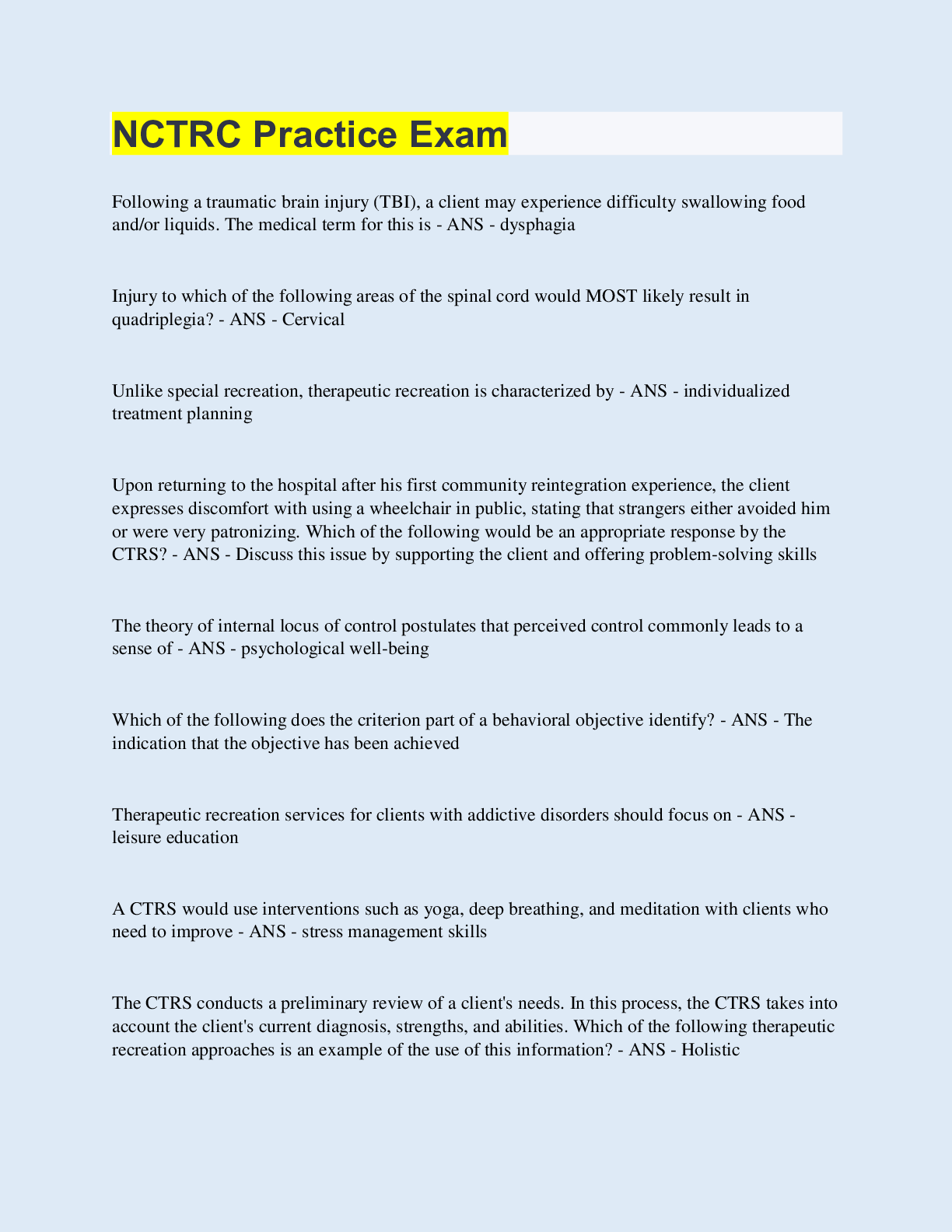
NCTRC Practice Exam
Following a traumatic brain injury (TBI), a client may experience difficulty swallowing food
and/or liquids. The medical term for this is - ANS - dysphagia
Injury to which of the following areas of
...
NCTRC Practice Exam
Following a traumatic brain injury (TBI), a client may experience difficulty swallowing food
and/or liquids. The medical term for this is - ANS - dysphagia
Injury to which of the following areas of the spinal cord would MOST likely result in
quadriplegia? - ANS - Cervical
Unlike special recreation, therapeutic recreation is characterized by - ANS - individualized
treatment planning
Upon returning to the hospital after his first community reintegration experience, the client
expresses discomfort with using a wheelchair in public, stating that strangers either avoided him
or were very patronizing. Which of the following would be an appropriate response by the
CTRS? - ANS - Discuss this issue by supporting the client and offering problem-solving skills
The theory of internal locus of control postulates that perceived control commonly leads to a
sense of - ANS - psychological well-being
Which of the following does the criterion part of a behavioral objective identify? - ANS - The
indication that the objective has been achieved
Therapeutic recreation services for clients with addictive disorders should focus on - ANS -
leisure education
A CTRS would use interventions such as yoga, deep breathing, and meditation with clients who
need to improve - ANS - stress management skills
The CTRS conducts a preliminary review of a client's needs. In this process, the CTRS takes into
account the client's current diagnosis, strengths, and abilities. Which of the following therapeutic
recreation approaches is an example of the use of this information? - ANS - Holistic
A CTRS reads a systematic review of research findings on the use of aromatherapy and then
designs an intervention program using this information. This is an example of - ANS - evidencebased practice
Which of the following is the FIRST step of a leisure education program for a client who has a
dual diagnosis of clinical depression and chronic alcoholism? - ANS - Develop leisure awareness
The difference between activity analysis and task analysis is that task analysis focuses on - ANS
- using a step by step sequencing approach
In a nursing home setting, which of the following interdisciplinary tools would a CTRS be
responsible for completing? - ANS - Minimum Data Set (MDS)
Which of the following informs a CTRS about how well the assessment results compare to what
is being measured? - ANS - Criterion-related validity
When documenting a client's progress toward treatment goals, subjective interpretation of the
client's progress must be supported with - ANS - behavioral observations
A CTRS implements a gardening program with a new client. At the beginning of the session, the
CTRS shows the client an example of a finished potted plant and introduces the client to others
who are at various stages of the potting process. Which of the following instructional strategy is
being employed by the CTRS? - ANS - Modeling can enhance learning
Which of the following technique can be effectively used by a CTRS with a geriatric client poststroke who exhibits limited socialization and decreased emotional expression? - ANS -
Remotivation
Which of the following team consists of a group of cross-discipline healthcare professionals
working jointly to address a single, identified client problem? - ANS - Transdisciplinary
After the client assessment has been completed, the next step in the programming process is to -
ANS - identify the problems
An assessment of a client with developmental disabilities reveals that the client has a flat affect
and periodic crying episodes. In which domain should the CTRS develop treatment goals? - ANS
- affective
In addition to a card holder, which of the following pieces of adaptive equipment can a client
with a C4 complete spinal cord injury use to play cards? - ANS - mouth stick
The process by which a non-governmental agency grants recognition to an individual who has
met certain predetermined qualifications specified by that agency is called - ANS - certification
A 58 year old client is currently residing in a long term care facility surrounded by persons who
are considerably older. The client repeatedly complains of loneliness, boredom, and being
ignored by friends and family. Which of the following verbal responses by the CTRS would be
effective? - ANS - probing
In a continuous quality improvement program, which of the following is an example of risk
management? - ANS - monitoring all community trip reports
The behavior modification process that uses successive approximations of a desired terminal
behavior is called - ANS - shaping
A CTRS is working with a client who displays the following behaviors: no interest in peers,
repetitive rocking, tantrums when routine changes, and repeats the CTRS's questions without
answering. Which of the following is the diagnosis? - ANS - ASD
The interaction pattern of an activity which encompasses a cooperative action by at least two
persons to achieve a mutual goal is termed - ANS - intragroup
Which therapeutic recreation practice model is designed to help clients to recover from a threat
to their health and to achieve optimal health through participation in prescriptive activity,
recreation, and leisure? - ANS - health protection/health promotion
According to standard ethical principles, placing a client in an activity that poses a high risk of
danger without programming for those risks is a violation of - ANS - non-maleficence
Which of the following assessment instrument focuses on assessing the client's perceptions of
freedom as it relates to leisure involvement? - ANS - Leisure Diagnostic Battery (LDB)
According to standards of practice, the most appropriate resource for a CTRS to collaborate with
during the discharge process is the client's - ANS - social worker
A CTRS is working with a client in a rehabilitation hospital. The client's goal is to resume
swimming at the YMCA after being discharged. With the client's consent, the CTRS meets with
the YMCA staff to discuss reasonable accommodations the client would require. Which of the
following activities is the CTRS engaged? - ANS - advocacy
After completing an assessment, the CTRS determines that the client is isolated and withdrawn
and expresses a desire to make friends. Which of the following interventions would initially meet
the client's needs? - ANS - craft group
During a socials skills assessment, the client picked up a deck of cards from the table and began
to play solitaire. What type of interaction pattern did this client display? - ANS - Extraindividual
An appropriate therapeutic recreation assessment technique for determining a client's level of
physical functioning is - ANS - task performance
Focus charting is used when the treatment team wants to - ANS - emphasize an event or behavior
in clients' records
Which of the following information is MOST important to include when writing progress notes?
- ANS - response to tx
Which of the following facilitation technique should be used with an 80 year-old client who is
mildly confused? - ANS - Reality orientation
Which of the following best describes Healthy People
[Show More]