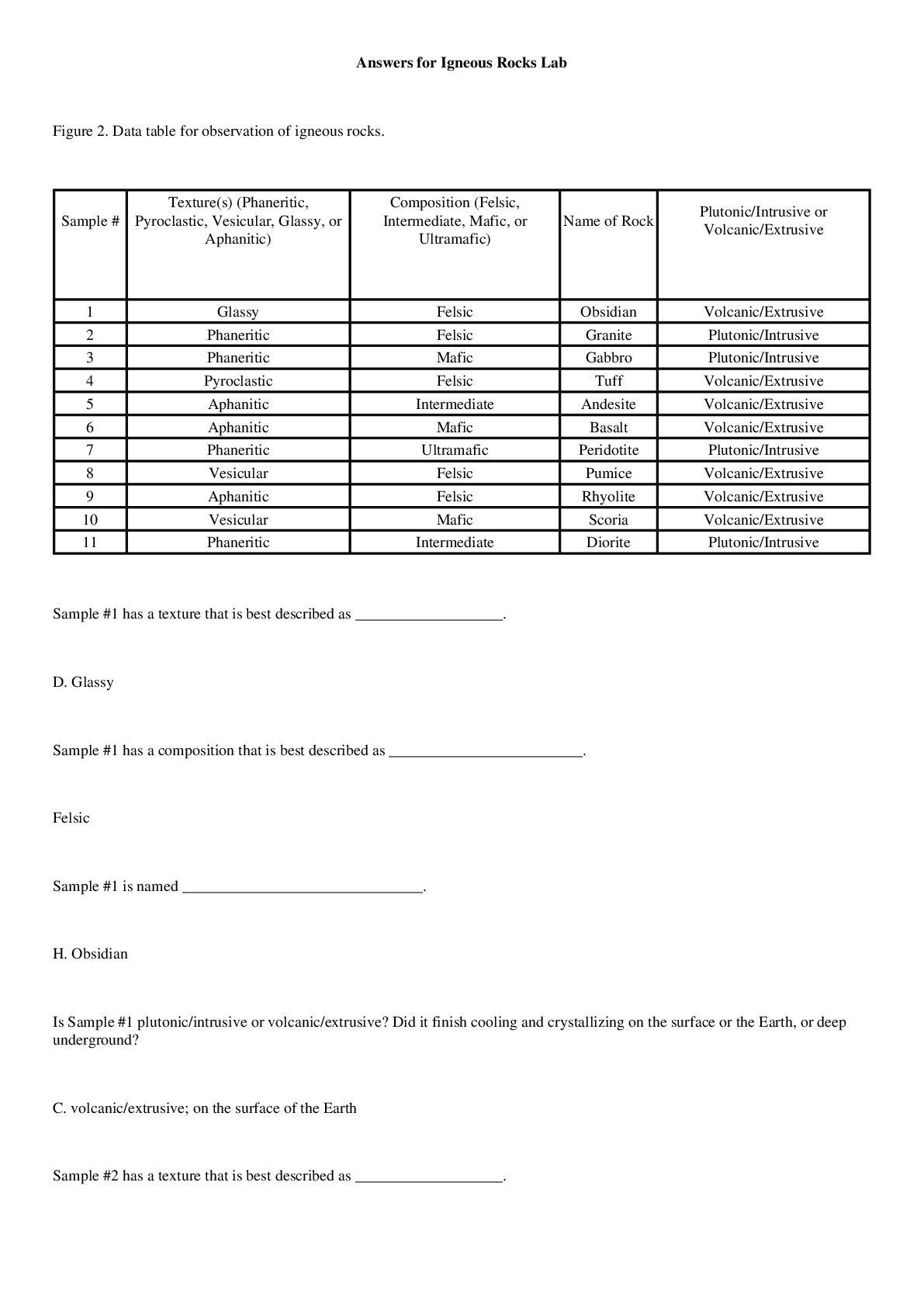
GEOLOGY LAAB EXPERIMENT ANSWERS FOR IGNEOS ROCKS
Mathematics > MARK SCHEMES > GCE Mathematics A H240/01: Pure Mathematics Advanced GCE Mark Scheme for Autumn 2021 (All)
GCE Mathematics A H240/01: Pure Mathematics Advanced GCE Mark Scheme for Autumn 2021 Oxford Cambridge and RSA Examinations GCE Mathematics A H240/01: Pure Mathematics Advanced GCE Mark S ... cheme for Autumn 2021Oxford Cambridge and RSA Examinations OCR (Oxford Cambridge and RSA) is a leading UK awarding body, providing a wide range of qualifications to meet the needs of candidates of all ages and abilities. OCR qualifications include AS/A Levels, Diplomas, GCSEs, Cambridge Nationals, Cambridge Technicals, Functional Skills, Key Skills, Entry Level qualifications, NVQs and vocational qualifications in areas such as IT, business, languages, teaching/training, administration and secretarial skills. It is also responsible for developing new specifications to meet national requirements and the needs of students and teachers. OCR is a not-for-profit organisation; any surplus made is invested back into the establishment to help towards the development of qualifications and support, which keep pace with the changing needs of today’s society. This mark scheme is published as an aid to teachers and students, to indicate the requirements of the examination. It shows the basis on which marks were awarded by examiners. It does not indicate the details of the discussions which took place at an examiners’ meeting before marking commenced. All examiners are instructed that alternative correct answers and unexpected approaches in candidates’ scripts must be given marks that fairly reflect the relevant knowledge and skills demonstrated. Mark schemes should be read in conjunction with the published question papers and the report on the examination. © OCR 2021H240/01 Mark Scheme October 2021 2 Text Instructions 1. Annotations and abbreviations Annotation in RM assessor Meaning and BOD Benefit of doubt FT Follow through ISW Ignore subsequent working M0, M1 Method mark awarded 0, 1 A0, A1 Accuracy mark awarded 0, 1 B0, B1 Independent mark awarded 0, 1 SC Special case ^ Omission sign MR Misread BP Blank Page Seen Highlighting Other abbreviations in mark scheme Meaning dep* Mark dependent on a previous mark, indicated by *. The * may be omitted if only one previous M mark cao Correct answer only oe Or equivalent rot Rounded or truncated soi Seen or implied www Without wrong working AG Answer given awrt Anything which rounds to BC By Calculator DR This question included the instruction: In this question you must show detailed reasoning.H240/01 Mark Scheme October 2021 3 2. Subject-specific Marking Instructions for A Level Mathematics A a Annotations must be used during your marking. For a response awarded zero (or full) marks a single appropriate annotation (cross, tick, M0 or ^) is sufficient, but not required. For responses that are not awarded either 0 or full marks, you must make it clear how you have arrived at the mark you have awarded and all responses must have enough annotation for a reviewer to decide if the mark awarded is correct without having to mark it independently. It is vital that you annotate standardisation scripts fully to show how the marks have been awarded. Award NR (No Response) - if there is nothing written at all in the answer space and no attempt elsewhere in the script - OR if there is a comment which does not in any way relate to the question (e.g. ‘can’t do’, ‘don’t know’) - OR if there is a mark (e.g. a dash, a question mark, a picture) which isn’t an attempt at the question. Note: Award 0 marks only for an attempt that earns no credit (including copying out the question). If a candidate uses the answer space for one question to answer another, for example using the space for 8(b) to answer 8(a), then give benefit of doubt unless it is ambiguous for which part it is intended. b An element of professional judgement is required in the marking of any written paper. Remember that the mark scheme is designed to assist in marking incorrect solutions. Correct solutions leading to correct answers are awarded full marks but work must not always be judged on the answer alone, and answers that are given in the question, especially, must be validly obtained; key steps in the working must always be looked at and anything unfamiliar must be investigated thoroughly. Correct but unfamiliar or unexpected methods are often signalled by a correct result following an apparently incorrect method. Such work must be carefully assessed. When a candidate adopts a method which does not correspond to the mark scheme, escalate the question to your Team Leader who will decide on a course of action with the Principal Examiner. If you are in any doubt whatsoever you should contact your Team Leader.H240/01 Mark Scheme October 2021 4 c The following types of marks are available. M A suitable method has been selected and applied in a manner which shows that the method is essentially understood. Method marks are not usually lost for numerical errors, algebraic slips or errors in units. However, it is not usually sufficient for a candidate just to indicate an intention of using some method or just to quote a formula; the formula or idea must be applied to the specific problem in hand, e.g. by substituting the relevant quantities into the formula. In some cases the nature of the errors allowed for the award of an M mark may be specified. A method mark may usually be implied by a correct answer unless the question includes the DR statement, the command words “Determine” or “Show that”, or some other indication that the method must be given explicitly. A Accuracy mark, awarded for a correct answer or intermediate step correctly obtained. Accuracy marks cannot be given unless the associated Method mark is earned (or implied). Therefore M0 A1 cannot ever be awarded. B Mark for a correct result or statement independent of Method marks. Unless otherwise indicated, marks once gained cannot subsequently be lost, e.g. wrong working following a correct form of answer is ignored. Sometimes this is reinforced in the mark scheme by the abbreviation isw. However, this would not apply to a case where a candidate passes through the correct answer as part of a wrong argument. d When a part of a question has two or more ‘method’ steps, the M marks are in principle independent unless the scheme specifically says otherwise; and similarly where there are several B marks allocated. (The notation ‘dep*’ is used to indicate that a particular mark is dependent on an earlier, asterisked, mark in the scheme.) Of course, in practice it may happen that when a candidate has once gone wrong in a part of a question, the work from there on is worthless so that no more marks can sensibly be given. On the other hand, when two or more steps are successfully run together by the candidate, the earlier marks are implied and full credit must be given. e The abbreviation FT implies that the A or B mark indicated is allowed for work correctly following on from previously incorrect results. Otherwise, A and B marks are given for correct work only – differences in notation are of course permitted. A (accuracy) marks are not given for answers obtained from incorrect working. When A or B marks are awarded for work at an intermediate stage of a solution, there may be various alternatives that are equally acceptable. In such cases, what is acceptable will be detailed in the mark scheme. If this is not the case please, escalate the question to your Team Leader who will decide on a course of action with the Principal Examiner. Sometimes the answer to one part of a question is used in a later part of the same question. In this case, A marks will often be ‘follow through’. In such cases you must ensure that you refer back to the answer of the previous part question even if this is not shown within the image zone. You may find it easier to mark follow through questions candidate-by-candidate rather than question-by-question. f We are usually quite flexible about the accuracy to which the final answer is expressed; over-specification is usually only penalised where the scheme explicitly says so. • When a value is given in the paper only accept an answer correct to at least as many significant figures as the given value.H240/01 Mark Scheme October 2021 5 • When a value is not given in the paper accept any answer that agrees with the correct value to 3 s.f. unless a different level of accuracy has been asked for in the question, or the mark scheme specifies an acceptable range. NB for Specification B (MEI) the rubric is not specific about the level of accuracy required, so this statement reads “2 s.f”. Follow through should be used so that only one mark in any question is lost for each distinct accuracy error. Candidates using a value of 9.80, 9.81 or 10 for g should usually be penalised for any final accuracy marks which do not agree to the value found with 9.8 which is given in the rubric. g Rules for replaced work and multiple attempts: • If one attempt is clearly indicated as the one to mark, or only one is left uncrossed out, then mark that attempt and ignore the others. • If more than one attempt is left not crossed out, then mark the last attempt unless it only repeats part of the first attempt or is substantially less complete. • if a candidate crosses out all of their attempts, the assessor should attempt to mark the crossed out answer(s) as above and award marks appropriately. h For a genuine misreading (of numbers or symbols) which is such that the object and the difficulty of the question remain unaltered, mark according to the scheme but following through from the candidate’s data. A penalty is then applied; 1 mark is generally appropriate, though this may differ for some units. This is achieved by withholding one A or B mark in the question. Marks designated as cao may be awarded as long as there are no other errors. If a candidate corrects the misread in a later part, do not continue to follow through. Note that a miscopy of the candidate’s own working is not a misread but an accuracy error. i If a calculator is used, some answers may be obtained with little or no working visible. Allow full marks for correct answers, provided that there is nothing in the wording of the question specifying that analytical methods are required such as the bold “In this question you must show detailed reasoning”, or the command words “Show” or “Determine”. Where an answer is wrong but there is some evidence of method, allow appropriate method marks. Wrong answers with no supporting method score zero. If in doubt, consult your Team Leader. j If in any case the scheme operates with considerable unfairness consult your Team Leader.H240/01 Mark Scheme October 2021 6 Question Answer Marks AO Guidance 1 16 – 4(k + 3) M1* 1.1 Attempt discriminant Allow b2 + 4ac for M1, but nothing else –4k – 12 + 16 > 0 A1 2.3 Obtain correct inequality Not necessarily expanded 4k – 4 < 0 M1dep * 1.1 Attempt to solve their inequality or equation for k k < 1 A1 1.1 Obtain k < 1 [4] OR (completing the square or differentiating) M1* – attempt to complete the square, or differentiate, and link minimum point to 0 A1 – obtain (k + 3) – 4 < 0 M1d* – solve their inequality or equation A1 – obtain k < 1 OR (using perfect square) M1* – link k + 3 to 4 A1 – obtain k + 3 < 4 M1d* – solve their inequality or equation A1 – obtain k < 1 2 (a) (C =) 4000 + 4m B1 3.3 Correct equation / expression for A Or 40 + 0.04m (C =) 6(m – 100) B1 3.3 Correct equation / expression for B Or 0.06(m – 100) [2] B1B0 if units inconsistent in two equations SC B1 for both 44 + 0.04m and 0.06m (or 4400 + 4m and 6m) – from using m = 0 at 100 minutes (b) 4000 + 4m = 6(m – 100) 2m = 4600 M1 1.1 Attempt to solve simultaneously, from two linear equations in m At least one equation must have constant term Could be implied by final answer of 38hrs 20 mins m = 2300 A1 3.4 Obtain 2300 (minutes) isw once 2300 seen [2]H240/01 Mark Scheme October 2021 7 Question Answer Marks AO Guidance 3 (a) x ky z = 2 30 4 3 = × × k k = 2.5 M1 3.1a Attempt to find value for k From x ky z = 2 or x k z y = 2 only Using sum, not product, is M0 but watch for + z being used for positive square root 2 x y z = 2.5 A1 1.1 Correct equation Ignore modulus sign if used around z Allow BOD if initial equation stated explicitly, k found correctly but then final equation not seen or seen as now incorrect [2] (b) x = × × 2.5 9 5 M1 1.1 Attempt to find x, from equation in terms of y, z and numerical k Could be from using direct proportion and not their equation from (a) x = 112.5 A1 1.1 Obtain 112.5 Or any exact equiv [2] 4 DR (a) f(0.5) = 0.25 – 0.75 – 5.5 + 6 = 0 B1 2.1 Attempt f(0.5) and show equal to 0 Must be using factor theorem so B0 for alternative methods B0 for just f(0.5) = 0 Condone 2(0.5)3 – 3(0.5)2 – 11(0.5) + 6 = 0 [1] (b) DR f(x) = (2x – 1)(x2 – x – 6) M1 1.1 Attempt complete division by (2x – 1) DR so need to see quadratic factor Allow equivalent complete methods eg coefficient matching / inspection / grid method Condone slip(s) in otherwise correct method A1 1.1 Obtain correct quadratic factor Seen in division / correct coeffs eg A = 1 etc / at top of gridH240/01 Mark Scheme October 2021 8 Question Answer Marks AO Guidance f(x) = (2x – 1)(x – 3)(x + 2) A1 1.1 Obtain correct fully factorised f(x) Must be seen as a product of all 3 factors SC B1 for correct factorisation with no DR [3] (c) DR x = 2y B1 3.1a State or imply that x = 2y Could be implied by equating 2y to at least one of their roots 2y = 0.5, y = –1 2y = 3, y = 1.58 M1 1.1 Attempt to find at least one value of y Exact or decimal 2y = –2, no solutions as 2y > 0 for all y Hence y = –1, y = log23 A1 2.4 Obtain both correct values, and no others Must give reason for 2y = –2 having no solution 1.58 or better, or log 3 log 2 n n for log 3 2 eg cannot log a negative number 2y always greater than 0 [3] 5 (a) (i) (2, 9) B1 1.1 Correct coordinate And no others [1] (ii) (1, 12) B1 B1 3.1a 1.1 Correct x-coordinate Correct y-coordinate If more than one solution given then award B1 if either co-ordinate is consistent in all solutions [2] (iii) (6, 2) B1 1.2 Correct coordinate And no others [1] (b) (i) x = –2, x = 4 B1 3.1a Both x-coordinates correct, and no others Ignore any attempt at y values [1] (ii) x < –2 B1 1.2 Correct inequality, and no others Allow ≤ Could be written in set notation [1] (iii) x = 4 B1 1.2 Correct x-coordinate, and no others Ignore any attempt at y valuesH240/01 Mark Scheme October 2021 9 Question Answer Marks AO Guidance [1] 6 (a) 1 3 1 2 3 2 3 3 1 3 3 8 8 3 8 ( )( )( ) (1 ) 1 ( )( ) 2! x x x − − − = + − + B1 1.1 Obtain correct first two terms Allow unsimplified second term, including product of two fractions M1 1.1 Attempt third term in expansion of 13 38 (1 ) − x Allow BOD if no brackets, even if never recovered Allow BOD if no negative sign 1 1 2 = − − 1 8 64 x x A1 1.1 Correct third term Allow unsimplified fraction as coefficient, but must be single term 1 1 1 1 3 3 3 3 3 3 (8 3 ) 8 (1 ) 2(1 ) − = − = − x x x 8 8 13 1 1 2 (8 3 ) 2 − = − − x x x 4 32 B1FT 1.1 Correct expansion of 13 (8 3 ) − x FT as 2 x their expansion (at least two terms) Bracket expanded and fractions simplified [4] (b) 8 x < 3 B1 1.2 Allow any equivalent eg − < < 8 8 3 3 x Must be strict inequality Must be condition for x, so B0 for 3 8 x < [1] (c) (1 2 ) 1 2 2 2 ( )( ) ( 2 3 )( ) (2 )2 2! x x x − − − + = + − + M1 3.1a Attempt first three terms of expansion Must be expanding (1 + 2x)-2 Allow BOD if no brackets on 2x, even if never recovered = − + 1 4 12 x x2 A1 1.1 Obtain correct first three terms Allow unsimplified fraction for coeff of third term 1 1 (2 12) ( 4) ( 1) × + − × − + − × 4 32 M1 1.1 Attempt all 3 relevant products Finding 3 appropriate terms from the product of two 3-term quadratics If part of full expansion then M1 when reqd 3 products and no others are combinedH240/01 Mark Scheme October 2021 10 Question Answer Marks AO Guidance 799 32 or 24 32 31 A1 1.1 Any exact equivalent, including 24.96875 Condone x2 still present [4] 7 (a) 2 2 2 ln x x x − x + M1 3.1a Attempt differentiation using product rule May expand first to give 2 2 2 ln x x x x x + − (allow middle term as just x) 2 2 2 ln x x x 0 − x + = 2 ln 2 0 x x x 2 2 + − = A.G. A1 1.1 Equate to 0 and obtain given answer Must be equated to 0 before clearing the fractions Must be equation ie … = 0 [2] (b) f 4 ln 2 . 2 ′(x x x x x ) = + + 2 1x B1 1.1 Correct derivative seen Allow simplified middle term of 2x 2 2 1 2 1 2 ln 2 4 ln 2 . 2 n n n n n n n n n n x x x x x x x x x x + + − = − + + M1 1.1 Use correct Newton-Raphson formula, with numerator correct and their derivative in the denominator Allow fractional term without subscripts SC Condone use of N-R on (x2 – 2)lnx ( ) ( 2 2 ) 1 4 ln 4 2 ln 2 4 ln 4 n n n n n n n n n n n x x x x x x x x x x x + + − + − = + 2 2 2 2 1 4 ln 4 2 ln 2 4 ln 4 n n n n n n n n n n x x x x x x x x x x + + − − + = + M1 1.1 Attempt rearrangement into single fraction with brackets expanded Allow without subscripts N-R not necessarily correct, but must be recognisable attempt SC Rearrange their N-R on (x2 – 2)lnx ( ) 2 2 1 2 ln 3 2 4 ln 1 n n n n n n x x x x x x + + + = + A.G. A1 2.1 Obtain given answer, with no errors seen Subscripts needed on RHS at least one step before AG LHS needs xn+1 seen [4] (c) x x 2 3 = = 1.25, 1.2075 B1 1.1 Condone 1.21, or better, for x3 x3 = 1.207515437… [1]H240/01 Mark Scheme October 2021 11 Question Answer Marks AO Guidance (d) (1.206, – 0.102) B1 2.2a Correct x-coordinate Must be 3dp or better B1 2.2a Correct y-coordinate Could be given as single coordinate or x = 1.206, y = – 0.102 Allow BOD if 1.206 given but not identified as x-value [2] 8 (a) (i) f ( ) x ∈ B1 2.5 Allow alternative notation, or worded equivalent Allow y, or just f, but not x Accept just Allow (-∞, ∞) [1] (ii) g( ) ( , 1] [1, ) x ∈ −∞ − ∪ ∞ B1 2.5 Allow alternative notation, or worded equivalent Allow y, or just g, but not x Or (-∞, ∞) with (–1, 1) clearly excluded [1] (b) (i) cos (0.6) = 0.8253, so 1 sec(0.6) 1.2116 = = 0.8253 2tan(1.2116) = 2× 2.6634 = 5.3269 M1 2.1 Attempt correct composition of functions At least one interim value required hence fg(0.6) = 5.33 A.G. A1 2.1 Conclude with 5.33 [2] SC B1 for stating 2tan(1 ÷ cos0.6) = 5.33 (ii) f(x) is a many to one function so has no inverse B1 2.4 Must refer to inverse of f not existing, with reason Must be clear that referring to the function fH240/01 Mark Scheme October 2021 12 Question Answer Marks AO Guidance [1] (c) DR 4tan2x + 6secx = 0 4(sec2x – 1) + 6secx = 0 M1 3.1a Attempt use of identity in their equation to obtain quadratic Allow tan2x = ± sec2x ± 1 Award M1 when reduced to single trig ratio 4sec2x + 6secx – 4 = 0 A1 1.1 Obtain correct equation in secx – possibly still with brackets Or correct quadratic in cosx – possibly still with brackets but with no fractions (4cos2x – 6cosx – 4 = 0) secx = –2, secx = 1 2 M1 1.1 Solve 3 term quadratic and attempt to find at least one value for x Could solve quadratic BC Must be using root that would give solution for x x = 2 4 3 3 π, π A1 1.1 Obtain at least one correct value Allow decimals or in degrees Must be from correct solution method of correct quadratic (condone second root not being seen – but must be correct if seen)H240/01 Mark Scheme October 2021 13 Question Answer Marks AO Guidance secx = 1 2 has no solutions as sec 1 x ≥ A1 2.3 Obtain both correct values, and no others, and explain that secx = 0.5 has no solutions as outside range Now exact and in radians Or equiv explanation for cosx [5] 9 (a) ekt > 0 for all t, so y > 0 for t ≥ 0 (or for all t) hence never crosses x-axis B1 2.4 Or show that 2e-3t = 0 has no solutions Need to see y ≠ 0 or y > 0 and reason relating to exponential (or logarithmic) function Must clearly be referring to y or 2e-3t [1] (b) e2t – 4et + 3 = 0 (et – 1)(et – 3) = 0 et = 1, et = 3 M1 3.1a Equate to 0 and attempt to solve disguised quadratic ‘determine’ so some evidence of method needed t = 0, t = ln3 A1 1.1 Obtain both correct values A0 for ln1 and not 0 [2] (c) d 2 2e 4e d x t t t = − B1 1.1 Correct xt dd Mark derivative and condone no/wrong labelH240/01 Mark Scheme October 2021 14 Question Answer Marks AO Guidance d 3 6e d y t t − = − B1 1.1 Correct yt dd Mark derivative and condone no/wrong label 3 2 d 6e d 2e 4e t t t yx − − = − M1 2.4 Attempt correct method to combine derivatives Combine their derivatives correctly ( ) 3 2 3 2 4 5 d 3e 3 3 d e 2e e 2e e 2e e t t t t t t t t yx − − = = = − − − A.G. A1 2.1 Show manipulation to given answer Need to see some evidence of how e-3t is dealt with AG so method must be fully correct [4] (d) 2e e 0 4 5 t t − = M1 3.1a Equate denominator to 0 Or d 0 d xy = or d 0 xdt = e 2 e 0 4t t ( − = ) t = ln2 A1 1.1 Solve for t to obtain t = ln2 No need to see e4t = 0 discounted (– 1, 14 ) A1 1.1 Obtain correct coordinate Or x = –1, y = 14 [3] 10 (a) (i) cos CD a y = hence CD = acosy B1 2.4 Justification for CD Need to see either cos CD a y = or adj = hyp × cosθ before given answer [1] (ii) area = 1 1 2 2 AC CD x b a y x . sin cos sin = ( ) 12 = ab x y sin cos A.G. B1 2.4 Use area of triangle to show given answer Could quote general expression for area and then show clear substitution If not, then sides being used need to be clearly identified through statement or diagram Could also use right-angled triangle, with base as AD Condone not being rearranged to given expression [1] (iii) CD = bcosx B1 2.1 Correct CD in terms of b and xH240/01 Mark Scheme October 2021 15 Question Answer Marks AO Guidance Area BCD = 1 1 2 2 BC CD y a b x y . sin cos sin = ( ) 12 = ab x y cos sin B1 2.1 Correct area of triangle BCD B0 B1 if correct area stated with no justification Area ABC = 1 1 2 2 AC BC x y ab x y . sin( + = + ) sin( ) B1 1.1 Correct area of triangle ABC 1 1 1 2 2 2 ab x y ab x y ab x y sin( + = + ) sin cos cos sin sin( ) sin cos cos sin x y x y x y + = + B1 2.1 Equate area of ABC to the sum of the areas of the two small triangles and complete proof convincingly Allow alternative proofs eg using lengths [4] (b) sin30cos cos30sin α α + = cos 45cos sin 45sin α α + B1 1.1 Correct use of compound angle formulae Could be implied if exact values used immediately – allow BOD for RHS May be seen as two separate expressions, not yet equated 1 1 1 1 2 2 2 2 cos 3sin 2 cos 2 sin α α α α + = + M1 1.1 Use exact trig values In either equation or two expressions Must see all 4 values, but expansions may not be fully correct ( 3 2 sin 2 1 cos − = − ) α α ( ) sin 2 1 tan cos 3 2 α α α − = = − M1 3.1a Gather like terms and attempt tanα May still have fractions in the fraction tanα does not yet need to be the subject, but must only appear once for M1 ( )( ) ( )( ) 2 1 3 2 6 2 2 3 3 2 3 2 3 2 − + + − − = = − + − M1 3.1a Attempt to rationalise their denominator Clear intention seen to multiply throughout by the conjugate of their denominator tan 2 6 3 2 α = + − − A.G. A1 2.1 Obtain given answer With full detail, including (at least) 3 – 2 in denominatorH240/01 Mark Scheme October 2021 16 Question Answer Marks AO Guidance [5] 11 (a) 2udu = 2xdx B1 1.1a Any correct expression linking du and dx Could be d 2 3 d u x x x = + 12 ( 2 )− 12 or equiv in terms of u ( 2 ) 2 4 3 d u u u u ∫ − M1* 2.1 Attempt to rewrite integrand in terms of u Not just dx = du, unless from a clear attempt at du eg using u = x + 3 ∫(4 12 d u u 2 − ) A1 1.1 Obtain correct integrand Allow unsimplified expression 34 u u c 3 − + 12 ( ) M1dep * 1.1 Attempt integration Simplify to form that can be integrated, then increase all powers by 1 3 3 4 4 u u c x x c ( 9) 2 2 2 − + = − + + ( 6 3 ) A.G. A1 2.1 Obtain given answer, with at least one intermediate step seen Need evidence of common factor (in terms of u or x) being taken out Condone omission of +c [5] (b) DR 34 ((− × − − × 5 2 6 3 ) ( )) M1 2.1 Attempt to use limits or u = √3 and u = 2 in integral in x = 0 and x = 1, terms of u Correct order and subtraction Attempt to use both limits in their integral to give two terms DR so just stating decimal area is M0 Either using answer from (a) or their integration attempt with +2 or +3 = 34(6 3 10 − ) or 0.523 A1 1.1 Obtain correct area under curve Accept exact (inc unsimplified) or decimal Using +2 gives 34(4 2 3 3 − ) or 0.614 2 2 3 2 ( ) 1 1 2 2 12 ( ) 2 d 12 3 4 .2 . 3 d 3 x x x x x yx x − + − + = + M1 3.1a Attempt derivative using the quotient rule Or equiv with product rule Need difference of two terms in numerator, at least one term correct, but allow subtraction in incorrect order Using either +2 or +3 equationH240/01 Mark Scheme October 2021 17 Question Answer Marks AO Guidance A1 1.1 Obtain correct, unsimplified, derivative With either +2 or +3 at x = 1, m = 11 2 hence m′ = − 11 2 M1 2.1 Attempt gradient of normal at x = 1 Substitute x = 1 and use negative reciprocal Using +2 gives m′ = − 32 3 3 Can be with m found BC 2 y x − = − − 2 ( 1) 11 when y = 0, x = 12 M1 1.1 Attempt to find point of intersection of normal with x-axis Attempt equation of normal with their gradient and either (1, 2) or (1, 3 34 ), and then use y = 0 to find x intersection area = 40 8 3 11 − + 3 73 = − 8 3 A1 3.1a Obtain correct area Allow any exact (including unsimplified) or decimal equivalent From combining a correct area under curve and a correct area of triangle (either 11 or 64 9 3 ), even if inconsistent Can still get A1 following M0 for area under curve BC and/or m found BC [7] 12 (a) (i) d d k θ t = − B1 3.3 Allow d d k θ t = or d 3.5 dt θ = − Both sides of differential equation required [1] (ii) θ = –3.5t + c M1 3.4 Obtain equation of the form θ = ±3.5t + c, where c could already be numerical and possibly incorrect Not dependent on correct differential equation in (i) θ = 160 – 3.5t A1 1.1 Obtain correct equation [2] Alt method For M1, integrate to get θ = kt + c, then use (0, 160) and (10, 125) to attempt c and hence kH240/01 Mark Scheme October 2021 18 Question Answer Marks AO Guidance (iii) The model would predict that the temperature would fall below room temperature, and eventually below freezing point B1 3.5b Any sensible comment Cooling rate unlikely to be linear Identify that limit (ie room temperature) will be reached [1] (b) (i) d ( 20) d k θ t = − − θ B1 3.3 Allow d ( 20) d k θ t = − θ Both sides of differential equation required ISW if k = – 3.5 used once correct equation seen (but B0 if only ever seen with – 3.5) [1] (ii) 1 d d 20 θ k t θ = − − ∫ ∫ M1 3.1a Separate variables (or invert each side) and attempt integration Allow M1 for integration of a differential equation not of this form eg d d ( 20) k θ t − θ = − , as long as t and/or θ are involved – must be attempt at correct rearrangement of their diff eqnH240/01 Mark Scheme October 2021 19 Question Answer Marks AO Guidance ln 20 θ − = − + kt c A1 1.1 Obtain correct integral Or ln 20 θ − = + kt c Condone brackets not modulus ln140 = c M1 3.4 Use t = 0, θ = 160 in an equation involving both k and c Equation must be from integration attempt, but could follow M0 As far as numerical c or k Using both pairs of values as limits in a definite integral is M2 ln105 = –10k + ln 140 k = – 0.1ln0.75 M1 1.1a Use t = 10, θ = 125 in an equation involving both k and c (c possibly now numerical) As far as numerical c and k ln 20 (0.1ln 0.75) ln140 θ − = + t θ − = 20 e(0.1ln 0.75) ln140 (0.1ln 0.75) t t + =140e M1 1.1 Attempt to make θ the subject As far as correctly removing logs Equation must now be of the correct form ie ln a b ct d θ + = + Could still be in terms of c and k to give eg θ = Aekt + 20 θ = + 20 140e(0.1ln 0.75)t A1 1.1 Obtain correct equation Allow – 0.0288 (or better) for 0.1ln0.75 and/or 4.94 (or better) for ln140 Allow θ = + 20 e(0.1ln 0.75) ln140 t+ Could see θ = 140(0.75)0.1t + 20 [6] (c) 25 = 160 – 3.5t ⇒ t = 38.6 mins ln5 = (0.1ln0.75)t + ln140 ⇒ t = 115.8 mins M1 3.4 Use θ = 25 in both of their equations to find values for t As far as two numerical values for t 77 minutes A1 3.4 Obtain 77 minutes Accept any answer rounding to 77, with no errors seen [2]OCR (Oxford Cambridge and RSA Examinations) The Triangle Building Shaftesbury Road Cambridge CB2 8EA [Show More]
Last updated: 3 years ago
Preview 1 out of 21 pages

Buy this document to get the full access instantly
Instant Download Access after purchase
Buy NowInstant download
We Accept:

Can't find what you want? Try our AI powered Search
Connected school, study & course
About the document
Uploaded On
Oct 07, 2022
Number of pages
21
Written in
All
This document has been written for:
Uploaded
Oct 07, 2022
Downloads
0
Views
71
Scholarfriends.com Online Platform by Browsegrades Inc. 651N South Broad St, Middletown DE. United States.
We're available through e-mail, Twitter, Facebook, and live chat.
FAQ
Questions? Leave a message!
Copyright © Scholarfriends · High quality services·



.png)