JNCIS-ENT Test Questions & Answers
QUESTION: 1
How much overhead does the GRE header add to an IPv4 packet?
A. 24 bytes
B. 32 bytes
C. 48 bytes
D. 64 bytes - ANS - Answer: A
Which OSPF area type can contain Type 7
...
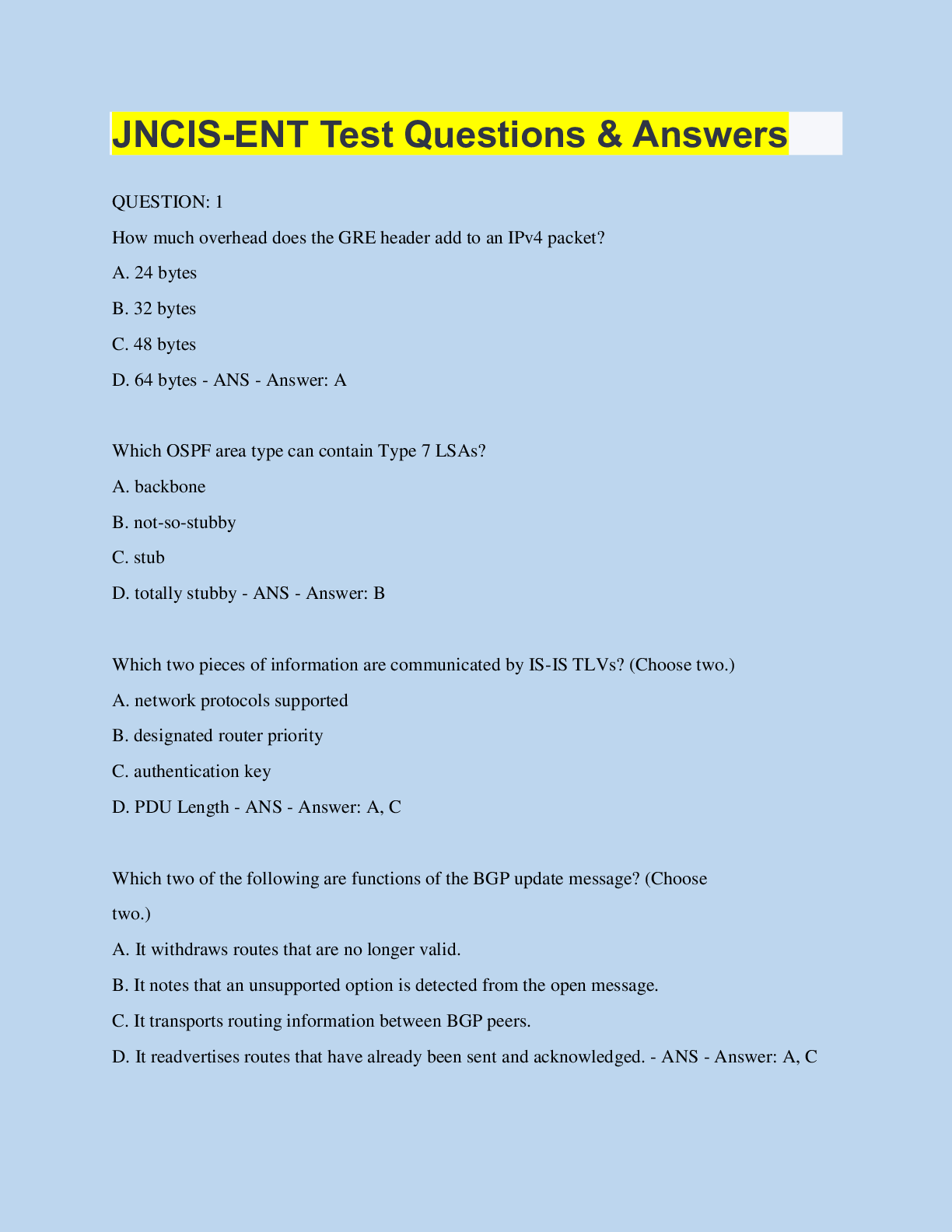
JNCIS-ENT Test Questions & Answers
QUESTION: 1
How much overhead does the GRE header add to an IPv4 packet?
A. 24 bytes
B. 32 bytes
C. 48 bytes
D. 64 bytes - ANS - Answer: A
Which OSPF area type can contain Type 7 LSAs?
A. backbone
B. not-so-stubby
C. stub
D. totally stubby - ANS - Answer: B
Which two pieces of information are communicated by IS-IS TLVs? (Choose two.)
A. network protocols supported
B. designated router priority
C. authentication key
D. PDU Length - ANS - Answer: A, C
Which two of the following are functions of the BGP update message? (Choose
two.)
A. It withdraws routes that are no longer valid.
B. It notes that an unsupported option is detected from the open message.
C. It transports routing information between BGP peers.
D. It readvertises routes that have already been sent and acknowledged. - ANS - Answer: A, C
Which routing-instance type allows the sharing of interface routes and the support
features used in source-based routing?
A. virtual-router
B. vrf
C. forwarding
D. multi-instance - ANS - Answer: C
Which statement describes the default Junos OS behavior for OSPF?
A. External LSAs are advertised in a stub area.
B. An ABR does not announce a default route into a stub area.
C. Stub area internal routers generate a default route.
D. Only totally stubby areas need a default route. - ANS - Answer: B
What are two valid BPDU types? (Choose two.)
A. topology change notification
B. configuration change
C. configuration
D. root bridge - ANS - Answer: A, C
QUESTION: 12
Which of the following is enabled by default on an EX Series switch?
A. MAC move limiting
B. storm control
C. IP source guard
D. dynamic ARP inspection - ANS - Answer: B
Which three statements correctly describe the default BGP advertisement behavior
in the Junos OS? (Choose three.)
A. Routes learned through EBGP are advertised to IBGP peers.
B. Routes learned through EBGP are advertised to other EBGP peers.
C. Routes learned through IBGP are advertised to other IBGP peers.
D. Routes learned through IBGP will be advertised to EBGP peers.
E. Routes learned through an IGP are automatically advertised to EBGP peers. - ANS - Answer:
A, B, D
When loop protection is enabled on an interface, what happens when the port stops
receiving BPDUs?
A. The port is placed in a loop-inconsistent role.
B. The port is placed into listening mode.
C. The port is transitioned into a forwarding state.
D. The interface is disabled. - ANS - Answer: A
Which OSPF LSA type is sent by all routers in an area to advertise its connected
subnets?
A. router
B. network
C. external
D. summary - ANS - Answer: A
Which command correctly assigns AS 65432 as the local router's autonomous
system?
A. set protocols bgp local-as 65432
B. set routing-options local-as 65432
C. set protocols bgp autonomous-system 65432
D. set routing-options autonomous-system 65432 - ANS - Answer: D
Which statements are true about graceful Routing Engines switchover (GRES)?
A. Configuration on both Routing Engines must be synchronized.
B. The backup Routing Engine cannot be managed through IP address because RPD
does not run on backup the Routing Engine.
C. Different hostnames must be configured on both Routing-Engines.
D. Both Routing-Engines are managed through a single out-of-band-management
IP address. - ANS - Answer: A
Configuring bpdu-timeout-action enables which protection mechanism?
A. root protection
B. BPDU protection
C. loop protection
D. RSTP protection - ANS - Answer: C
Which Junos command correctly configures the ge-0/0/0.0 interface to operate only
for IS-IS Level 2?
A. set interfaces ge-0/0/0.0 family iso level 2 enable
B. set interfaces ge-0/0/0.0 family iso level 1 disable
C. set protocols isis interface ge-0/0/0.0 level 2 enable
D. set protocols isis interface ge-0/0/0.0 level 1 disable - ANS - Answer: D
Which two OSPF LSA types can be used to advertise routes between areas?
[Show More]







.png)