304 ACLS Exam Study Questions
COMPILED IN 2022 – COMPLETE SOLUTION
Concept that helps to promote effective/efficient teamwork & reduces likelihood of errors is called
_____. - ✔✔Problem solving
In 6-person high-perfo
...
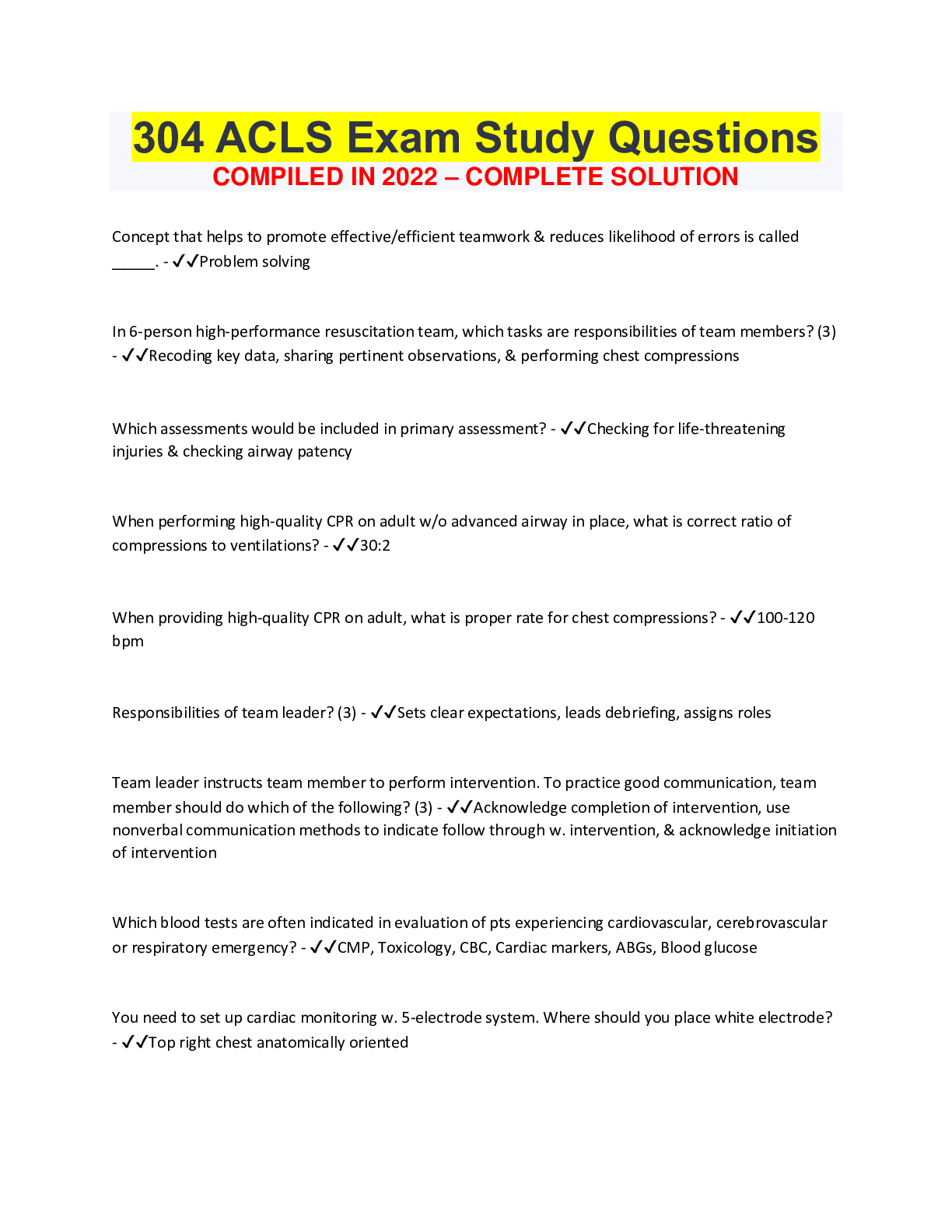
304 ACLS Exam Study Questions
COMPILED IN 2022 – COMPLETE SOLUTION
Concept that helps to promote effective/efficient teamwork & reduces likelihood of errors is called
_____. - ✔✔Problem solving
In 6-person high-performance resuscitation team, which tasks are responsibilities of team members? (3)
- ✔✔Recoding key data, sharing pertinent observations, & performing chest compressions
Which assessments would be included in primary assessment? - ✔✔Checking for life-threatening
injuries & checking airway patency
When performing high-quality CPR on adult w/o advanced airway in place, what is correct ratio of
compressions to ventilations? - ✔✔30:2
When providing high-quality CPR on adult, what is proper rate for chest compressions? - ✔✔100-120
bpm
Responsibilities of team leader? (3) - ✔✔Sets clear expectations, leads debriefing, assigns roles
Team leader instructs team member to perform intervention. To practice good communication, team
member should do which of the following? (3) - ✔✔Acknowledge completion of intervention, use
nonverbal communication methods to indicate follow through w. intervention, & acknowledge initiation
of intervention
Which blood tests are often indicated in evaluation of pts experiencing cardiovascular, cerebrovascular
or respiratory emergency? - ✔✔CMP, Toxicology, CBC, Cardiac markers, ABGs, Blood glucose
You need to set up cardiac monitoring w. 5-electrode system. Where should you place white electrode?
- ✔✔Top right chest anatomically orientedWhat is rapid assessment? - ✔✔Quick assessment to ensure safety, form initial impression of pt, & if pt
appears to be unresponsive check for responsiveness/breathing/pulse
During primary assessment, what tool would you use to determine pts LOC? - ✔✔AVPU Model
When providing high-quality CPR on adult, what is proper depth for chest compressions? - ✔✔2-2.4"
Team member confirms message is received & understood. What communication technique is team
member using? - ✔✔Closed-Loop Communication
What end-tidal carbon dioxide (ETCO2) value confirms adequate ventilation in intubated pt w.
respiratory arrest? - ✔✔35-45 mmHg
CPR:
Which statements apply to providing high-quality chest compressions? (3) - ✔✔Minimize interruptions,
proper depth, proper rate
Closed-loop communication - ✔✔Communication technique used to prevent misunderstandings;
receiver confirms message has been received & understood.
Critical thinking uses - ✔✔Obtaining an initial impression, determining course of action, anticipating
roles & functions as part of team based on pts presentation/condition, consistently re-evaluating
situation for changes, interpreting changes & applying them to pts care & tx, & modifying actions based
on changes you observe.
Team Leader Responsibilities - ✔✔Assigns & understands team roles - Sets clear expectations -
Prioritizes, directs & acts decisively - Encourages/allows team input & interaction - Focuses on big
picture - Monitors performance while providing support - Acts as role model - Coaches team - Reevaluates & summarizes progress - Leads debriefing
Team Member Responsibilities - ✔✔Have necessary knowledge/skills to perform assigned role - Stay in
assigned role but assist others PRN, as long as they're able to maintain own responsibilities -
Communicate effectively w. team leader if they: Feel they're lacking any knowledge/skills to performassigned roles, identify something team leader may have overlooked, or recognize dangerous
situation/need for urgent action - Share info w. other team members - Focus on achieving goals - Ask
pertinent questions & share pertinent observations - Participate in debriefing sessions - Crew
Crew Resource Management - ✔✔Concept helps to promote effective/efficient teamwork & reduce
likelihood of errors. Emphasizes using all available resources (people, equipment, procedures) to reduce
likelihood of human error & promote effective/efficient teamwork. Guides team members to
communicate directly & effectively w. team leader about dangerous or time-critical decisions. When
problem arises, team members must get attention of team leader, state concern, describe problem as
they see it & suggest solution. Team leader provides direction, enabling team to work together to
resolve issue.
6-Person High-Performance Resuscitation Team - ✔✔Includes 3 who fulfill CPR/defib roles & 3 who
perform leadership/supportive roles
Data Manager - ✔✔Responsible for communicating & recording key data during resuscitation effort (i.e.
data r/t med admin & interruptions to chest compressions)
Airway manager & ventilator - ✔✔Responsible for managing airway & providing ventilations. Trained RT,
if available, would fill role
Compressor - ✔✔Responsible for chest compressions
AED/Defibrillator Operator - ✔✔Responsible for managing AED or defibrillator & establishing any other
monitoring. Also, relieves team member performing compressions
Team Leader - ✔✔Responsible for prioritizing & directing other team members' actions.
Medication Administrator - ✔✔Responsible for establishing vascular access & administering
medications.
Assess, Recognize & Care - ✔✔Describes ongoing process of gathering data about pt condition, using
data to identify problem & intervening to address problem. Acutely ill pt condition can change rapidly(for better or worse), you must continuously assess pt, recognize whats happening & provide care
accordingly
Assess - ✔✔Process of gathering data to help determine whats happening. To ensure most pressing
problems addressed first, take phased, systematic approach to assessment: perform rapid assessment,
primary assessment & when condition allows, secondary assessment.
In emergency situation, assessment ongoing.
Recognize - ✔✔After you gather assessment data, use critical thinking, your past clinical experience and
your general knowledge to correctly interpret the meaning of the data and gain an understanding of the
patient's clinical situation and care needs. This understanding enables you to determine your next steps.
Care - ✔✔Implement appropriate care based on understanding of condition. Proper care can't be
provided w/o effective assessment & accurate recognition of condition
Primary assessment - ✔✔Focused assessment of airway, breathing, circulation, disability, & exposure
(ABCDE) to identify potentially life-threatening conditions & address them immediately
Secondary assessment - ✔✔Broader assessment to narrow list of differential dx & discover underlying
causes. Includes focused hx, exam, & diagnostic testing
When advanced airway in place & pt in cardiac arrest, compressions & ventilations delivered
continuously w. no interruptions.
1 provider delivers __________ q6s while 2nd provider performs compressions at rate of 100-120/min -
✔✔1 ventilation
Provide minimal level of supplemental oxygen needed to maintain oxygen saturation of at least _____ -
✔✔94%.
Based on visual survey, pt appears to be unresponsive. What should your immediate next action be? -
✔✔Check for responsiveness using shout-tap-shout sequenceIf they're unresponsive, call for additional resources & simultaneously check breathing/pulse for 5-10
seconds
Brown lead going right side of chest in __________ - ✔✔Middle (~3-4th ICS)
Which complications can occur when providing ventilations w. BVM resuscitator? -
✔✔Regurgitation/Aspiration (d/t gastric insufflation) - Tension Pneumothorax (d/t barotrauma) -
Decreased Cardiac Output (d/t decreased venous return)
You need to obtain intraosseous (IO) access. Identify preferred site. - ✔✔Anterior proximal tibia often
used bc it provides flat surface w. relatively thin outer layer of bone, large marrow cavity, & easily
identifiable landmarks to facilitate placement. Proximal humerus also used.
Which airway device is most appropriate as initial intervention for semiconscious pt who requires
ventilation w. BVM resuscitator? - ✔✔NPA (nasopharyngeal airway) may be used w. conscious,
semiconscious or unconscious pts
You have just placed advanced airway. How should you verify correct placement? - ✔✔Confirm initially,
if pt moved & ongoing basis.
Methods: Physical assessment (observing for bilateral chest rise & auscultating over lungs/epigastrium)
& confirmation tool (i.e. capnography)
Fogging in tube & improved O2 saturation on pulse oximetry aren't reliable methods of confirmation
Resuscitation team decides to place advanced airway in pt whose in cardiac arrest. How should
ventilations be provided following placement of airway? - ✔✔Provide 1 ventilation q6s w/o pausing
compressions
Which assessment could be made during rapid assessment? - ✔✔Pt is diaphoretic
When obtaining 12-lead ECG, where should electrodes for limb leads be placed? - ✔✔On upper arms
and on the thighs/calves
Avoid bony areas like the anklesECG rhythm strip part that's time from beginning of atrial depolarization to beginning of ventricular
depolarization - ✔✔PR Interval
EKG:
Heart's electrical conduction system part that generates electrical impulses initiating heartbeat
rhythm/rate: - ✔✔Sinoatrial (SA) node
Which anatomic landmark should be used to ensure proper placement of precordial electrodes for 12-
lead ECG? - ✔✔Angle of Louis (sternal angle), which is adjacent to 2nd rib. Then palpate down along
sternal border to identify 4th ICS
Don't place AED pads over___________ - ✔✔Pacemaker
Hover hands over chest but don't touch during: - ✔✔AED shock (to minimize time not performing
compressions)
Bag ventalition device holds ______mL - ✔✔700
If capnography is < 10 there may be probelm with _________ - ✔✔Compressions
Chest Compression Fraction - ✔✔Total percentage of time during resuscitation attempt in which active
chest compressions are being performed.
Needs to be >= 60% w. goal of 80
You'd expect to see ETCO2 < ___ in presence of hyperventilation - ✔✔35 mmHg
Which underlying mechanism can lead to hypoxia in pt w. right shift of oxygen-hemoglobin dissociation
curve? - ✔✔Decreased affinity for oxygen binding
[Show More]