TECH ELEVATOR TECHNICAL INTERVIEW TOPICS/QUESTIONS|WITH CORRECT ANSWERS
Physics > QUESTIONS & ANSWERS > Primavera - Online PHYSICS 1A PHYSICS 1 PhysicsA_Mod5_Homework (All)
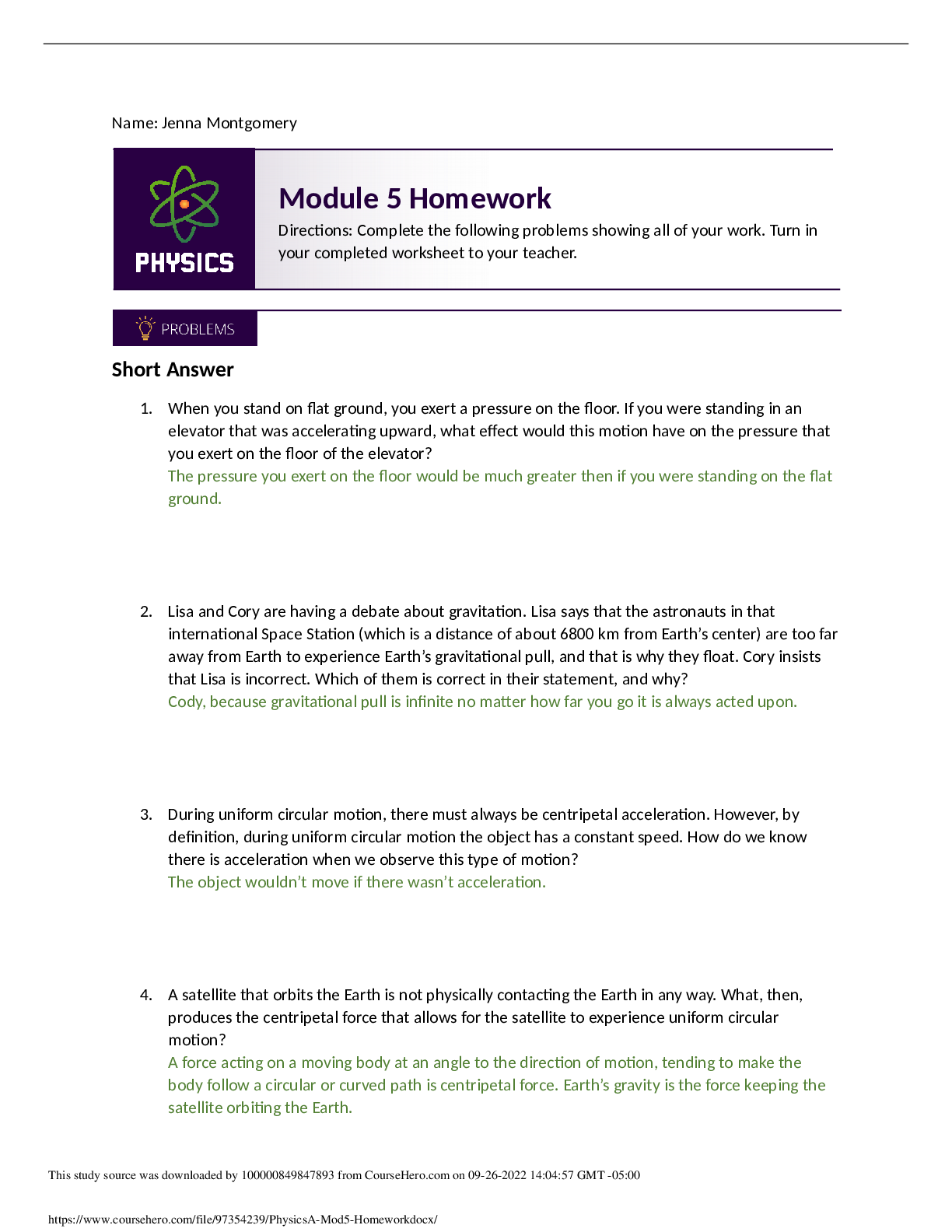
Name: Jenna Montgomery Short Answer 1. When you stand on flat ground, you exert a pressure on the floor. If you were standing in an elevator that was accelerating upward, what effect would this mot ... ion have on the pressure that you exert on the floor of the elevator? 2. Lisa and Cory are having a debate about gravitation. Lisa says that the astronauts in that international Space Station (which is a distance of about 6800 km from Earth’s center) are too far away from Earth to experience Earth’s gravitational pull, and that is why they float. Cory insists that Lisa is incorrect. Which of them is correct in their statement, and why? 3. During uniform circular motion, there must always be centripetal acceleration. However, by definition, during uniform circular motion the object has a constant speed. How do we know there is acceleration when we observe this type of motion? 4. A satellite that orbits the Earth is not physically contacting the Earth in any way. What, then, produces the centripetal force that allows for the satellite to experience uniform circular motion? Module 5 Homework Directions: Complete the following problems showing all of your work. Turn in your completed worksheet to your teacher. —go on to the next page— 5. Laura is holding a box full of paper to take to the recycling bin. She carries the box from one side of the room to the other. Has she done any work on the box? Why or why not? 6. Why must work be done at the beginning of a roller coaster ride in order for the ride to proceed?. Practice 7. A pressure sensor inside of a mixing tank is designed to turn red when the pressure inside the tank exceeds 1.9 kPa. If the sensor is a square, 10 cm on each side, how great a force must be exerted on the sensor in order for it to turn red? 8. A certain planet has a radius of 4990 km. If, on the surface of that planet, a 95.0 kg object has a weight of 591 N, then what is the mass of the planet? 9. A racecar is driving around a circular track. The car is moving with a speed of 49.7 m/s, and the track has a radius 114 m. What is the magnitude of the centripetal acceleration of the car? —go on to the next page— 10. Luther is designing a roller coaster for an amusement park. At one point, the roller coaster will enter a horizontal loop at a speed of 31.8 m/s. If Luther does not want the centripetal acceleration to exceed 29.0 m/s2, what is the minimum radius of the horizontal loop? 11. To train for the physical demands of a shuttle launch, a 78.4 kg astronaut is put into a large centrifuge, where they are spun at a high speed. The centrifuge has a radius of 6.40 m, and spins with a period of 1.84 seconds. What is the centripetal force experienced by the astronaut? 12. Martin is spinning a rope over his head with a weight attached to the end. The rope has a length of 1.7 m, and Martin spins it so that the weight has a velocity of 5.9 m/s. If the rope can only withstand a force of 88 N, what is the maximum mass the weight can have? 13. Claude is pushing a laboratory cart into the physics lab. The cart has a mass of 34.1 kg, and Claude pushes with a force of 19.0 N, at an angle of 17.6° below horizontal. If He pushes the cart for 7.40 m, how much work does he do on the cart? 14. Jenny is sledding down a hill. At one point, she has a velocity of 8.4 m/s. If Jenny has a mass of 59 kg, what is her kinetic energy at this point? —go on to the next page— 15. Samantha is on her bicycle, at the top of a 25 m hill. If Samantha and the bicycle have a combined mass of 73 kg, what is her gravitational potential energy at this point? 16. When a certain roller coaster is at the top of a 61 m hill, it has no velocity. As the coaster descends the hill, It gains speed. What is the roller coaster’s speed when the it has a height of 34 m above the ground? Application Brady is setting up a track for his toy car to race down. The track starts at the top of a staircase that is 3.60 meters tall. At the bottom of the staircase, the car runs through a horizontal loop. The toy car has a mass of 41.5 grams. Assume no friction is present. 17. At the top of the staircase, how much gravitational potential energy does the toy car have? 18. Upon reaching the bottom of the staircase, what is the velocity of the car? 19. The horizontal loop at the bottom of the staircase has a radius of 0.71 m. What is the centripetal force that the track exerts on the car when it is in the loop? (Hint: use the velocity value that you found in question 18) —go on to the next page— 20. The toy car’s 4 wheels have a total contact area of 5×10⁻³ m2 . What is the pressure that the car exerts on the track? 200m [Show More]
Last updated: 3 years ago
Preview 1 out of 5 pages
Buy this document to get the full access instantly
Instant Download Access after purchase
Buy NowInstant download
We Accept:

Can't find what you want? Try our AI powered Search
Connected school, study & course
About the document
Uploaded On
Sep 26, 2022
Number of pages
5
Written in
All
This document has been written for:
Uploaded
Sep 26, 2022
Downloads
0
Views
80
Scholarfriends.com Online Platform by Browsegrades Inc. 651N South Broad St, Middletown DE. United States.
We're available through e-mail, Twitter, and live chat.
FAQ
Questions? Leave a message!
Copyright © Scholarfriends · High quality services·



.png)
.png)
.png)
.png)
.png)