Information granularity - ANSWER refers to the extent of detail within the information (fine and detailed or coarse and abstract) Granularity refers to the extent of detail within the information (fine and detailed or "c
...
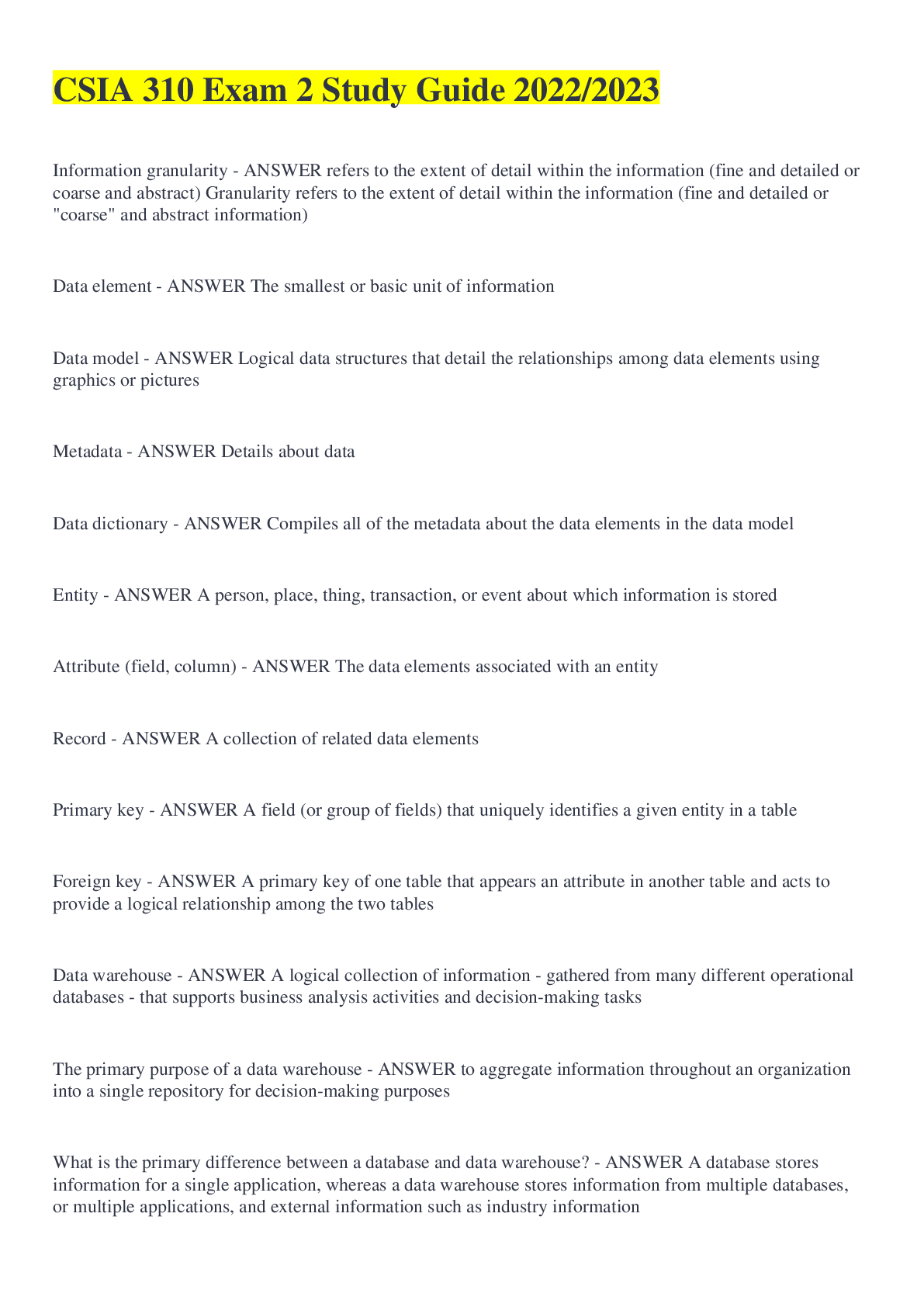
Information granularity - ANSWER refers to the extent of detail within the information (fine and detailed or coarse and abstract) Granularity refers to the extent of detail within the information (fine and detailed or "coarse" and abstract information)
Data element - ANSWER The smallest or basic unit of information
Data model - ANSWER Logical data structures that detail the relationships among data elements using graphics or pictures
Metadata - ANSWER Details about data
Data dictionary - ANSWER Compiles all of the metadata about the data elements in the data model
Entity - ANSWER A person, place, thing, transaction, or event about which information is stored
Attribute (field, column) - ANSWER The data elements associated with an entity
Record - ANSWER A collection of related data elements
Primary key - ANSWER A field (or group of fields) that uniquely identifies a given entity in a table
Foreign key - ANSWER A primary key of one table that appears an attribute in another table and acts to provide a logical relationship among the two tables
Data warehouse - ANSWER A logical collection of information - gathered from many different operational databases - that supports business analysis activities and decision-making tasks
The primary purpose of a data warehouse - ANSWER to aggregate information throughout an organization into a single repository for decision-making purposes
What is the primary difference between a database and data warehouse? - ANSWER A database stores information for a single application, whereas a data warehouse stores information from multiple databases, or multiple applications, and external information such as industry information
Where the business has been. - ANSWER Historical perspective is always important in determining trends and patterns of behavior.
Where it is now. - ANSWER Current situations are critical to either modify if not acceptable or encourage if they are trending in the right direction.
Where it will be in the near future. - ANSWER Being able to predict with surety the direction of the company is critical to sound planning and to creating sound business strategies.
Dimension - ANSWER A particular attribute of information.
Cube - ANSWER Common term for the representation of multidimensional information
Infographics - ANSWER Present the results of data analysis, displaying the patterns, relationships, and trends in a graphical format.
Analysis paralysis - ANSWER Occurs when the user goes into an emotional state of over-analysis (or over-thinking) a situation so that a decision or action is never taken, in effect paralyzing the outcome
Data visualization - ANSWER Describes technologies that allow users to "see" or visualize data to transform information into a business perspective.
Data visualization tools - ANSWER Move beyond Excel graphs and charts into sophisticated analysis techniques such as pie charts, controls, instruments, maps, time-series graphs, and more.
Business intelligence dashboards - ANSWER Track corporate metrics such as critical success factors and key performance indicators and include advanced capabilities such as interactive controls allowing users to manipulate data for analysis.
Data artist - ANSWER a business analytics specialist who uses visual tools to help people understand complex data
National service providers (NSPs) - ANSWER Private companies that own and maintain the worldwide backbone that supports the Internet
Network access points (NAPs) - ANSWER Traffic exchange points in the routing hierarchy of the Internet that connects NSPs
Regional service providers (RSPs) - ANSWER Offer Internet service by connecting to NSPs, but they also can connect directly to each other
Bandwidth - ANSWER The maximum amount of data that can pass from one point to another in a unit of time
lil bit - ANSWER you cant f*** with me if you wanted you
Bit Rate - ANSWER bits per second (bps)
Modem - ANSWER A device which allows a computer to transmit and receive data
Broadband - ANSWER A high-speed Internet connection that is always connected
Protocol - ANSWER A standard that specifies the format of data as well as the rules to be followed during transmission
Network Convergence - ANSWER The efficient coexistence of telephone, video, and data communication within a single network, offering convenience and flexibility not possible with separate infrastructures
Unified communications (UC) - ANSWER The integration of communication channels into a single service
Peer-to-peer (P2P) - ANSWER A computer network that relies on the computing power and bandwidth of the participants in the network rather than a centralized server.
Voice over IP (VoIP) - ANSWER Uses IP technology to transmit telephone calls.
Skype - ANSWER pairs P2P (peer-to-peer) technology with a PC's sound card to create a voice service, which the user can use to call other Skype users
Vonage - ANSWER lets the user place calls to any person who has a mobile or landline (regular telephone) number
Internet Protocol TV (IPTV) - ANSWER Distributes digital video content using IP across the Internet and private IP networks
Intranet - ANSWER A restricted network that relies on Internet technologies to provide an Internet-like environment within the company for information sharing, communications, collaboration, web publishing, and the support of business process.
Extranet - ANSWER An extension of an intranet that is only available to authorized outsiders, such as customers, partners, and suppliers.
Virtual Private Network (VPN) - ANSWER Companies can establish direct private network links among themselves or create private, secure Internet access, in effect a "private tunnel" within the Internet.
SSL Certificate - ANSWER An electronic document that confirms the identity of a website or server and verifies that a public key belongs to a trustworthy individual or company
Secure hypertext transfer protocol (SHTTP or HTTPS) - ANSWER A combination of HTTP and SSL to provide encryption and secure identification of an Internet server
Personal area networks (PAN) - ANSWER Provides communication over a short distance that is intended for use with devices that are owned and operated by a single user (40 feet).
Local Area Network (LAN) - ANSWER connects a group of computers in close proximity, such as an office building, school or home
Wireless LAN (WLAN) - ANSWER A local area network that uses radio signals to transmit and receive data over distances of a few hundred feet.
Campus Area Network (CAN) - ANSWER connects several local buildings
Wireless MAN (WMAN) - ANSWER A metropolitan (wide) area network that uses radio signals to transmit and receive data.
Worldwide Interoperability for Microwave Access (WiMAX) - ANSWER A communications technology aimed at providing high-speed wireless data over metropolitan area networks.
Wireless WAN (WWAN) - ANSWER A wide area network that uses radio signals to transmit and receive data.
Wireless ("untethered") benefits - ANSWER increases productivity
speeds delivery to market
reduces operating costs
Radio-Frequency Identification (RFID) - ANSWER Uses electronic tags and labels to identify objects wirelessly over short distances
RFID Tag - ANSWER An electronic identification device that is made up of a chip and antenna
RFID reader (RFID interrogator) - ANSWER A transmitter/receiver that reads the contents of RFID tags in the area
Passive RFID tag - ANSWER Does not have a power source
Active RFID tag - ANSWER Contains a transmitter and a power source
Semipassive RFID tags - ANSWER use a battery to run the microchip's circuitry, but communicate by drawing power from the RFID reader.
Asset tracking - ANSWER occurs when a company places active or semi-passive RFID tags on expensive products or assets to gather data on the items' location with little or no manual intervention.
RFID accelerometer - ANSWER a device that measures the acceleration (the rate of change of velocity) of an item and is used to track truck speeds or taxi cab speeds.
Chipless RFID tags - ANSWER use plastic or conductive polymers instead of silicon-based microchips, allowing them to be washed or exposed to water without damaging the chip.
Global positioning system (GPS) - ANSWER A satellite-based navigation system providing extremely accurate position, time, and speed information
Geocache - ANSWER A GPS technology adventure game that posts the longitude and latitude location for an item on the Internet for users to find
Geocoin - ANSWER A round coin-sized object uniquely numbered and hidden in geocache
Automatic vehicle location (AVL) - ANSWER Uses GPS tracking to track vehicles
Geographic Information systems (GIS) - ANSWER Consists of hardware, software, and data that provide location information for display on a multidimensional map
Spatial data (geospatial data or geographic information) - ANSWER Identifies the geographic location of features and boundaries on Earth, such as natural or constructed features, oceans, and more.
Geocoding - ANSWER a coding process that assigns a digital map feature an attribute that serves as a unique ID (tract number, node number) or classification
GIS professionals are certified - ANSWER in geocoding practices to ensure industry standards are met when classifying spatial data.
Location Based Services (LBS) - ANSWER Applications that use location information to provide a service
Eintegration - ANSWER use of the Internet to provide customers with the ability to gain personalized information by querying corporate databases and their information sources.
Integration - ANSWER Allows separate systems to communicate directly with each other, eliminating the need for manual entry into multiple systems
Application integration - ANSWER the integration of a company's existing management information systems
Data integration - ANSWER the integration of data from multiple sources, which provides a unified view of all data
Forward integration - ANSWER takes information entered into a given system and sends it automatically to all downstream systems and processes
Backward integration - ANSWER takes information entered into a given system and sends it automatically to all upstream systems and processes
[Show More]