History > QUESTIONS & ANSWERS > Ap Euro Practice Exam Questions and Answers 2022 (All)
Ap Euro Practice Exam Questions and Answers 2022
Document Content and Description Below
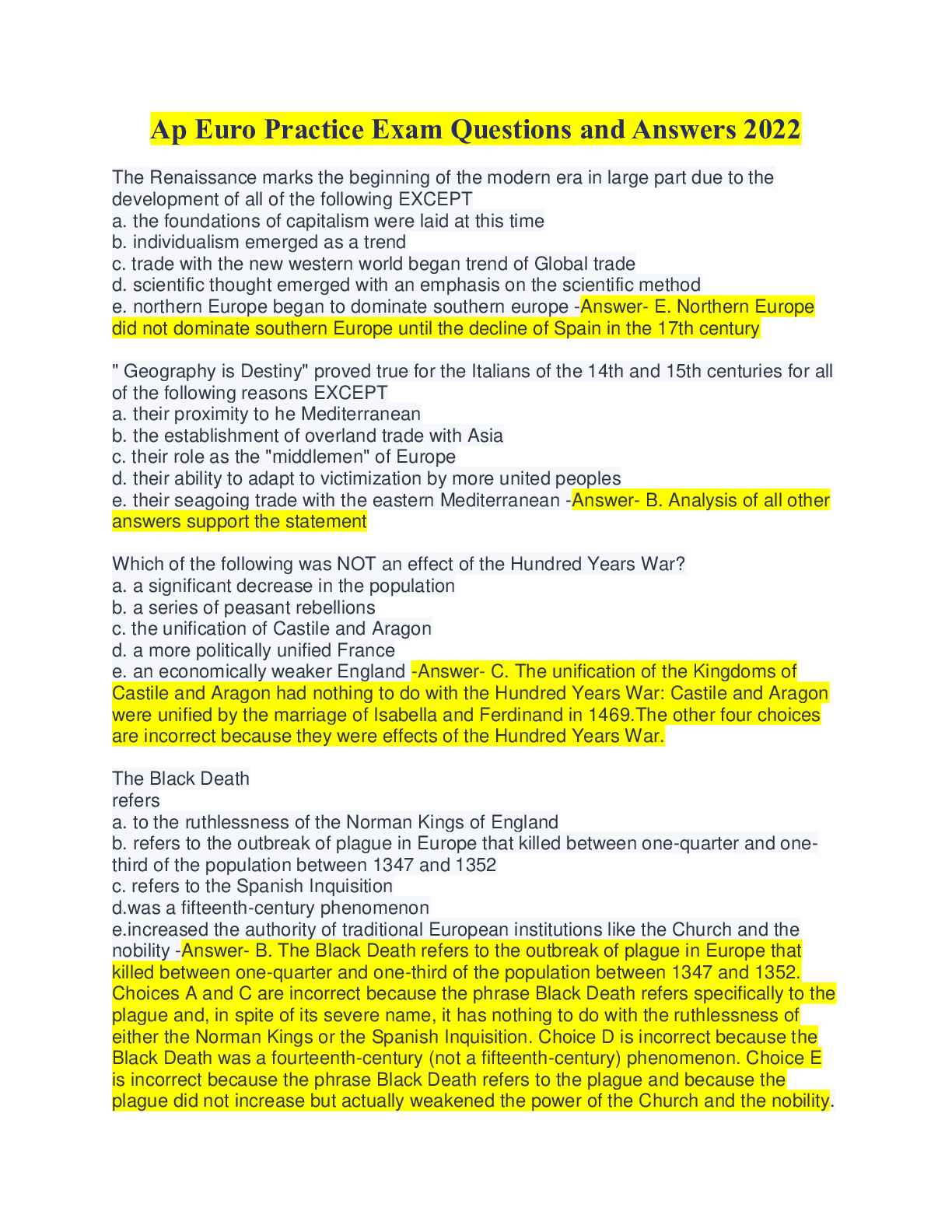
Ap Euro Practice Exam Questions and Answers 2022 The Renaissance marks the beginning of the modern era in large part due to the development of all of the following EXCEPT a. the foundations of cap ... italism were laid at this time b. individualism emerged as a trend c. trade with the new western world began trend of Global trade d. scientific thought emerged with an emphasis on the scientific method e. northern Europe began to dominate southern europe -Answer- E. Northern Europe did not dominate southern Europe until the decline of Spain in the 17th century " Geography is Destiny" proved true for the Italians of the 14th and 15th centuries for all of the following reasons EXCEPT a. their proximity to he Mediterranean b. the establishment of overland trade with Asia c. their role as the "middlemen" of Europe d. their ability to adapt to victimization by more united peoples e. their seagoing trade with the eastern Mediterranean -Answer- B. Analysis of all other answers support the statement Which of the following was NOT an effect of the Hundred Years War? a. a significant decrease in the population b. a series of peasant rebellions c. the unification of Castile and Aragon d. a more politically unified France e. an economically weaker England -Answer- C. The unification of the Kingdoms of Castile and Aragon had nothing to do with the Hundred Years War: Castile and Aragon were unified by the marriage of Isabella and Ferdinand in 1469.The other four choices are incorrect because they were effects of the Hundred Years War. The Black Death refers a. to the ruthlessness of the Norman Kings of England b. refers to the outbreak of plague in Europe that killed between one-quarter and one-third of the population between 1347 and 1352 c. refers to the Spanish Inquisition d.was a fifteenth-century phenomenon e.increased the authority of traditional European institutions like the Church and the nobility -Answer- B. The Black Death refers to the outbreak of plague in Europe that killed between one-quarter and one-third of the population between 1347 and 1352. Choices A and C are incorrect because the phrase Black Death refers specifically to the plague and, in spite of its severe name, it has nothing to do with the ruthlessness of either the Norman Kings or the Spanish Inquisition. Choice D is incorrect because the Black Death was a fourteenth-century (not a fifteenth-century) phenomenon. Choice E is incorrect because the phrase Black Death refers to the plague and because the plague did not increase but actually weakened the power of the Church and the nobility. Fifteenth-century attempts by the cardinals to reform, reunite, and reinvigorate the Church are known collectively as a.the Reformation b.the Counter-Reformation c.the Inquisition d.the Conciliar Movement e.the Court of the Star Chamber -Answer- D. The fifteenth-century attempts by councils of cardinals to reform, reunite, and reinvigorate the Church are known collectively as the Conciliar Movement. Choice A is incorrect because, although the leaders of the movement that came to be known as the Reformation did originally have as their goal reforming and reinvigorating the Church, they were not cardinals in the Church and their movement was not one of reunification. Choice B is incorrect because, although the socalled Counter-Reformation also had reform as one of its goals, it increasingly came to be concerned with stamping out Protestantism and was also not a movement particular to the cardinals. Choice C is incorrect because the Inquisition was an instrument of the Church invented in Spain to enforce the conversion of Muslims and Jews, and later used to root out Protestants. Finally, choice E is incorrect because the Court of the Star Chamber was an instrument used by the early Tudor kings of England to curb the power of the nobility and had nothing to do with Church reform. Which of the following is NOT a way in which fifteenth-century armies differed from their predecessors? a.They were commanded by officers of noble birth. b.They were composed of mercenary soldiers. c.They fought for pay and spoils rather than honor and feudal obligation. d.They relied on artillery and infantry more than on cavalry. e.They created a greater need for taxes. -Answer- A. The commanding of armies by men of noble birth was a continuous aspect of European armies that did not change until the nineteenth century. Choices B-E are incorrect because these are all ways in which fifteenth-century armies did differ from their predecessors. Of the fifteenth-century attempts by monarchs to consolidate and centralize power, the most successful was in a. England b. France c. Germany d. Italy e. Spain -Answer- E. Spain's Isabella and Ferdinand were most successful at consolidating and centralizing political power in the fifteenth century, as they were able to use their control of the Church and the combined wealth of Castile and Aragon to curb the power of the nobility and enforce uniform loyalty to the crown. Choice A is incorrect because in England the process of centralization was delayed by an internal power struggle between two rival branches of the royal family known as the War of the Roses, though some progress was made after Henry Tudor came to power in 1485. Choice B is incorrect because France did make progress in consolidating and centralizing power, second only to Spain, but French progress was delayed by the need to subdue the powerful Duke of Burgundy, which was not accomplished until 1477. Choice C is incorrect because German nobles were able to retain considerable autonomy from the Holy Roman Emperor who was an elected ruler, which obviously impeded the consolidation of power. And choice D is incorrect because the Italian peninsula still consisted of independent city-states that were ruled by powerful merchant-princes. n the fifteenth century, the Holy Roman Emperor a. was another name for the pope b. was dethroned in the Hundred Years War c. was elected by a seven-member council of German archbishops and nobles d. was Ferdinand of Aragon e. sponsored the voyages of Christopher Columbus -Answer- C. The Holy Roman Emperor was elected by a seven-member council consisting of the archbishops of Mainz, Trier, and Cologne, the Duke of Saxony, the Margrave of Brandenburg, the Count Palatine, and the King of Bohemia. Choice A is incorrect because the Holy Roman Emperor was a specific title which did not refer to the pope. Choice B is incorrect because the Hundred Years War was an English dynastic struggle that did not involve or affect the Holy Roman Emperor. Choice D is incorrect because Ferdinand of Aragon was never Holy Roman Emperor. Choice E is incorrect because the voyages of Columbus were sponsored by the Spanish monarchy. The era of daring exploration and discovery at the end of the fifteenth and beginning of the sixteenth centuries was inspired by a. the Reformation b. the invention of the steam engine c. the need to escape the Black Death d. the search for gold and competition for the spice trade e. the successful circumnavigation of the globe by the Magellan expedition -Answer- D. It was the search for gold and competition for the spice trade between Spain and Portugal that provided the inspiration for the era of daring exploration and discovery at the end of the fifteenth and beginning of the sixteenth centuries. Choice A is incorrect because the Reformation's focus was internal to Europe and had nothing to do with exploration outside European borders. Choice B is incorrect because the steam engine was not widely used to power ships until the nineteenth century, not in the fifteenth and sixteenth centuries. Choice C is also incorrect not only because the timing is wrong—the Black Death was a fourteenth-century phenomenon that had ended by the fifteenth- to sixteenth-century time period mentioned in the question— but also because it was a sickness that killed much of the population of Europe and crippled Europe's economy and had nothing to do with exploring the rest of the world beyond Europe. Finally, choice E is incorrect because the successful circumnavigation of the globe by the Magellan expedition was an example and, in some ways, a culmination of the era of exploration and discovery, but it was not its inspiration. Which of the following was NOT an effect of the creation of a Spanish Empire in the New World? a. inflation in the economy of Europe b. the establishment of Roman Catholicism in the New World c. the rise of a wealthy merchant class in Europe d. the establishment of a hierarchical social structure in Europe e. the establishment of a system of economic dependence between Europe and the New World -Answer- D. The hierarchical social structure of Europe was not a result of the creation of a Spanish Empire in the New World; that social structure dates back to the early medieval period. Choice A is incorrect because the influx of new wealth from Spain's New World Empire did cause inflation in Europe. Choice B is incorrect because the creation of Spain's New World Empire also involved missionaries who firmly established Christianity there. Choice C is incorrect because the wealth gained in trade with the New World Empire did lead to the rise of a wealthy merchant class. Choice E is incorrect because it did foster economic dependence between Europe and the New World. Which of the following was NOT an effect of the creation of a Spanish Empire in the New World? a.inflation in the economy of Europe b.the establishment of Roman Catholicism in the New World c.the rise of a wealthy merchant class in Europe d.the establishment of a hierarchical social structure in Europe e.the establishment of a system of economic dependence between Europe and the New World -Answer- C. The religion of Renaissance Italy, which was Catholicism, was shared by many of the European kingdoms. Choice A is incorrect because the Italian peninsula's geographical location wasa reason the Renaissance began here: As the gateway to Europe for Eastern trade coming in through the Mediterranean Sea, Italy was the first region to benefit from economic recovery and the influx of ancient texts. Choices B, D, and E are incorrect because the fact that the Italian peninsula was organized politically into independent city-states (choice B) that competed with each other commercially (choice E) meant that the traditional nobility was less powerful and that social status was less hierarchical and based on occupation (choice D). All these factors allowed for the development of the individual ambition and civic pride that characterized Renaissance values and ideals. Which of the following is NOT a Renaissance value? a.mastery of ancient languages b.patronage of the arts c.scholarly achievement d.proficiency in the military arts e.civic duty -Answer- D. Proficiency in the military arts had been a traditional value of the nobility of medieval Europe, but it was downplayed in the Renaissance. The other choices are values particular to the Renaissance. Renaissance humanism a.devalued mastery of ancient languages b.urged the development of a single talent to perfection c.valued ancient philosophers as the final authorities on all matters d.denied the existence of God e.valued scholarship for its own sake and for the glory it brought the city-state -Answer- E. Renaissance humanism did indeed value scholarship. In contrast, choice A is incorrect because Renaissance humanism did not devalue the mastery of ancient languages; in contrast, it sought to revive and encourage such learning of Greek and Latin, for example. Choice B is incorrect because Renaissance humanism emphasized well-roundedness, not just the perfection of a single talent (think of today's use of the term "Renaissance man"). Choice C is incorrect because, although Renaissance humanists respected the ancient philosophers, they did not view them as the final authorities but instead believed they could enter into conversation with and eventually surpass them. Finally, choice D is incorrect because Renaissance humanists did not deny the existence of God at all: In contrast, they believed that all of man's abilities were gifts from God that should be developed to the fullest. [Show More]
Last updated: 3 years ago
Preview 1 out of 29 pages
Buy this document to get the full access instantly
Instant Download Access after purchase
Buy NowInstant download
We Accept:

Also available in bundle (1)
Click Below to Access Bundle(s)
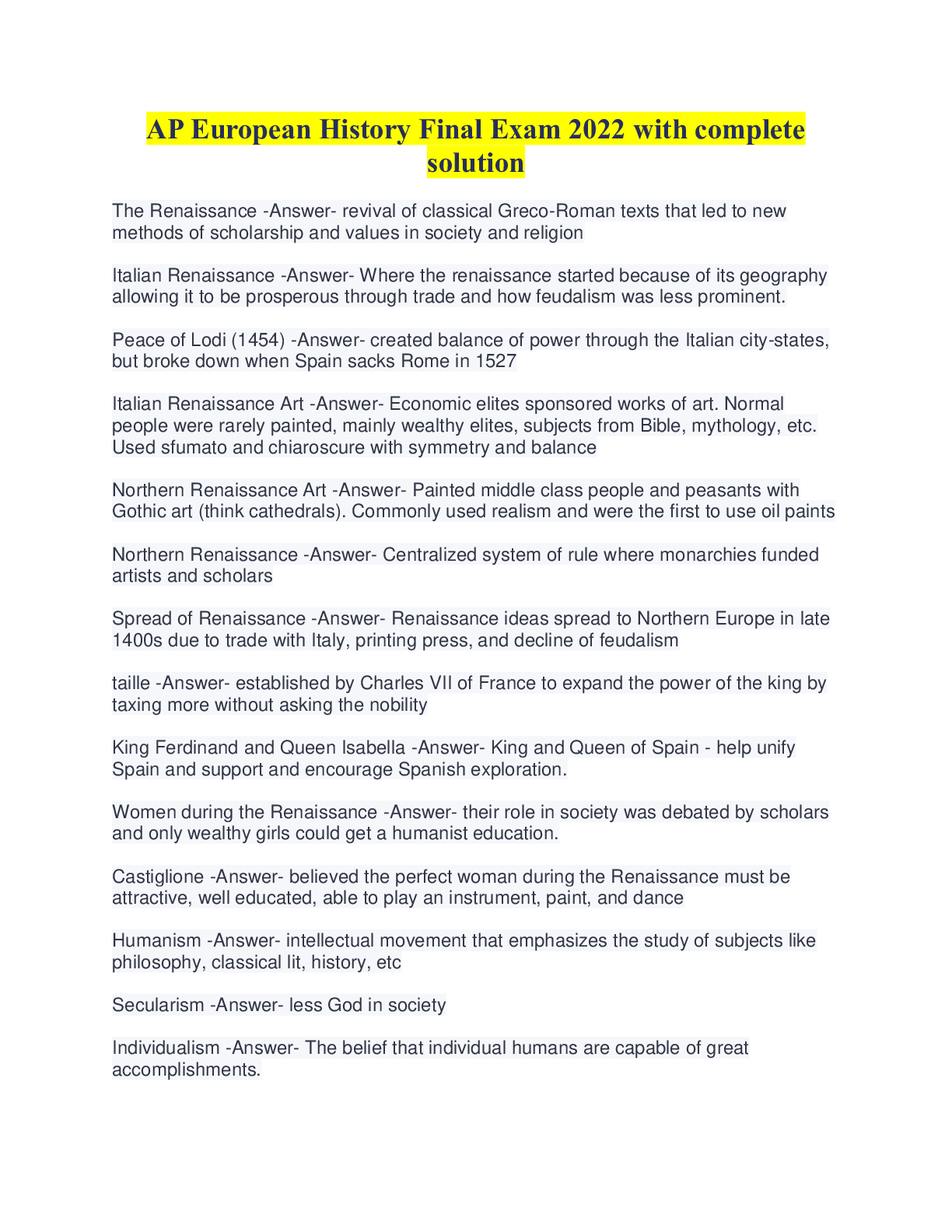
AP European History Final Exam 2022 with complete solution Ap Euro Practice Exam Questions and Answers 2022 AP European History Questions with Complete Solutions AP European History Exam Review For 2022 Studiers; Everything you need to pass AP European History Exam AP Euro Exam Review 2022 with complete solution
AP European History Final Exam 2022 with complete solution Ap Euro Practice Exam Questions and Answers 2022 AP European History Questions with Complete Solutions AP European History Exam Revi...
By Excel 3 years ago
$13
5
Reviews( 0 )
$10.00
Can't find what you want? Try our AI powered Search
Document information
Connected school, study & course
About the document
Uploaded On
Sep 14, 2022
Number of pages
29
Written in
All

Additional information
This document has been written for:
Uploaded
Sep 14, 2022
Downloads
0
Views
155