WGU C173 Study Guide Latest Update
Already Passed
- Correct Answer- subtraction operator, outputs the difference between the two input numbers
!= Correct Answer- a comparison operator used to compare if one operator i
...
WGU C173 Study Guide Latest Update
Already Passed
- Correct Answer- subtraction operator, outputs the difference between the two input numbers
!= Correct Answer- a comparison operator used to compare if one operator is not equal to
another
* Correct Answer- multiplication operator, outputs the product of the two input numbers
** Correct Answer- exponentiation operator, outputs the result of multiplying
by itself
number of times
/ Correct Answer- division operator, outputs the result of dividing the first number by the
second
% Correct Answer- modulo operator, outputs the remainder of dividing the first number by the
second
+ Correct Answer- addition operator, outputs the sum of the two input numbers OR
concatenation operator, joins two values together
< Correct Answer- a comparison operator used to compare if one operator is less than another
< Correct Answer- a comparison operator used to compare if one operator is less than another
<= Correct Answer- a comparison operator used to compare if one operator is less than or
equal to another = Correct Answer- This is an assignment statement. A variable is named
and also assigned a value or expression. If multiple values are assigned to the same named
variable, the last assignment is the one used.
= Correct Answer- assignment operator, assigns a value
== Correct Answer- a comparison operator used to compare if one operator is equal to another
> Correct Answer- a comparison operator used to compare if one operator is greater than
another
>= Correct Answer- a comparison operator used to compare if one operator is greater than or
equal to another
A = True / B = False: not (A and B) Correct Answer- Answer: not (True and False) = not (False) =
True
A = True / B = False: not (A or B) Correct Answer- Answer: not (True or False) = not (True) =
False
A = True / B = False: not A and not B Correct Answer- Answer: not True and not False = False
A = True / B = False: not A or not B Correct Answer- Answer: not True or not False = True
A biologist wants to process water salinity measurement until water temperature falls below a
certain level. Which control structure supports this biologist's needs? Correct Answer- While
loop
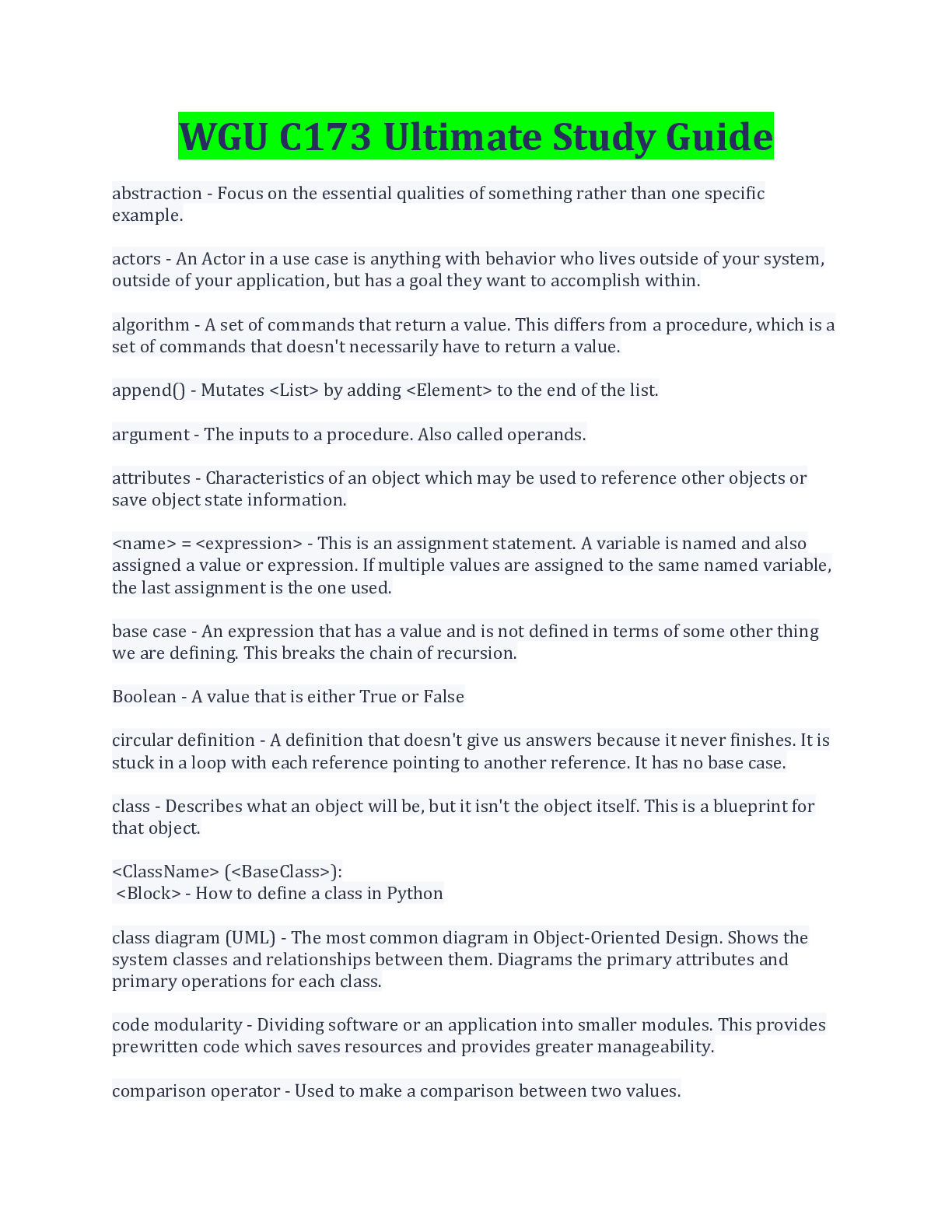
abstraction Correct Answer- Focus on the essential qualities of something rather than one
specific example.Activity Correct Answer- The actions required to achieve or abandon a goal
Actor Correct Answer- A person or entity that interacts with a system
actors Correct Answer- An Actor in a use case is anything with behavior who lives outside of
your system, outside of your application, but has a goal they want to accomplish within.
Addition Operator (Also Concatenates Strings) Correct Answer- +
algorithm Correct Answer- A set of commands that returns a value. This differs from a
procedure, which is a set of commands that doesn't necessarily have to return a value.
append() Correct Answer- Mutates by adding to the end of the list.
argument Correct Answer- The inputs to a procedure. Also called operands.
Assignment Operator (Assigns A Value) Correct Answer- =
attributes Correct Answer- Characteristics of an object which may be used to reference other
objects or save object state information.
base case Correct Answer- An expression that has a value and is not defined in terms of some
other thing we are defining. This breaks the chain of recursion.
benchmark Correct Answer- A known value of performance that can be compared against at a
future time and under a specific load.
Boolean Correct Answer- A value that is either True or Falsecircular definition Correct Answer- A definition that doesn't give us answers because it never
finishes. It is stuck in a loop with each reference pointing to another reference. It has no base
case.
class ():
Correct Answer- How to define a class in Python
class Correct Answer- Describes what an object will be, but it isn't the object itself. This is a
blueprint for that object.
class diagram (UML) Correct Answer- The most common diagram in Object-Oriented Design.
Shows the system classes and relationships between them. Diagrams the primary attributes
and primary operations for each class.
code modularity Correct Answer- Dividing software or an application into smaller modules. This
provides prewritten code which saves resources and provides greater manageability.
comparison operator Correct Answer- Used to make a comparison between two values.
Comparison Operator Equal To Correct Answer- ==
Comparison Operator Greater Than Correct Answer- >
Comparison Operator Greater Than or Equal To Correct Answer- >=
Comparison Operator Less Than Correct Answer- <
Comparison Operator Less Than or Equal To Correct Answer- <=Comparison Operator Not Equal Correct Answer- !=
compiled language Correct Answer- You write source code, and compiler goes through that
code and creates a separate file containing the machine code. That new file is used to run the
program. Can be faster than interpreted code. Must be compiled for a specific platform.
compiler Correct Answer- A program that takes source code and converts it to machine code by
producing a separate file.
Compiler Correct Answer- Converting high-level instruction into machine language.
concatenate Correct Answer- To connect or link in a series or chain.
constructor Correct Answer- A special type of function used to create a class or object. The
constructor prepares the new object for use.
def (): Correct Answer- Defines a function in Python.
dictionary Correct Answer- Provides a mapping between keys, which can be values of any
immutable type, and values, which can be any value. Because this is implemented using a hash
table, the time to lookup a value does not increase (significantly) even when the number of
keys increases.
Division Operator Correct Answer- /
Editor Correct Answer- Writing the program.encapsulation Correct Answer- Surrounding something to both keep the contents together and
also to protect those contents. In Object Orientation this refers to the idea of taking our
attributes and behaviors and bundling them together in the same unit, or the same class.
Exponent Operator Correct Answer- **
expression Correct Answer- Any Python construct that has a value
False and False Correct Answer- False
False and True Correct Answer- False
False or False Correct Answer- False
False or True Correct Answer- True
for in : Correct Answer- Executes a block once for each element of a
collection.
For Loop Correct Answer- Uses a counter to control iteration.
framework Correct Answer- Huge amounts of code already written, already tested, ready for
you to link to and use within your programs. Also called libraries.
function Correct Answer- In programming, this is a named section of a program that performs a
specific task. It only executes when invoked. Is able to


.png)
.png)
.png)
.png)
.png)
.png)




.png)
.png)
.png)
.png)