EMCC public speaking final exam (ch1-16)
COMPLETE SOLUTION
Chapter 1. _____ refers to the messages listeners and back to a speaker while he or she is speaking. -
✔✔feedback
Chapter 1. Shenita didn't know whether if s
...
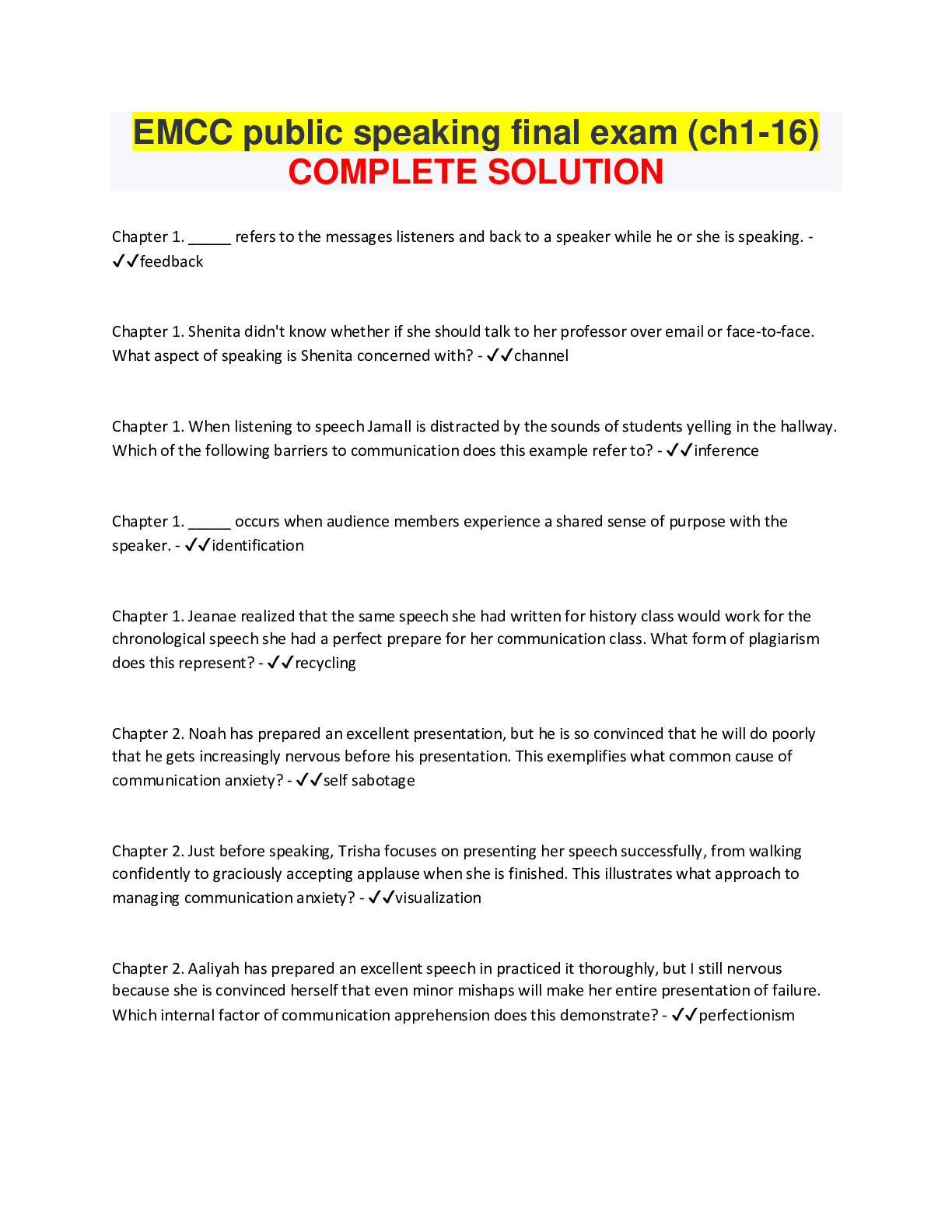
EMCC public speaking final exam (ch1-16)
COMPLETE SOLUTION
Chapter 1. _____ refers to the messages listeners and back to a speaker while he or she is speaking. -
✔✔feedback
Chapter 1. Shenita didn't know whether if she should talk to her professor over email or face-to-face.
What aspect of speaking is Shenita concerned with? - ✔✔channel
Chapter 1. When listening to speech Jamall is distracted by the sounds of students yelling in the hallway.
Which of the following barriers to communication does this example refer to? - ✔✔inference
Chapter 1. _____ occurs when audience members experience a shared sense of purpose with the
speaker. - ✔✔identification
Chapter 1. Jeanae realized that the same speech she had written for history class would work for the
chronological speech she had a perfect prepare for her communication class. What form of plagiarism
does this represent? - ✔✔recycling
Chapter 2. Noah has prepared an excellent presentation, but he is so convinced that he will do poorly
that he gets increasingly nervous before his presentation. This exemplifies what common cause of
communication anxiety? - ✔✔self sabotage
Chapter 2. Just before speaking, Trisha focuses on presenting her speech successfully, from walking
confidently to graciously accepting applause when she is finished. This illustrates what approach to
managing communication anxiety? - ✔✔visualization
Chapter 2. Aaliyah has prepared an excellent speech in practiced it thoroughly, but I still nervous
because she is convinced herself that even minor mishaps will make her entire presentation of failure.
Which internal factor of communication apprehension does this demonstrate? - ✔✔perfectionismChapter 2. Replacing the thought "everyone laugh at my speech because I sound so dumb" with "I've
done my research and I know what I'm talking about" is an example of ______? - ✔✔cognitive
reconstruction
Chapter 2. Developing a communication orientation refers to approaching public speaking by thinking of
it as a - ✔✔interactive process
Chapter 3. Which part of a speech would you find the main idea and supporting materials? - ✔✔body
Chapter 3. What plant strategies to speakers used to let their audience know they are through with one
point or part of their speech and moving onto the next? - ✔✔transitions
Chapter 3. Which part of the speech the speaker prepare first? - ✔✔body
Chapter 3. And his presentation, Jalen side of the words of his grandmother reflecting on the experience
of voting for the first time. What type of supporting material does this represent? - ✔✔testimony
Chapter 3. What kind of supporting material refers to facts that are measured mathematically? -
✔✔statistics
Chapter 4. Getting up and closing the window or door because you were having trouble hearing would
be the best way to handle what barrier to listening? - ✔✔Physical noise
Chapter 4. Thinking about the date you have after class rather than listening to your instructor
represents what common cause of inattention? - ✔✔Personal concerns
Chapter 4. As the speaker discuss the necessity of using only high-tech fitness machines, Bailey realize
that he was probably only saying this because he was a sales rep for the company that sold the
machines. Baily is practicing the art of ______ listening as she evaluates the message she hears. -
✔✔criticalChapter 4. As she listen to a presentation, Maria was impressed by the way the speaker clearly
distinguished each main point with carefully thought out transitions. Which aspect of the speech was
Maria considering? - ✔✔structure
Chapter 4. What form of listening is particularly important to protect us from the designs of dishonest
speakers? - ✔✔critical
Chapter 5. The age and gender of an audience are examples of _____ information. - ✔✔demographic
Chapter 5. _____ refers to stronghold thoughts and feelings that predispose us to respond positively or
negatively to a given topic or message. - ✔✔attitudes
Chapter 5. ______ are the physiological needs, desires, and impulses that move audiences to action. -
✔✔motives
Chapter 5. A _______ is what we know or what we think we know about a subject. - ✔✔belief
Chapter 5. Which of the following provides an example of an open ended question? - ✔✔How do you
feel about the subject of immigration reform?
Chapter 6. The specific purpose statement "to inform my listeners about heart disease in the latest
drugs for treating high blood pressure" will fall into which trap of poor topic selection? - ✔✔double
focus
Chapter 6. While a specific purpose should expressed with the speaker wants to accomplish, the thesis
statement should _______. - ✔✔Summarize the speaker central ideas
Chapter 6. What does the speaker do in the discovery phase of selecting a topic? - ✔✔Identify general
topic areas
Chapter 6. A speaker will engage in brainstorming during which part of the process of finding and
developing speech topics? - ✔✔Discovering a topicChapter 6. What does the specific purpose of a speech represent? - ✔✔The response desired from the
audience
Chapter 7. After she read the magazine article on social services, Hanna realized it was referring to
websites for women looking to find a date rather than state agencies that supplied aid to struggling
families. Which of the four Rs of evaluating sources Hanna using
[Show More]