Psychology > STUDY GUIDE > Developmental Psychology, Questions and answers, 2022 update, graded A+ (All)
Developmental Psychology, Questions and answers, 2022 update, graded A+
Document Content and Description Below
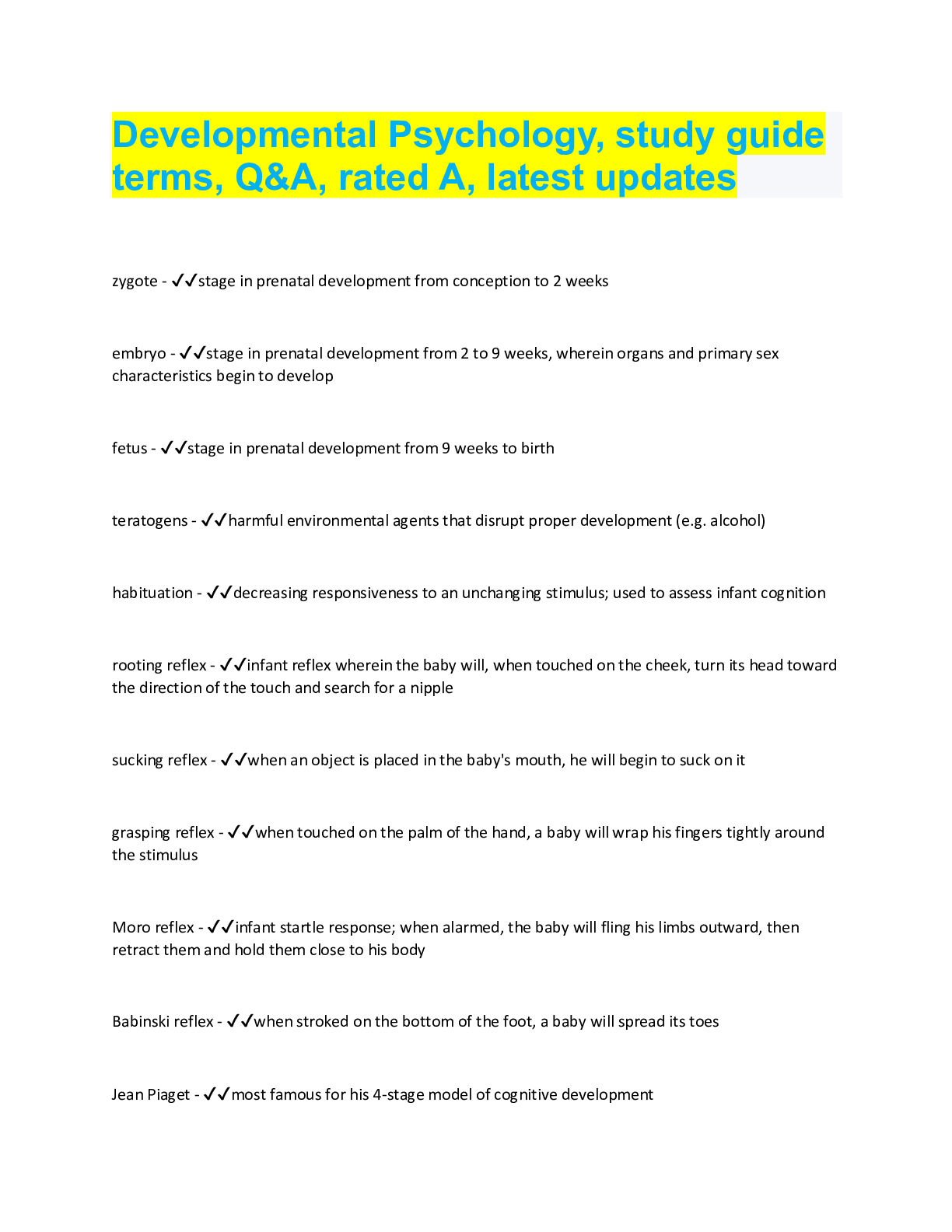
Developmental Psychology, Questions and answers, 2022 update, graded A+ zygote - ✔✔stage in prenatal development from conception to 2 weeks embryo - ✔✔stage in prenatal development fro ... m 2 to 9 weeks, wherein organs and primary sex characteristics begin to develop fetus - ✔✔stage in prenatal development from 9 weeks to birth teratogens - ✔✔harmful environmental agents that disrupt proper development (e.g. alcohol) habituation - ✔✔decreasing responsiveness to an unchanging stimulus; used to assess infant cognition rooting reflex - ✔✔infant reflex wherein the baby will, when touched on the cheek, turn its head toward the direction of the touch and search for a nipple sucking reflex - ✔✔when an object is placed in the baby's mouth, he will begin to suck on it grasping reflex - ✔✔when touched on the palm of the hand, a baby will wrap his fingers tightly around the stimulus Moro reflex - ✔✔infant startle response; when alarmed, the baby will fling his limbs outward, then retract them and hold them close to his body Babinski reflex - ✔✔when stroked on the bottom of the foot, a baby will spread its toes Jean Piaget - ✔✔most famous for his 4-stage model of cognitive development schema - ✔✔concept or framework that organizes and aids in interpretation of information maturation - ✔✔physical (or biological) process of growth; believed to occur in mostly universal sequence, though timing varies from individual to individual assimilation - ✔✔interpreting new information with the context of existing schemas accommodation - ✔✔adjusting or changing one's schema's to account for new information conservation - ✔✔principle that certain properties of matter (e.g. mass, volume, number) remain the same despite changes in appearance; exhibited during the concrete operational phase object permanence - ✔✔awareness that things continue to exist even though they are not perceived; develops at 6-8 months of age sensorimotor - ✔✔in Piaget's theory, the stage (from birth to 2) during which infants know the world mostly in terms of their impressions and motor activities preoperational - ✔✔in Piaget's theory, the stage (from about 2 to 6/7) during which a child learns to communicate using symbols (language) but does not demonstrate mental operations of concrete logic. egocentrism - ✔✔the inability of preoperational children to take the perspective of another animism - ✔✔belief, often demonstrated by preoperational children, that inanimate objects have thoughts and feelings magical thinking - ✔✔cognitive feature of preoperational children; unconstrained by adult understandings of reality, they may believe, for example, that it is possible to turn into a racecar theory of mind - ✔✔people's ideas about their own and others' mental states (about their feelings, perceptions, and thoughts and the behavior these might predict) categorization inability - ✔✔the inability of preoperational children to group items according to rules or criteria concrete operational - ✔✔in Piaget's theory, the stage of cognitive development (from 6/7 to 11/12) during which children gain the mental operations that allow them to think logically about real or "concrete" events formal operational - ✔✔in Piaget's theory, the stage of cognitive development which begins about age 12 and is characterized by the ability to think logically about abstact concepts social development theory - ✔✔Vygotsky's theory of cognitive development which emphasized the importance of other people (more knowledge others) in our mental growth Lev Vygotsky - ✔✔most famous for social development theory (of child cognitive development) More Knowledge Other (MKO) - ✔✔In Vygotsky's theory, another person who possesses expertise and can help you learn something zone of proximal development - ✔✔In Vygotsky's theory, the context in which learning takes place; the gap between when a child can accomplish with assistance and when he can do something independently stranger anxiety - ✔✔fear of people other than those with whom the infant is familiar; appears around 8 months and peaks at 13 months attachment - ✔✔an emotional tie with another person; shown in infants by their seeking closeness with caregivers and displaying distress upon separation [Show More]
Last updated: 3 years ago
Preview 1 out of 10 pages
Buy this document to get the full access instantly
Instant Download Access after purchase
Buy NowInstant download
We Accept:

Reviews( 0 )
$8.00
Can't find what you want? Try our AI powered Search
Document information
Connected school, study & course
About the document
Uploaded On
Aug 27, 2022
Number of pages
10
Written in
All
Seller

Reviews Received
Additional information
This document has been written for:
Uploaded
Aug 27, 2022
Downloads
0
Views
93