1. How should developers integrate refactoring into their workflow?
Allocate a portion of their capacity to refactoring in every Iteration
Create and estimate refactoring tasks for each story in the team backlog
Creat
...
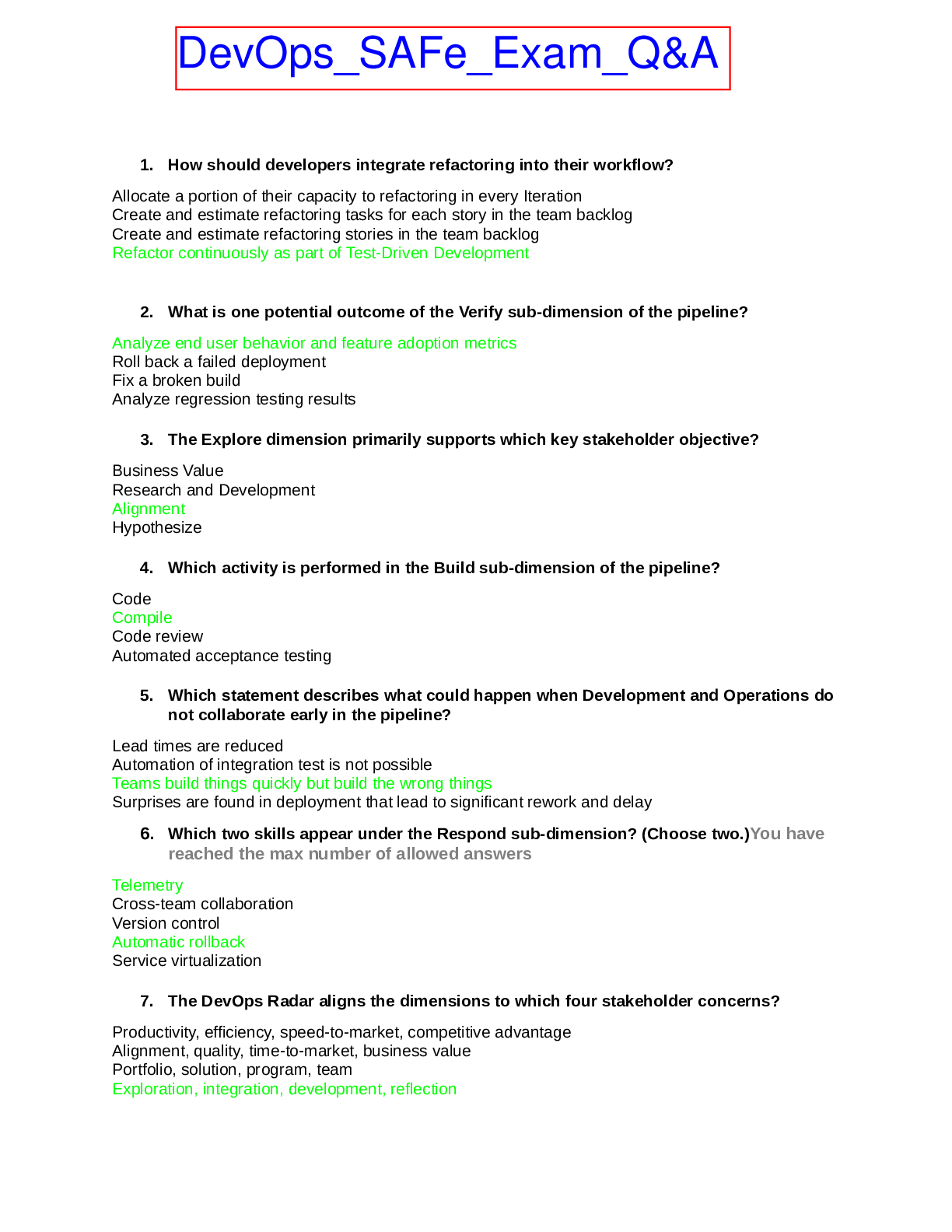
1. How should developers integrate refactoring into their workflow?
Allocate a portion of their capacity to refactoring in every Iteration
Create and estimate refactoring tasks for each story in the team backlog
Create and estimate refactoring stories in the team backlog
Refactor continuously as part of Test-Driven Development
2. What is one potential outcome of the Verify sub-dimension of the pipeline?
Analyze end user behavior and feature adoption metrics
Roll back a failed deployment
Fix a broken build
Analyze regression testing results
3. The Explore dimension primarily supports which key stakeholder objective?
Business Value
Research and Development
Alignment
Hypothesize
4. Which activity is performed in the Build sub-dimension of the pipeline?
Code
Compile
Code review
Automated acceptance testing
5. Which statement describes what could happen when Development and Operations do
not collaborate early in the pipeline?
Lead times are reduced
Automation of integration test is not possible
Teams build things quickly but build the wrong things
Surprises are found in deployment that lead to significant rework and delay
6. Which two skills appear under the Respond sub-dimension? (Choose two.)You have
reached the max number of allowed answers
Telemetry
Cross-team collaboration
Version control
Automatic rollback
Service virtualization
7. The DevOps Radar aligns the dimensions to which four stakeholder concerns?
Productivity, efficiency, speed-to-market, competitive advantage
Alignment, quality, time-to-market, business value
Portfolio, solution, program, team
Exploration, integration, development, reflection8. What are two parts of the Continuous Delivery Pipeline? (Choose two.)
Continuous Delivery
Continuous Integration
Deploy on Demand
Continuous Exploration
Continuous Testing
9. What does the Activity Ratio measure in the value stream?
The percentage of time spent on value-added activities
The efficiency of the business process activities as a ratio of process time to cycle time
The percentage of time spent on delays to the number of processes in the value stream
The percentage of time spent on non-value-added activities
10. What is an output of the Release sub-dimension?
A Feature deployed to production
A Feature made available to internal users
A Feature made available to end users
A Feature migrated to the cloud
11. Gemba walks are an important competency in support of which sub-dimension of the
DevOps Health Radar?
Collaborate and Research
Hypothesize
Learn
Verify
12. Why is hypothesis evaluation important when analyzing data from monitoring
systems in the Release dimension?
It helps Operations teams know where to apply emergency fixes
It helps quickly create balanced scorecards for stakeholder review
It helps identify the Minimum Viable Product for evaluating the hypothesis
It helps link objective production data to the hypothesis being tested
13. What are two reasons for test data management? (Choose two.)
To provide a viable option for disaster-recovery management
To track the results of automated test cases for use by corporate audit
To automate provisioning data to an application in order to set it to a known state before testing
begins
To generate synthetic test data inputs in order to validate test scenarios for automated tests
maintained in version control
To truncate data from the database to enable fast-forward recovery
14. Feature toggles are useful for which activity?
To enable continuous testing
To enable continuous code integrationTo decouple deployment from release
To prevent testing complexity
15. What is the consequence of working in isolation on long-lived code branches?
Static analysis tests will fail
Trunk/Main will not always be in a deployable state
Rollbacks will be difficult
Deployments will fail
16. Which incident response practice most strongly suggests a lack of DevOps culture?
Manual rollback procedures
On-call developers
Frequent server reboots
Frequent fix-forward changes
17. When does the Continuous Integration dimension of the Continuous Delivery Pipeline
begin?
When code is checked in to version control
When the Team Backlog has been refined
When a feature has been pulled for work
When a user story has satisfied its definition of done
18. Which statement illustrates the biggest bottleneck?
LT = 10 days, PT = 0.5 day, %C&A = 100%
LT = 1 day, PT = 0.5 day, %C&A = 90%
LT = 6 days, PT = 5 days, %C&A = 100%
LT = 5 days, PT = 2.5 days, %C&A = 100%
19. What are the first two areas that should be identified in value stream mapping?
(Choose two.)You have reached the max number of allowed answers
Process time, lead time, and percent complete and accurate
The steps
The bottlenecks
The people who do the work
The people who supervise the work
20. Which steps in the value stream should be the main focus when choosing the most
important improvement items?
Steps with a long process time
Steps with a high activity ratio
Steps with short process time and short lead time in the future-state map
Steps with long lead time and short process time in the current-state map
21. Which metric reflects the quality of output at each step in the value stream?Deployment frequency
Escaped defects
%C/A - percent complete and accurate
Process Time
22. Which technical practice incorporates build-time identification of security
vulnerabilities in the code?
Threat Modeling
Penetration Testing
Dynamic Code Analysis
Application Security
23. Ensuring that security controls such as threat modeling, application security, and
penetration testing are in place throughout the Continuous Delivery Pipeline is an
example of which stabilizing skill?
Failover/disaster recovery
Design for operations
Continuous security monitoring
DevSecOps
24. What identifies potential changes to the current state value stream that could improve
flow?
Impact mapping
Problem-Solving Workshop
Value stream identification
Future state mapping
25. What are the top two advantages of mapping the current state of the delivery pipeline?
(Choose two.)You have reached the max number of allowed answers
To help identify and make short-term fixes
To enable everyone in the organization to see how the value stream is actually performing
To achieve a collective understanding and consensus around problems
To identify some of the processes within the delivery pipeline
To help with incremental software delivery
26. Which is true about the "Boundaries and Limitations" portion of the DevOps
Transformation Canvas?
It captures the people who need to be involved in the DevOps transformation
It captures cultural constraints that will prevent us from ever moving forward
It captures actions that require the support of other people or teams
It captures lower priority improvement items
27. Where do features go after Continuous Exploration?
Into Continuous Integration where they are merged and tested with other Features
Into a backlog tool where they are then split into Epics
Into development where they are then split into Stories
Into the Program Backlog where they are then prioritized28. What are two benefits of DevOps? (Choose two.)
Fewer defects
Tightly coupled architecture
Faster lead time
Increase batch size
Better alignment between strategy and execution
29. What is the recommended way to prioritize the potential items for the DevOps
transformation?
Minimum Viable Product
Lean Business Case
Minimum Marketable Feature
Weighted Shortest Job First
30. When full deployment automation is not possible, which practice helps developers
deploy code into production?
Infrastructure as code
Deployment automation
Self-service deployment
Continuous deployment
31. Which two statements describe the purpose of value stream mapping? (Choose two.)
To deliver incremental value in the form of working, tested software, and systems
To visualize how value flows
To understand the Product Owner's priorities
To create an action plan for continuous improvement - is this correct?
To create an understanding of the budget
32. Security vulnerability scanning is an important architectural consideration in which
dimension of the DevOps Health Radar?
Release on Demand
Continuous Exploration
Continuous Deployment
Continuous Integration
33. What can impede the progress of a DevOps transformation the most?
Lack of funding for CI/CD Pipeline tools
When various groups in the organization have different directions and goals
When teams use frequent retrospectives
When there is no DevOps team
34. What triggers the release activity?
Change validated in staging environmentSuccessful user acceptance tests
Business decision to go live
Successful deployment to production
35. What marks the beginning of the Continuous Delivery Pipeline?
A committed feature
An idea
A checked-in change
A committed user story
36. A canary release involves releasing value to whom?
One subset of users at a time
External users only
Internal users first
Internal users only
37. How is Lean UX used in Continuous Exploration?
To validate the return on investment
To create a platform to continuously explore
To automate the user interface scripts
To collaboratively create a benefit hypothesis - is this the correct answer?
38. What does value stream mapping help reveal in the Continuous Delivery Pipeline?
Where documentation should be reduced
Who is responsible for optimizing the value stream
Bottlenecks to the flow of value - is this the correct answer?
Where automation is needed
What differentiates Deployment and Release in the Continuous Delivery Pipeline?
Deployment is done on a cadence; release is done on demand
Deployment occurs every iteration; release occurs at PI boundaries
Deployment is performed by Development; release is performed by Operations
Deployment involves moving value to production; release involves making value available to end
users
Which incident response practice most strongly suggests a lack of DevOps culture?
Manual rollback procedures
Frequent fix-forward changes
Frequent server reboots
On-call developers
When does the Continuous Integration dimension of the Continuous Delivery Pipeline begin?
When a feature has been pulled for work
When the Team Backlog has been refined
When code is checked in to version control
When a user story has satisfied its definition of doneSecurity vulnerability scanning is an important architectural consideration in which
dimension of the DevOps Health Radar?
Continuous Deployment
Continuous Exploration
Continuous Integration
Release on Demand
Which two skills appear under the Respond sub-dimension? (Choose two.)
Version control
Cross-team collaboration
Automatic rollback
Telemetry
Service virtualization
What is a consequence of working in isolation on long-lived code branches?
Trunk/Main will not always be in a deployable state
Deployments will fail
Rollbacks will be difficult
Static analysis tests will fail
What is the main goal of a SAFe DevOps transformation?
To create immutable infrastructure to avoid changes to the production environment
To align people across the Value Stream to deliver value continuously
To implement an advanced tool chain to automate the entire Continuous Delivery Pipeline
To create a strong DevOps team with leadership support
Which skill can significantly accelerate mean-time-to-restore by enabling support teams to see
issues the way actual end users did?
Session replay
Blue/green deployment
Page analytics
Incident management
Which two areas should be monitored in the Release on Demand aspect to support DevOps and
Continuous Delivery? (Choose two.)
Business Metrics
Agile Release Train velocity
Deployment cycle time
Full-stack system behavior
Build statusWho should be consulted first when calculating the % Complete and Accurate?
The lead developer
Testers
The people responsible for the next step
End users
What is the primary purpose of creating an automated test suite?
To increase the return on investment for finding defects
To increase unit test coverage during an Iteration
To enable continuous testing
To eliminate all manual testing
What falls outside the scope of the Stabilize activity?
Continuous security monitoring is done
Blue/green deployment
Features are monitored after release
Failover and recovery processes are in place
Who is responsible for building and continually improving the Continuous Delivery Pipeline?
DevOps Teams
Scrum Teams
Agile Release Trains
System Teams
Why is it important to take a structured approach to analyze problems in the delivery pipeline?
It provides a structured roadmap for the SAFe implementation
It helps ensure that actual causes of problems are addressed, rather than symptoms
It ensures that solutions are more likely to be approved for implementation
It allows the solution to be demoed to key stakeholders
Which DevOps principle focuses on identifying and eliminating bottlenecks in the Continuous
Delivery Pipeline?
Automation
Lean flow
Recovery
MeasurementWhat are two aspects of the Continuous Delivery Pipeline, in addition to Continuous Integration?
(Choose two.)You have reached the max number of allowed answers
Continuous Release
Continuous Testing
Continuous Deployment
Continuous Improvement
Continuous Exploration
What is the correct order of activities in the Continuous Integration aspect?
Develop, Build, Test end-to-end, Stage
Build, Develop, Stage, Test end-to-end
Develop, Test end-to-end, Build, Stage
Stage, Develop, Build, Test end-to-end
Which two security skills are part of the Continuous Integration aspect? (Choose two.)You have
reached the max number of allowed answers
Network security practices
Application security
SOX compliance analysis
Security board review
Penetration testing
Value flows through which aspect in the Continuous Delivery Pipeline?
Continuous Integration
Develop
Monitor
Research
What is one recommended way to architect for operations?
Implement feature toggles
Create detailed run books
Establish an architecture review board
Require developers to support their own code
What is trunk-based development?
All teams committing their code into one trunkEvery team works in their own trunk
Teams with similar dependencies create one single branch for the team's work
Each developer maintains a separate branch
What is the primary goal of the Stabilize activity?
To establish quality-of-service agreements with customers
To enhance stability with blue/green deployment
To avoid unplanned outages and security breaches
To achieve active-active site replication
What are two important items to monitor in production to support the Release on Demand aspect
in SAFe? (Choose two.)You have reached the max number of allowed answers
System performance
Time-to-market
Lead time to defect fixing
Business value
Deployment lead time
What is the primary benefit of value stream mapping?
It fosters collaboration among development and operations managers
It creates the hypothesis of which Solution to build
It identifies how to build Agile Release Trains
It provides insight into organizational efficiency and value flow
What is the blue/green deployment pattern?
To decouple deployment from release
To deploy to only some data centers to reduce the deployment risk
To ensure no changes happen in production without going through the Continuous Delivery
Pipeline
To deploy between an inactive and active environment
What does Culture in a CALMR approach mean?
A culture where developers code and operations deploys
A culture where technical expertise is paramount
A culture of shared responsibility and risk tolerance
A culture where development and operations report to the same managerInnovation accounting stresses the importance of avoiding what?
Quantitative metrics
Vanity metrics
ROI calculations
Objective metrics
Which term describes the time it takes value to flow across the entire Value Stream?
Rolled percent complete and accurate
Total lead time
Activity ratio
Deployment frequency
In what activity of Continuous Exploration are Features prioritized in the Program Backlog?
Synthesize
Finalize
Hypothesize
Research
Which technical practice is key to enabling trunk-based development?
Gated commits
Feature branching
Refactoring
Code freezes
What is a core DevOps principle?
Iteration review
Lean Budgets
Servant leadership
Culture
When preparing a DevOps backlog, prioritizing features using WSJF includes which two
factors? (Choose two.)You have reached the max number of allowed answers
Duration/job size
Team velocityBusiness value
Cost of delay
Total count of items on the Program Backlog
Mapping the value stream helps accomplish which two actions? (Choose two.)You have reached
the max number of allowed answers
To prioritize the Program Backlog
To understand how the flow of value can be improved
To gain insight into organizational efficiency
To add or remove user segments based on business decisions
To serve as a blueprint for development
Why are canary releases used?
To reduce deployment times
To allow incremental release
To prevent outages
To introduce minimum viable features
After the team maps the steps of the current state Value Stream during value stream mapping,
what are the next two steps? (Choose two.)
Identify who is involved in each step of the delivery pipeline
Perform a SWOT analysis
Discuss the current state and perform an improvement analysis
Measure the performance at each step
Identify bottlenecks in the delivery pipeline
The Release on Demand aspect enables which key business objective?
Alignment
Time-to-market
Quality
Business value
Who is responsible for ensuring quality is built into the code in SAFe?
Agile Teams
DevelopersTesters
Product Owners
What are two activities performed as part of defining the hypothesis in Continuous Exploration?
(Choose two.)You have reached the max number of allowed answers
Elicit feedback
Use innovation assessments
Identify Metrics based on leading indicators
Define the minimum viable product
Use value stream mapping
What is the main goal of a SAFe DevOps transformation?
To align people across the Value Stream to deliver value continuously
To create immutable infrastructure to avoid changes to the production environment
To create a strong DevOps team with leadership support
To implement an advanced tool chain to automate the entire Continuous Delivery Pipeline
One goal of DevOps in SAFe is to fully automate the steps between which two pipeline
activities?
Code commit and release
Code commit and user acceptance testing
Code commit and deploy
Code commit and stage
What are two benefits of DevOps? (Choose two.)You have reached the max number of allowed
answers
Less time spent fixing security issues
Less time spent on new work
More lead time
Less frequent deployments
Fewer defects
Value stream mapping metrics include calculations of which three Metrics? (Choose three.)You
have reached the max number of allowed answersActivity Ratio
Release Frequency
Emergency Change %
Total Process Time
Rolled % Complete and Accurate
Outage Frequency
Which statement is true about DevOps?
It enables low-risk releases and fast recovery with no room for errors
It enables a tolerance for low-risk, low-failure, and rapid recovery
It enables high-risk releases and fast recovery with fast fix-forward
It enables low-risk releases and fast recovery with fast fix-forward
Which practice prevents configuration drift between production and non-production
environments?
Immutable infrastructure
Self-service deployment
Deployment automation
Session replay
Which statement describes a measurable benefit of adopting DevOps practices and principles?
It guarantees an increase in profits and decrease in downtime
It identifies key Value Streams
It creates a highly functional, cross-team culture
It results in faster lead time, and more frequent deployments
What is the desired frequency of deployment in SAFe?
Daily
Continuous
Once per Iteration
Once per PI
Which statement describes the Lean startup lifecycle?Define the hypothesis, build a minimum viable product (MVP), continuously evaluate the
MVP while implementing additional Features until WSJF determines work can stop
Create a hypothesis statement, assign an Epic owner, deliver Features created from the Lean
business case, deploy
Define the minimum viable product (MVP), build the MVP, implement Epic Features until
all Features are delivered
Define a Lean business case, build a minimum viable product, implement the Epic Features
until all Features are delivered
What does the %C&A metric measure in the Continuous Delivery Pipeline?
The percent concurrent and accurate process times of each pipeline activity
The percent of change averages of each pipeline activity
The percent of time downstream customers receive work that is usable as-is
The percent complete and average times of each pipeline activity
Which two technical practices focus on Built-in Quality? (Choose two.)You have reached the
max number of allowed answers
Pair work
Test-driven development
Feature toggles
Canary releases
Environment configuration
What is the purpose of a minimum viable product?
To demo to Product Management for feedback
To validate the hypothesis
To release to production
To sell to new markets
What are the first two actions for visualizing the current state of the Continuous Delivery
Pipeline? (Choose two.)You have reached the max number of allowed answers
Identify lead time
Identify the development methodology
Identify the steps
Identify the peopleIdentify throughput
DevOps is a key enabler of continuous delivery. What does continuous mean in this context?
To deploy to production as often as possible and release when the business needs it
To deploy to production multiple times per year and release on a cadence once or twice a
year
To deploy to production and release on cadence every Iteration
To deploy to production and release at least once every Program increment
What does the CALMR approach to DevOps mean?
Culture, Automation, Lean Flow, Measurement, Recovery
Continuous, Automation, Lean Flow, Metrics, Resilience
Collaboration, Adjustment, Lean Flow, Measurement, Reliability
Culture, Agile, Lean Flow, Metrics, Recovery
What is the primary purpose of mapping the value stream?
To understand how value flows through the system and various functions of the organization
To balance resources along the Development and Operation workflow
To provide a canvas for documenting DevOps transformation
To visualize steps in the value stream and make it easier to see the sequence of these steps
What is the lead time for a particular step in a value stream?
Waiting time at a particular step
Process time at a particular step
Time taken to complete a task at a particular step
Time from when the work is ready from the previous step to work completion
Process Time is a metric of the time it takes to do what?
To move work from idea to cash
For an individual to perform their assigned job in a step of the process
To complete work at particular step of the process
To move work form end of the previous step to the end of the current step
Total Process Time divided by Total Lead Time provides which metric?% Complete and Accurate
Total Process Time
Activity Ratio
Actual Value-Added Work Time
Identifying the Minimal Marketable Feature is part of what?
Lean Startup
Lean Leadership
Lean Principles
Lean UX
What should be done first in test-driven development?
Write code
Write a test
Commit code
Refactor
What is the main intent behind deliberately creating an outage in an environment?
To exercise the recovery process and find potential areas of improvement
To test the accuracy of operations response documentation
To measure customer service response and customer satisfaction during the outage
To train the team to identify components that must be rearchitected to reduce outages
How frequently should Agile Release Trains release?
Continuously
On demand
Once per Iteration
Once per PI
What is measured in each step of the value stream during value stream mapping?
Lead Time, Lag Time, % Complete and Accurate
% Complete and Accurate, Cycle Time, Process Time
Lead Time, Process Time, % Complete and Accurate
Total Lag Time, Total Process Time, % Complete and AccurateSample Test: SAFe® 4 DevOps Practitioner This sample test provides example (not actual) content and
format of the questions that will be on the certification exam. Performance on the sample test is NOT an
indicator of performance on the certification exam and this should not be considered an assessment
tool. 1. Which sub-dimension supports the flow of value through the Release on Demand dimension? A.
Release B. Monitor C. Respond D. Deploy 2. What is an activity ratio? A. The ratio of lead time and
process time B. The ratio of lead time and throughput C. The ratio of lead time and tact time D. The ratio
of process time and lead time 3. What is BDD? A. Behavior-Driven Development B. Business-Driven
Development C. Benchmark-Driven Development D. Backlog-Driven Development 4. What is the ultimate
goal of DevOps in SAFe? A. To clarify program and team roles B. To enable Agile Release Trains to deliver
value more frequently C. To combine Development and Operations groups into one team D. To automate
the integration, testing and deployment of features 5. What do the 'C' and the 'R' stand for in a CALMR
approach to DevOps? A. Culture and Recovery B. Culture and Resilience C. Collaboration and Recovery D.
Continuous and Resilience Continued… SAFe® 4 DevOps Practitioner Sample Test V4.6 Page 2 Published
11.2018 | Updated 02.2019 ©Scaled Agile, Inc. 6. How is completeness and accuracy of a particular step
in a value stream measured? A. Percent of work without any technical debt B. Work that is
collaboratively completed by the team C. Percent of work that the next step can process as is D. Work
completed and accepted by the Product Owner 7. Within the Continuous Exploration dimension, what
helps gather more feedback about customer needs? A. Research B. Collaborate C. Synthesize D.
Hypothesize 8. Continuous Deployment includes which two sub-dimensions? (Choose two.) A. Respond
B. Monitor C. Stage D. Release E. Stabilize Continued… SAFe® 4 DevOps Practitioner Sample Test V4.6
Page 3 Published 11.2018 | Updated 02.2019 ©Scaled Agile, Inc. Answer Key: 1. A 2. D 3. A 4. B 5. A 6. C
7. A 8. AB (End of sample test)
Hi Aditya,
Please have a look at these new questions.
What differentiates Deployment and Release in the Continuous Delivery Pipeline?
1. Deployment is done on a cadence; release is done on demand
2. Deployment occurs every iteration; release occurs at PI boundaries
3. Deployment is performed by Development; release is performed by Operations
4. Deployment involves moving value to production; release involves making value available to
end users
Which incident response practice most strongly suggests a lack of DevOps culture?
Repeated
1. Manual rollback procedures
2. Frequent fix-forward changes
3. Frequent server reboots
4. On-call developers
When does the Continuous Integration dimension of the Continuous Delivery Pipeline begin?
1. When a feature has been pulled for work
2. When the Team Backlog has been refined
3. When code is checked in to version control
4. When a user story has satisfied its definition of doneSecurity vulnerability scanning is an important architectural consideration in which
dimension of the DevOps Health Radar?
1. Continuous Deployment
2. Continuous Exploration
3. Continuous Integration
4. Release on Demand
Which two skills appear under the Respond sub-dimension? (Choose two.)
1. Version control
2. Cross-team collaboration
3. Automatic rollback
4. Telemetry
5. Service virtualization
What is a consequence of working in isolation on long-lived code branches?
1. Trunk/Main will not always be in a deployable state
2. Deployments will fail
3. Rollbacks will be difficult
4. Static analysis tests will fail
1. How should developers integrate refactoring into their workflow?
1. Allocate a portion of their capacity to refactoring in every Iteration
2. Create and estimate refactoring tasks for each story in the team backlog
3. Create and estimate refactoring stories in the team backlog
4. Refactor continuously as part of Test-Driven Development
2. What is one potential outcome of the Verify sub-dimension of the pipeline?????
1. Analyze end user behavior and feature adoption metrics
2. Roll back a failed deployment
3. Fix a broken build
4. Analyze regression testing results
3. The Explore dimension primarily supports which key stakeholder objective?
1. Business Value
2. Research and Development
3. Alignment
4. Hypothesize
4. Which activity is performed in the Build sub-dimension of the pipeline?
1. Code
2. Compile
3. Code review
4. Automated acceptance testing5. Which statement describes what could happen when Development and Operations do
not collaborate early in the pipeline?????
1. Lead times are reduced
2. Automation of integration test is not possible
3. Teams build things quickly but build the wrong things
4. Surprises are found in deployment that lead to significant rework and delay
6. Which two skills appear under the Respond sub-dimension? (Choose two.)You have
reached the max number of allowed answers
1. Telemetry
2. Cross-team collaboration
3. Version control
4. Automatic rollback
5. Service virtualization
7. The DevOps Radar aligns the dimensions to which four stakeholder concerns?
1. Productivity, efficiency, speed-to-market, competitive advantage
2. Alignment, quality, time-to-market, business value
3. Portfolio, solution, program, team
4. Exploration, integration, development, reflection
8. What are two parts of the Continuous Delivery Pipeline? (Choose two.)
1. Continuous Delivery
2. Continuous Integration
3. Deploy on Demand
4. Continuous Exploration
5. Continuous Testing
9. What does the Activity Ratio measure in the value stream??????
1. The percentage of time spent on value-added activities
2. The efficiency of the business process activities as a ratio of process time to cycle time
3. The percentage of time spent on delays to the number of processes in the value stream
4. The percentage of time spent on non-value-added activities
10. What is an output of the Release sub-dimension?
1. A Feature deployed to production
2. A Feature made available to internal users
3. A Feature made available to end users
4. A Feature migrated to the cloud
11. Gemba walks are an important competency in support of which sub-dimension of the
DevOps Health Radar?
1. Collaborate and Research2. Hypothesize
3. Learn
4. Verify
12. Why is hypothesis evaluation important when analyzing data from monitoring
systems in the Release dimension?
1. It helps Operations teams know where to apply emergency fixes
2. It helps quickly create balanced scorecards for stakeholder review
3. It helps identify the Minimum Viable Product for evaluating the hypothesis
4. It helps link objective production data to the hypothesis being tested
13. What are two reasons for test data management? (Choose two.)
1. To provide a viable option for disaster-recovery management
2. To track the results of automated test cases for use by corporate audit
3. To automate provisioning data to an application in order to set it to a known state before
testing begins
4. To generate synthetic test data inputs in order to validate test scenarios for automated tests
maintained in version control
5. To truncate data from the database to enable fast-forward recovery
14. Feature toggles are useful for which activity?
1. To enable continuous testing
2. To enable continuous code integration
3. To decouple deployment from release
4. To prevent testing complexity
15. What is the consequence of working in isolation on long-lived code branches?
1. Static analysis tests will fail
2. Trunk/Main will not always be in a deployable state
3. Rollbacks will be difficult
4. Deployments will fail
16. Which incident response practice most strongly suggests a lack of DevOps
culture????
1. Manual rollback procedures
2. On-call developers
3. Frequent server reboots
4. Frequent fix-forward changes
17. When does the Continuous Integration dimension of the Continuous Delivery Pipeline
begin?
1. When code is checked in to version control
2. When the Team Backlog has been refined
3. When a feature has been pulled for work
4. When a user story has satisfied its definition of done18. Which statement illustrates the biggest bottleneck?
1. LT = 10 days, PT = 0.5 day, %C&A = 100%
2. LT = 1 day, PT = 0.5 day, %C&A = 90%
3. LT = 6 days, PT = 5 days, %C&A = 100%
4. LT = 5 days, PT = 2.5 days, %C&A = 100%
19. What are the first two areas that should be identified in value stream mapping?
(Choose two.)You have reached the max number of allowed answers
1. Process time, lead time, and percent complete and accurate
2. The steps
3. The bottlenecks
4. The people who do the work
5. The people who supervise the work
20. Which steps in the value stream should be the main focus when choosing the most
important improvement items?
1. Steps with a long process time
2. Steps with a high activity ratio
3. Steps with short process time and short lead time in the future-state map
4. Steps with long lead time and short process time in the current-state map
21. Which metric reflects the quality of output at each step in the value stream?
1. Deployment frequency
2. Escaped defects
3. %C/A - percent complete and accurate
4. Process Time
22. Which technical practice incorporates build-time identification of security
vulnerabilities in the code?
1. Threat Modeling
2. Penetration Testing
3. Dynamic Code Analysis
4. Application Security
23. Ensuring that security controls such as threat modeling, application security, and
penetration testing are in place throughout the Continuous Delivery Pipeline is an example of
which stabilizing skill?
1. Failover/disaster recovery
2. Design for operations
3. Continuous security monitoring
4. DevSecOps
24. What identifies potential changes to the current state value stream that could improve
flow?
1. Impact mapping
2. Problem-Solving Workshop3. Value stream identification
4. Future state mapping
25. What are the top two advantages of mapping the current state of the delivery
pipeline? (Choose two.)You have reached the max number of allowed answers
1. To help identify and make short-term fixes
2. To enable everyone in the organization to see how the value stream is actually performing
3. To achieve a collective understanding and consensus around problems
4. To identify some of the processes within the delivery pipeline
5. To help with incremental software delivery
26. Which is true about the "Boundaries and Limitations" portion of the DevOps
Transformation Canvas?
1. It captures the people who need to be involved in the DevOps transformation
2. It captures cultural constraints that will prevent us from ever moving forward
3. It captures actions that require the support of other people or teams
4. It captures lower priority improvement items
27. Where do features go after Continuous Exploration?
1. Into Continuous Integration where they are merged and tested with other Features
2. Into a backlog tool where they are then split into Epics
3. Into development where they are then split into Stories
4. Into the Program Backlog where they are then prioritized
28. What are two benefits of DevOps? (Choose two.)
1. Fewer defects
2. Tightly coupled architecture
3. Faster lead time
4. Increase batch size
5. Better alignment between strategy and execution
29. What is the recommended way to prioritize the potential items for the DevOps
transformation?
1. Minimum Viable Product
2. Lean Business Case
3. Minimum Marketable Feature
4. Weighted Shortest Job First
30. When full deployment automation is not possible, which practice helps developers
deploy code into production?
1. Infrastructure as code
2. Deployment automation3. Self-service deployment
4. Continuous deployment
31. Which two statements describe the purpose of value stream mapping? (Choose
two.)???
1. To deliver incremental value in the form of working, tested software, and systems
2. To visualize how value flows
3. To understand the Product Owner's priorities
4. To create an action plan for continuous improvement - is this correct?
5. To create an understanding of the budget
32. Security vulnerability scanning is an important architectural consideration in which
dimension of the DevOps Health Radar?
1. Release on Demand
2. Continuous Exploration
3. Continuous Deployment
4. Continuous Integration
33. What can impede the progress of a DevOps transformation the most?
1. Lack of funding for CI/CD Pipeline tools
2. When various groups in the organization have different directions and goals
3. When teams use frequent retrospectives
4. When there is no DevOps team
34. What triggers the release activity?
1. Change validated in staging environment
2. Successful user acceptance tests
3. Business decision to go live
4. Successful deployment to production
35. What marks the beginning of the Continuous Delivery Pipeline?
1. A committed feature
2. An idea
3. A checked-in change
4. A committed user story
36. A canary release involves releasing value to whom?
1. One subset of users at a time
2. External users only
3. Internal users first
4. Internal users only37. How is Lean UX used in Continuous Exploration?
1. To validate the return on investment
2. To create a platform to continuously explore
3. To automate the user interface scripts
4. To collaboratively create a benefit hypothesis - is this the correct answer?
38. What does value stream mapping help reveal in the Continuous Delivery Pipeline?
1. Where documentation should be reduced
2. Who is responsible for optimizing the value stream
3. Bottlenecks to the flow of value
4. Where automation is needed
Security vulnerability scanning is an important architectural consideration in which dimension of
the DevOps Health Radar?
**! Continuous Exploration
Release on Demand
Continuous Integration
Continuous Deployment
A canary release involves releasing value to whom?
Internal users first
External users only
Internal users only
* One subset of users at a time
What does value stream mapping help reveal in the Continuous Delivery Pipeline?
Who is responsible for optimizing the value stream
Where automation is needed
* Bottlenecks to the flow of value
Where documentation should be reducedWhy is hypothesis evaluation important when analyzing data from monitoring systems in the
Release dimension?
It helps quickly create balanced scorecards for stakeholder review
* It helps link objective production data to the hypothesis being tested
It helps identify the Minimum Viable Product for evaluating the hypothesis
It helps Operations teams know where to apply emergency fixes
When full deployment automation is not possible, which practice helps developers deploy
code into production?
Continuous deployment
* Self-service deployment
Infrastructure as code
Deployment automation
What should be measured in a CALMR approach to DevOps?
Mean time to restore
Deployment frequency
Unit test coverage
* Measure everything
How is Lean UX used in Continuous Exploration?
To create a platform to continuously explore
To automate the user interface scripts
To validate the return on investment
* To collaboratively create a benefit hypothesis
The Explore dimension primarily supports which key stakeholder objective?
Business Value
* Alignment
Research and Development
Hypothesize
What marks the beginning of the Continuous Delivery Pipeline?
* An idea
A committed feature
A checked-in change
A committed user story
How should developers integrate refactoring into their workflow?
Create and estimate refactoring stories in the team backlog
* Refactor continuously as part of Test-Driven Development
Allocate a portion of their capacity to refactoring in every Iteration
Create and estimate refactoring tasks for each story in the team backlogWhen does the Continuous Integration dimension of the Continuous Delivery Pipeline begin?
When the Team Backlog has been refined
* When a feature has been pulled for work
When a user story has satisfied its definition of done
When code is checked in to version control
Which is true about the "Boundaries and Limitations" portion of the DevOps Transformation
Canvas?
It captures lower priority improvement items
* It captures actions that require the support of other people or teams
It captures cultural constraints that will prevent us from ever moving forward
It captures the people who need to be involved in the DevOps transformation
Which statement illustrates the biggest bottleneck?
* LT = 10 days, PT = 0.5 day, %C&A = 100%
LT = 6 days, PT = 5 days, %C&A = 100%
LT = 1 day, PT = 0.5 day, %C&A = 90%
LT = 5 days, PT = 2.5 days, %C&A = 100%
When should teams use root cause analysis to address impediments to continuous delivery?
During the Management Review & Problem Solving portion of PI Planning
* During Inspect and Adapt
During Iteration Planning
During the Iteration Retrospective
1 Which sub-dimension supports the flow of value through the Release on Demand dimension?
A. Release
B. Monitor
C. Respond
D. Deploy
2. What is an activity ratio?
A. The ratio of lead time and process time
B. The ratio of lead time and throughput
C. The ratio of lead time and tact time
D. The ratio of process time and lead time
3. What is BDD?
A. Behavior-Driven DevelopmentB. Business-Driven Development
C. Benchmark-Driven Development
D. Backlog-Driven Development
4 How is completeness and accuracy of a particular step in a value stream measured?
A. Percent of work without any technical debt
B. Work that is collaboratively completed by the team
C. Percent of work that the next step can process as is
D. Work completed and accepted by the Product Owner
5. Within the Continuous Exploration dimension, what helps gather more feedback about customer
needs?
A. Research
B. Collaborate
C. Synthesize
D. Hypothesize
6. Continuous Deployment includes which two sub-dimensions? (Choose two.)
A. Respond
B. Monitor
C. Stage
D. Release
E. Stabilize
7 What is the ultimate goal of DevOps in SAFe?
A. To clarify program and team roles
B. To enable Agile Release Trains to deliver value more frequently
C. To combine Development and Operations groups into one team
D. To automate the integration, testing and deployment of features8. What do the 'C' and the 'R' stand for in a CALMR approach to DevOps?
A. Culture and Recovery
B. Culture and Resilience
C. Collaboration and Recovery
D. Continuous and ResilienceWhere do features go after Continuous Exploration?
Into a backlog tool where they are then split into Epics
Into Continuous Integration where they are merged and tested with other Features
Into the Program Backlog where they are then prioritized - not confirmed
Into development where they are then split into Stories
Which statement illustrates the biggest bottleneck?
LT = 10 days, PT = 0.5 day, %C&A = 100%
LT = 5 days, PT = 2.5 days, %C&A = 100%
LT = 1 day, PT = 0.5 day, %C&A = 90% - not confirmed
LT = 6 days, PT = 5 days, %C&A = 100%
What can impede the progress of a DevOps transformation the most?
When there is no DevOps team - Not confirmed
When various groups in the organization have different directions and goals
When teams use frequent retrospectives
Lack of funding for CI/CD pipeline tools
The DevOps Health Radar aligns the four aspects of the Continuous Delivery
Pipeline to which four stakeholder concerns?
Productivity, efficiency, speed-to-market, competitive advantage
Alignment, quality, time-to-market, business value - Not confirmed
Exploration, integration, development, reflection
Portfolio, Solution, program, team
When does the Continuous Integration aspect of the Continuous Delivery
Pipeline begin?
When a user story has satisfied its definition of done
When the Team Backlog has been refined
When a Feature has been pulled for work - not confirmed
When code is checked-in to version control
Where do features go after Continuous Exploration?
Into development where they are then split into Stories
Which statement illustrates the biggest bottleneck?
LT = 10 days, PT = 0.5 day, %C&A = 100%
What can impede the progress of a DevOps transformation the most?
When there is no DevOps team
The DevOps Health Radar aligns the four aspects of the Continuous Delivery
Pipeline to which four stakeholder concerns?
Exploration, integration, development, reflection
When does the Continuous Integration aspect of the Continuous Delivery
Pipeline begin?
When code is checked-in to version controlQuestions are from SAFe DevOps 5.0
Which technical practice incorporates build-time identification of security
vulnerabilities in the code?
Threat modeling
Dynamic code analysis - can not be the answer
Application security
Penetration testing
Feature toggles are useful for which activity?
To enable continuous testing - not confirmed - wiki
To prevent testing complexity
To decouple deployment from release
To enable continuous code integration
What should the team be able to do after current-state mapping?
Describe the biggest bottlenecks in the delivery pipeline
Understand the steps needed to improve the Continuous Delivery Pipeline
Identify those responsible for the biggest bottlenecks in the process
Define a plan to reduce the lead time and increase process time - not confirmed
Gemba walks are an important competency in support of which activity of the
DevOps Health Radar?
Hypothesize
Verify
Collaborate and Research
Learn - not confirmed
What is a consequence of working in isolation on long-lived code branches?
Deployments will fail
Rollbacks will be difficult
Trunk/main will not always be in a deployable state
Static analysis tests will fail
What identifies potential changes to the current-state Value Stream that
could improve flow?
Future-state mapping
Value Stream identification
Impact mapping
Problem-solving workshop
Which incident response practice most strongly suggests a lack of DevOps
culture?
On-call developers
Frequent fix-forward changes
Manual rollback procedures
Frequent server reboots
• Trunk/main will not always be in a deployable state
• Future-state mapping
• Manual rollback procedures
Explanation:
• The trunk-based development is where all the developers (for a certain
deployable unit) commit to a single shared branch under source-control. This branch is
referred to as the 'trunk'. It includes continuous integration and continuous delivery.
In order words, it comprises no long-lived branches as they make continuous delivery
impossible. Here, the team requires merging back as earliest as possible, at most once
a day.
• Value Stream Mapping is referred to as a planning tool that is utilized to
analyze the current state furthermore develop the future state for a sequence of
events that takes the service or product from the starting of the particular process
until it reaches the user. It represents both data and materials as they progress
through the process. The future state mapping determines improvement to be
implemented to the value stream, which will shorten the entire lead time. It
represents the picture of the lean transformation process for a particular value stream.
• The primitive principles of DevOps are fast reply to feedback,
continuous delivery, and automation. The DevOps relies on automation to
facilitate speed, repeatable processes, consistency, and environment development. It
simply recognized that the manual processes are the enemy of high productivity, fast
value delivery, and safety. Moreover, here automation is not only saving time. It
improves development, testing, packaging, and implementation of the processes that
could be made routine. Automation also provides faster response and learning to
market demand and user feedback. Moreover, frequent-fix forward changes or on-call
developers are the technical support for fast recovery.Reference: https://www.emsstrategies.com/dd020107article.html
Reference: https://www.scaledagileframework.com/devops/37. What is a consequence of working in isolation on long-lived code
branches?
Trunk/Main will not always be in a deployable state
Rollbacks will be difficult
Deployments will fail
Static analysis tests will fail
38. What are two reasons for test data management? (Choose two.)
To track the results of automated test cases for use by corporate audit
To generate synthetic test data inputs in order to validate test scenarios for automated tests
maintained in version control
To automate provisioning data to an application in order to set it to a known state before testing
begins
To truncate data from the database to enable fast-forward recovery
To provide a viable option for disaster-recovery management
39. What organizational anti-pattern does DevOps help to address?
Too much focus on centralized planning
Teams that are isolated and working within functional areas (e.g., Business, Operations, and
Technology)
Organizations that make decisions along functional lines
Organizations that have at least three management layers
40. Which two skills appear under the Respond sub-dimension? (Choose two.)
Automatic rollback
Version control
Cross-team collaboration
Telemetry
Service virtualization
41. What differentiates Deployment and Release in the Continuous Delivery
Pipeline?
Deployment is performed by Development; release is performed by Operations
Deployment occurs every iteration; release occurs at PI boundaries
Deployment involves moving value to production; release involves making value available to end
users
Deployment is done on a cadence; release is done on demand
33. Which statement describes what could happen when Development and
Operations do not collaborate early in the pipeline?
Teams build things quickly but build the wrong things
Lead times are reduced
Automation of integration test is not possible
Surprises are found in deployment that lead to significant rework and delay
34. Weighted shortest job first is applied to backlogs to identify what?
Maximum economic value
Epics, features, and capabilities
Proxy for job size
User business value
35. Which technical practice incorporates build-time identification of security
vulnerabilities in the code?
Application Security
Threat Modeling
Dynamic Code Analysis
Penetration Testing
36. What are two parts of the Continuous Delivery Pipeline? (Choose two.)
Continuous Exploration
Continuous Testing
Continuous Delivery
Continuous Integration
Deploy on Demand
What organizational anti-pattern does DevOps help to address?
Organizations that make decisions along functional lines
Organizations that have at least three management layers
Too much focus on centralized planning
Teams that are isolated and working within functional areas
What is one potential outcome of the Verify activity of the Continuous
Delivery Pipeline?
Roll back a failed deployment
Analyze end user behavior and Feature adoption Metrics
Analyze regression testing results
Fix a broken build
Which statement describes what could happen when development and
operations do not collaborate early in the pipeline?
Teams build things quickly but build the wrong things
Surprises are found in deployment that lead to significant rework and delay
Automation of integration test is not possible
Lead times are reduced
What are two reasons for test data management? (Choose two.)
To track the results of automated test cases for use by corporate audit
To provide a viable option for disaster-recovery management
To truncate data from the database to enable fast-forward recovery
To generate synthetic test data inputs in order to validate test scenarios for automated tests
maintained in version control
To automate provisioning data to an application in order to set it to a known state before testing
begins
What are two benefits of devops(Choose two.)
Increased batch size
Better alignment between strategy and execution
Tightly coupled architecture
Faster lead time
Fewer defects
[Show More]
.png)