Quantitative Methods / Research  >  QUESTIONS & ANSWERS  >  Research Methods Exam Questions and Answers (All)

Research Methods Exam Questions and Answers

Document Content and Description Below

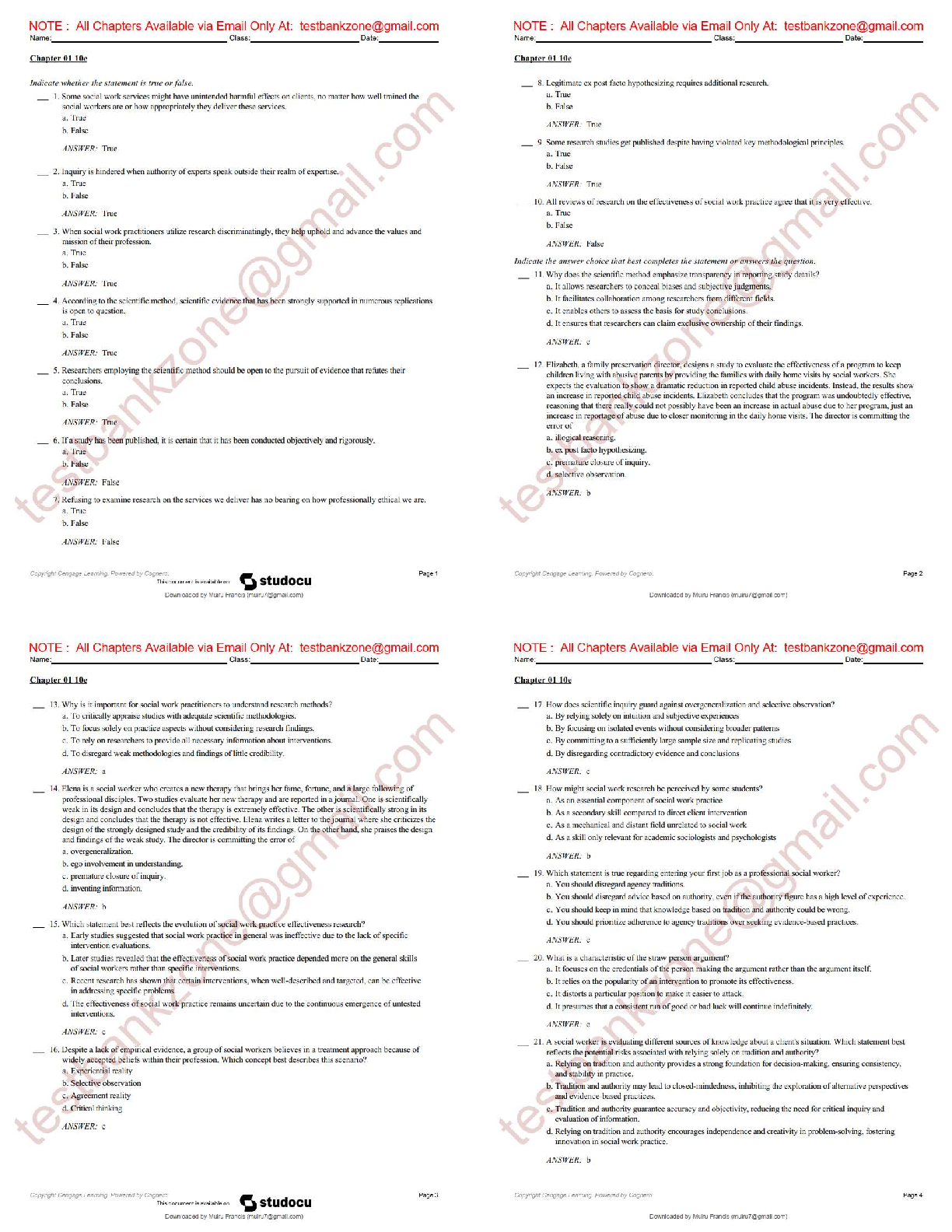
Research Methods Exam Questions and Answers When maximizing the internal validity of an experiment, what threats are created to external validity? >>> When maximizing internal validity, an experime ... nter introduces somewhat artificial circumstances that reduce external validity and the generalizability of results. What are some threats to internal validity? >>> "History" which is the effect of common events occurring in the lives of the participants. "Maturation" is when the participant changes over the course of the observation based on things like growing older, wiser, bored, tired, etc. Testing is also a threat because previous effects of one test may alter results on subsequent tests. Example of this would be practice or familiarity with the testing protocols. (p. 24-34) Describe the difference between internal validity and external validity. >>> Internal validity refers to the extent to which an investigation rules out or makes implausible alternative explanations of the results, whereas external validity refers to the extent to which the results of an investigation can be generalized beyond the conditions of the experiment to other populations, settings, and circumstances. (p. 24, 36) Explain why statistical regression is a threat to internal validity and how it can be avoided. >>> Statistical regression refers to the tendency for extreme scores on any measure to revert toward the mean. If testing a participant twice and seeing an improvement the second occurs, it is difficult to know whether this is due to the treatment or the tendency for scores to become less extreme. In order to decrease this threat, one can use a control group to discern whether the changes in the two treatment conditions were any greater than changes without treatment (pg. 28-29) To pose a treat to validity, what two conditions must be met? >>> To pose a threat to validity, the difference found as a result of the intervention must systematically vary between experimental groups or conditions. Also, that difference must be plausible and reasonably be able to explain the results. Frivolous differences are not reasonable threats to validity (p.31-32). Reactivity of an experimental arrangement functions as a threat to external validity insofar as subjects are aware of their participation in an investigation, and thus, could act in nuanced ways. The concern to external validity is whether these results would be obtained if subjects were not aware of their participation; however, ethical protocols dictate awareness of participation. What type of investigation might be an exception to this paradigm? >>> Studies that examine records and thus may not require informed consent. Pg. 42Is internal validity considered before external validity, and if so, why? >>> Yes, internal validity is considered first because one must first have an unambiguous finding before one can ask about its generality (external validity; p. 51). What are the tradeoffs of increasing and decreasing experimental precision? >>> Research designs that make an experiment more sensitive as a test of the independent and dependent variables tend to limit the generality of the findings. Conversely, designs that enhance the generality of the results tend to increase variability and to decrease the sensitivity of the experiment. How does internal validity play a role when assessing the construct validity in an investigation? >>> Internal validity is relevant because before making claims about construct validity, we need to ensure that the internal validity of the investigation is sufficient (p. 56). What threat does the placebo effect pose and why? >>> The placebo effect poses a threat to construct validity. It is difficult to determine the basis for the effects due to the fact the improvement could be caused by merely taking the drug. (pg. 58) What is a placebo, and how is it important to construct validity? >>> (p. 58-60) A placebo is a substance that has no active pharmacological properties that would be expected to produce change for the problem to which it is applied. It is important to have a placebo (or control group) to highlight and remove the possibility of the placebo effect, thus reducing a threat to construct validity. [Show More]

Last updated: 3 years ago

Preview 1 out of 14 pages

Buy Now

Instant download

We Accept:

Payment methods accepted on Scholarfriends (We Accept)
Preview image of Research Methods Exam Questions and Answers document

Buy this document to get the full access instantly

Instant Download Access after purchase

Buy Now

Instant download

We Accept:

Payment methods accepted on Scholarfriends (We Accept)

Reviews( 0 )

$10.00

Buy Now

We Accept:

Payment methods accepted on Scholarfriends (We Accept)

Instant download

Can't find what you want? Try our AI powered Search

349
0

Document information


Connected school, study & course


About the document


Uploaded On

Aug 10, 2022

Number of pages

14

Written in

All

Seller


Profile illustration for Professor Lynne
Professor Lynne

Member since 4 years

372 Documents Sold

Reviews Received
34
13
4
0
4
Additional information

This document has been written for:

Uploaded

Aug 10, 2022

Downloads

 0

Views

 349

Document Keyword Tags

More From Professor Lynne

View all Professor Lynne's documents »

$10.00
What is Scholarfriends

Scholarfriends.com Online Platform by Browsegrades Inc. 651N South Broad St, Middletown DE. United States.

We are here to help

We're available through e-mail, Twitter, Facebook, and live chat.
 FAQ
 Questions? Leave a message!

Follow us on
 Twitter

Copyright © Scholarfriends · High quality services·