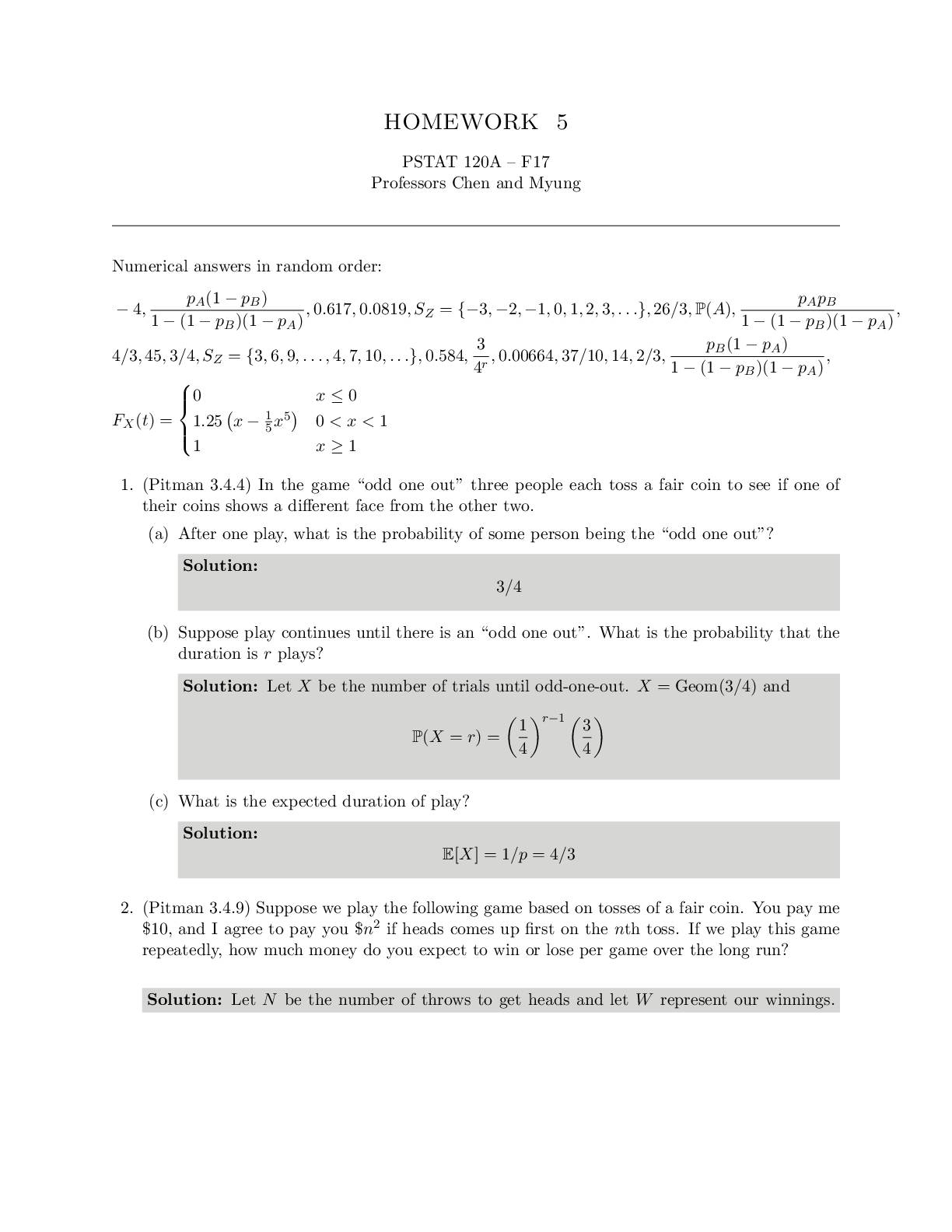
Numerical answers in random order:
− 4; pA(1 − pB)
1 − (1 − pB)(1 − pA); 0:617; 0:0819; SZ = f−3; −2; −1; 0; 1; 2; 3; : : :g; 26=3; P(A); 1 − (1 −ppABpB)(1 − pA);
4=3; 45; 3=4; SZ = f3; 6; 9; : : : ; 4; 7; 10; : : :g;
...
Numerical answers in random order:
− 4; pA(1 − pB)
1 − (1 − pB)(1 − pA); 0:617; 0:0819; SZ = f−3; −2; −1; 0; 1; 2; 3; : : :g; 26=3; P(A); 1 − (1 −ppABpB)(1 − pA);
4=3; 45; 3=4; SZ = f3; 6; 9; : : : ; 4; 7; 10; : : :g; 0:584; 3
4r ; 0:00664; 37=10; 14; 2=3; 1 − (1pB−(1pB−)(1 pA−) pA);
FX(t) =
8><>:
0 x ≤ 0
1:25 x − 1 5x5� 0 < x < 1
1 x ≥ 1
1. (Pitman 3.4.4) In the game \odd one out" three people each toss a fair coin to see if one of
their coins shows a different face from the other two.
(a) After one play, what is the probability of some person being the \odd one out"?
Solution:
3=4
(b) Suppose play continues until there is an \odd one out". What is the probability that the
duration is r plays?
Solution: Let X be the number of trials until odd-one-out. X = Geom(3=4) and
P(X = r) = �1 4�r−1 �3 4�
(c) What is the expected duration of play?
Solution:
E[X] = 1=p = 4=3
2. (Pitman 3.4.9) Suppose we play the following game based on tosses of a fair coin. You pay me
$10, and I agree to pay you $n2 if heads comes up first on the nth toss. If we play this game
repeatedly, how much money do you expect to win or lose per game over the long run?
Solution: Let N be the number of throws to get heads and let W represent our winnings.Then, N = Geom(1=2), and
E[W] = E[N2 − 10]
= E[N2] − 10
= (Var(N) + E[N]2) − 10
= �(1 −1=12=2)2 + 11=4� − 10
= 6 − 10
= −4
3. (Pitman 3.4.10) Suppose that A tosses a coin which lands heads with probability pA, and B
tosses one which lands heads with probability pB. They toss their coins simultaneously over
and over again, in a competition to see who gets the first head. The one to get the first head
is the winner, except that a draw results if they get their first heads together. Calculate
(a) the probability that A wins;
Solution: Let XA be the number of tosses until A gets heads and XB be the number
of tosses until B gets heads. We write (A’s flip, B’s flip) as an ordered pair for each
simultaneous toss. Then
P(A wins) = P((H; T)) + P((T; T); (H; T)) + P((T; T); (T; T); (H; T)) + : : :
= pA(1 − pB) + pA(1 − pA)(1 − pB)2 + pA(1 − pA)2(1 − pB)3 + : : :
= pA
1 X k
=1
(1 − pB)k(1 − pA)k−1
= pA(1 − pB)
1 X k
=0
((1 − pB)(1 − pA))k
=
pA(1 − pB)
1 − (1 − pB)(1 − pA)
(b) the probability that B wins;
Solution:
P(B wins) = pB(1 − pA)
1 − (1 − pB)(1 − pA)
(c) the probability that a draw occurs;
[Show More]