Week 7 Assignment Developing Hypothesis and understanding Possible Conclusion for Proportions
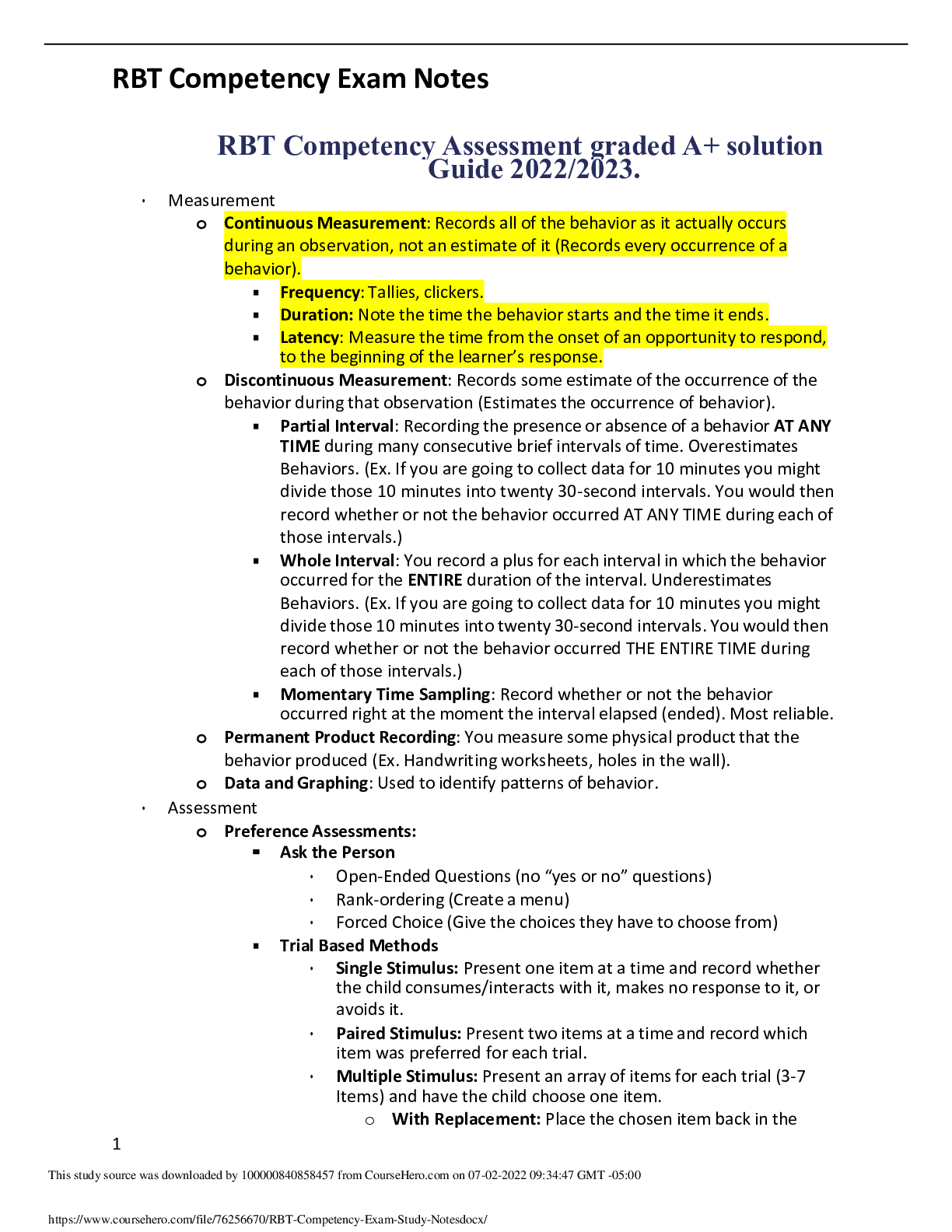
General Questions > EXAM > RBT Competency Assessment graded A+ solution Guide 2022/2023. (All)
RBT Competency Assessment A+ Guide. Indirect Measurement - interviews, rating scales, questions, surveys Direct Measurement - observation of the behavior and recording it as it occurs Behavioral Defin ... itions - operational, includes verbs describing behavior, objective + unambiguous, does not rely on internal states (happy, sad), does not use labels (bad or good) Operational - describes what the behavior looks like so two independent observers can recognize + record the same behavior Indirect Outcome Recording - measures results that produces an observable product in the environment. main advantage is that it's easy to use Direct Outcome Recording - instead of relying on memory data is gathered immediately as the behavior occurs or as it produces results Event Recording - behavior is observed continuously throughout the observation period, and each instance of the behavior is recorded immediately as it occurs. Must meet two criteria: Does the behavior look the same every time? Does the behavior have a clear beginning and end? Frequency Recording - used for behaviors that have a clear beginning and end, tally the number of times the behavior occurs Intensity - magnitude or force of response (only record if this is the aspect of the behavior you are trying to change) Duration - how long a behavior persists, should be used if you are trying to decrease how long a behavior lasts Latency - time that occurs between the SD and the response (ex. how long to respond to a peer's question). You record this when the goal is to decrease the time between SD and response Partial Interval Recording - involves checking off an interval if the behavior occurs at ANY point within the interval - even if it only occured for 1 second. You can use this for self-stimulatory behaviors or behaviors that don't look the same every time. An overexaggeration of the behavior, you use this method to decrease behavior. Whole Interval Recording - involves checking off the interval if the behavior occurs throughout the WHOLE interval. Use when it is difficult to tell when the behavior begins or ends, when it occurs at such a high rate it is difficult to keep count. An under-exaggeration of behavior, you use this method to increase behavior. Momentary Time Sampling Recording - data is less representative than intervals, looking for a behavior's occurrence during a specific part of the interval and recording if it is occurring at that precise moment. Ex: setting a timer to go off every minute for a 30 minute interval, only checking for behavior and marking it down as the timer goes off. Reinforcement - follows a behavior that increases that behavior Punishment - follows a behavior that decreases that behavior Positive Reinforcement - addition of a pleasant stimulus Negative Reinforcement - removal of an aversive stimulus Positive Punishment - addition of an aversive stimulus Negative Punishment - removal of a pleasant stimulus Motivating Operations - Variables in the environment that alter the relative value of a particular reinforcer at a particular time. Deprivation - when a person hasn't had access to a particular reinforcer for a significant period of time, makes it more potent Immediacy - the time between the occurrence of the behavior and the delivery of the reinforcer. The more immediate, the more effective Size - the magnitude of the reinforcer changes the effectiveness. You want to not give too much or the reinforcer will lose its value, but too little will not be motivating enough. Contingency - when the reinforcer is delivered only for the target behavior it is more effective Schedules of Reinforcement - specifies how often particular behaviors receive reinforcement Continuous schedule - used for learning new behaviors, the behavior is reinforced every time Intermittent Schedule - used to maintain behavior once a skill is acquired. Behavior is only reinforced some of the time. They generate high response rates and prevent behavior from stopping. Fixed Ratio Schedule - a schedule of reinforcement after a fixed level of responses. Ex: reinforce after every 5th correct response. Variable Ratio Schedule - An average number of responses must be made before delivery of reinforcement. Ex: slot machine Fixed Interval Schedule - it doesn't matter how many times the behavior occurred, the person only gets the reinforcer once the response is given after a fixed amount of time. Ex: receiving a paycheck. Variable Interval Schedule - the reinforcer is delivered for the first response that occurs after an unpredictable amount of time has passed. Ex: checking your email - you probably do this periodically throughout the day without a set schedule Extinction - when the response no longer produces reinforcement. Extinction burst - when the behavior is no longer reinforced, it will briefly increase in frequency, intensity and duration. This is because the learner wants to see if performing the behavior more intensely will produce reinforcement. Response Cost - taking away a reinforcer as a result of behavior (ex: taking car keys away after missing curfew) Behavior Intervention Plan - plans developed to guide parents, teachers and other paraprofessionals on how to decrease inappropriate behvaiors and teach or increase replacement behaviors in all settings. Everyone who interacts with the individual should follow the plan Functional Behavior Assessment - a collection of different procedures of gathering information on antecedants, behaviors, and consequences in order to determine the factors that lead to maintaining problem behavior. Antecedant - an environmental condition existing or occurring immediately before the behavior of interest (ex: the setting, people they are around, the actions of people around them) Visual Schedules - a set of pictures that communicate a series of activities or steps of a specific schedule. Gives a sense of control, predictability and choice over their schedule Means to an end visual - shows the individual when they are finished or when something new is going to happen, like a transition. Ex: timer, token board, first/then board. More likely to stay on task if they can see when they get a break Functional Communication training - the use of appropriate communicative behavior to replace the inappropriate behavior. If we make it easier to communicate through words, ............................................Continues [Show More]
Last updated: 3 years ago
Preview 1 out of 5 pages
Buy this document to get the full access instantly
Instant Download Access after purchase
Buy NowInstant download
We Accept:

Can't find what you want? Try our AI powered Search
Connected school, study & course
About the document
Uploaded On
Jul 02, 2022
Number of pages
5
Written in
All
This document has been written for:
Uploaded
Jul 02, 2022
Downloads
0
Views
226
Scholarfriends.com Online Platform by Browsegrades Inc. 651N South Broad St, Middletown DE. United States.
We're available through e-mail, Twitter, Facebook, and live chat.
FAQ
Questions? Leave a message!
Copyright © Scholarfriends · High quality services·



.png)