CE 370 – Spring 2020 – Homework 4 latest complete solution
Due Tuesday, February 25, at the start of class
35 Points
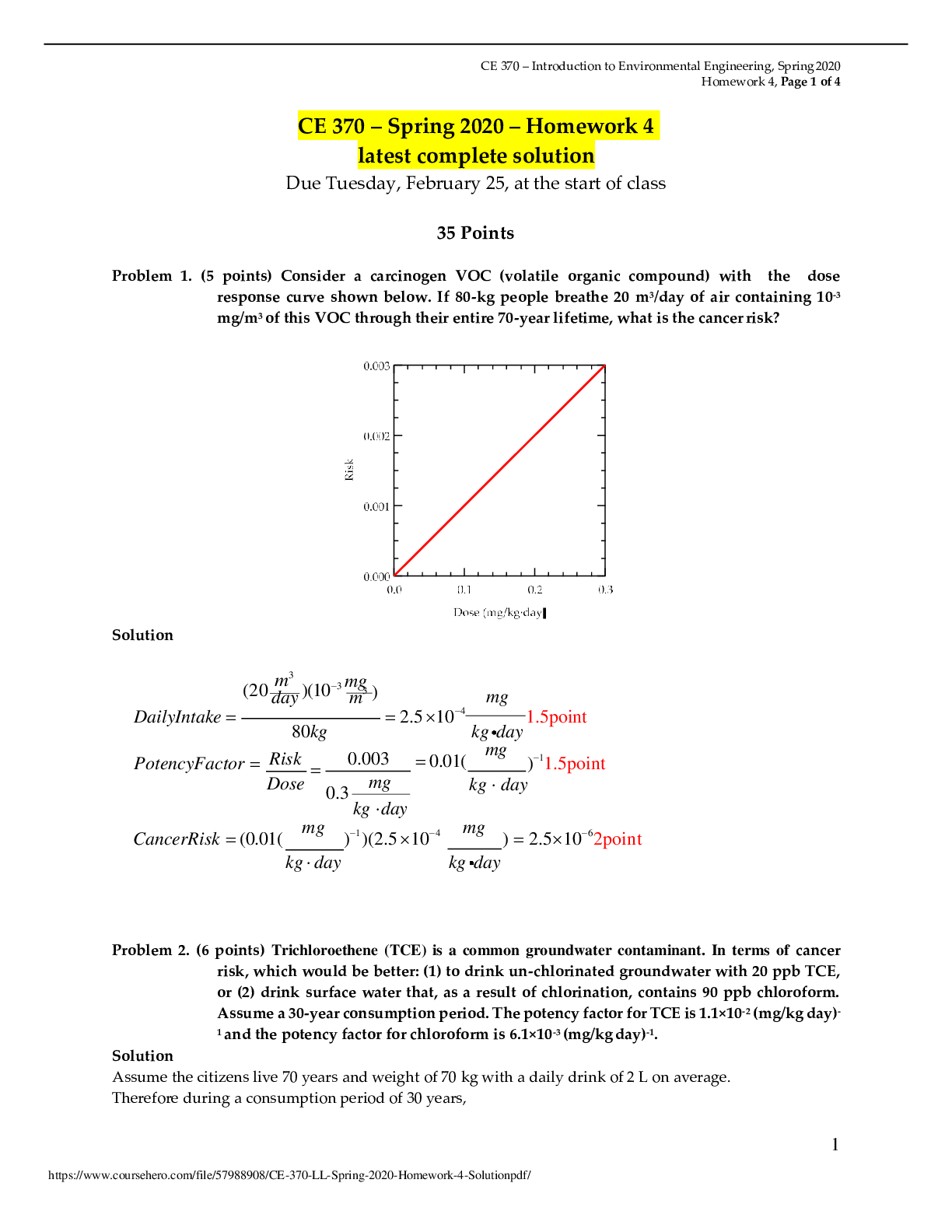
Problem 1. (5 points) Consider a carcinogen VOC (volatile organic compound) with the dose re
...
CE 370 – Spring 2020 – Homework 4 latest complete solution
Due Tuesday, February 25, at the start of class
35 Points
Problem 1. (5 points) Consider a carcinogen VOC (volatile organic compound) with the dose response curve shown below. If 80-kg people breathe 20 m3/day of air containing 10-3 mg/m3 of this VOC through their entire 70-year lifetime, what is the cancer risk?
Problem 2. (6 points) Trichloroethene (TCE) is a common groundwater contaminant. In terms of cancer risk, which would be better: (1) to drink un-chlorinated groundwater with 20 ppb TCE, or (2) drink surface water that, as a result of chlorination, contains 90 ppb chloroform. Assume a 30-year consumption period. The potency factor for TCE is 1.1×10⁻² (mg/kg day)- 1 and the potency factor for chloroform is 6.1×10⁻³ (mg/kg day)-1.
Problem 3. (4 points) Apple seeds contain cyanide (CN). Cyanide is toxic and has an LD50 of approximately 2 mg/kg. Assume an apple contains 7 grams of seeds, and the seeds contain 1 gram of cyanide per 1000 grams of seeds. How many apples (with seeds!) would a typical person (80 kg) need to consume to have a 50% chance of death?
Solution
Problem 4. (6 points) Out-of-state tuition at the Penn State University Park campus rose from
$26,276/yr in 2010 to $31,346/yr in 2016.
a. What is the exponential rate of growth over that time?
b. If that growth rate were to continue, what would be the out-of-state tuition in 2040 (i.e., 24 years from 2016, when you may have a child entering college).
Problem 5. (6 points) World reserves of chromium are about 800 million tons, and current usage is about 2 million tons per year. If growth in demand for chromium increases exponentially at a constant rate of 3.0 percent per year, how long would it take to use up current reserves? Suppose the total resource is five times current reserves; if the use rate continues to grow at 3.0 percent, how long would it take to use up the resources?
Problem 6. (8 points) Consider the following disaggregation of carbon emissions:
Carbon emissions (kg C/yr) = Population × Energy (kJ/yr)/person × Carbon (kg C)/Energy (kJ)
Using the following estimates for the United States and assuming growth rates remain constant:
Population (kJ/yr)/Person kg C/kJ
1990 amount 250×106 320×106 15×10-6
Growth (%/yr) 0.6 0.5 -0.3
a. Find the carbon emission rate in 2020.
b. Find the total carbon emitted in those 30 years.
c. Find the total Energy demand in 2020.
d. Find the per capita carbon emission rate in 2020.
[Show More]




 answers.png)