NURS 6501
Christine Jean-Baptiste
Knowledge Check: Module 8
Student Response
This Knowledge Check reviews the topics in Module 8 and is formative in nature. It is
worth 20 points where each question is worth 1 point
...
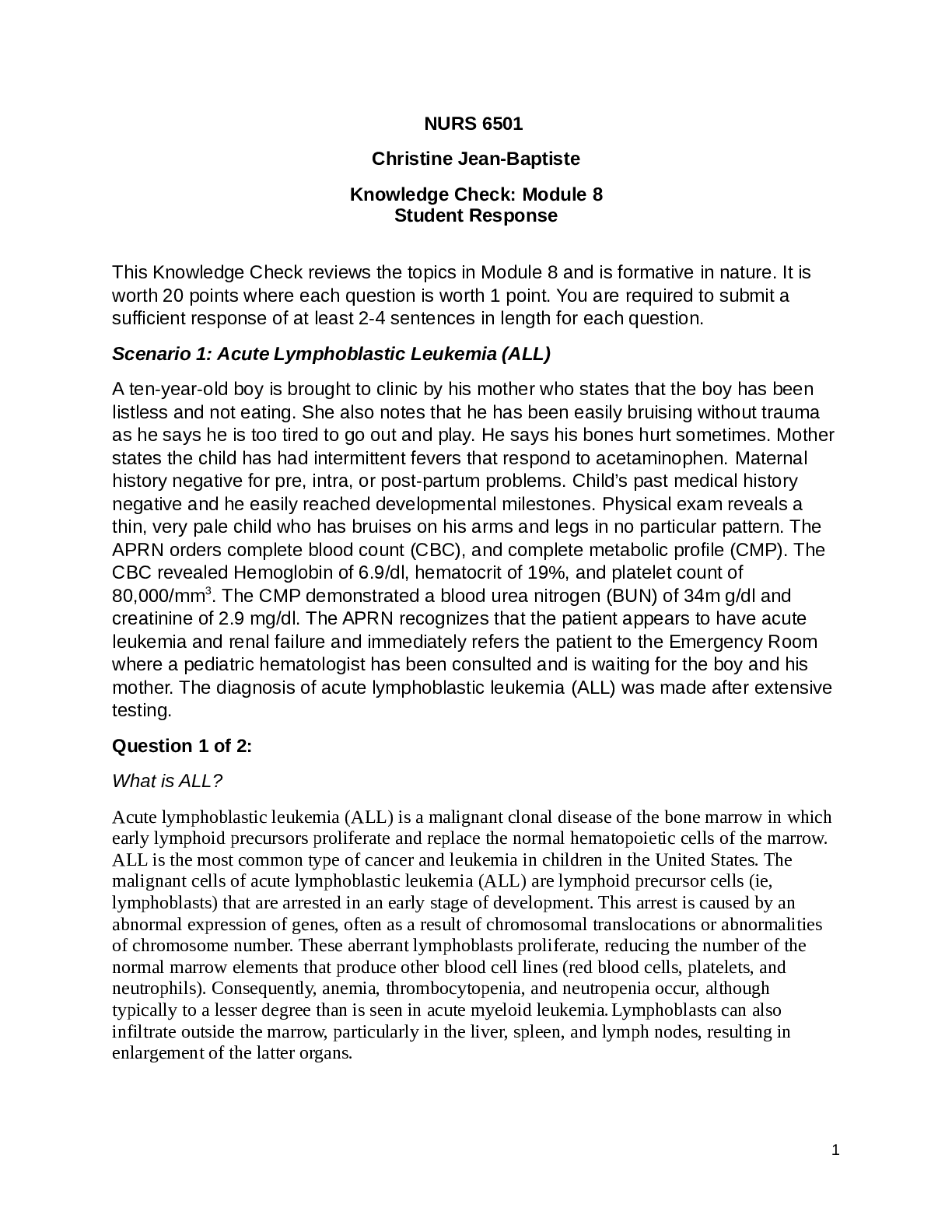
NURS 6501
Christine Jean-Baptiste
Knowledge Check: Module 8
Student Response
This Knowledge Check reviews the topics in Module 8 and is formative in nature. It is
worth 20 points where each question is worth 1 point. You are required to submit a
sufficient response of at least 2-4 sentences in length for each question.
Scenario 1: Acute Lymphoblastic Leukemia (ALL)
A ten-year-old boy is brought to clinic by his mother who states that the boy has been
listless and not eating. She also notes that he has been easily bruising without trauma
as he says he is too tired to go out and play. He says his bones hurt sometimes. Mother
states the child has had intermittent fevers that respond to acetaminophen. Maternal
history negative for pre, intra, or post-partum problems. Child’s past medical history
negative and he easily reached developmental milestones. Physical exam reveals a
thin, very pale child who has bruises on his arms and legs in no particular pattern. The
APRN orders complete blood count (CBC), and complete metabolic profile (CMP). The
CBC revealed Hemoglobin of 6.9/dl, hematocrit of 19%, and platelet count of
80,000/mm3
. The CMP demonstrated a blood urea nitrogen (BUN) of 34m g/dl and
creatinine of 2.9 mg/dl. The APRN recognizes that the patient appears to have acute
leukemia and renal failure and immediately refers the patient to the Emergency Room
where a pediatric hematologist has been consulted and is waiting for the boy and his
mother. The diagnosis of acute lymphoblastic leukemia (ALL) was made after extensive
testing.
Question 1 of 2:
What is ALL?
Acute lymphoblastic leukemia (ALL) is a malignant clonal disease of the bone marrow in which
early lymphoid precursors proliferate and replace the normal hematopoietic cells of the marrow.
ALL is the most common type of cancer and leukemia in children in the United States. The
malignant cells of acute lymphoblastic leukemia (ALL) are lymphoid precursor cells (ie,
lymphoblasts) that are arrested in an early stage of development. This arrest is caused by an
abnormal expression of genes, often as a result of chromosomal translocations or abnormalities
of chromosome number. These aberrant lymphoblasts proliferate, reducing the number of the
normal marrow elements that produce other blood cell lines (red blood cells, platelets, and
neutrophils). Consequently, anemia, thrombocytopenia, and neutropenia occur, although
typically to a lesser degree than is seen in acute myeloid leukemia. Lymphoblasts can also
infiltrate outside the marrow, particularly in the liver, spleen, and lymph nodes, resulting in
enlargement of the latter organs.
1
Question 2 of 2:
How does renal failure occur in some patients with ALL?
Renal failure occurs in some patients with ALL as a result of hyperuricemia. Uric levels rise as
an end product of purine metabolism from cellular destruction. Because the major excretory
pathway is through the kidneys, urates can precipitate in renal tubules or ureters and can lead to
oliguria and acute renal failure.
Scenario 2: Sickle Cell Disease (SCD)
A 12-year-old female with known sickle cell disease (SCD) present to the Emergency
Room in sickle cell crisis. The patient is crying with pain and states this is the third acute
episode she has had in the last nine months. Both parents are present and appear very
anxious and teary eyed. A diagnosis of acute sickle cell crisis was made. Appropriate
therapeutic interventions were initiated by the APRN and the patient’s pain
level decreased, and she was transferred to the pediatric intensive care unit (PICU) for
observation and further management.
Question 1 of 2:
What is the pathophysiology of acute SCD crisis and why is pain the
predominate feature of acute crises?
The pathogenesis of sickling includes erythrocyte derangement, chronic hemolysis,
microvascular occlusions, and tissue damage. Deoxygenation is probably the most important
variable in determining the occurrence of sickling. Other significant variables that affect sickling
include interaction of Hbs with other types of hemoglobin in the cell, mean cell hemoglobin
concentration (MCHC), intracellular pH, and transit times of erythrocytes through the
microcirculation. The intense pain of an acute crisis is due to lack of oxygen to major organs and
bones. The lack of oxygen leads to ischemia and organ death.
Question 2 of 2:
Discuss the genetic basis for SCD.
SCD denotes all genotypes containing at least one sickle gene, in which HbS makes up at least
half the hemoglobin present. Major sickle genotypes described so far include the following:
HbSS disease or sickle cell anemia (the most common form) - Homozygote for the S
globin with usually a severe or moderately severe phenotype and with the shortest
survival
HbS/b-0 thalassemia - Double heterozygote for HbS and b-0 thalassemia; clinically
indistinguishable from sickle cell anemia (SCA)
HbS/b+ thalassemia - Mild-to-moderate severity with variability in different ethnicities
HbSC disease - Double heterozygote for HbS and HbC characterized by moderate
clinical severity
HbS/hereditary persistence of fetal Hb (S/HPHP) - Very mild or asymptomatic phenotype
2
Sickle cell trait or the carrier state is the heterozygous form characterized by the presence of
around 40% HbS, absence of anemia, inability to concentrate urine (isosthenuria), and hematuria.
Under conditions leading to hypoxia, it may become a pathologic risk factor. Sickle cell disease
produces illness, while sickle cell trait usually does not. People who inherit two genes for sickle
hemoglobin (one from each parent) have sickle cell disease. With a few exceptions, a child can
inherit sickle cell disease only if both parents have one gene for sickle cell hemoglobin.
Scenario 3: Hemophilia
The parents of a 9-month boy bring the infant to the pediatrician’s office for evaluation
of a swollen right knee and excessive bruising. The parents have noticed that the
baby began having bruising about a month ago but thought the bruising was due to the
child’s attempts to crawl. They became concerned when the baby woke up with a
swollen knee. Infant up to date on all immunizations,
[Show More]