NURS 6501
Knowledge Check: Module 7
Student Response
Scenario 1: Polycystic Ovarian Syndrome (PCOS)
A 28-year-old woman presents to the clinic with a chief complaint of hirsutism and
irregular menses. She describes
...
NURS 6501
Knowledge Check: Module 7
Student Response
Scenario 1: Polycystic Ovarian Syndrome (PCOS)
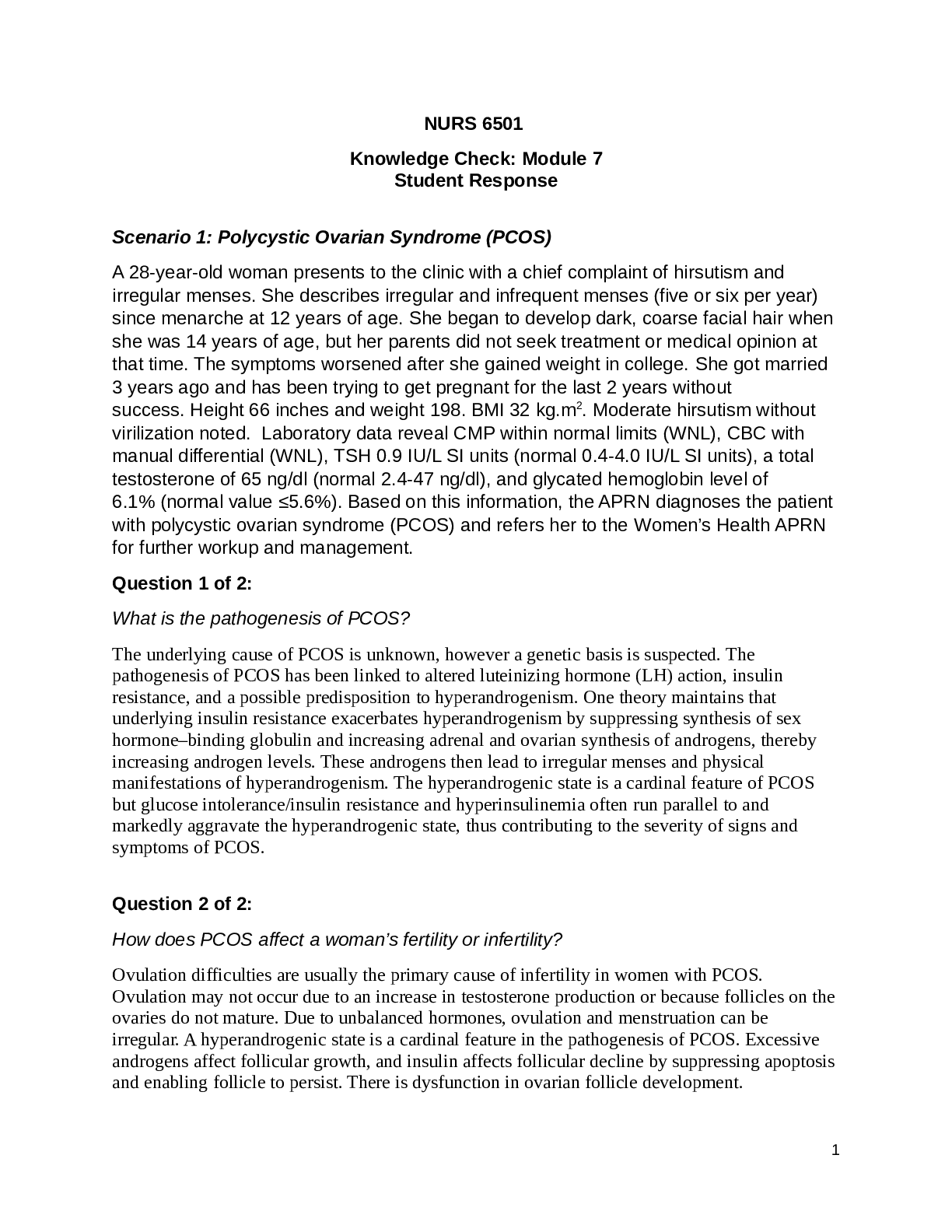
A 28-year-old woman presents to the clinic with a chief complaint of hirsutism and
irregular menses. She describes irregular and infrequent menses (five or six per year)
since menarche at 12 years of age. She began to develop dark, coarse facial hair when
she was 14 years of age, but her parents did not seek treatment or medical opinion at
that time. The symptoms worsened after she gained weight in college. She got married
3 years ago and has been trying to get pregnant for the last 2 years without
success. Height 66 inches and weight 198. BMI 32 kg.m2
. Moderate hirsutism without
virilization noted. Laboratory data reveal CMP within normal limits (WNL), CBC with
manual differential (WNL), TSH 0.9 IU/L SI units (normal 0.4-4.0 IU/L SI units), a total
testosterone of 65 ng/dl (normal 2.4-47 ng/dl), and glycated hemoglobin level of
6.1% (normal value ≤5.6%). Based on this information, the APRN diagnoses the patient
with polycystic ovarian syndrome (PCOS) and refers her to the Women’s Health APRN
for further workup and management.
Question 1 of 2:
What is the pathogenesis of PCOS?
The underlying cause of PCOS is unknown, however a genetic basis is suspected. The
pathogenesis of PCOS has been linked to altered luteinizing hormone (LH) action, insulin
resistance, and a possible predisposition to hyperandrogenism. One theory maintains that
underlying insulin resistance exacerbates hyperandrogenism by suppressing synthesis of sex
hormone–binding globulin and increasing adrenal and ovarian synthesis of androgens, thereby
increasing androgen levels. These androgens then lead to irregular menses and physical
manifestations of hyperandrogenism. The hyperandrogenic state is a cardinal feature of PCOS
but glucose intolerance/insulin resistance and hyperinsulinemia often run parallel to and
markedly aggravate the hyperandrogenic state, thus contributing to the severity of signs and
symptoms of PCOS.
Question 2 of 2:
How does PCOS affect a woman’s fertility or infertility?
Ovulation difficulties are usually the primary cause of infertility in women with PCOS.
Ovulation may not occur due to an increase in testosterone production or because follicles on the
ovaries do not mature. Due to unbalanced hormones, ovulation and menstruation can be
irregular. A hyperandrogenic state is a cardinal feature in the pathogenesis of PCOS. Excessive
androgens affect follicular growth, and insulin affects follicular decline by suppressing apoptosis
and enabling follicle to persist. There is dysfunction in ovarian follicle development.
1
Inappropriate gonadotropin secretion triggers the beginning of a vicious cycle that perpetuates
anovulation.
Scenario 2: Pelvic Inflammatory Disease (PID)
A 20-year-old female college student presents to the Student Health Clinic with a chief
complaint of abdominal pain, foul smelling vaginal discharge, and fever and chills for the
past 4 days. She denies nausea, vomiting, or difficulties with defecation. Last bowel
movement this morning and was normal for her. Nothing has helped with the pain
despite taking ibuprofen 200 mg orally several times a day. She describes the pain as
sharp and localizes the pain to her lower abdomen. Past medical history
noncontributory. GYN/Social history + for having had unprotected sex while at a
fraternity party. Physical exam: thin, Ill appearing anxious looking white female who is
moving around on the exam table and unable to find a comfortable position.
Temperature 101.6F orally, pulse 120, respirations 22 and regular. Review of systems
negative except for chief complaint. Focused assessment of abdomen
demonstrated moderate pain to palpation left and right lower quadrants. Upper
quadrants soft and non-tender. Bowel sounds diminished in bilateral lower quadrants.
Pelvic exam demonstrated + adnexal tenderness, + cervical motion tenderness and
copious amounts of greenish thick secretions. The APRN diagnoses the patient as
having pelvic inflammatory disease (PID).
Question:
What is the pathophysiology of PID?
Pelvic inflammatory disease (PID) is an infectious and inflammatory disorder of the upper
female genital tract, including the uterus, fallopian tubes, or ovaries; in more severe form, the
entire peritoneal cavity. The development of upper genital tract infections is mediated by the
failure of a number of defense mechanisms that usually are effective in preventing PID.
Chlamydia and gonorrhea are the predominant sexually transmitted organism associated with
PID. Many anaerobic bacteria have been implica
[Show More]