NURS 6501
Knowledge Check: Module 5
Student Response
This Knowledge Check reviews the topics in Module 5 and is formative in nature. It is
worth 20 points where each question is worth 1 point. You are required to sub
...
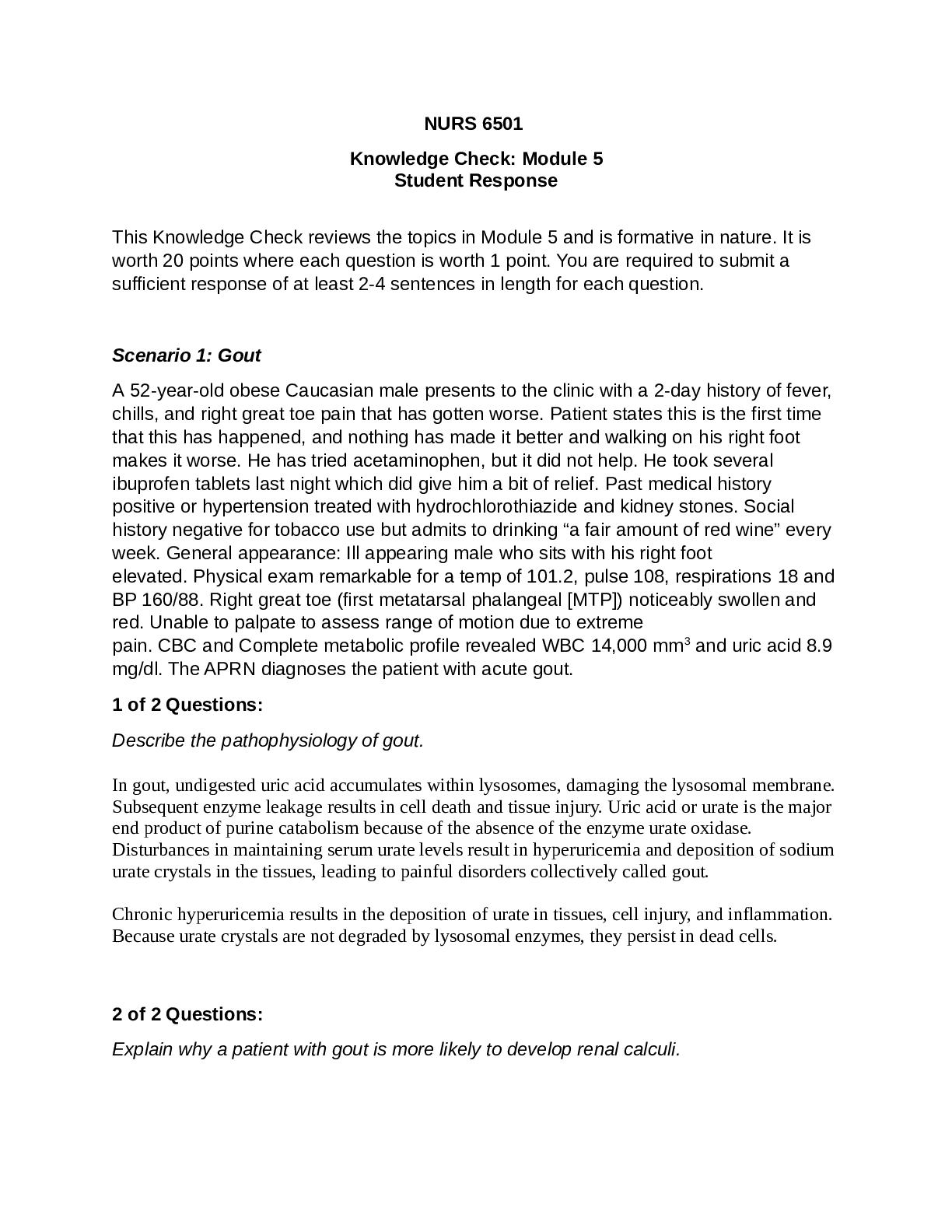
NURS 6501
Knowledge Check: Module 5
Student Response
This Knowledge Check reviews the topics in Module 5 and is formative in nature. It is
worth 20 points where each question is worth 1 point. You are required to submit a
sufficient response of at least 2-4 sentences in length for each question.
Scenario 1: Gout
A 52-year-old obese Caucasian male presents to the clinic with a 2-day history of fever,
chills, and right great toe pain that has gotten worse. Patient states this is the first time
that this has happened, and nothing has made it better and walking on his right foot
makes it worse. He has tried acetaminophen, but it did not help. He took several
ibuprofen tablets last night which did give him a bit of relief. Past medical history
positive or hypertension treated with hydrochlorothiazide and kidney stones. Social
history negative for tobacco use but admits to drinking “a fair amount of red wine” every
week. General appearance: Ill appearing male who sits with his right foot
elevated. Physical exam remarkable for a temp of 101.2, pulse 108, respirations 18 and
BP 160/88. Right great toe (first metatarsal phalangeal [MTP]) noticeably swollen and
red. Unable to palpate to assess range of motion due to extreme
pain. CBC and Complete metabolic profile revealed WBC 14,000 mm3 and uric acid 8.9
mg/dl. The APRN diagnoses the patient with acute gout.
1 of 2 Questions:
Describe the pathophysiology of gout.
In gout, undigested uric acid accumulates within lysosomes, damaging the lysosomal membrane.
Subsequent enzyme leakage results in cell death and tissue injury. Uric acid or urate is the major
end product of purine catabolism because of the absence of the enzyme urate oxidase.
Disturbances in maintaining serum urate levels result in hyperuricemia and deposition of sodium
urate crystals in the tissues, leading to painful disorders collectively called gout.
Chronic hyperuricemia results in the deposition of urate in tissues, cell injury, and inflammation.
Because urate crystals are not degraded by lysosomal enzymes, they persist in dead cells.
2 of 2 Questions:
Explain why a patient with gout is more likely to develop renal calculi.
Uric acid stones occur in persons who excrete excessive uric acid in the urine, such as those with
gouty arthritis. Uric acid is primarily a product of biosynthesis of endogenous purines and is
secondarily affected by consumption of purines (e.g., meat and beer) in the diet. A consistently
acidic urine greatly increases this risk, including defective excretion.
Scenario 2: Lyme Disease
Stan is a 45-year-old man who presents to the clinic complaining of intermittent fevers,
joint pain, myalgias, and generalized fatigue. He noticed a rash several days ago that
seemed to appear and disappear on different parts of his abdomen. He noticed the
lesion below this morning and decided to come in for evaluation. He denies recent
international travel and the only difference in his usual routine was clearing some
underbrush from his back yard about a week ago. Past medical history non-contributory
with exception of severe allergy to penicillin resulting in hives and difficulty breathing.
Physical exam: Temp 101.1 ˚F, BP 128/72, pulse 102 and regular, respirations 18. Skin
inspection revealed a 4-inch diameter bull’s eye type red rash over the left flank
area. The APRN, based on history and physical exam, diagnoses the patient with Lyme
Disease. She ordered appropriate labs to confirm diagnosis but felt it urgent to begin
antibiotic therapy to prevent secondary complications.
Question:
What is Lyme disease and what patient factors may have increased his risk developing
Lyme disease?
Lyme disease is a multisystem inflammatory disease caused by the spirochete Borrelia
burgdorferi transmitted by Ixodes tick bites and is the most frequently reported vector-borne
illness. The microorganism is difficult to culture; escapes immune defenses through antigenic
variation; blocks complement- mediated killing; impedes release of antimicrobial peptides,
leukocyte chemotaxis, and antimicrobial killing; and hides in tissue. It spreads to other tissues by
entering capillary beds.
Factors of the patient that increased his risk developing Lyme disease is that he cleared brush
from his back yard a week ago. Ticks live in those atmospheres and can easily attach to the skin
of humans and animals.
Scenario 3: Osteoporosis
A 72-year-old female was walking her
[Show More]