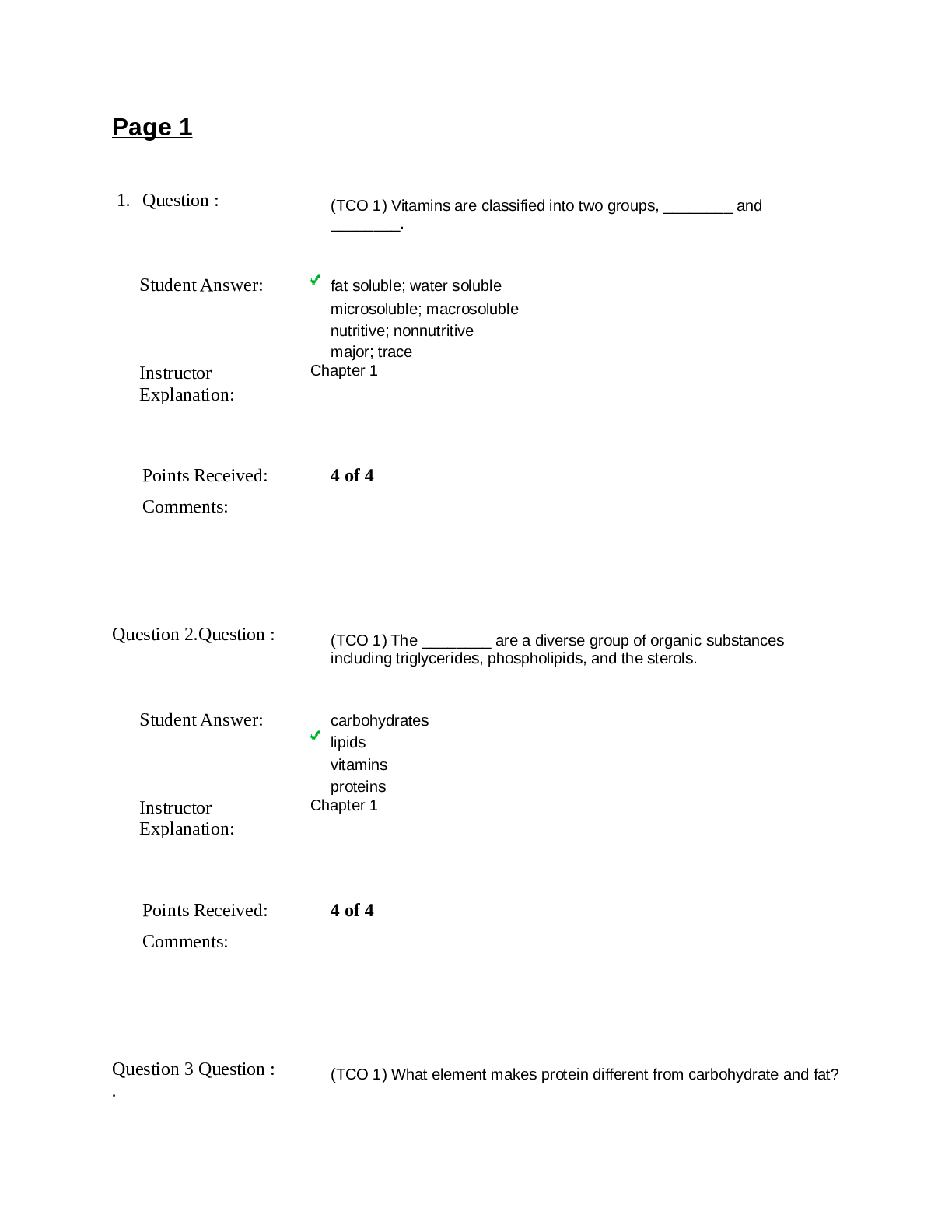
Question :
(TCO 1) Which of the following is NOT an essential nutrient?
Student Answer: Water
Alcohol
Vitamins
Minerals
Instructor
Explanation:
Chapter 1
Points Received: 4 of 4
Comments:
Question 2. Question
...
Question :
(TCO 1) Which of the following is NOT an essential nutrient?
Student Answer: Water
Alcohol
Vitamins
Minerals
Instructor
Explanation:
Chapter 1
Points Received: 4 of 4
Comments:
Question 2. Question :
(TCO 1) Which of the following nutrients contains the element nitrogen?
Student Answer: Carbohydrates
Lipids
Water
Proteins
Instructor
Explanation:
Chapter 1
Points Received: 4 of 4
Comments:
Question 3. Question :
(TCO 1) Which statement is FALSE concerning the field of nutrition?Student Answer: Nutrition is the study of how food nourishes the body.
Nutrition encompasses how we consume, digest, metabolize, and
store food.
Nutrition is an ancient science that dates back to the 14th century.
Nutrition involves studying the factors that influence eating
patterns.
Instructor
Explanation:
Chapter 1
Points Received: 4 of 4
Comments:
Question 4. Question :
(TCO 1) Which of the following nutrients is the most energy dense?
Student Answer: Carbohydrate
Lipid
Protein
Vitamin
Instructor
Explanation:
Chapter 1
Points Received: 4 of 4
Comments:
Question 5. Question :
(TCO 1) For dinner, Bill consumes 255 grams of carbohydrate, 70
grams of protein, and 50 grams of fat. In addition, Bill decides that he
wants a glass of wine with his meal. If he drinks one glass of wine
containing 8 grams of alcohol, how many total kilocalories does he
consume in this meal?Student Answer: 56 kilocalories
540 kilocalories
1,675 kilocalories
1,806 kilocalories
Instructor
Explanation:
Chapter 1
Points Received: 4 of 4
Comments:
Question 6. Question :
(TCO 1) Which of the following is a micronutrient?
Student Answer: Carbohydrates
Vitamins
Lipids
Alcohol
Instructor
Explanation:
Chapter 1
Points Received: 4 of 4
Comments:
Question 7. Question :
(TCO 2) Reduced rates of hypertension is the central objective of the:
Student Answer: Food Guide Pyramid.
5-A-Day for Better Health Program.DASH diet.
the Exchange System.
Instructor
Explanation:
Chapter 2
Points Received: 4 of 4
Comments:
Question 8. Question :
(TCO 2) Which of the following is required on all food labels?
Student Answer: the net contents of the package
ingredient list
the name and address of the vendor
all of these
Instructor
Explanation:
Chapter 2
Points Received: 4 of 4
Comments:
Question 9. Question :
(TCO 2) In which group are cheeses listed in the Exchange System?
Student Answer: milk
meat
fruit
starchInstructor
Explanation:
Chapter 2
Points Received: 4 of 4
Comments:
Question 10. Question :
(TCO 2) The type of study that observes a large population to
determine factors that may influence nutritional habits and disease
trends is called a(n):
Student Answer: case controlled study.
clinical trial.
epidemiological study.
animal study.
Instructor
Explanation:
Chapter 1
Points Received: 4 of 4
Comments:
Question 11. Question :
(TCO 2) The second step of the scientific method is:
Student Answer: observation and description of a phenomenon.
testing a research question or hypothesis.
generating a hypothesis.
collecting data.
Instructor
Explanation:
Chapter 1
Points Received: 4 of 4Comments:
Question 12. Question :
(TCO 2) The 5-A-Day for Better Health Program was developed by the:
Student Answer: American Dietetic Association.
National Centers for Disease Control.
National Dairy Council.
National Cancer Institute.
Instructor
Explanation:
Chapter 2
Points Received: 4 of 4
Comments:
Question 13. Question :
(TCO 3) Digestion and absorption occur at the ________ level.
Student Answer: tissue
organ
system
organism
Instructor
Explanation:
Chapter 3
Points Received: 4 of 4
Comments:
Question 14. Question :
(TCO 3) What is chyme?Student Answer: ulcerations of the esophageal lining
healthy bacteria of the small intestine
mixture of partially digested food, water, and gastric juices
substance that allows for the emulsification of dietary lipid
Instructor
Explanation:
Chapter 3
Points Received: 4 of 4
Comments:
Question 15. Question :
(TCO 3) Responding to the presence of protein and fat in our meal,
cholecystokinin (CCK) signals the gallbladder to release a substance
called:
Student Answer: lipase.
pepsin.
chyme.
bile.
Instructor
Explanation:
Chapter 3
Points Received: 4 of 4
Comments:
Question 16. Question :
(TCO 3) Which best explains why carbohydrate digestion ceases whenfood reaches the stomach?
Student Answer: Carbohydrate is completely digested in the mouth.
Salivary enzymes cannot function in the acid environment of the
stomach.
Carbohydrate is completely absorbed in the esophagus.
Intestinal bacteria are needed for carbohydrate digestion.
Instructor
Explanation:
Chapter 3
Points Received: 4 of 4
Comments:
Question 17. Question :
(TCO 3) All of the following are found in saliva EXCEPT:
Student Answer: water and mucus.
enzymes.
antibodies.
bicarbonate.
Instructor
Explanation:
Chapter 3
Points Received: 4 of 4
Comments:1. Question :
(TCO 4) Peggy Sue's doctor wants to screen her for reactive
hypoglycemia. If her doctor's suspicions are correct and Peggy Sue
does have reactive hypoglycemia, what would you expect her blood
glucose concentration to be at approximately TWO HOURS after she
had begun her glucose tolerance test?
Student Answer: elevated as compared to a normal individual
depressed as compared to a normal individual
normal; two hours after consuming the glucose load, her blood
concentrations will be no different from those of a normal individual.
Instructor
Explanation:
Chapter 4
Points Received: 4 of 4
Comments:
Question 2. Question :
(TCO 4) Gluconeogenesis is:
Student Answer: the synthesis of new glucose from amino acids.
the release of stored glycogen from the liver.
the process by which plants use sunlight to synthesize glucose.
the uptake of glucose by the body's cells.
Instructor
Explanation:
Chapter 4
Points Received: 4 of 4
Comments:
Question 3. Question :
(TCO 4) Which of the following does NOT describe the cell membraneof an animal cell?
Student Answer: rigid barrier resistant to all noncellular molecules
structurally organized into a lipid bilayer
dynamic and continuously changing
perimeter structure of the cell that is composed of phospholipids,
cholesterol, proteins, and carbohydrate chains
Instructor
Explanation:
Chapter 3
Points Received: 4 of 4
Comments:
Question 4. Question :
(TCO 4) Which of the following is associated with the development of
ketosis?
Student Answer: a diet that contains too much fat
a diet that contains insufficient fat
a diet that contains too much carbohydrate
a diet that contains insufficient carbohydrate
Instructor
Explanation:
Chapter 4
Points Received: 4 of 4
Comments:
Question 5. Question :
(TCO 4) The term complex carbohydrates refers to:
[Show More]
.png)