• Physiological Adaptation ✓
Part I: Initial Nursing Assessment
Present Problem:
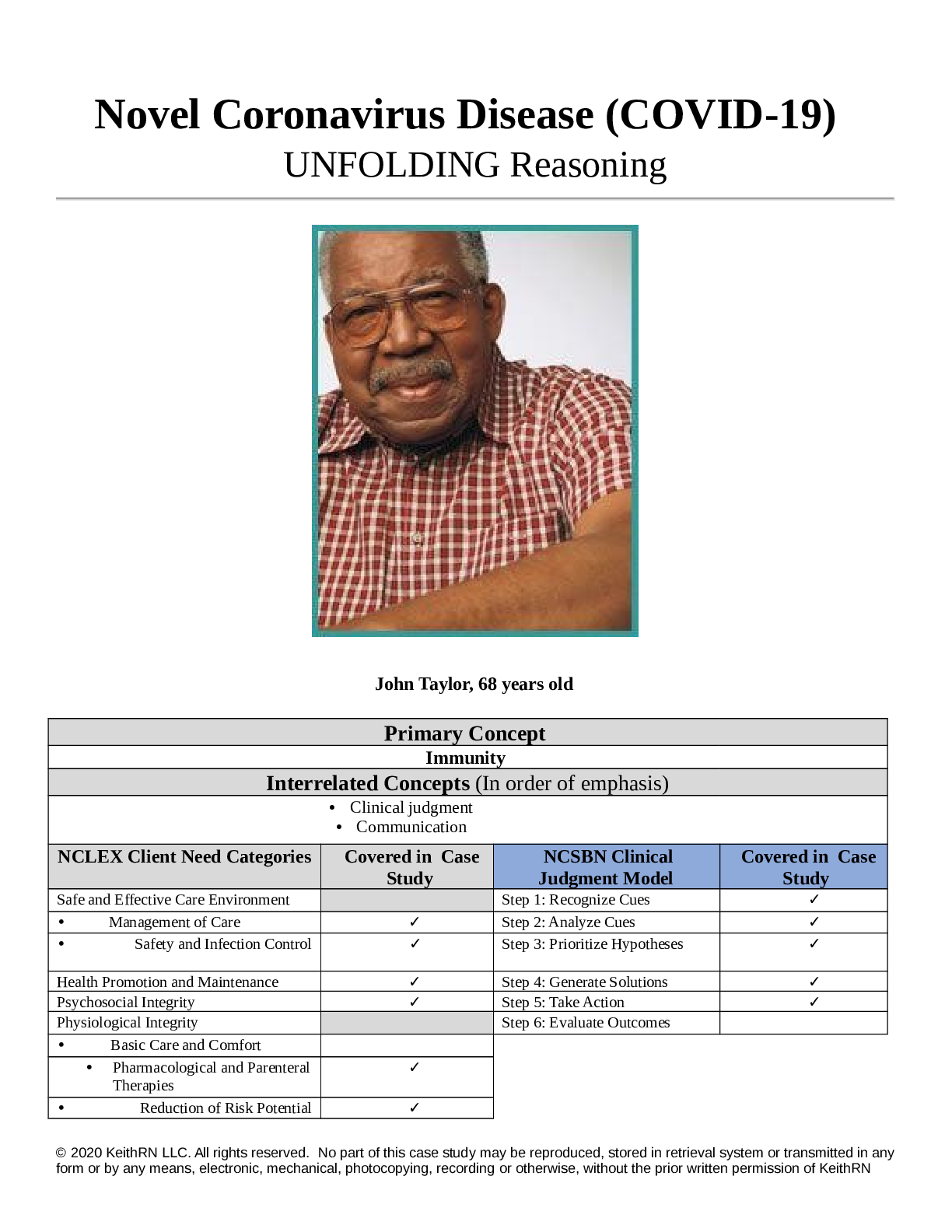
John Taylor is a 68-year-old African-American male with a history of type II diabetes and hypertension. He came to the
emergency depart
...
• Physiological Adaptation ✓
Part I: Initial Nursing Assessment
Present Problem:
John Taylor is a 68-year-old African-American male with a history of type II diabetes and hypertension. He came to the
emergency department (ED) triage window because he felt crummy, complaining of a headache, runny nose, feeling
weaker, “achy all over” and hot to the touch and sweaty the past two days. When he woke up this morning, he no longer felt
hot but began to develop a persistent “nagging cough” that continued to get worse throughout the day. John is visibly
anxious and asks, “Do I have that killer virus that I hear about on the news?”
Personal/Social History:
John lives in a large inner-city that has had over three thousand confirmed cases of COVID-19. He has been married to
Maxine, his wife of 45 years, and is a retired police officer and active in his local church.
1. What data from the histories are RELEVANT and must be NOTICED as clinically significant by the nurse?
(NCSBN: Step 1 Recognize cues/NCLEX: Reduction of Risk Potential)
RELEVANT Data from Present Problem: Clinical Significance:
Hx T2DM, HTN
Reports feeling weak, headache, hot,
diaphoretic, cough, anxious, African
American
Comorbidities
Symptoms of illness
Psychological state
Places him at higher risk
RELEVANT Data from Social History: Clinical Significance:
Heavily populated residence, 3000
confirmed cases, attends church,
married
High risk of transmission
Attends public gatherings (church) increasing changes
of transmission
Risk of spreading infection to his wife
2. What additional clarifying questions does the triage nurse need to ask John to determine if his cluster of physical
symptoms is consistent with COVID-19?
Have you traveled recently? (Within & out of state)
Have you had any contact with anyone who tested positive?
Are you and your wife attending church or other community gatherings currently? If so, have
you been practicing social distancing?
Wife have any symptoms?
Smoke or asthma hx?
Occupation?
Have you treated your fever?
Flu shot?
Pneumonia vaccine?
Do you have additional symptoms such as shortness of breath, sore throat, loss of taste or
smell?
3. Based on the clinical data collected, identify what measures need to be immediately implemented using the
following clinical pathway.
© 2020 KeithRN LLC. All rights reserved. No part of this case study may be reproduced, stored in retrieval system or transmitted in any
form or by any means, electronic, mechanical, photocopying, recording or otherwise, without the prior written permission of KeithRN
Initiate contact / droplet precautions
Keep patient in separate room
Provide mask to patient
Test for Covid
4. What type of isolation precautions does the nurse need to implement if COVID-19 is suspected? What specific
measures must be implemented to prevent transmission?
Type of Isolation: Implementation Components:
Standard
precautions (all
patients), contact
and droplet
precautions
Airborn
precautions
PPE, (N95 mask, face shield, gown, gloves), hand hygiene, no visitors
For aerosolizing procedures, negative pressure room
Part II: Patient Care Begins in the ED:
John is brought back to a room. As the nurse responsible for his care,
you collect the following clinical data:
Current VS: P-Q-R-S-T Pai
[Show More]
.png)



.png)
.png)