Choose the correct coding strand (non-template) from this template
(non-coding) DNA: 5' ACG GTA 3'
(1/1 Points)
5' UAC CGU 3'
3' UAC CGU 5'
3' TAC CGT 5'
5' TAC CGT 3'
Correct! First, note that we are asked for a
...
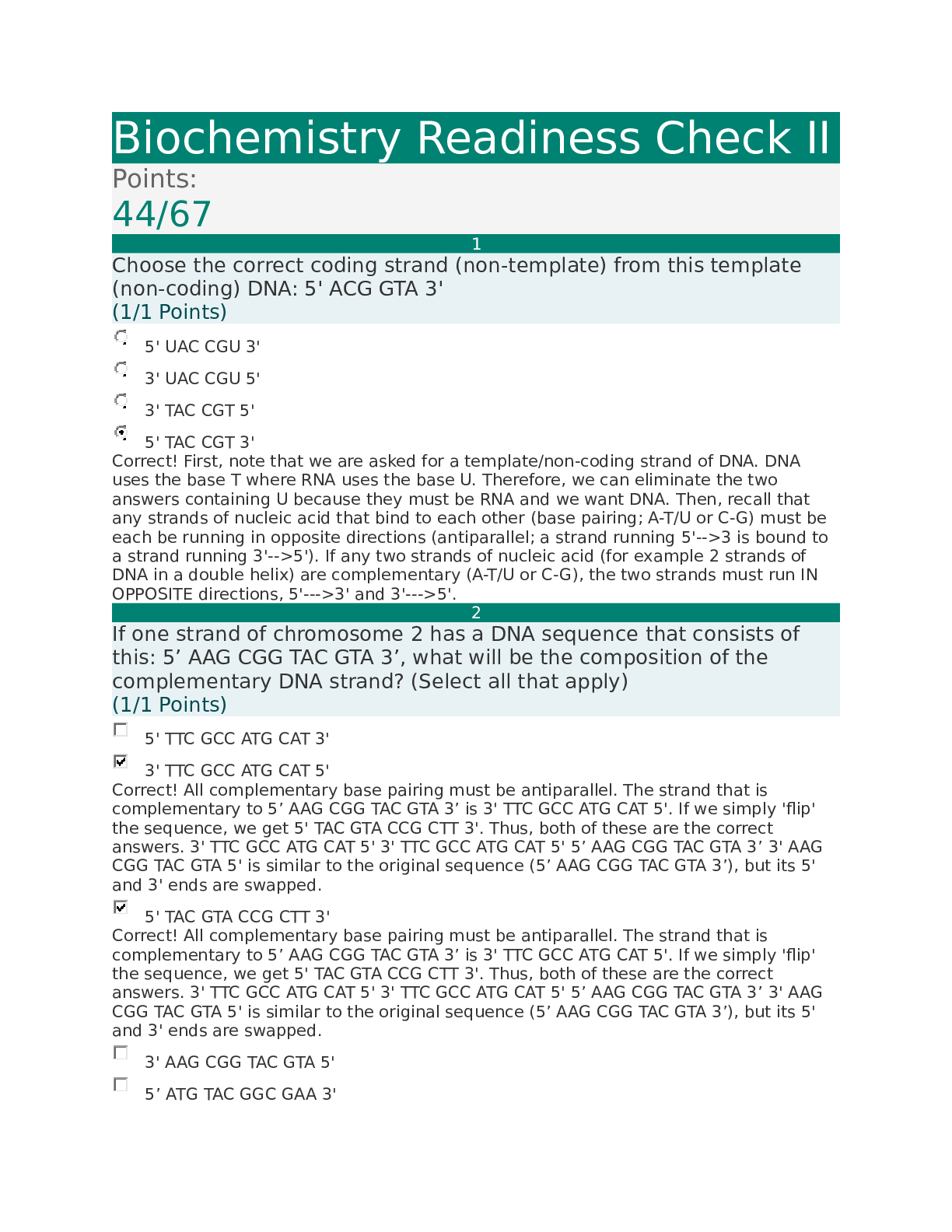
Choose the correct coding strand (non-template) from this template
(non-coding) DNA: 5' ACG GTA 3'
(1/1 Points)
5' UAC CGU 3'
3' UAC CGU 5'
3' TAC CGT 5'
5' TAC CGT 3'
Correct! First, note that we are asked for a template/non-coding strand of DNA. DNA
uses the base T where RNA uses the base U. Therefore, we can eliminate the two
answers containing U because they must be RNA and we want DNA. Then, recall that
any strands of nucleic acid that bind to each other (base pairing; A-T/U or C-G) must be
each be running in opposite directions (antiparallel; a strand running 5'-->3 is bound to
a strand running 3'-->5'). If any two strands of nucleic acid (for example 2 strands of
DNA in a double helix) are complementary (A-T/U or C-G), the two strands must run IN
OPPOSITE directions, 5'--->3' and 3'--->5'.
2
If one strand of chromosome 2 has a DNA sequence that consists of
this: 5’ AAG CGG TAC GTA 3’, what will be the composition of the
complementary DNA strand? (Select all that apply)
(1/1 Points)
5' TTC GCC ATG CAT 3'
3' TTC GCC ATG CAT 5'
Correct! All complementary base pairing must be antiparallel. The strand that is
complementary to 5’ AAG CGG TAC GTA 3’ is 3' TTC GCC ATG CAT 5'. If we simply 'flip'
the sequence, we get 5' TAC GTA CCG CTT 3'. Thus, both of these are the correct
answers. 3' TTC GCC ATG CAT 5' 3' TTC GCC ATG CAT 5' 5’ AAG CGG TAC GTA 3’ 3' AAG
CGG TAC GTA 5' is similar to the original sequence (5’ AAG CGG TAC GTA 3’), but its 5'
and 3' ends are swapped.
5' TAC GTA CCG CTT 3'
Correct! All complementary base pairing must be antiparallel. The strand that is
complementary to 5’ AAG CGG TAC GTA 3’ is 3' TTC GCC ATG CAT 5'. If we simply 'flip'
the sequence, we get 5' TAC GTA CCG CTT 3'. Thus, both of these are the correct
answers. 3' TTC GCC ATG CAT 5' 3' TTC GCC ATG CAT 5' 5’ AAG CGG TAC GTA 3’ 3' AAG
CGG TAC GTA 5' is similar to the original sequence (5’ AAG CGG TAC GTA 3’), but its 5'
and 3' ends are swapped.
3' AAG CGG TAC GTA 5'
5’ ATG TAC GGC GAA 3'
3
The following sequence is the coding strand of the collagen gene: 5’
ATG GCG TTC GAA 3’ What is the sequence of the corresponding
mRNA?
(1/1 Points)
3' ATG GCG TTC GAA 5'
5' AUG GCG UUC CUU 3'
5' AUG GCG UUC GAA 3'
Correct! The coding strand and the mRNA both go in the same direction, but do not both
contain Ts.
5' UTG GCG TTC GUU 3'
4
Which ingredients/molecules are required to set up a polymerase chain
reaction? Select all that apply.
(1/1 Points)
Amino Acids
RNA nucleotides
DNA polymerase
Correct! In PCR, a DNA sample is separated into single strands and incubated with DNA
polymerase, deoxynucleotides (dNTPs), and two short DNA primers whose sequences
flank the DNA segment of interest and thus define the region to be amplified. Recall
from the section on DNA replication that DNA polymerase needs a primer to begin DNA
synthesis. This requirement means the primers will direct the DNA polymerase to only
synthesize complementary strands of the target DNA.
DNA nucleotides
Correct! In PCR, a DNA sample is separated into single strands and incubated with DNA
polymerase, deoxynucleotides (dNTPs), and two short DNA primers whose sequences
flank the DNA segment of interest and thus define the region to be amplified. Recall
from the section on DNA replication that DNA polymerase needs a primer to begin DNA
synthesis. This requirement means the primers will direct the DNA polymerase to only
synthesize complementary strands of the target DNA.
Template DNA
Correct! In PCR, a DNA sample is separated into single strands and incubated with DNA
polymerase, deoxynucleotides (dNTPs), and two short DNA primers whose sequences
flank the DNA segment of interest and thus define the region to be amplified. Recall
from the section on DNA replication that DNA polymerase needs a primer to begin DNA
synthesis. This requirement means the primers will direct the DNA polymerase to only
synthesize complementary strands of the target DNA.
DNA Primers
Correct! In PCR, a DNA sample is separated into single strands and incubated with DNA
polymerase, deoxynucleotides (dNTPs), and two short DNA primers whose sequences
flank the DNA segment of interest and thus define the region to be amplified. Recall
from the section on DNA replication that DNA polymerase needs a primer to begin DNA
[Show More]
.png)





.png)
.png)