ATI TEAS READING (A GUARANTEED)
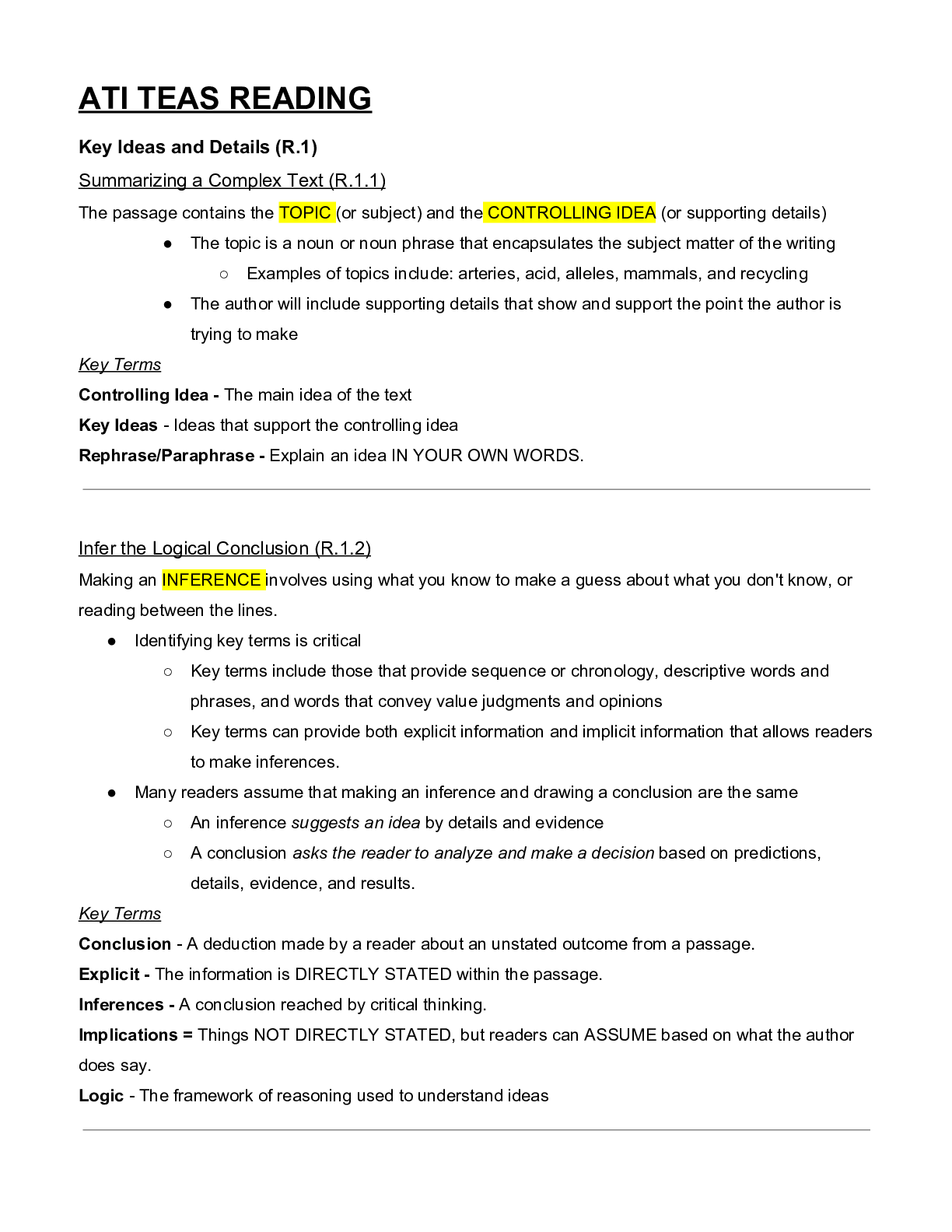
ATI TEAS READING
Key Ideas and Details (R.1)
Summarizing a Complex Text (R.1.1)
The passage contains the TOPIC (or subject) and the CONTROLLING IDEA (or supporting deta
...
ATI TEAS READING (A GUARANTEED)
ATI TEAS READING
Key Ideas and Details (R.1)
Summarizing a Complex Text (R.1.1)
The passage contains the TOPIC (or subject) and the CONTROLLING IDEA (or supporting details)
● The topic is a noun or noun phrase that encapsulates the subject matter of the writing
○ Examples of topics include: arteries, acid, alleles, mammals, and recycling
● The author will include supporting details that show and support the point the author is
trying to make
Key Terms
Controlling Idea - The main idea of the text
Key Ideas - Ideas that support the controlling idea
Rephrase/Paraphrase - Explain an idea IN YOUR OWN WORDS.
Infer the Logical Conclusion (R.1.2)
Making an INFERENCE involves using what you know to make a guess about what you don't know, or
reading between the lines.
● Identifying key terms is critical
○ Key terms include those that provide sequence or chronology, descriptive words and
phrases, and words that convey value judgments and opinions
○ Key terms can provide both explicit information and implicit information that allows readers
to make inferences.
● Many readers assume that making an inference and drawing a conclusion are the same
○ An inference suggests an idea by details and evidence
○ A conclusion asks the reader to analyze and make a decision based on predictions,
details, evidence, and results.
Key Terms
Conclusion - A deduction made by a reader about an unstated outcome from a passage.
Explicit - The information is DIRECTLY STATED within the passage.
Inferences - A conclusion reached by critical thinking.
Implications = Things NOT DIRECTLY STATED, but readers can ASSUME based on what the author
does say.
Logic - The framework of reasoning used to understand ideasIdentify the topic, main idea, and supporting details (R.1.3)
The reader must identify the topic and author’s main idea, and then identify the author’s key points that
support the topic (supporting details).
● Explain how supporting details clarify or relate to the main idea
Be aware of the placement of the topic sentence
● The topic sentence should appear near the beginning and include the main idea
○ A topic sentence must not be too specific or too general
● The topic answers the question, “Who or what is this passage about?”
Supporting details develop - through explanation, elaboration, or clarification - the idea portrayed in the
topic sentence.
● The supporting ideas should answer the questions, “who, what, where, when, why, and how?”
Key Terms
Topic - Subject of a text
Main Idea = Main idea is most important point being made. Often needs a full sentence.
Supporting Details = Provide EVIDENCES/EXAMPLES for the main idea.
Follow a given set of directions (R.1.4)
The reader must demonstrate the ability to follow directions by identifying important terms and
recognizing the relationships among the tasks.
Procedural signal words - Terms that signify order, relationship among steps. Follow a set of directions,
like in a RECIPE to make a cake.
first second next last
then finally while before
Directions are very specific, using language that tells how to accomplish the steps
From left to right Carefully and with
After it has set Choose all that apply
While the … complete steps From top to bottomIdentify specific Information from printed Communication (R.1.5)
Printed communication, such as memos, announcements, and advertisements fulfill this definition.
● It is beneficial to understand how to identify relevant information and recognize the text structures
of printed communication
Memo (Memorandum) - A common form of WRITTEN or PRINTED COMMUNICATION. It has heading
at the top indicating RECIPIENTS, AUTHOR, DATE, AND RECIPIENT, and SUBJECT. Below this
information will be the body of the memo; which includes and INTRODUCTION informing the readers of
the specific context of the memo. Following with BODY PARAGRAPHS, informing the reader of important
information. The CONCLUDING SECTION includes take-away information, and includes where to
address any questions for concerns.
*usually business oriented*
Printed Public Announcements - A common form of PRINTED COMMUNICATION.
Public (printed) announcements inform the public about organizations, upcoming events, and services
● The message must be short, the design simple and eye-pleasing, and the important information
easily accessible.
● The content should include:
○ a link to information access
○ Information about the supporting organizations
○ Supporting details
■ The supporting details should be in images and short phrases, if possible.
Classified Advertisement (ads) - Short, detailed text offering items and services
● A headline that engages the reader in seconds (can be a rhetorical question, bold statement or
exclamation)
● An item or service offered to the audience (mentions the benefits of the item or service)
● A call to action (includes how to get the item or service)
Key Terms
Blog - A website that is usually informal and independently run
Classified - A print advertisement selling or soliciting something
Forum - An online message board
Memorandum - A written informal note usually used for business purposes
[Show More]




.png)