NR 503 midterm study sheet
Pulmonary
• Anticholinergics and tx for asthma, bronchitis and assoc pathogenesis
o Anticholinergics block acetylcholine receptors for bronchoconstriction; thus: bronchodilation
Asthma: s
...
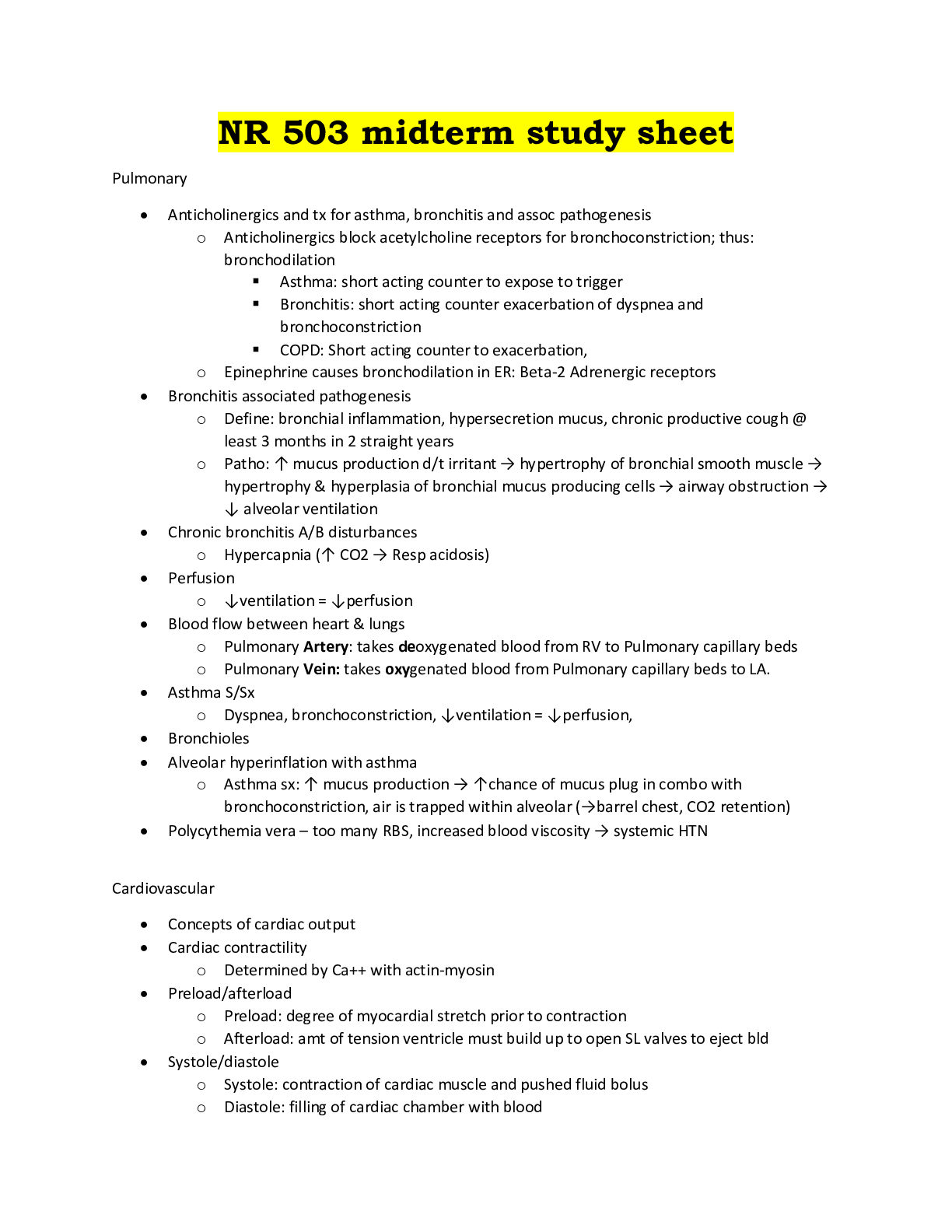
NR 503 midterm study sheet
Pulmonary
• Anticholinergics and tx for asthma, bronchitis and assoc pathogenesis
o Anticholinergics block acetylcholine receptors for bronchoconstriction; thus: bronchodilation
Asthma: short acting counter to expose to trigger
Bronchitis: short acting counter exacerbation of dyspnea and bronchoconstriction
COPD: Short acting counter to exacerbation,
o Epinephrine causes bronchodilation in ER: Beta-2 Adrenergic receptors
• Bronchitis associated pathogenesis
o Define: bronchial inflammation, hypersecretion mucus, chronic productive cough @ least 3 months in 2 straight years
o Patho: ↑ mucus production d/t irritant → hypertrophy of bronchial smooth muscle → hypertrophy & hyperplasia of bronchial mucus producing cells → airway obstruction → ↓ alveolar ventilation
• Chronic bronchitis A/B disturbances
o Hypercapnia (↑ CO2 → Resp acidosis)
• Perfusion
o ↓ventilation = ↓perfusion
• Blood flow between heart & lungs
o Pulmonary Artery: takes deoxygenated blood from RV to Pulmonary capillary beds
o Pulmonary Vein: takes oxygenated blood from Pulmonary capillary beds to LA.
• Asthma S/Sx
o Dyspnea, bronchoconstriction, ↓ventilation = ↓perfusion,
• Bronchioles
• Alveolar hyperinflation with asthma
o Asthma sx: ↑ mucus production → ↑chance of mucus plug in combo with bronchoconstriction, air is trapped within alveolar (→barrel chest, CO2 retention)
• Polycythemia vera – too many RBS, increased blood viscosity → systemic HTN
Cardiovascular
• Concepts of cardiac output
• Cardiac contractility
o Determined by Ca++ with actin-myosin
• Preload/afterload
o Preload: degree of myocardial stretch prior to contraction
o Afterload: amt of tension ventricle must build up to open SL valves to eject bld
• Systole/diastole
o Systole: contraction of cardiac muscle and pushed fluid bolus
o Diastole: filling of cardiac chamber with blood
• Heart valves (open v/s closed during cycle, S1, S2)
o S1: Atrioventricular valves close as atrium pushes remaining atrial vol into ventricles. SL open to allow diastole.
o S2: Semi lunar valves close as LV and RV push systemic (aorta) & pulmonary (pulm a.) systems. AV open diastole.
• Stenosis of heart valves and effects
• Stroke volume
• Cor pulmonale – right heart failure as a result of pulmonary congestion from LHF
• Heart failure & physiologic processes that lead to HF sx
o LHF process
↑systemic vascular pressure → ↑LV contraction force (↑afterload : ↑SVR) -overtime→ ↓LV EF→→ ↑LV preload (doesn’t empty) → ↓LA EF →↑LA preload →↑ pulm blod vol. & pressure →forces fluid into lung tissues (clin man: pulm edema, dyspnea, poss RHF & biventricular HF.)
o RHF process
↑pulm vascular pressure → ↑RV contraction force (↑afterload: pulm htn) → ↓RV EF → ↑RA preload (backflow too) →↑vena cava z7 systemic venous vol. & P’ → forces fluid into pulm tissues (clin man: jugular distention, hepatosplenomegaly, peripheral edema →LHF = biventricular HF)
o High output failure
• HTN
• Calcium binding and troponin – Ca++ unbinding allows for cardiac muscle relaxation …
Hematology
• Hematopoiesis – blood cell formation. Varying with age. Bone marrow by 5th month; long bones post 20yrsold.
o 7 day cycle: Hemocytoblast + erythropoietin = proerythroblast -> early & late erythroblast -> normoblast (loses nucleus, ribosomes, mitochondria) -> reticulocyte -> erythrocyte
o Kidney & liver stimulate growth factors for erythropoietin (EPO) production in response to hypoxia; androgens (testosterone) stimulate increased production *commonality of male dominated ??? anemia
o Stimulated by infiltration of yellow marrow with Red marrow.
• IDA – most prevalent (20%)
o Insufficient Fe intake or inability of mitochondria to utilize
• Erythrocyte function and lifespan – 100-120 days, tport oxygen to tissues, tport NO to lungs for exhalation, Vitamin C increases cellular resistance to bacteria & keep Ferrous from ferric(non-oxygen binding). Anaerobic ATP only, no nucleus, ribosomes, or mitochondria
o Adult = 2 alpha + 2 beta; Ferrous, B12, folic acid are needed for structure
o Tissue oxygenation
• Erythropoietin – produced by the kidneys in response to hypoxia,
• Functions of hemoglobin
o Tport O2, nutrients to the tissues via binding with heme,
o Tport NO & metabolic waste volatile acids to exhalation
• Development of anemia due to gastrectomy -> pernicious anemia
• Effects of being transfused with wrong blood type –> hemolytic anemia
• Anemias
Name Class Problem Cause Results in patho
Aplastic anemia Normocytic-normochromic Decr cell number Exposure from: ATB, viral inf, chemical or radiation, tumors Destroys red bone marrow replaced with yellow marrow only Loss of blood cell producing areas (replaced with fat) Finally: Pancytopenia – cyanosis, blood clotting problems, WBC loss = incr infection.
Hemolytic Normocytic-normochromic Lysis of premature RBC d/t toxins/enzymes produced by agent Infection, helminths, autoimmune, transfusion rxn, RH incompatible
Megaloblastic Anemia
Pernicious Macrocytic-normochromic – cell too large Malabsorption of B12 d/t decr Intrinsic factor (IF) production/ secretion Autosomal rxn, loss of GI cells to produce IF, Decr B12 yields decr DNA synth, decr RBC # & myelination, associated neuropathies Gastritis, gastrectomy
Folate Deficiency Macrocytic-normochromic – cell too large Insufficient folate intake or decr absorption from diet d/t GI disease Malnutrition, alcoholism, anticonvulsant Rx Abnormal RBC formation, premature death of RBCs, Female in utero – hi risk neural tube defects
Iron Deficiency Microcytic-hypochromic Insufficient Fe available Insufficient intake, chronic & or acute occult bleeding, transferrin deficiency or mitochondrial defects Decr Hb synthesis, decr size & pallor complexion Bleeding: 2-4ml/day = 1-2 mg Fe. 3 stages: S1: bodys Fe depleted. S2: Fe tport to bone marrow diminished, Fe-def erythropoiesis. S3: Hb def RBC enter circ for aged RBC affects seen S3.
Sickle cell Hemoglobinopathies – autosomal recessive (both parents) Single A.A on beta chain “glutamic acid -> Valine” – elongated HbS Lack RBC O2 carrying ability on sickled cells, response to stress, anxiety, fear, cold, dehydration = poor O2 binding, incr sickling RBC premature death 10-15 days in circ, incr risk for Fe circ overload (rbc lysis 2 mg per), occlusion of bld vessels & spleen, incr risk CVA, splenic damage Sickle cell trait (only 1 parent gene) [adaptation to fight malaria] typically asymptomatic carrier.
Thalassemia Hemoglobinopathies – autosomal recessive (both parents) Many genetic mutations at alpha or beta chain. Possible deletion Synthesis of Hb w/ abnormal or missing chains distorting & dysfunction of RBC Minor or major Cooley’s forms of disease: asymptomatic to lethal
Genitourinary/ renal
• A&P of kidney
o Nephron functional unit
Glomerulus
• Filters
Proximal Tubule
• Reabsorption: Na(Major), glucose, K+, Amino acids, HCO3-, Phosphate, urea, H2O (ADH not req.)
• Secretion: H+, foreign substances
• Tonicity: isotonic
Loop of Henle: concentrate urine
• Descending:
o Reabsorption: H2O, Na+ diffuses in
o Tonicity: isotonic
• Ascending
o Reabsorption: Na+; water is taken away
o Tonicity: hypertonic
Distal tubule
• Reabsorption: Na+, H20 (ADH req.!), HCO3-
• Secretion: K+, Urea, H+, NH3, some drugs
• Tonicity: hypotonic
Collecting duct
• Reabsorption: H2O
• Secretion or absorb: Na+, K+, H+, NH3
• Final concentration for micturition
• Nephron damage
o Permanent, apart of the normal aging process
At age 75 output ~85ml/min GFR; normal is 125ml/min
o
• Conditions assoc with renal failure
o
• Calculi blockage of ureter
o Postrenal condition
• Benign prostatic hypertrophy
o Postrenal condition
• Prerenal, Intrarenal, Postrenal disease and cause
o Prerenal
Renal hypoperfusion d/t hypotension w/ ↓CO or ↓bld vol.
Patho: ↓renal bld flow →hypoperfusion → ↓GFR → ↑PCT Na H2O reaborp →↑aldosterone & ADH secretion → ↑DCT Na H2O reabsorp → oliguria
o Intrarenal
ATN, acute or other glomerulopathies
Patho: Renal tubule injury → Cast formation → ↑intratubular Obs → ↑intratubular Pressure → Tubular back flow → ↓ GFR → oliguria
o Postrenal
UT obstruction
Patho: Uni or bilateral obs → ↑ intraluminal Pressure → release of inflammatory mediators & vascular endothelial cell injury → renal vasoconstriction → cellular interstitial edema → ↓glomerular filtration pressure → oliguria
• Glomerulonephritis
o Patho: 1. trigger event → 2. Ag-Ab complex formation & deposition in glomerulus → 3. activate Complement syst. & WBC infiltration → 4. glomerular injury & leakage → 5-a. proteinuria/ hematuria 5-b. ↓ capillary perfusion + coag. Cascade activate & fibrin deposition. 5-c ↓GFR. 6. Clin man: edema, ↑Crt, azotemia, oliguria
• Tx of renal failure
• Blood hydrostatic pressure
• Kidney filtration
• Role of angiotensin converting enzyme (ACE) – angiotensin 1 to angiotensin 2 which ↑ bld vol and ↑ vasoconstriction to improve perfusion to the Kidneys.
[Show More]