Quiz: Numbers and Operations, Algebraic Thinking,
Computational Fluency
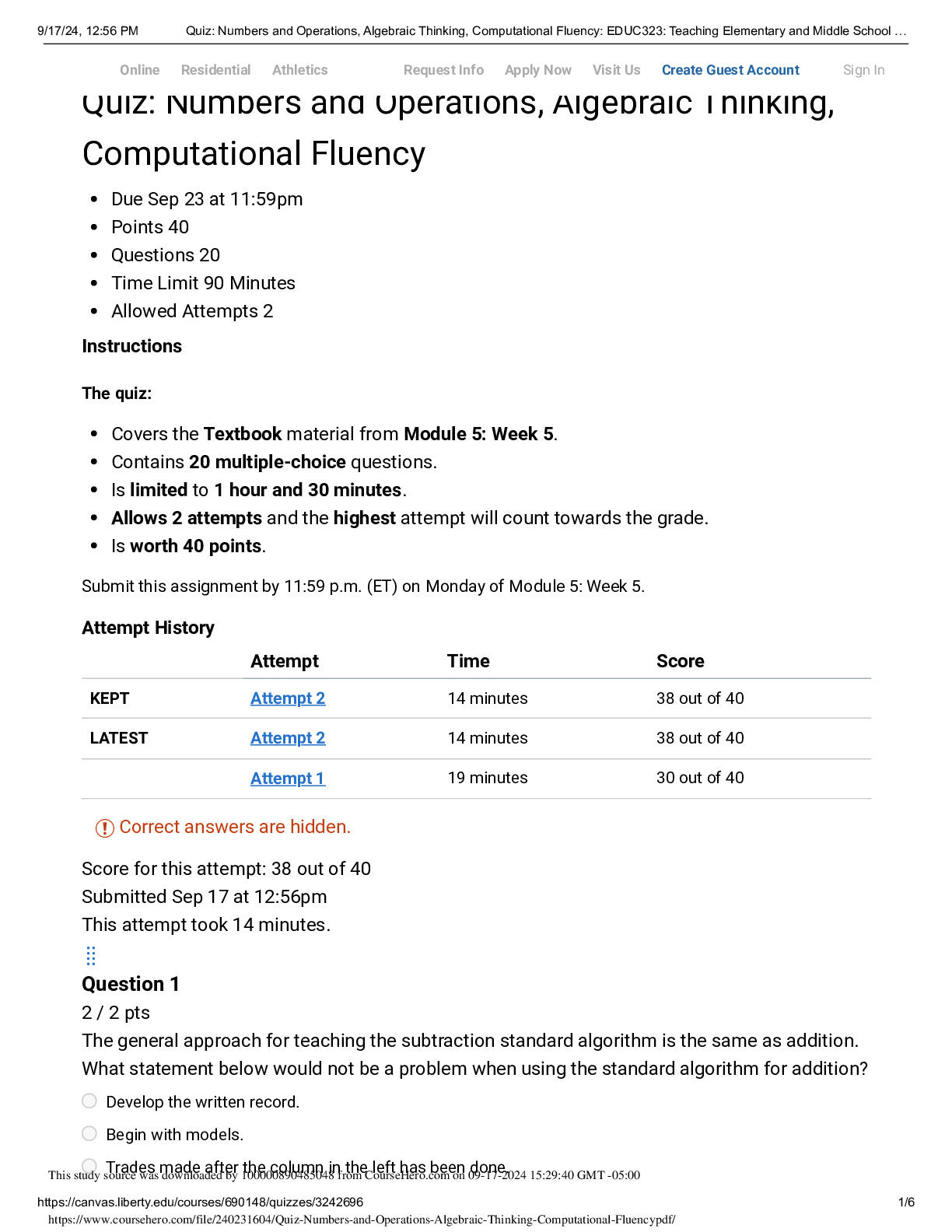
Score for this attempt: 38 out of 40
Q
uestion 1
2 / 2 pts
Develop the written record.
Begin with models.
Trades made after the column in
...
Quiz: Numbers and Operations, Algebraic Thinking,
Computational Fluency
Score for this attempt: 38 out of 40
Q
uestion 1
2 / 2 pts
Develop the written record.
Begin with models.
Trades made after the column in the left has been done.
The general approach for teaching the subtraction standard algorithm is the same as addition.
What statement below would not be a problem when using the standard algorithm for addition?
Exercises with zeros.
Q
uestion 2
2 / 2 pts
Instructional changes include focusing more on reasoning strategies than on computations that are
otherwise done on a phone or calculator.
Recent studies have found that a very low percentage of adults use math computation in everyday life.
Mental computation contributes to diminished number sense.
The ability to compute fluently without technology is no longer.
Q
uestion 3
2 / 2 pts
The algorithm is a good choice in some situations.
Require written record first.
Require concrete models first.
Explicit connections are made between concept and procedure.
Q
uestion 4
2 / 2 pts
Focus on rules.
Focus on traditional methods.
Focus on answers.
Offer or accept a range of estimates.
Q
uestion 5
2 / 2 pts
Jump strategy.
Split strategy.
Take-Away strategy.
Shortcut strategy.
Expectations for competency in today's workforce as well as in daily life mean that changes are
warranted in how computation is taught. Identify the true statement below.
There are important things to remember when teaching the standard algorithm. Identify the
statement that does not belong.
Which statements is true regarding computational estimation?
Which is one type of reasoning strategies for addition and subtraction?
Q
uestion 6
2 / 2 pts
Left-handed method.
Mental computation.
Standard algorithm.
Rounding.
Q
uestion 7
2 / 2 pts
Assign homework for additional practice.
Require students practice the standard algorithm.
Have students model using base-ten materials with a place-value mat to carry out the computation.
Memorize the steps.
Q
uestion 8
2 / 2 pts
Clusters.
Partitioning the multiplier.
Array.
Half-then-double.
Q
uestion 9
2 / 2 pts
Clusters.
Missing factor.
Area model.
Open array.
In
correctQuestion 10
0 / 2 pts
When reasoning strategies are used, what is part of the process and not a separate skill?
What can a teacher do if a student has difficulty with regrouping, specifically the recording of
regrouping in the standard algorithm is reversed.
What compensation strategy works when you are multiplying with 5 or 50?
This model uses a structure that automatically organizes proportionate equal groups and offers
a visual demonstration of the commutative and distributive properties.
To make connections to the algorithm.
Multiples of 2 are easier to compare.
Underestimate how many can be shared.
Pretend there are fewer sets to share than there really are.
Q
uestion 11
2 / 2 pts
Partial quotients with a visual model and compensation.
Partition or fair share model.
Explicit trade method and partitioning.
Think multiplication and decomposition.
Q
uestion 12
2 / 2 pts
They require a deep knowledge of how numbers work.
They require a solid knowledge of division procedures.
They require a deep knowledge of partitioning.
They require a solid knowledge of multiplication.
Q
uestion 13
2 / 2 pts
Is one of them 25?
Is it 50?
Is it between $400 and $700?
Is one of these right?
Q
uestion 14
2 / 2 pts
Associative.
Why would it be beneficial to round up the divisor in a long division problem with two digit
divisors?
What are two reasoning strategies for division?
What is the reason why mental calculations estimates are more complex?
One strategy for teaching computational estimation is to ask for information, but not the
answer. Which statement below would be an example of asking for information?
The __________ property is central to learning multiplication basic facts and algorithms for the
operation.
Multiplicative identity.
Distributive.
Inverse relationship of addition and subtraction.
Q
uestion 15
2 / 2 pts
Open number line.
Grid paper.
Calculator.
Hundreds chart.
Q
uestion 16
2 / 2 pts
A constant value.
A symbol of relationships.
A placeholder for one exact number.
A quantity that varies.
Q
uestion 17
2 / 2 pts
Random number generator.
Lottery number.
Patterns in skip counting.
Patterns with a core that repeats.
Q
uestion 18
2 / 2 pts
Pattern identification.
Function patterns.
Abstract concept of equality.
Conjecture.
A tool called __________, is normally thought of as teaching numeration but can help students to
connect place-value and algebraic thinking.
What is an early misconception about variables?
Patterns are found in all areas of mathematics. Which is an example of a repeating pattern?
Complete this statement, "The use of a balance scale or semi-concrete drawings of a balance
help develop a strong understanding of ..."
Q
uestion 19
2 / 2 pts
Graphs of equal patterns.
Working with addition and subtraction word problems.
Solving inequality and equality problems with symbols.
The equal function can be represented concretely by a number balance scale.
Q
uestion 20
2 / 2 pts
Relational-structural view.
Relational-computational view.
Correspondence-relational view.
Operational view.
Quiz Score: 38 out of 40
Which action below will help build students' understanding of the equal sign?
Which view of the equal sign means, students view the equal sign as a balance and can use
relationships between the two sides of the equal sign to reason about equivalence?
Powered by TCPDF (www.tcpdf.org)
[Show More]