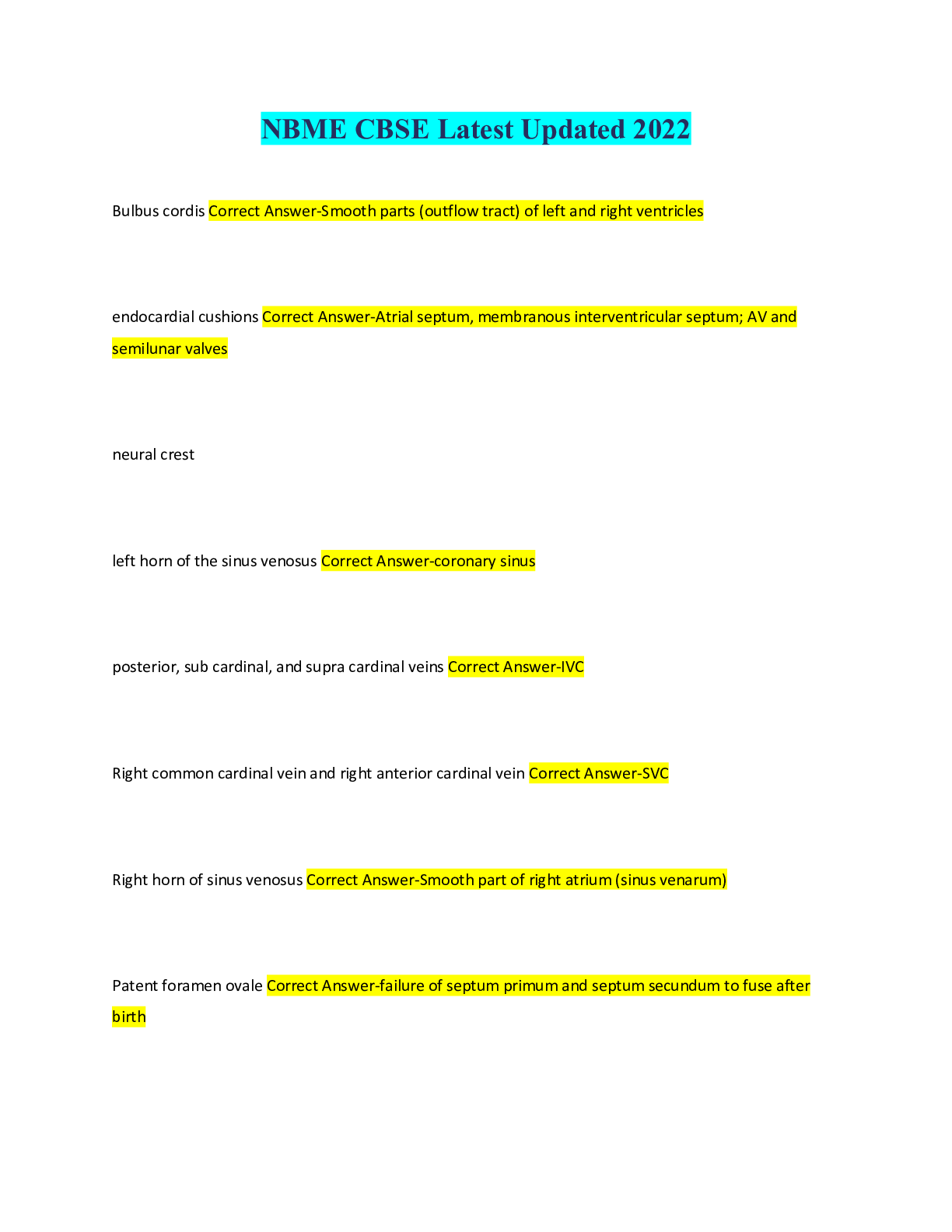
Bulbus cordis Correct Answer-Smooth parts (outflow tract) of left and right ventricles
endocardial cushions Correct Answer-Atrial septum, membranous interventricular septum; AV and
semilunar valves
neural crest
left
...
Bulbus cordis Correct Answer-Smooth parts (outflow tract) of left and right ventricles
endocardial cushions Correct Answer-Atrial septum, membranous interventricular septum; AV and
semilunar valves
neural crest
left horn of the sinus venosus Correct Answer-coronary sinus
posterior, sub cardinal, and supra cardinal veins Correct Answer-IVC
Right common cardinal vein and right anterior cardinal vein Correct Answer-SVC
Right horn of sinus venosus Correct Answer-Smooth part of right atrium (sinus venarum)
Patent foramen ovale Correct Answer-failure of septum primum and septum secundum to fuse after
birth
Transposition of the great vessels
Tetralogy of Fallot
Persistent truncus arteriosus Correct Answer-Conotruncal abnormalities associated with failure of
neural crest cells to migrate
ductus venosus Correct Answer-connects the umbilical vein to the inferior vena cava, bypassing the liver
becomes ligamentum venosum
phrenic nerve Correct Answer-innervates the diaphragm and pericardium
S3 heart sound Correct Answer-Increased ventricular filling pressure (e.g., mitral regurgitation, HF),
common in dilated ventricles
normal in kids and pregnant women
S4 heart sound Correct Answer-atrial kick late diastole, right before S1
best heard at apex in LLD position
High atrial pressure.
Stiff/hypertrophic ventricle (aortic stenosis, restrictive cardiomyopathy)
Always abnormal
atria contract Correct Answer-a wave of JVP
c wave Correct Answer-RV contraction (closed tricuspid valve bulging into atrium) wave of JVP
x descent Correct Answer-JVP wave corresponding to downward displacement of closed tricuspid valve
during rapid ventricular ejection phase
reduced or absent in tricuspid regurge
V wave Correct Answer-JVP wave corresponding to inc'd RA pressure due to filling against closed
tricuspid valve
y descent Correct Answer-JVP wave corresponding to RA emptying into RV
absent in cardiac tamponade
plusus parvus et tardus Correct Answer-pulses are weak with delayed peak
Aortic stenosis
PR interval Correct Answer-0.12-0.20 seconds
120 milliseconds
QT interval length Correct Answer-9 - 11 squares = .36 to .44 seconds
Hypokalemia Correct Answer-U wave present on ECG
Mg sulfate Correct Answer-for torsades de pointe, hypokalemia (can lengthen QT and cause torsades),
and pre-eclampsia (prevent seizures)
Romano-Ward syndrome Correct Answer--Congenital long QT syndrome
-Autosomal dominant, pure cardiac phenotype (no deafness).
Jervell and Lange-Nielsen syndrome Correct Answer--Congenital long QT syndrome
-Autosomal recessive, sensorineural deafness
Brugada syndrome Correct Answer--Autosomal dominant disorder affecting Na channels most common
in Asian males.
-ECG pattern of pseudo-right bundle branch block and ST elevations in V1-V3 (anterior ventricular
septum)
-inc risk of ventricular tachyarrhythmias and sudden cardiac deatgh
Prevent SCD with implantable cardioverter-defibrillator (ICD).
Wolff-Parkinson-White Syndrome Correct Answer-Most common type of ventriuclar pre-excitation
sydnrome. Abnormal fast accessory conduction pathway from atria to venricle bypasses the rate�slowing AV node causing a delta wave and widening QRS with shortened PR interval. Could lead to a
reentrant circuit and suprvaventicular tachy.
First degree AV block Correct Answer-- PRI >5 boxes/.20 sec (200 msec)
- Fixed but prolonged PRI
(consistent but long)
- normally get bradycardia here
second degree AV block mobitz type 2 Correct Answer--PR interval is constant
-atrial conduction to ventricle is intermittent: dropped QRS without increasing PR interval length
-disease below AV node in His bundle
may progress to 3rd degree/complete AV block
Second Degree AV Block Mobitz Type 1 (wenckebach) Correct Answer-Progressive lengthening of pr
interval leading to dropped QRS
third degree AV block Correct Answer-The atria and Ventricles are totally dissociated.
-So, the QRSs and the P waves have no relation to each other.
PCWP Correct Answer-4-12 mmHg
est of LA pressure
Williams Syndrome Correct Answer-a genetic condition characterized by mental retardation in most
regards but surprisingly good use of language relative to their other abilities, elfin facies
Chromosome 7
assoc with supravalvular aortic stenosis
DiGeorge Syndrome Correct Answer-Maldevelopment of 3 and 4 pharyngeal pouches, fascial
dysmorphia, cardiac shunt (trunks arteriosus, tetralogy of Fallot), lack of T-cells, undeveloped paracortex
Corneal arcus Correct Answer-Lipid deposits in the cornea. Common in the elderly, but appears earlier in
life with hypercholesterolemia
Stanford A aortic dissection Correct Answer-Dissection of the ascending aorta
Tx with surgery
Stanford B aortic dissection Correct Answer-Dissection of the descending aorta below the level o the left
subclavian artery
Tx: Beta Blockers then vasodilators
Left bundle branch block Correct Answer-QRS> 120 msec
Deep, broad S waves in V1 and V2
Broad R waves in in V5 and V6
hypertrophic obstructive cardiomyopathy Correct Answer-common AD inherited heart defect of a thick
septal wall
mutations in sarcomeric proteins (myosin binding protein C; Beta myosin heavy chain)
sudden death in young athletes
Loffler endocarditis Correct Answer-assoc w hypereosinophilic syndrome; histology shows eosinophilic
infiltrates in myocardium
cause restrictive/infiltrative cardiomyopathy with low voltage ECG
Endocardial fibroelastosis Correct Answer-Dense layer of fibrosis and elastic tissue in the endocardium;
cause of restrictive cardiomyopathy in children
[Show More]