CHAPTER
6
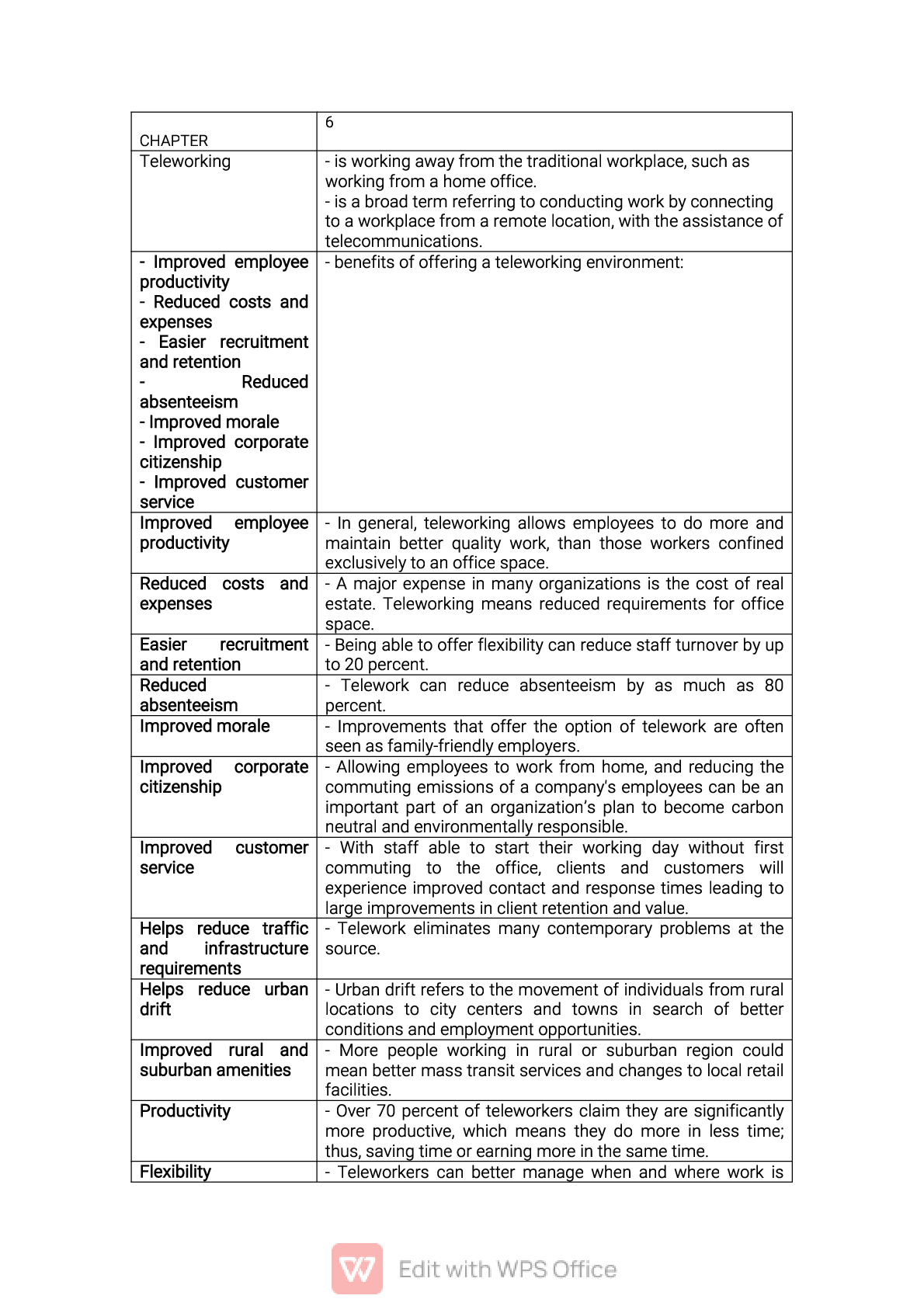
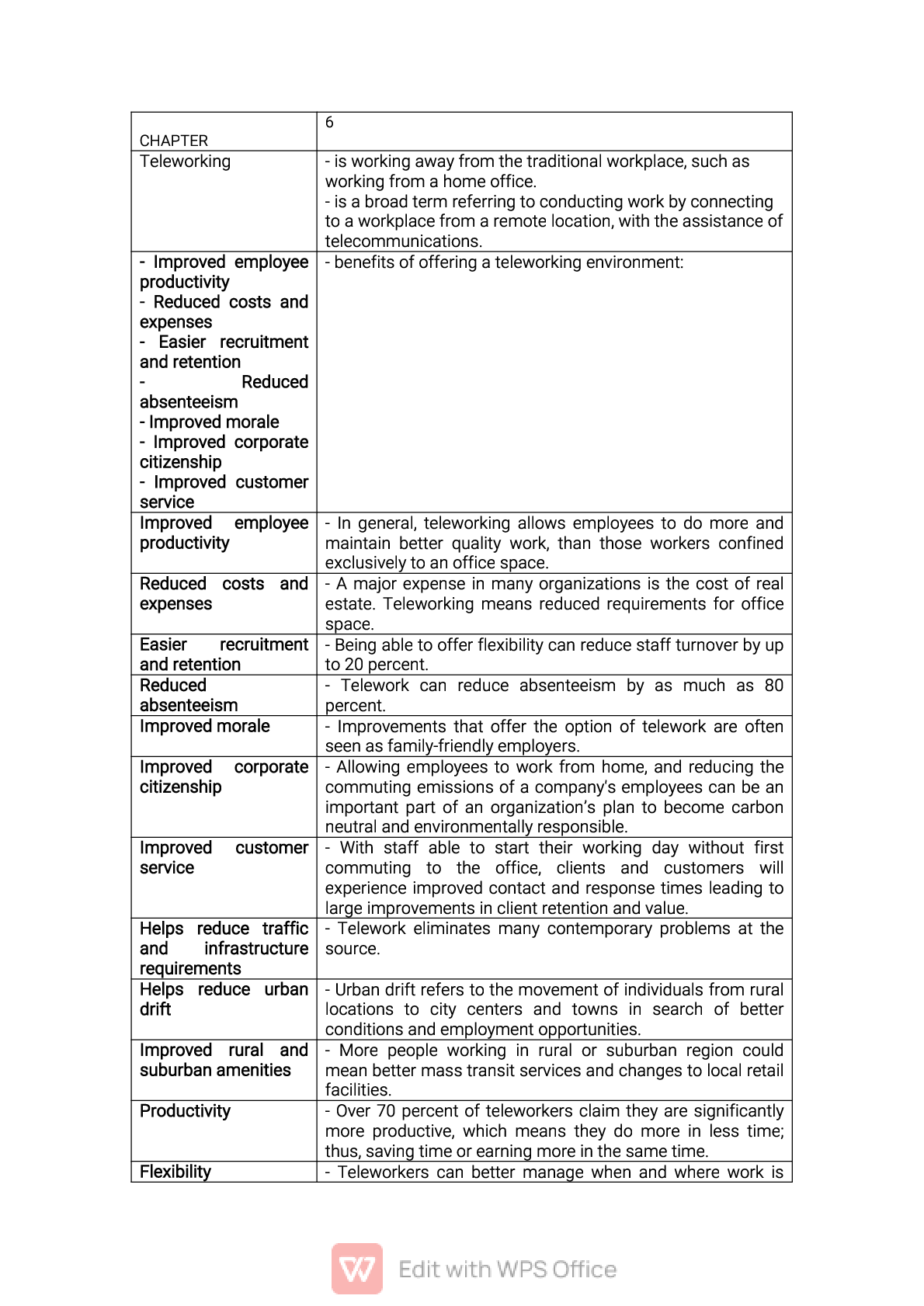
Teleworking - is working away from the traditional workplace, such as
working from a home office.
- is a broad term referring to conducting work by connecting
to a workplace from a remote location, with th
...
CHAPTER
6
Teleworking - is working away from the traditional workplace, such as
working from a home office.
- is a broad term referring to conducting work by connecting
to a workplace from a remote location, with the assistance of
telecommunications.
- Improved employee
productivity
- Reduced costs and
expenses
- Easier recruitment
and retention
- Reduced
absenteeism
- Improved morale
- Improved corporate
citizenship
- Improved customer
service
- benefits of offering a teleworking environment:
Improved employee
productivity
- In general, teleworking allows employees to do more and
maintain better quality work, than those workers confined
exclusively to an office space.
Reduced costs and
expenses
- A major expense in many organizations is the cost of real
estate. Teleworking means reduced requirements for office
space.
Easier recruitment
and retention
- Being able to offer flexibility can reduce staff turnover by up
to 20 percent.
Reduced
absenteeism
- Telework can reduce absenteeism by as much as 80
percent.
Improved morale - Improvements that offer the option of telework are often
seen as family-friendly employers.
Improved corporate
citizenship
- Allowing employees to work from home, and reducing the
commuting emissions of a company's employees can be an
important part of an organization’s plan to become carbon
neutral and environmentally responsible.
Improved customer
service
- With staff able to start their working day without first
commuting to the office, clients and customers will
experience improved contact and response times leading to
large improvements in client retention and value.
Helps reduce traffic
and infrastructure
requirements
- Telework eliminates many contemporary problems at the
source.
Helps reduce urban
drift
- Urban drift refers to the movement of individuals from rural
locations to city centers and towns in search of better
conditions and employment opportunities.
Improved rural and
suburban amenities
- More people working in rural or suburban region could
mean better mass transit services and changes to local retail
facilities.
Productivity - Over 70 percent of teleworkers claim they are significantly
more productive, which means they do more in less time;
thus, saving time or earning more in the same time.
Flexibility - Teleworkers can better manage when and where work is
performed.
Cost savings - Employees that must commute to an office spend a
significant amount of money adding up vehicle fuel and
maintenance, lunches, work clothes, eating out, and all the
other costs of traditional work that one can reduce by
teleworking.
Home and family - For many people, spending more time with the family or
caring for dependent relatives is a major reason for
teleworking.
Tracking of employee
progress
- It may be difficult for some managers to track the work
accomplishments of employees that telework.
Necessary to
implement a new
management style
- Managers that oversee employees within an office have the
capability to maintain in-person contact with all employees.
Feeling of isolation - For many people, working on their own becomes lonely.
Slower connections - Residential and rural areas do not generally get the kind of
technology support and services that inner city offices can
receive, and they can be expensive.
Distractions - Whether it is a neighbor, a spouse, a child, lawn mowing, the
laundry, the TV or the refrigerator, there are distractions in
the home office.
- Broadband
connections
- IPsec VPNs
- Traditional private
WAN Layer 2
technologies
- There are three primary remote connection technologies
available to organizations supporting teleworker services:
Broadband
connections
- The broadband term refers to advanced communications
systems capable of providing high-speed transmission of
services, such as data, voice, and video, over the Internet and
other networks.
IPsec VPNs - This is the most common option for teleworkers, combined
with remote access over broadband, to establish a secure
VPN over the public Internet.
Traditional private
WAN Layer 2
technologies
- These types of connections provide many remote
connection solutions and include technologies, such as
Frame Relay, ATM, and leased lines.
Home office
components
- The required home office components are a laptop or
desktop computer, broadband access (cable, DSL, or
wireless), and a VPN router or VPN client software installed
on the computer.
Corporate
components
- Corporate components are VPN-capable routers, VPN
concentrators, multifunction security appliances,
authentication, and central management devices for resilient
aggregation and termination of the VPN connections.
Quality of service
(QoS)
- supported VoIP and videoconferencing components is
becoming an integral component of the teleworkers toolkit.
- refers to the capability of a network to provide better service
to selected network traffic, as required by voice and video
applications. Providing support for VoIP
[Show More]