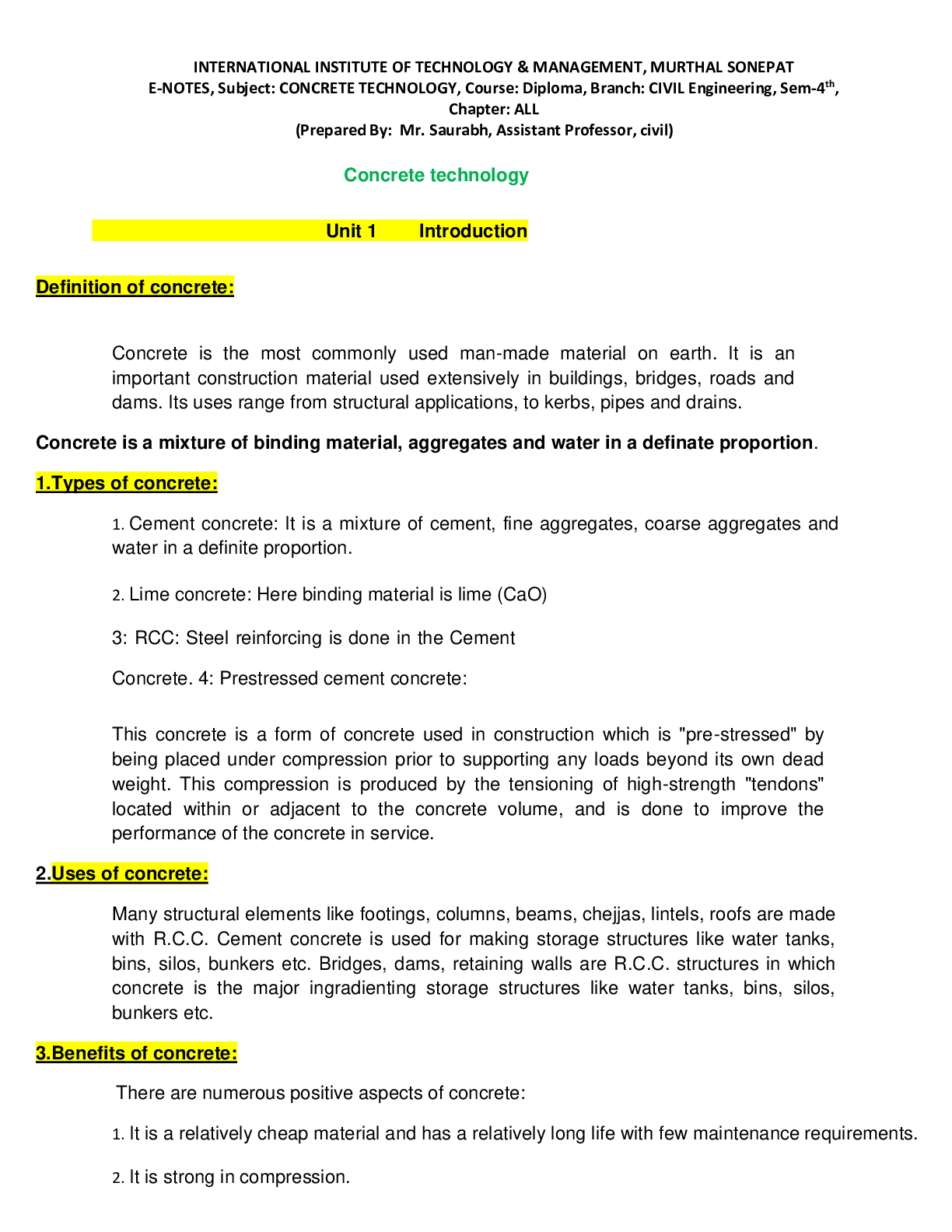
Definition of concrete:
Concrete is the most commonly used man-made material on earth. It is an
important construction material used extensively in buildings, bridges, roads and
dams. Its uses range from structural
...
Definition of concrete:
Concrete is the most commonly used man-made material on earth. It is an
important construction material used extensively in buildings, bridges, roads and
dams. Its uses range from structural applications, to kerbs, pipes and drains.
Concrete is a mixture of binding material, aggregates and water in a definate proportion.
1.Types of concrete:
1. Cement concrete: It is a mixture of cement, fine aggregates, coarse aggregates and
water in a definite proportion.
2. Lime concrete: Here binding material is lime (CaO)
3: RCC: Steel reinforcing is done in the Cement
Concrete. 4: Prestressed cement concrete:
This concrete is a form of concrete used in construction which is "pre-stressed" by
being placed under compression prior to supporting any loads beyond its own dead
weight. This compression is produced by the tensioning of high-strength "tendons"
located within or adjacent to the concrete volume, and is done to improve the
performance of the concrete in service.
2.Uses of concrete:
Many structural elements like footings, columns, beams, chejjas, lintels, roofs are made
with R.C.C. Cement concrete is used for making storage structures like water tanks,
bins, silos, bunkers etc. Bridges, dams, retaining walls are R.C.C. structures in which
concrete is the major ingradienting storage structures like water tanks, bins, silos,
bunkers etc.
3.Benefits of concrete:
There are numerous positive aspects of concrete:
1. It is a relatively cheap material and has a relatively long life with few maintenance requirements.
2. It is strong in compression.
INTERNATIONAL INSTITUTE OF TECHNOLOGY & MANAGEMENT, MURTHAL SONEPAT
E-NOTES, Subject: CONCRETE TECHNOLOGY, Course: Diploma, Branch: CIVIL Engineering, Sem-4
th
,
Chapter: ALL
(Prepared By: Mr. Saurabh, Assistant Professor, civil)
3. Before it hardens it is a very pliable substance that can easily be shaped.
4. It is non-combustible.
4.Limitations of concrete:
The limitations of concrete include:
1.Relatively low tensile strength when compared to other building materials.
2. Low ductility.
3. Low strength-to-weight ratio.
4. It is susceptible to cracking.
INTERNATIONAL INSTITUTE OF TECHNOLOGY & MANAGEMENT, MURTHAL SONEPAT
E-NOTES, Subject: CONCRETE TECHNOLOGY, Course: Diploma, Branch: CIVIL Engineering, Sem-4
th
,
Chapter: ALL
(Prepared By: Mr. Saurabh, Assistant Professor, civil)
Unit 2
Ingredients of concrete
A. Cement: cement is a binding material used in the masonry.
Physical Properties of Cement
Different blends of cement used in construction are characterized by their physical properties.
Some key parameters control the quality of cement. The physical properties of good cement
are based on:
Fineness of cement
Soundness
Consistency
Strength
Setting time
Heat of hydration
Loss of ignition
Bulk density
Specific gravity (Relative density)
These physical properties are discussed in details in the following segment. Also, you will find
the test names associated with these physical properties.
1. Fineness of Cement
The size of the particles of the cement is its fineness. The required fineness of good cement is
achieved through grinding the clinker in the last step of cement production process. As
hydration rate of cement is directly related to the cement particle size, fineness of cement is
very important.
2. Soundness of Cement
refers to the ability of cement to not shrink upon hardening. Good quality cement retains its
volume after setting without delayed expansion, which is caused by excessive free lime and
magnesia.
INTERNATIONAL INSTITUTE OF TECHNOLOGY & MANAGEMENT, MURTHAL SONEPAT
E-NOTES, Subject: CONCRETE TECHNOLOGY, Course: Diploma, Branch: CIVIL Engineering, Sem-4
th
,
Chapter: ALL
(Prepared By: Mr. Saurabh, Assistant Professor, civil)
Tests: Unsoundness of cement may appear after several years, so tests for ensuring soundness must be able to
determine that potential.
2.1 Le Chatelier Test
This method, done by using Le Chatelier Apparatus, tests the expansion of cement due to lime. Cement
paste (normal consistency) is taken between glass slides and submerged in water for 24 hours at 20+1°C.
It is taken out to measure the distance between the indicators and then returned under water, brought
to boil in 25-30 mins and boiled for an hour. After cooling the device, the distance between indicator
points is measured again. In a good quality cement, the distance should not exceed 10 mm.
3.Consistency of Cement
The ability of cement paste to flow is consistency.
It is measured by Vicat Test.
In Vicat Test Cement paste of normal consistency is taken in the Vicat Apparatus. The plunger of the
apparatus is brought down to touch the top surface of the cement. The plunger will penetrate the
cement up to a certain depth depending on the consistency. A cement is said to have a normal
consistency when the plunger penetrates 10±1 mm.
4. Strength of cement
Three types of strength of cement are measured – compressive, tensile and flexural. Various factors
affect the strength, such as water-cement ratio, cement-fine aggregate ratio, curing conditions, size and
shape of a specimen, the manner of molding and mixing, loading conditions and age. While testing the
strength, the following should be considered:
Cement mortar strength and cement concrete strength are not directly related. Cement strength
is merely a quality control measure.
The tests of strength are performed on cement mortar mix, not on cement paste.
Cement gains strength over time, so the specific time of performing the test should be
mentioned.
INTERNATIONAL INSTITUTE OF TECHNOLOGY & MANAGEMENT, MURTHAL SONEPAT
E-NOTES, Subject: CONCRETE TECHNOLOGY, Course: Diploma, Branch: CIVIL Engineering, Sem-4
th
,
Chapter: ALL
(Prepared By: Mr. Saurabh, Assistant Professor, civil)
5. Compressive Strength
It is the most common strength test. A test specimen (50mm) is taken and subjected to a compressive
load until failure. The loading sequence must be within 20 seconds and 80 seconds.
Tensile strength
Though this test used to be common during the early years of cement production, now it does not offer any useful
information about the properties of cement.
Flexural strength
This is actually a measure of tensile strength in bending. The test is performed in a 40 x40 x 160 mm
cement mortar beam, which is loaded at its center point until failure.
Standard test: ASTM C 348: Flexural Strength of Hydraulic Cement Mortars
6. Setting Time of Cement
Cement sets and hardens when water is added. This setting time can vary depending on multiple
factors, such as fineness of cement, cement-water ratio, chemical content, and admixtures. Cement
used in construction should have an initial setting time that is not too low and a final setting time not
too high. Hence, two setting times are measured:
Initial set: When the paste begins to stiffen noticeably (typically occurs within 30-45 minutes) Final set: When
the cement hardens, being able to sustain some load (occurs below 10 hours) Again, setting time can also be an
indicator of hydration rate.
Standard Tests:
AASHTO T 131 and ASTM C 191: Time of Setting of Hydraulic Cement by Vicat Needle AASHTO T 154: Time of Setting of
Hydraulic Cement by Gillmore Needles
ASTM C 266: Time of Setting of Hydraulic-Cement Paste by Gillmore Needles
INTERNATIONAL INSTITUTE OF TECHNOLOGY & MANAGEMENT, MURTHAL SONEPAT
E-NOTES, Subject: CONCRETE TECHNOLOGY, Course: Diploma, Branch: CIVIL Engineering, Sem-4
th
,
Chapter: ALL
(Prepared By: Mr. Saurabh, Assistant Professor, civil)
7. Heat of Hydration
When water is added to cement, the reaction that takes place is called hydration. Hydration generates
heat, which can affect the quality of the cement and also be beneficial in maintaining curing
temperature during cold weather. On the other hand, when heat generation is high, especially in large
structures, it may cause undesired stress. The heat of hydration is affected most by C3S and C3A present
in cement, and also by water-cement ratio, fineness and curing temperature. The heat of hydration of
Portland cement is calculated by determining the difference between the dry and the partially hydrated
cement (obtained by comparing these at 7th and 28th days).
Standard Test: ASTM C 186: Heat of Hydration of Hydraulic Cement
8. Loss of Ignition
Heating a cement sample at 900 - 1000°C (that is, until a constant weight is obtained) causes weight
loss. This loss of weight upon heating is calculated as loss of ignition. Improper and
prolonged storage or adulteration during transport or transfer may lead to pre-hydration and
carbonation, both of which might be indicated by increased loss of ignition.
Standard Test: AASHTO T 105 and ASTM C 114: Chemical Analysis of Hydraulic Cement
9. Bulk density
When cement is mixed with water, the water replaces areas where there would normally be air. Because
of that, the bulk density of cement is not very important. Cement has a varying range of density
depending on the cement composition percentage. The density of cement may be anywhere from 62 to
78 pounds per cubic foot.
10. Specific Gravity (Relative Density)
Specific gravity is generally used in mixture proportioning calculations. Portland cement has a specific
gravity of 3.15, but other types of cement (for example, portland-blast-furnace-slag and portland�pozzolan cement) may have specific gravities of about 2.90.
Standard Test: AASHTO T 133 and ASTM C 188: Density of Hydraulic Cement
INTERNATIONAL INSTITUTE OF TECHNOLOGY & MANAGEMENT, MURTHAL SONEPAT
E-NOTES, Subject: CONCRETE TECHNOLOGY, Course: Diploma, Branch: CIVIL Engineering, Sem-4
th
,
Chapter: ALL
(Prepared By: Mr. Saurabh, Assistant Professor, civil)
B. Chemical Properties of Cement
The raw materials for cement production are limestone (calcium), sand or clay (silicon), bauxite
(aluminum) and iron ore, and may include shells, chalk, marl, shale, clay, blast furnace slag, slate.
Chemical analysis of cement raw materials provides insight into the chemical properties of cement.
1 Tricalcium aluminate (C3A)
Low content of C3A makes the cement sulfate-resistant. Gypsum reduces the hydration of C3A, which
liberates a lot of heat in the early stages of hydration. C3A does not provide any more than a little
amount of strength.
Type I cement: contains up to 3.5% SO3 (in cement having more than 8% C3A) Type II
cement: contains up to 3% SO3 (in cement having less than 8% C3A)
2. Tricalcium silicate (C3S)
C3S causes rapid hydration as well as hardening and is responsible for the cement’s early
strength gain an initial setting.
3. Dicalcium silicate (C2S)
As opposed to tricalcium silicate, which helps early strength gain, dicalcium silicate in cement helps
the strength gain after one week.
4. Ferrite (C4AF)
Ferrite is a fluxing agent. It reduces the melting temperature of the raw materials in the kiln from
3,000°F to 2,600°F. Though it hydrates rapidly, it does not contribute much to the strength of the
cement.
5. Magnesia (MgO)
The manufacturing process of Portland cement uses magnesia as a raw material in dry process plants.
An excess amount of magnesia may make the cement unsound and expansive, but a little amount of it
can add strength to the cement. Production of MgO-based cement also causes less CO2 emission. All
cement is limited to a content of 6% MgO.
6. Sulphur trioxide
Sulfur trioxide in excess amount can make cement unsound.
[Show More]