NR 602 Week 5 Quiz Study Guide
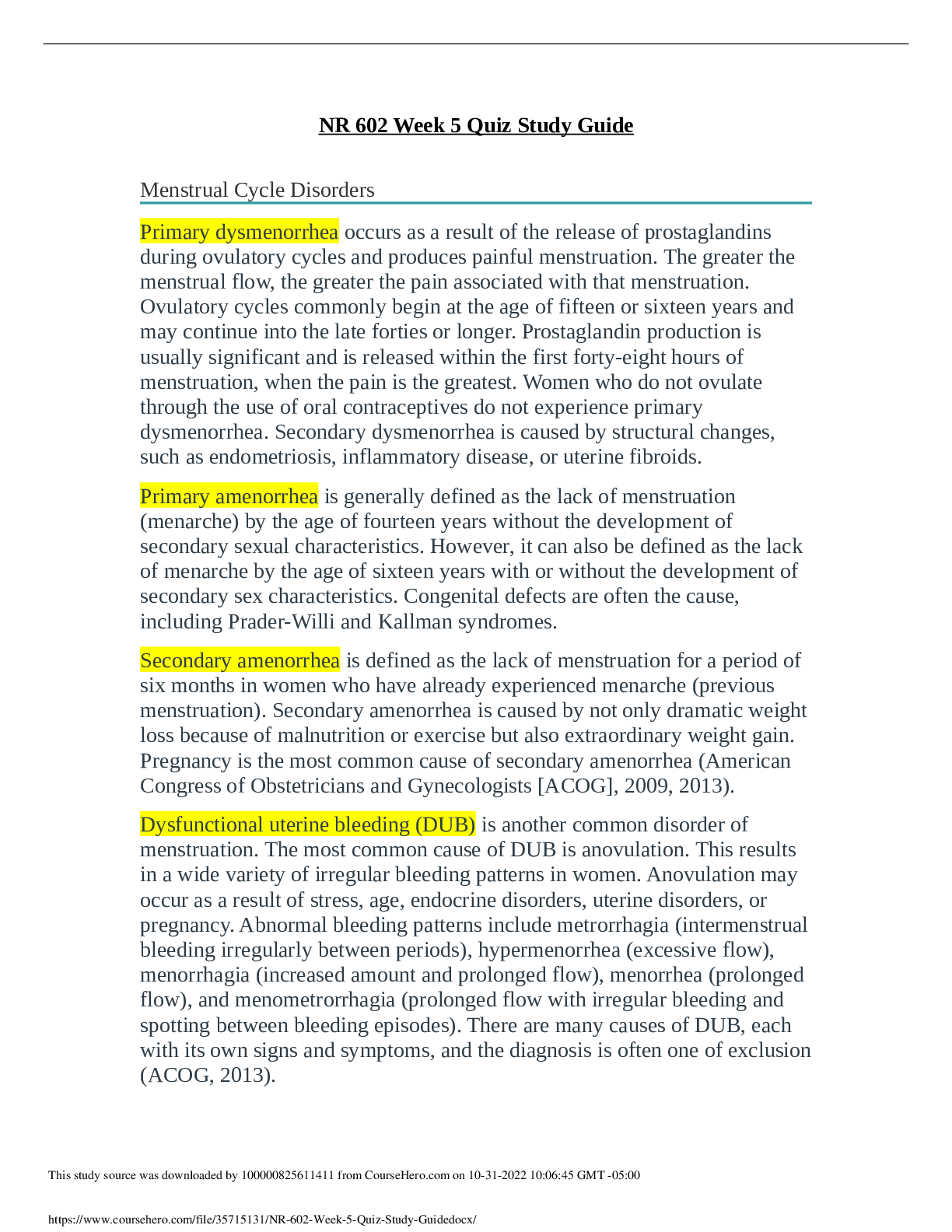
NR 602 Week 5 Quiz Study Guide
Menstrual Cycle Disorders
Primary dysmenorrhea occurs as a result of the release of prostaglandins
during ovulatory cycles and produces painful menstruati
...
NR 602 Week 5 Quiz Study Guide
NR 602 Week 5 Quiz Study Guide
Menstrual Cycle Disorders
Primary dysmenorrhea occurs as a result of the release of prostaglandins
during ovulatory cycles and produces painful menstruation. The greater the
menstrual flow, the greater the pain associated with that menstruation.
Ovulatory cycles commonly begin at the age of fifteen or sixteen years and
may continue into the late forties or longer. Prostaglandin production is
usually significant and is released within the first forty-eight hours of
menstruation, when the pain is the greatest. Women who do not ovulate
through the use of oral contraceptives do not experience primary
dysmenorrhea. Secondary dysmenorrhea is caused by structural changes,
such as endometriosis, inflammatory disease, or uterine fibroids.
Primary amenorrhea is generally defined as the lack of menstruation
(menarche) by the age of fourteen years without the development of
secondary sexual characteristics. However, it can also be defined as the lack
of menarche by the age of sixteen years with or without the development of
secondary sex characteristics. Congenital defects are often the cause,
including Prader-Willi and Kallman syndromes.
Secondary amenorrhea is defined as the lack of menstruation for a period of
six months in women who have already experienced menarche (previous
menstruation). Secondary amenorrhea is caused by not only dramatic weight
loss because of malnutrition or exercise but also extraordinary weight gain.
Pregnancy is the most common cause of secondary amenorrhea (American
Congress of Obstetricians and Gynecologists [ACOG], 2009, 2013).
Dysfunctional uterine bleeding (DUB) is another common disorder of
menstruation. The most common cause of DUB is anovulation. This results
in a wide variety of irregular bleeding patterns in women. Anovulation may
occur as a result of stress, age, endocrine disorders, uterine disorders, or
pregnancy. Abnormal bleeding patterns include metrorrhagia (intermenstrual
bleeding irregularly between periods), hypermenorrhea (excessive flow),
menorrhagia (increased amount and prolonged flow), menorrhea (prolonged
flow), and menometrorrhagia (prolonged flow with irregular bleeding and
spotting between bleeding episodes). There are many causes of DUB, each
with its own signs and symptoms, and the diagnosis is often one of exclusion
(ACOG, 2013).
This study source was downloaded by 100000825611411 from CourseHero.com on 10-31-2022 10:06:45 GMT -05:00
https://www.coursehero.com/file/35715131/NR-602-Week-5-Quiz-Study-Guidedocx/Premenstrual dysphoric disorder (PMDD)
� At least 5 PMS-type symptoms severe enough to markedly
disrupt normal functioning in most if not all menstrual cycles
� Occurs in luteal phase and resolves within 1 week after
menses
� Must include at least one of these symptoms— markedly
depressed mood, marked anxiety, marked affective lability,
persistent and marked anger
� Prevalence, 3–10% of reproductive age women
� Treatment—SSRI/SNRI, combination oral contraceptives
containing drospirenone if also desires contraception, other
hormonal interventions
Anovulation
is when the ovaries do not release an oocyte during a menstrual cycle.
Therefore, ovulation does not take place. However, a woman who does not
ovulate at each menstrual cycle is not necessarily going through menopause.
Chronic anovulation is a common cause of infertility.
Atrophic vaginitis
Up to 40 percent of postmenopausal women have symptoms of atrophic
vaginitis. Because the condition is attributable to estrogen deficiency, it may
occur in pre-menopausal women who take antiestrogenic medications or
who have medical or surgical conditions that result in decreased levels of
estrogen. The thinned endometrium and increased vaginal pH level induced
by estrogen deficiency predispose the vagina and urinary tract to infection
and mechanical weakness. The earliest symptoms are decreased vaginal
lubrication, followed by other vaginal and urinary symptoms that may be
exacerbated by superimposed infection. Once other causes of symptoms
have been eliminated, treatment usually depends on estrogen replacement.
Estrogen replacement therapy may be provided systemically or locally, but
the dosage and delivery method must be individualized. Vaginal moisturizers
This study source was downloaded by 100000825611411 from CourseHero.com on 10-31-2022 10:06:45 GMT -05:00
https://www.coursehero.com/file/35715131/NR-602-Week-5-Quiz-Study-Guidedocx/and lubricants, and participation in coitus may also be beneficial in the
treatment of women with atrophic vaginitis.
Vaginitis
Vaginitis is an inflammation of the vagina.
Vaginitis affects women of all ages but is most common during the
reproductive years.
A change in the balance of the yeast and bacteria that normally live in the
vagina can result in vaginitis. This causes the lining of the vagina to become
inflamed. Factors that can change the normal balance of the vagina include
the following:
Use of antibiotics
Changes in hormone levels due to pregnancy, breastfeeding,
or menopause
Douching
Spermicides
Sexual intercourse
Infection
[Show More]





 New.png)