AnP MIDTERM NOTES
Some Function of Plasma Membrane Proteins
• Transport
o Transport proteins create hydrophilic channels and are selective to which specific ion it is trying to transport, so a protein meant for Na wil
...
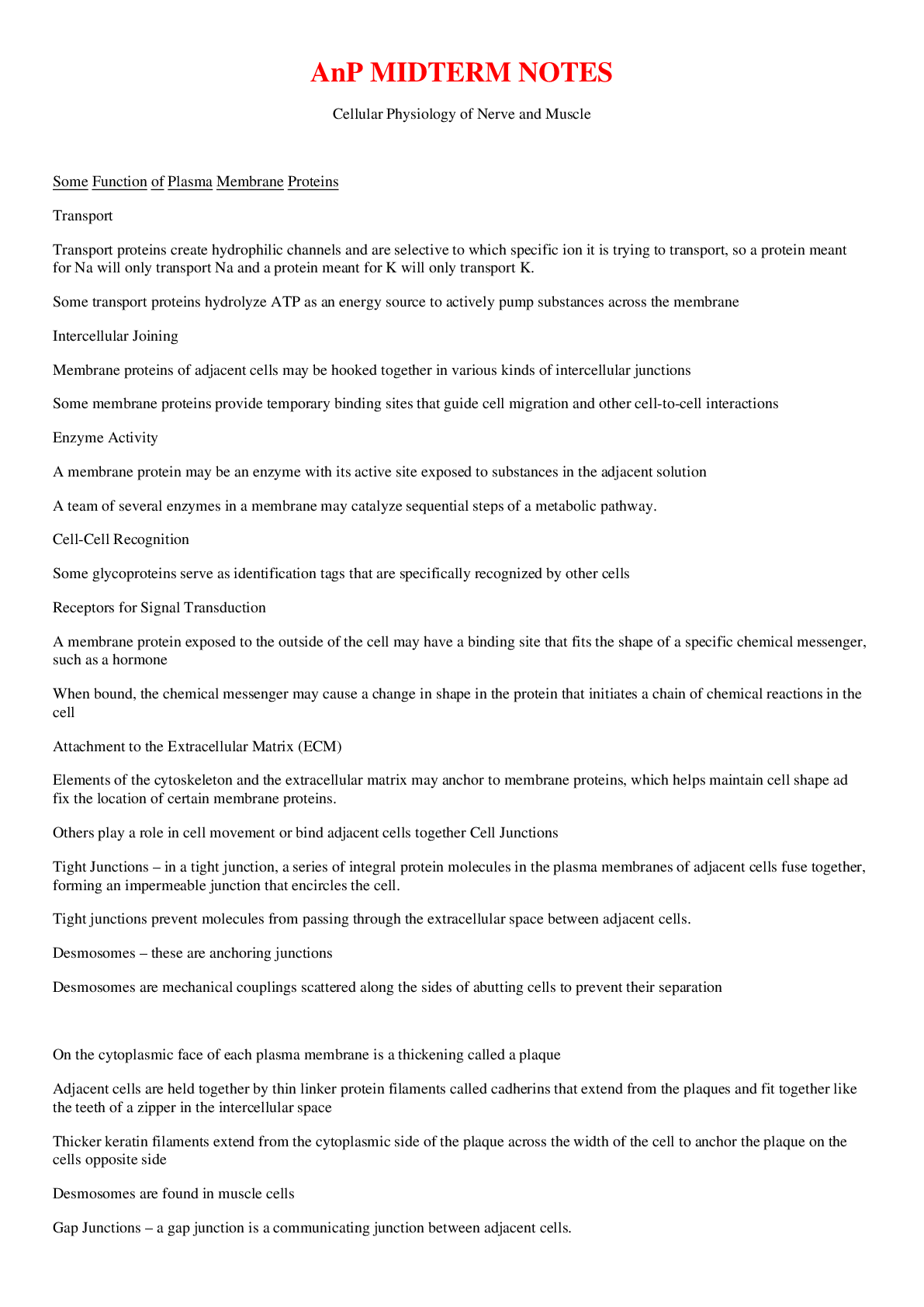
AnP MIDTERM NOTES
Some Function of Plasma Membrane Proteins
• Transport
o Transport proteins create hydrophilic channels and are selective to which specific ion it is trying to transport, so a protein meant for Na will only transport Na and a protein meant for K will only transport K.
o Some transport proteins hydrolyze ATP as an energy source to actively pump substances across the membrane
• Intercellular Joining
o Membrane proteins of adjacent cells may be hooked together in various kinds of intercellular junctions
o Some membrane proteins provide temporary binding sites that guide cell migration and other cell-to-cell interactions
• Enzyme Activity
o A membrane protein may be an enzyme with its active site exposed to substances in the adjacent solution
o A team of several enzymes in a membrane may catalyze sequential steps of a metabolic pathway.
• Cell-Cell Recognition
o Some glycoproteins serve as identification tags that are specifically recognized by other cells
• Receptors for Signal Transduction
o A membrane protein exposed to the outside of the cell may have a binding site that fits the shape of a specific chemical messenger, such as a hormone
o When bound, the chemical messenger may cause a change in shape in the protein that initiates a chain of chemical reactions in the cell
• Attachment to the Extracellular Matrix (ECM)
o Elements of the cytoskeleton and the extracellular matrix may anchor to membrane proteins, which helps maintain cell shape ad fix the location of certain membrane proteins.
o Others play a role in cell movement or bind adjacent cells together Cell Junctions
• Tight Junctions – in a tight junction, a series of integral protein molecules in the plasma membranes of adjacent cells fuse together, forming an impermeable junction that encircles the cell.
o Tight junctions prevent molecules from passing through the extracellular space between adjacent cells.
• Desmosomes – these are anchoring junctions
o Desmosomes are mechanical couplings scattered along the sides of abutting cells to prevent their separation
o On the cytoplasmic face of each plasma membrane is a thickening called a plaque
▪ Adjacent cells are held together by thin linker protein filaments called cadherins that extend from the plaques and fit together like the teeth of a zipper in the intercellular space
▪ Thicker keratin filaments extend from the cytoplasmic side of the plaque across the width of the cell to anchor the plaque on the cells opposite side
o Desmosomes are found in muscle cells
• Gap Junctions – a gap junction is a communicating junction between adjacent cells.
o At gap junctions the adjacent plasma membranes are very close, and hollow cylinders called connexons, which are composed of transmembrane proteins, connect the cells.
o Ions, simple sugar, and other small molecules pass through these water- filled channels from one cell to the next.
o Gap junctions are present in electrically excitable tissues where ion passage from cell to cell helps synchronize their electrical activity and contraction.
CONTINUED...............DOWNLOAD FOR BEST SCORES
[Show More]