FSI AAMFT Sample Exam Questions
CBT family therapy techniques are least likely to be used with: - ANS - This type of therapy is
the least likely treatment for schizophrenia.
Drawing from John Bowlby's work, this model
...
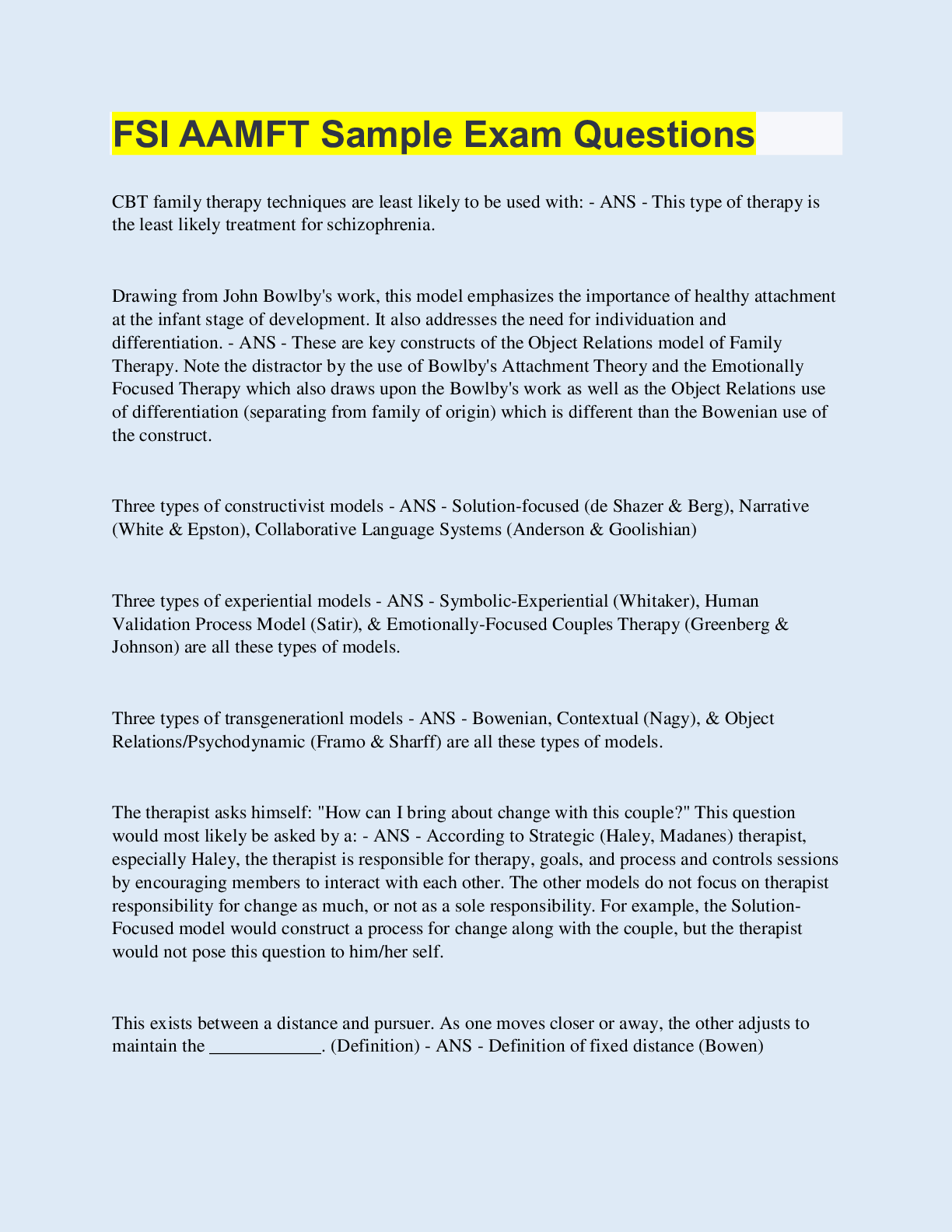
FSI AAMFT Sample Exam Questions
CBT family therapy techniques are least likely to be used with: - ANS - This type of therapy is
the least likely treatment for schizophrenia.
Drawing from John Bowlby's work, this model emphasizes the importance of healthy attachment
at the infant stage of development. It also addresses the need for individuation and
differentiation. - ANS - These are key constructs of the Object Relations model of Family
Therapy. Note the distractor by the use of Bowlby's Attachment Theory and the Emotionally
Focused Therapy which also draws upon the Bowlby's work as well as the Object Relations use
of differentiation (separating from family of origin) which is different than the Bowenian use of
the construct.
Three types of constructivist models - ANS - Solution-focused (de Shazer & Berg), Narrative
(White & Epston), Collaborative Language Systems (Anderson & Goolishian)
Three types of experiential models - ANS - Symbolic-Experiential (Whitaker), Human
Validation Process Model (Satir), & Emotionally-Focused Couples Therapy (Greenberg &
Johnson) are all these types of models.
Three types of transgenerationl models - ANS - Bowenian, Contextual (Nagy), & Object
Relations/Psychodynamic (Framo & Sharff) are all these types of models.
The therapist asks himself: "How can I bring about change with this couple?" This question
would most likely be asked by a: - ANS - According to Strategic (Haley, Madanes) therapist,
especially Haley, the therapist is responsible for therapy, goals, and process and controls sessions
by encouraging members to interact with each other. The other models do not focus on therapist
responsibility for change as much, or not as a sole responsibility. For example, the SolutionFocused model would construct a process for change along with the couple, but the therapist
would not pose this question to him/her self.
This exists between a distance and pursuer. As one moves closer or away, the other adjusts to
maintain the ____________. (Definition) - ANS - Definition of fixed distance (Bowen)
Which one of the following therapists would emphasize that difficulties are turned into chronic
problems by the persistence of misguided attempted solutions, forming positive feedback
escalation? - ANS - Watzlawick, Weakland, and Fisch
A mother calls the therapist sounding very panicky, wanting an immediate appointment. At the
first session, the mother states that her 12-year old son Sam has just been caught in the bathroom
of a neighbor's home with a 6-year old boy. The 6-year old says that Sam was playing with his
"bum" and kissing his penis. When confronted by his mother, Sam admitted to having "played"
with the boy on 4 previous occasions. The neighbor boy's parents have banned Sam from their
home and informed other parents and the school about his "perversion". Sam's mother called a
psychiatrist prior to calling you who she says stated, "You can put him into therapy and give him
drugs, but it's probably already too late." You begin seeing Sam and his family. From a Milan
Systemic approach you would: - ANS - Inquiring about the family processes infers neutrality,
hypothesizing and circularity, all of which are hallmarks of Milan Systemic therapy (Palazzoli,
Boscolo, Cecchin). Realigning the hierarchy is Strategic (Haley, Madanes). Invisible loyalties
come from Nagy's model, and interest in affect would be most closely connected to Experiential
therapists.
The Family Preservation Model seen in many federally-funded programs grew out of: - ANS -
This model grew out of the MRI model, often required for federally-funded programs
Questions are a fundamental tool used by all therapists. When a Solution Focused therapist,
working with a client presenting with issues around overeating, asks "What would you not want
to change regarding the way you eat?", they are beginning to negotiate the: - ANS - In this
example, the therapist is laying the ground work for exceptions to the problem using the formular
first-session task.
In this model, frequency, duration, and termination of sessions are determined and negotiated on
a session-by-session basis with input from all members of the family and therapy team. - ANS -
How collaborative therapy (Anderson & Goolishian) determines frequency, duration, and
termination of sessions
A technique in which choice of language and labeling of events is used to give new meaning to a
situation. (Definition) Ex: "You really care about your wife and don't want to lose the
relationship you have." - ANS - Definition & example of Reframing (Strategic/Haley, Madanes)
This philosopher exposed how various discourses within a society are dehumanized, objectified,
and marginalized by various social groups who are in power over the other groups - ANS -
Foucault (Constructivist) exposed this concept about societal discourse.
The most traditional family therapy perspective of problematic behavior - ANS - These are most
traditionally seen as symptom of a dysfunctional system.
An imminent threat of danger is a(n) _______ whereas struggles to manage a problem is a(n)
______. - ANS - Difference between an emergency and a crisis.
The most effective treatment for PTSD - ANS - EMDR is the most effective treatment for this
disorder
Bracket suggests a _____ in Structural Mapping. Ex: wife and mother } husband - ANS -
Structural (Minuchin) map symbol for coalition.
Drawing boundaries on a structural map
Solid lines = ____ boundaries
Dash lines = ____ boundaries
Dotted lines= ____ boundaries - ANS - How to draw rigid, clear, and diffuse boundaries on a
structural (Minuchin) map.
Give due consideration to each individual's interests in the various relational dimensions.
(Definition) - ANS - Definition of multidirectional partiality (Contextual/Nagy)
Allows the therapist to use his own judgment in disclosing identifying information if it is either a
normal or necessary part of 'treatment, payment or health care operations'. (Definition) - ANS -
Definition of the Permitted Uses and Disclosures clause of the Privacy Rule
When initially working with anorexics and their families, a Structural/Minuchin therapist would:
- ANS -
"I understand why you want to stay with him" to someone whose spouse has had multiple affairs
- ANS - "Sample quote" for restraining change through therapeutic paradox (Strategic/Haley,
Madanes)
Which research group found that abuse co-exists with understanding and friendship in a unique
and painful way? - ANS - The Ackerman Institute found this in the underlying relationship
structures
A type of sexual dysfunction in which a person cannot achieve orgasm despite adequate
stimulation. (Definition) - ANS - Definition of Anorgasmia
The DSM-5 has a new approach to the axial assessment system of the DSM-IV TR including
these two changes - ANS - The DSM-5 has collapsed the first 3 Axes from the DSM-IV TR into
a single category and now requires separate notations for significant psycho-social and
contextual factors as well as disability.
According to some outcome studies which of the following approaches have been particularly
useful in dealing with substance abuse in families, especially for engaging young substance
abusers? - ANS - Psychoeducation has proven to be the most effective because it is nonconfrontational.
Short term treatment designed to help the client to achieve new adaptations to changed life
circumstances (Definition) - ANS - Definition of crisis management
Verbal instructions by a behavioral therapist (Definition) - ANS - Definition of coaching
In the ____ model, the THERAPIST is responsible for change. In the ____ model, the
CLIENT(s) are responsible for change. - ANS - Who is responsible for change in Strategic
(Haley, Madanes) and Milan Systemic (Palazzoli, Boscolo, Cecchin)
The MRI (Watzlawick, Beavin, & Jackson) model does not focus on the _____ aspect of a
problem. - ANS - The functional/metaphoric nature of the problem is not a focus of this model
[Show More]