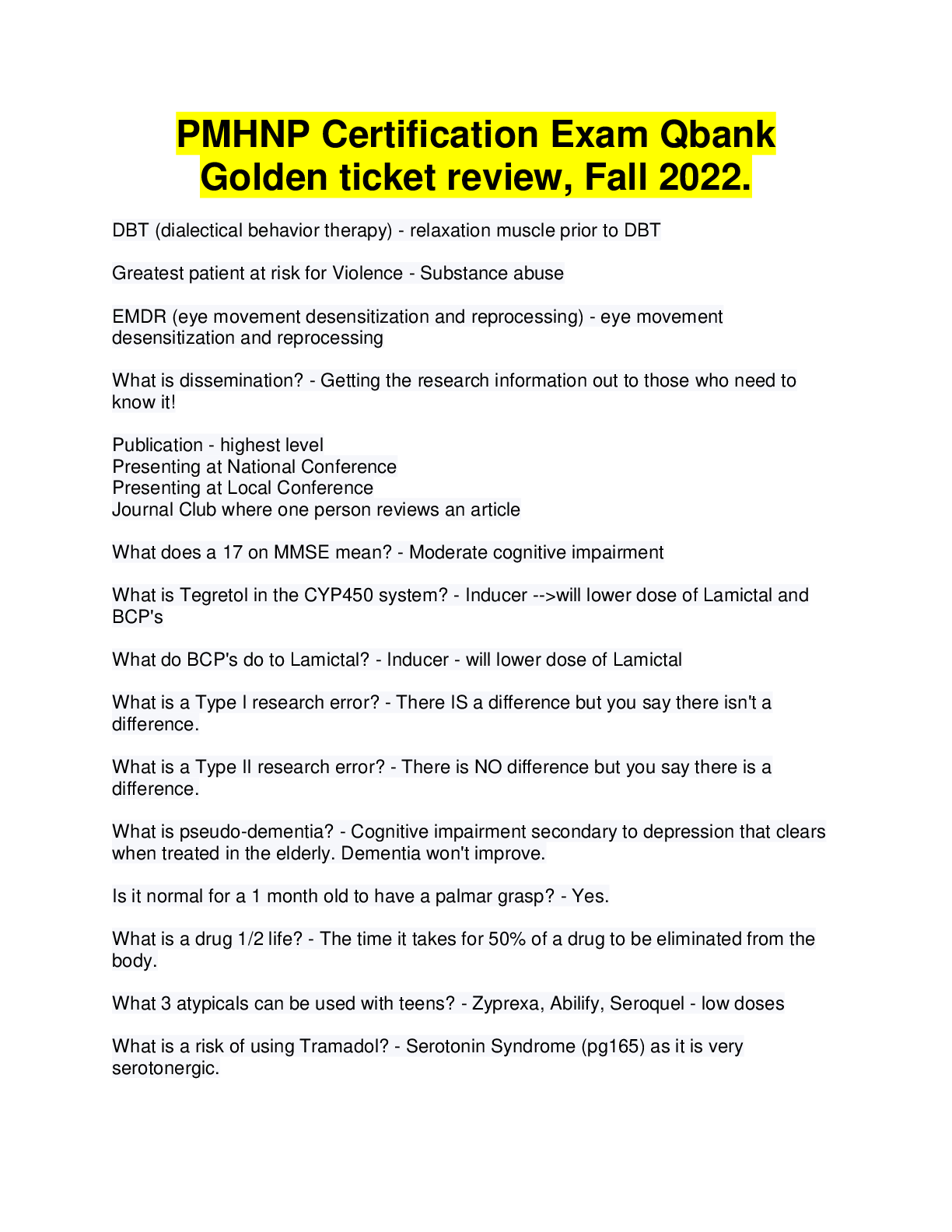
Exit HESI Version 2 Study guide.
Grave's disease signs and symptoms - -Enlarged thyroid
-Acceleration of body process: weight loss, increased appetite, diarrhea, heat intolerance, tachycardia, palpitations, increased
...
Exit HESI Version 2 Study guide.
Grave's disease signs and symptoms - -Enlarged thyroid
-Acceleration of body process: weight loss, increased appetite, diarrhea, heat intolerance, tachycardia, palpitations, increased BP, diaphoresis, nervousness, insomnia
-Exopthalamos
-Increased T3 and T4 levels
-Low TSH levels
Grave's disease test - -Radioactive Iodine Uptake to detect how the thyroid is working
-Ultrasound
-Bloodwork
-Imaging tests
Grave's disease treatment - -Goal: inhibit production of thyroid hormones and block effect on the body
-Radioactive iodine therapy: destroys overactive thyroid cells over time
-Propylthiouracil, methimazole
-Betablockers
-Subtotal or full thyroidectomy (risk of damaging vocal cords and parathyroid glands)
Nursing interventions for a pt with COPD - -Sit upright (positioning)
-Pursed lip breathing
-Diaphragmatic breathing
-HOB up
-Not too much O2: decreases stimulus to breathe
-O2 is not first choice!
Considerations when choosing an IV site - -Avoid restricted extremities (fistula, breast CA (mastectomy/lymphedema), cellulitis)
-If no upper extremities available, can use legs
-Infiltration is a problem, dont reinstill IV access; keep IV in but start a new line
Pheochromocytoma - -Tumor on the adrenals that causes release of catecholamines (epi and norepi)
-Can cause hypertensive crisis (above 240)
-Monitor BP frequently
-Mosly cardio sx: increased HR and BP
General teaching points for pt taking meds - -Take the full dose of antibiotics (can build resistance)
-Pay attention to timing and whether you take with food or on an empty stomach
Describe post-surgical nursing assessment - -VITALS!!
-Take VS first to give you "the lay of the land" and plan further treatment
-Watch for shock and hemorrhaging
-Make sure BP is above 90
-Give O2 if decreased sat
-Look/ask about pain if HR increased
Describe Lupus and pt education - -*Autoimmune disorder
-Could have a decreased WBC count; increased risk for infection
-Avoid crowds, avoid sick people, avoid sunlight (trigger)
Explain safe insulin administration practice and how to teach another nurse - -Give in SubQ fat, rotate spots
-Sliding scale dose is based on most recent glucose level
-Check orders in the computer if forget dose/med
-Clean area with alcohol
-Make sure you have the right pt
Assessment points for pt with constipation - -Assess current medications
-Check measures that they're currently taking (daily enemas, laxatives, etc)
-Assessment: no bowel sounds, abd distention
-Make a doctors appointment
-Assess current nutrition, diet, and exercise
-Drink more water
Osteomalacia and implications for pt teaching - -Focus on nutritional support
-Sunlight is a good source of vitamin D
-Vitamin D is important to absorb calcium and phosphorous
-Check vitamin D levels
Osteomyelitis - -Bone infection
-Treat with antibiotics
-Poor healing, injury entered the bone
UTI - -Pt doesn't always report sx!
-Urine sample is foul smelling and cloudy
-Send sample to lab for urinalysis
-Order a secondary test (culture and sensitivity) to choose the correct tx
Assessment and nursing interventions for hip fx - -Assess for pain
-Hip fracture sometimes shortens the leg/rotates it
-Treat like its a hip fracture even if no testing done yet
-Assess circulation (pulse, cap refill, feeling, movement, wiggle toes, color)
-Don't elevate the leg
-No extra motion until hip is stabilized
-Assess skin and circulation if in traction
Care and assessment for adrenalectomy - -Pt at risk for electrolyte abnormalities
-Put on telemetry
-Daily serum electrolytes
-Monitor VS
-Watch for dysrhythmias
Tracheostomy pt teaching - -Maintain airway: suctioning
-Communicate with white boards
-Cough and suction on the way out
-No more than 10 seconds
Steps of the chain of infection - -Causative agent
-Reservoir
-Portal of exit: ex: wound, dressing change
-Mode of transmission: nurse could be mode if they wear a gown in the hallway
-Portal of entry
-Susceptible host: decreased immune system, also have wounds (entry site)
*Ways to block transmission: precautions, wash hands
Aseptic handwashing - -Wash clean to dirty
-Point arms down so dirty water runs from clean to dirty
Chrones Diet - -Low fat
-High-calorie: dried fruit increases calories and nutrients
-High nutrient foods
-Ex: eggs w/o yolk, lean meat, fish, seafood, chicken
Heart Failure Diet - -No canned/processed food
-No cheese or salami
-Limit sodium (fluid retention)
-Vegetables and fruits
Mormon Diet - -No alcohol
-No caffeine
-Give milk, juice, or water
-If diabetic, no juice
-Church = latter day saints
Muslim Diet - -Ramadan: fast for one month each year from dawn till after dark
-Respect this
-No alcohol
Enema administration and nursing considerations - -Monitor pt for cramping and abd pain
-Coach and support pt through this pain
-Need to get procedure done, take break, deep breaths, then continue
Trapeze bar and considerations - -Need upper body strength/upper extremities
-Get history from pt: make sure they don't have any problems with dislocated shoulder
-Allows more independence and participation with repositioning
Education for splenomegaly - -Avoid heavy lifting/straining
-Avoid contact sports
-Cant go right back to the norm, unless they just sit at a desk all day
-Wear a seatbelt in the car
Manual bladder irrigation and CBI - -CBI: 3 way catheter
-Check for kinks if not flowing properly
-Manually irrigate CBI if there's a clot
-If a clot is blocking, the pressure in the bladder could cause leakage around the catheter site
Assessment for hypocalcemia - -<8.5
-Chvostek's sign: stroke face and face twitches
-Trousseau's sign: pump up BP cuff, hand/wrist flexes
-Possibly from thyroid surgery
TB Precautions - -Airborne isolation
-N-95 masks
-Negative pressure, single room
MRSA Precautions - -Precautions if they've already had MRSA
-Contact isolation
-Single rm or cohorted
Pertussis (whooping cough) Precautions - -Droplet isolation and contact precautions
-Facemask
AKI assessment - -Decreased kidney function because of secondary condition and output decreases
-Oliguria: less than 400 cc in 24 hrs
-Kidneys aren't producing urine
-Possibly can't produce urine sample
AKI Interventions - -Follow up and look at what drugs they're on
-Monitor electrolytes
-Monitor weight and edema
-Monitor VS: HTN/HypoTN, increased HR
-Aggressive fluids: watch for fluid overload, check lung sounds and vitals
-Lasix or Mannitol
IM Injections - -If you stick yourself, fill out appropriate paper work and get pts blood sample
-If you think you're in the wrong space, get a larger needle
-If you aspirate and get blood return, take out and throw everything away
Catheter Insertion - -Always ask for allergies: could be allergic to the Iodine/Bedadine used to sterilize
-Document time, size of foley, fluid in the balloon
-Landmark = meatus inbetween clitoris and vaginal opening
Safety concerns with Parkinson's - -Early: falls, decreased mobility, risk for aspiration
-Late: wheelchair bound, ulcers, decreased muscle, decreased mobility
Distracting Injury - -Ex: traumatic amputation, so focused on treating that you don't realize the pt isn't breathing
-ABCs
-C: know the cause and how to control it
3 Middle ear bones - Incus, Maleus (hammer), Stapes
Hearing - -Maleus (hammer) is first small bone hit from the eardrum vibrations
-Sound waves go to tiny hair cells in cochlea and communicate with the brain to perceive sound
Stapedectomy - -Performed for otosclerosis
-Incision behind inner ear, stapes removed and implant inserted
-Allows sound and vibrations to pass from eardrum to inner ear fluids
Stapedectomy pt teaching - -Improvement of hearing isn't immediate, can initially be worse
-Hearing improves in 3 weeks, maximum hearing takes 6 months
-Dressing on the ear
Fat embolism symptoms - -SOB
-Confusion
-Anxious/restless
Fat embolism risk factors - -Breaking a long bone (usually femur)
Polycystic Kidney Disease treatments - -Need pain relievers
-NO NSAIDS (advil, naproxin sodium, motrin)
-Can have tylenol
Neurogenic Diabetes Insipidus assessment - -Very high urine output, very dilute
-Monitor sodium
*Monitor osmolarity and osmolality: abnormal means its dilute urine
-Mostly from trauma to hypothalamus
DVT assessment - -Pain
-Warmth
-Increased size in leg: sometimes they measure the calf
DVT plan of care - -Maintain on bed rest
-No SCDs
-Concern after surgery
-Tx: heparin; d/c daily dose of aspirin
Pt receiving blood - -Nurse takes vitals for first 15-30 min, then can delegate to UAP
-Nurse documents final vitals
-VS: watch for significant changes
-No specific diet
Symptoms of transfusion reaction - -Sx: fever, chills, flank pain, change in VS, nausea, headache, urticaria, dyspnea, bronchospasm
-Stop infusion immediately
Korotkoff sounds - -Heard over brachial artery
Emphysema treatment - -Sit pt up in bed
-Pursed lip breathing doesn't make the pt work less
-Need to rest...might need bipap
Emphysema classic presentation - Barrel chest
Stages of CKD - -1,2,and 3: pt still functioning well, living faily normal life, may never progress or advance
-Stage 5: dialysis 3x/week
-Can't go on a week long vacation without dialysis; will end up back in the hospital
-Fistula = restricted extremity (no BP or IV)
Trouble shooting for pulse ox - -Warm up the extremity
-Change site: nose, toes, earlobes
Trouble shooting for BP machine - -Get a different machine!
Herpes Zoster - -Rash along the nerves of the side of the body (usually one side)
-Very painful
Herpes Zoster treatment - -Try to stop the replication of the virus; can still have symptoms
-Pain meds throughout: narcotics
[Show More]








.png)


 V1-V2.png)