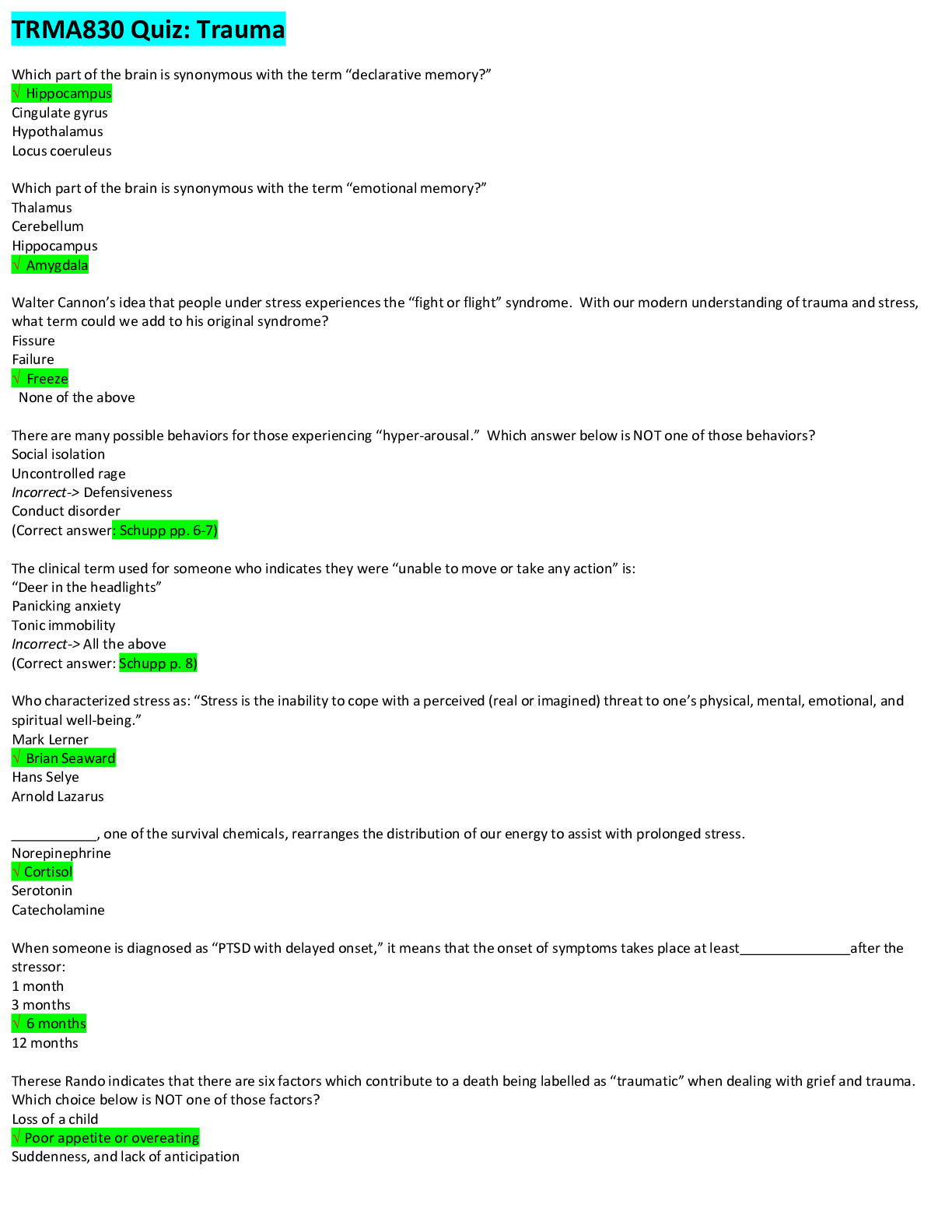
Which part of the brain is synonymous with the term “declarative memory?”
Hippocampus
Cingulate gyrus
Hypothalamus
Locus coeruleus
Which part of the brain is synonymous with the term “emotional memory?”
Thalamus
...
Which part of the brain is synonymous with the term “declarative memory?”
Hippocampus
Cingulate gyrus
Hypothalamus
Locus coeruleus
Which part of the brain is synonymous with the term “emotional memory?”
Thalamus
Cerebellum
Hippocampus
Amygdala
Walter Cannon’s idea that people under stress experiences the “fight or flight” syndrome. With our modern understanding of trauma and stress,
what term could we add to his original syndrome?
Fissure
Failure
Freeze
None of the above
There are many possible behaviors for those experiencing “hyper-arousal.” Which answer below is NOT one of those behaviors?
Social isolation
Uncontrolled rage
Incorrect-> Defensiveness
Conduct disorder
(Correct answer: Schupp pp. 6-7)
The clinical term used for someone who indicates they were “unable to move or take any action” is:
“Deer in the headlights”
Panicking anxiety
Tonic immobility
Incorrect-> All the above
(Correct answer: Schupp p. 8)
Who characterized stress as: “Stress is the inability to cope with a perceived (real or imagined) threat to one’s physical, mental, emotional, and
spiritual well-being.”
Mark Lerner
Brian Seaward
Hans Selye
Arnold Lazarus
___________, one of the survival chemicals, rearranges the distribution of our energy to assist with prolonged stress.
Norepinephrine
Cortisol
Serotonin
Catecholamine
When someone is diagnosed as “PTSD with delayed onset,” it means that the onset of symptoms takes place at least _____________ after the
stressor:
1 month
3 months
6 months
12 months
Therese Rando indicates that there are six factors which contribute to a death being labelled as “traumatic” when dealing with grief and trauma.
Which choice below is NOT one of those factors?
Loss of a child
Poor appetite or overeating
Suddenness, and lack of anticipation
Multiple deaths
This study source was downloaded by 100000842722785 from CourseHero.com on 07-26-2022 08:44:22 GMT -05:00
https://www.coursehero.com/file/98700062/TRMA830-Quiz-Traumadocx/
At one time, a client suffering with Dissociative Identity Disorder was called:
Obsessive-Compulsive personality disorder
Borderline personality disorder
Depersonalization disorder
Multiple personality disorder
Emotional and behavioral symptoms that occur within 3 months of the onset of a stressor are diagnosed as:
Adjustment disorders
Generalized anxiety disorders
Bereavement
Complex PTSD
The diagnosis for someone suffering with excessive anxiety and worry about numerous minor events is called:
Somatic symptom disorder
Acute stress disorder
Generalized anxiety disorder
Posttraumatic stress disorder
There several factors that complicate grief and trauma resolution. Which choice below is NOT one of those factors?
Conversion reactions
Holding onto false hopes
Absence of emotion
Personality factors
The ___________________ cluster of PTSD diagnostic symptoms reflects the manner in which traumatic memory functions.
avoidance
respiratory
allostasis
re-experiencing
The domain of PTSD symptom clusters is defined by five interrelated sets of symptoms. Which answer is NOT one of those clusters?
self and ego processes
hyperarousal
organismic valuing
re-experiencing of trauma
The multilevel impact of PTSD on organismic functioning produces syndrome constellations that are built on the triad of core PTSD symptoms.
Which choice below is not one of those three given in the reading?
hyperarousal
multimodal
re-experiencing
avoidance
____________________ describes the return to baseline or normal functioning.
Homeostasis
Stability
Dynamic Regulation
All the above
PTSD ___________________ is an automatic, psychobiologically determined response pattern designed to adapt to the perception, or existence of,
threats to the well-being of the organism.
hyperfocus
hypervigilance
hyperconcentration
None of the above
The hallmark feature of PTSD is _________________ and forms of reliving, re-experiencing, or reenacting aspects of the original trauma.
being in combat
surviving an accident
traumatic memory
None of the above
[Show More]